SEO in 2026: What Actually Gets You to the First Page of Google
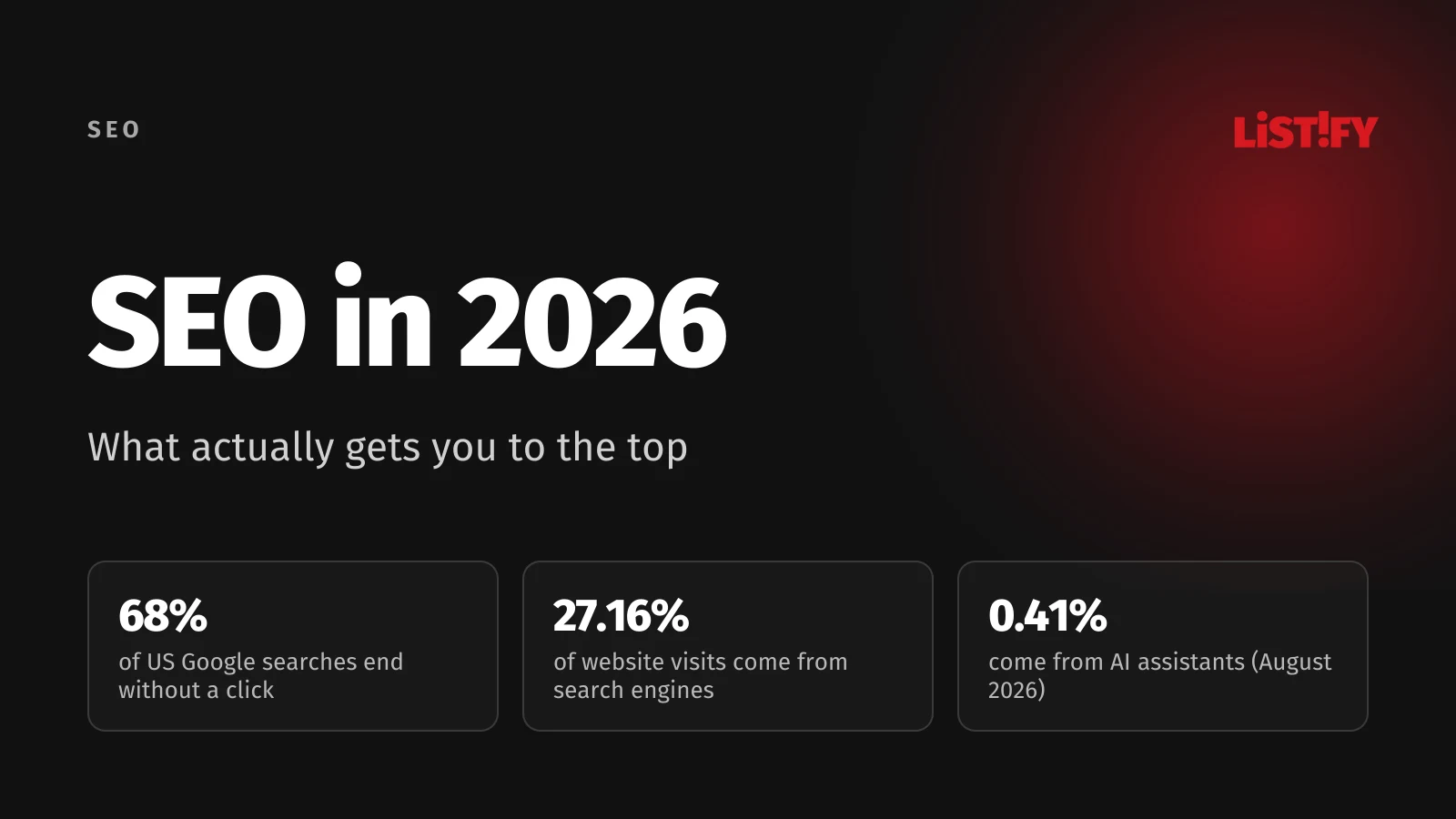
Google now answers many questions itself, and in the US 68% of Google searches end without a click. Yet search engines still send more than a quarter of all website visits, while AI assistants send less than half a percent. SEO hasn’t died, but what search engines reward has shifted. Here is what works according to data and official documentation, which popular tips are myths, and how to plan SEO for the next 12 months.
Short answer: in 2026, pages reach the top for the same reasons as before, only judged more strictly. A page has to be crawlable and indexed, answer a specific question better than competitors, show first-hand experience and original data, load fast on mobile, and earn mentions and links from other sites. According to Google, there is no separate AI Overviews SEO, Google Search ignores llms.txt files, and FAQ schema no longer earns expandable questions in results.
01What changed in search between 2024 and 2026
Google launched AI Overviews in the US in May 2024, and by May 2025 they were available in 200 countries and territories. AI Mode, a chat-style search mode, followed in the US in May 2025 and expanded to over 200 countries and territories in October 2025. Since May 2026, people can move from an AI Overview straight into a conversation in AI Mode. By May 2026, Google reported more than 2.5 billion monthly active users for AI Overviews and more than 1 billion for AI Mode.
For websites, one thing follows: when the search engine answers on its own, people often don’t click anywhere. Pew Research Center measured this directly by tracking the browsing of 900 US adults in March 2025.
- Results without an AI summary15%
- Results with an AI summary8%
- Link inside the AI summary1%
Share of visits to a results page in which the user clicked a traditional result (last row: a link inside the summary). 900 US adults, 68,879 searches, March 2025. Source: Pew Research Center.
Ahrefs data points the same way. For queries that trigger an AI Overview, the average desktop click-through rate of the top-ranking page fell from 7.3% in December 2023 to 1.6% in December 2025. Informational queries without an overview dropped too, but less.
- Queries with an AI OverviewDecember 2023: 7.3%December 2025: 1.6%
- Informational queries without oneDecember 2023: 7.6%December 2025: 3.9%
Estimate based on aggregated Google Search Console data, desktop only, informational queries. Ahrefs itself notes this is a correlation. Source: Ahrefs, February 2026.
It isn’t a one-way decline, though. In data from 53 brands tracked by the agency Seer Interactive, organic CTR on queries with an AI Overview bottomed out at 1.3% in December 2025 and climbed back to 2.4% by February 2026. Sites cited in the overview get 120% more clicks per impression than uncited ones, according to Seer, but still fewer than on results pages without an overview. In August 2025, Google said total organic click volume had been “relatively stable” year over year, without publishing the numbers.
What matters most is which queries trigger an overview. In Seer’s data, informational queries (“what is”, “how to”, “why”) show one 36% of the time, commercial queries 8% and transactional queries only 5%. A business selling products or services mostly loses visits to how-to guides and explainers, far less to buying queries.
Zero-click searches aren’t new, but they keep growing. SparkToro, using the same Similarweb panel across six countries, measured the following in early 2026:
- United Kingdom69.5%
- United States68.0%
- France65.3%
- Canada63.8%
- Italy63.4%
- Germany62.1%
Similarweb clickstream panel, desktop and mobile, excluding the Google app. January to April 2026. Source: SparkToro, June 2026.
And how many people arrive from chatbots? Ahrefs measures traffic on 112,309 websites that use its analytics. In August 2026, AI assistants (ChatGPT, Gemini, Perplexity, Claude and others) sent 0.41% of visits, while search engines sent 27.16%.
- Direct37.88%
- Search engines27.16%
- Paid ads16.67%
- Unknown13.10%
- Social media8.07%
- AI assistants0.41%
112,309 websites using Ahrefs Web Analytics, worldwide. These sites chose to install the tool, so this isn’t a random sample of the web. The categories overlap, so they add up to about 103%, and in August 2026 unattributed “Unknown” traffic nearly tripled, which lowered the other shares. Google alone sent 24.24% of visits. Source: Ahrefs, ChatGPT vs Google.
The takeaway is sober: AI answers mostly take clicks from informational pages, search engines remain the second largest source of visits, and AI assistants are still below one percent. Writing SEO off in 2026 means giving up a channel that brings roughly one visit in four.
02Google dominates, but Bing still matters on desktop
StatCounter measures search engine referrals on more than a million websites. In August 2026, Google sent 91.02% of them worldwide, 89.65% in Europe and 86.01% in the US.
- Google91.02%
- Bing4.55%
- Yahoo!1.24%
- Yandex1.01%
- DuckDuckGo0.70%
- Baidu0.62%
All devices. StatCounter measures clicks from search engines to websites, not the number of searches, and doesn’t count ChatGPT or Perplexity as search engines. Source: StatCounter.
Bing is stronger on desktop, with 8.91% of desktop referrals worldwide, and in the US it reached 8.99% across all devices. If your customers work at a computer, typically in B2B, register the site in Bing Webmaster Tools too and notify search engines about new pages through IndexNow, which Bing supports.
03What Google officially says, and what’s a myth
SEO is full of advice that was born years ago and keeps getting copied from article to article. In 2026, it’s easy to see which of it Google itself contradicts. This table is based on Google’s developer documentation and the official changes it has published in recent months.
| The claim | What Google says |
|---|---|
| E-E-A-T is a ranking factor | Google writes that E-E-A-T (experience, expertise, authoritativeness, trustworthiness) “isn’t a specific ranking factor”. Its systems use a mix of signals that identify good content, and trust matters most. |
| The ideal article is 2,000 words | Google has no preferred word count, and its new guide to AI search says there is no ideal page length. |
| Google penalizes AI-written content | Appropriate use of AI isn’t against the guidelines. The violation is mass-producing pages without added value, no matter how they were created. |
| An llms.txt file gets you into Google’s AI answers | Google Search ignores it, so it neither helps nor harms. You also don’t need other AI text files, Markdown copies of pages or special markup. |
| FAQ schema gets you expandable questions | Since May 7, 2026, Google no longer shows this result type at all. How-to results were retired back in September 2023. |
| Google uses 200 ranking factors | The number comes from an old Google page from around 2013. Current documentation gives no count. |
| AI Overviews need special optimization | According to Google, there are no additional requirements. A page just needs to be indexed and eligible to appear with a snippet. |
In its guide to generative AI search (published in May 2026, updated in July), Google adds a line worth showing to anyone selling “AI optimization”: from Google Search’s perspective, optimizing for generative AI search is still SEO. Google also says no third-party tool has access to its internal ranking or AI systems, so treat any “AI visibility score” as an outside estimate.
04Content that wins in 2026
Google keeps repeating that it rewards content written for people, not for search engines. In practice, that means a page where readers learn something they can’t find elsewhere. That’s exactly what an AI Overview can’t replace: it can summarize general knowledge, but it doesn’t know your projects, prices, photos or experience.
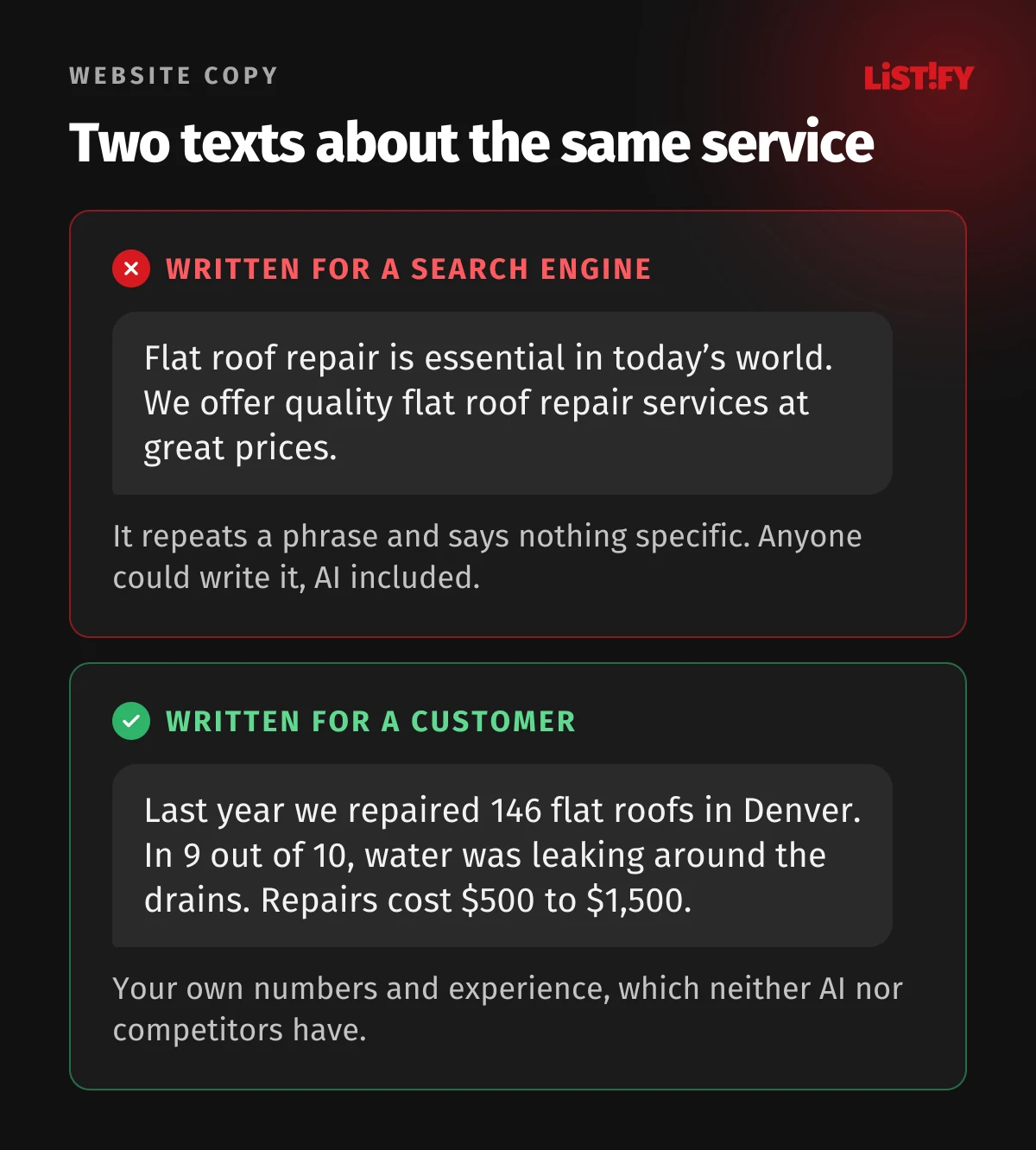
- Answer first. The first paragraph should answer the question in the heading. Details, exceptions and steps come after.
- Your own numbers and experience. How many jobs you’ve done, what goes wrong most often, what it costs, how long it takes. No language model knows this.
- Author and sources. Google “strongly encourages” adding accurate authorship information where readers expect it. Link to the sources you rely on.
- One page, one intent. A page about pricing and a page about how the service works are two different pages.
- Update instead of starting over. An older page refreshed with new data often has an edge over a brand new article: in Ahrefs data, 72.9% of pages in the top 10 are more than three years old.
Beware of the opposite extreme. In 2026, Google explicitly says that creating pages for every variation of a query in order to manipulate AI answers violates its scaled content abuse policy. A hundred near-identical “plumber in [city]” pages won’t help you and may hurt. For writing copy that sells, see our guide on how to write landing page copy.
To see what people actually ask, start with Google’s free autocomplete. While preparing this article, typing “seo 2026” returned suggestions such as “seo 2026 updates”, “seo 2026 strategy” and “seo 2026 reddit”. Test the questions in your own field the same way and write pages for what people really search for.
05The technical foundation: without it, content won’t help
Even the best text is useless if search engines can’t find it, don’t index it, or if it takes five seconds to load on a phone. Technical SEO is the dull part of the job, but also the easiest to measure.
- Indexing. In Google Search Console, check how many pages are indexed and why the rest are missing. The usual culprits are pages blocked by mistake, duplicates without a canonical URL and orphan pages with no internal links.
- Mobile. Google indexes and ranks the mobile version of your site. Whatever is missing on mobile effectively doesn’t exist for Google.
- Speed and stability. Google recommends good Core Web Vitals: the largest element loaded within 2.5 s (LCP), a response to input within 200 ms (INP) and layout shift of 0.1 or less (CLS), measured at the 75th percentile of page loads. How speed relates to visitors leaving is covered in our article on the 3-second rule.
- Structure and internal links. Important pages should be a few clicks from the homepage and linked with descriptive anchor text.
- JavaScript. According to its documentation, Google has been rendering JavaScript for years, so loading content with JavaScript isn’t a problem for Google Search. Still, check in Search Console that Google sees the full text.
Technical quality also affects sales: a fast, clear website converts better regardless of search engines. Why good looks alone aren’t enough is explained in why a pretty website is not enough. On template sites, speed tends to be the weakest spot, as we show in the article on the WordPress template trap.
06Backlinks and brand mentions
Links from other websites still matter, and the data points that way. In a 2023 study, Ahrefs found roughly 20 million pages in its index with no referring domains, and by its own estimates only 2,997 of them got more than 1,000 search visits a month. That’s about one in 6,671. Ahrefs itself stresses this is a correlation, not proof of cause.
For AI answers, brand mentions join links. Ahrefs compared 75,000 brands and found that visibility in AI Overviews correlates most with the number of web mentions (0.664), much less with the number of backlinks (0.218). Again, that’s a correlation. Google also warns that chasing inauthentic “mentions” isn’t as helpful as it might seem.
- What works: original data and surveys that others cite, interviews and commentary in industry media, partner and supplier relationships, profiles in relevant industry and local directories, reviews.
- What doesn’t: paid articles just for a link, excessive link exchanges, low-quality directory and bookmark links. Google lists these as link spam.
07How to get cited in AI Overviews and AI Mode
Google’s answer for AI Overviews and AI Mode is simple: a page must be indexed and eligible to be shown in Google Search with a snippet. There are no additional technical requirements. The overviews also rely on Google’s core ranking systems, so pages that rank well in classic results have a better chance of being cited.
- Answer directly. A short, precise answer in the first paragraph is easy to cite. Put the detail below it.
- Be unique. Google’s guide says content people find unique, compelling and useful will likely influence your presence in generative AI search more than anything else in the long run.
- Measure it. Since August 31, 2026, every site in Search Console has generative AI performance reports showing how often it appears in Google’s AI features.
- Don’t opt out by mistake. At the same time, Google rolled out a control that lets any site exclude itself from AI features. The default is to include the site, and according to Google the setting doesn’t affect rankings in the rest of Search.
08Local SEO: Google Business Profile
If you serve customers in a specific area, the map pack and your business profile often matter more than a classic result. Google names three main factors for local ranking: relevance (how well a profile matches the search), distance and prominence, meaning how well known the business is. Prominence is based partly on how many sites link to the business and on its reviews. According to Google, there’s no way to request or pay for a better local ranking.
- Complete your Google Business Profile fully: categories, hours, services, photos and service area.
- Ask customers for reviews and reply to them, good and bad.
- Keep the same business name, address and phone number on your site, profile and directories.
- For each location you really serve, publish a page with specific information, not a copy with the city name swapped.
09Structured data in 2026: what still makes sense
Google has spent the last two years simplifying its results. In January 2025, breadcrumbs disappeared from mobile results. In June 2025, Google announced it would drop seven little-used structured data types (it later kept one of them, Book Actions), and in May 2026 it switched off FAQ rich results entirely. Google also says structured data isn’t required for generative AI search.
That doesn’t make it useless. It helps search engines understand a page and still powers rich results for products, review snippets, recipes, events and job postings. The priority: content and technical health first, structured data after.
10Google updates in 2025 and 2026
Google announces major ranking changes on its Search Status Dashboard. If your rankings jumped or dropped suddenly, compare the date with this table.
| Update | Started | Finished |
|---|---|---|
| March 2025 core update | Mar 13, 2025 | Mar 27, 2025 |
| June 2025 core update | Jun 30, 2025 | Jul 17, 2025 |
| August 2025 spam update | Aug 26, 2025 | Sep 22, 2025 |
| December 2025 core update | Dec 11, 2025 | Dec 29, 2025 |
| March 2026 spam update | Mar 24, 2026 | Mar 25, 2026 |
| March 2026 core update | Mar 27, 2026 | Apr 8, 2026 |
| May 2026 core update | May 21, 2026 | Jun 2, 2026 |
| June 2026 spam update | Jun 24, 2026 | Jun 26, 2026 |
| August 2026 spam update | Aug 18, 2026 | Aug 21, 2026 |
| September 2026 spam update | Sep 24, 2026 | in progress (as of Sep 28, 2026) |
After a core update, rewriting the site blindly makes little sense. In December 2025, Google clarified in its documentation that content improvements can lift rankings without waiting for the next major core update. A drop after a spam update is a different story: then you need to find and remove whatever breaks the policies.
One more change matters if your customers search from Europe. Since August 30, 2026, a manual action under Google’s site reputation policy no longer has its usual effect for users searching in the European Economic Area: the affected section may only be ranked separately from the rest of the site. Outside the EEA, these manual actions work as before.
11A 12-month SEO plan
SEO is ongoing work, and the order matters. Before you build your SEO strategy for 2026, answer five questions.
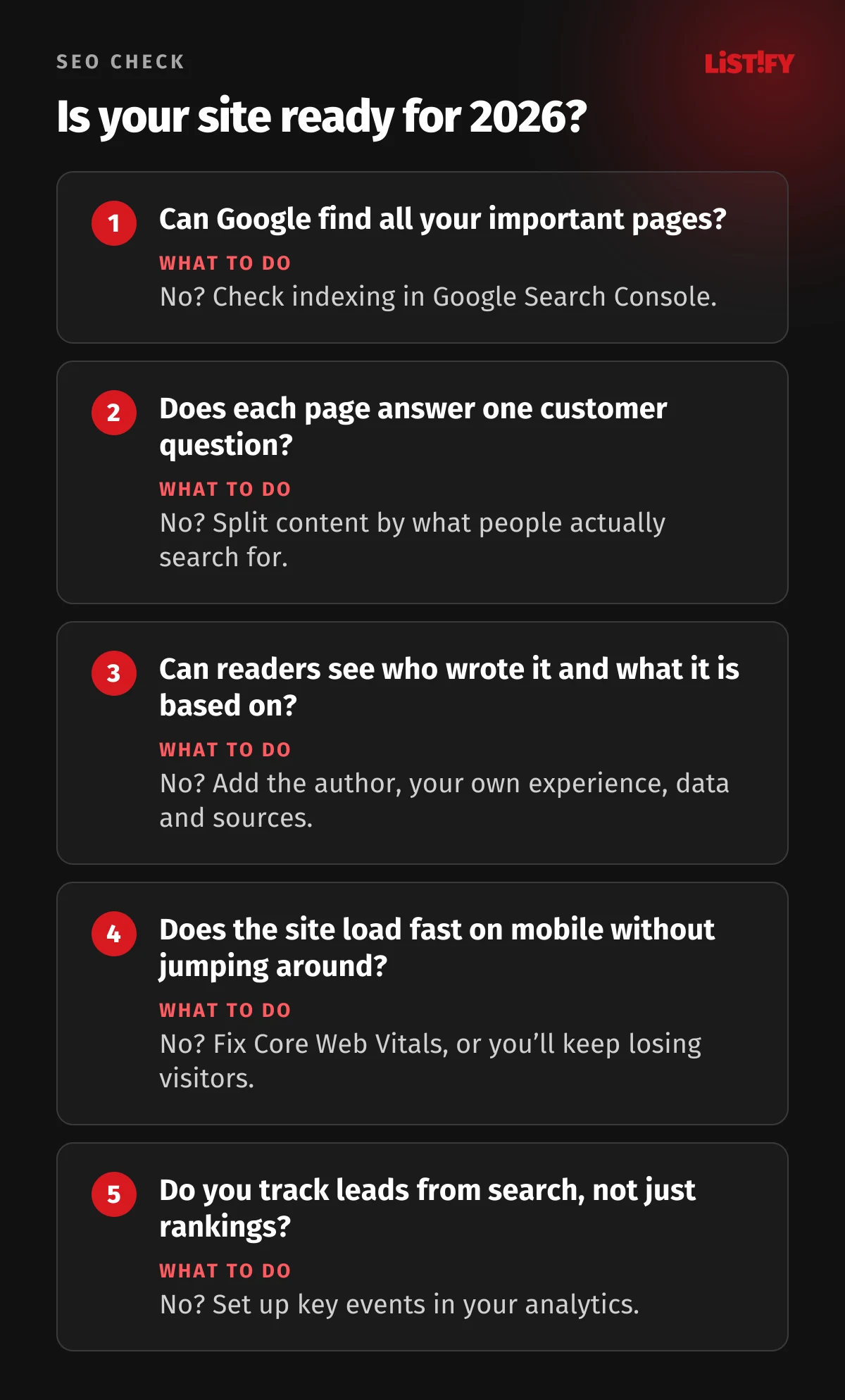
Here is what the first year can look like. Sequence matters more than speed: nobody will see content on a site that isn’t indexed.
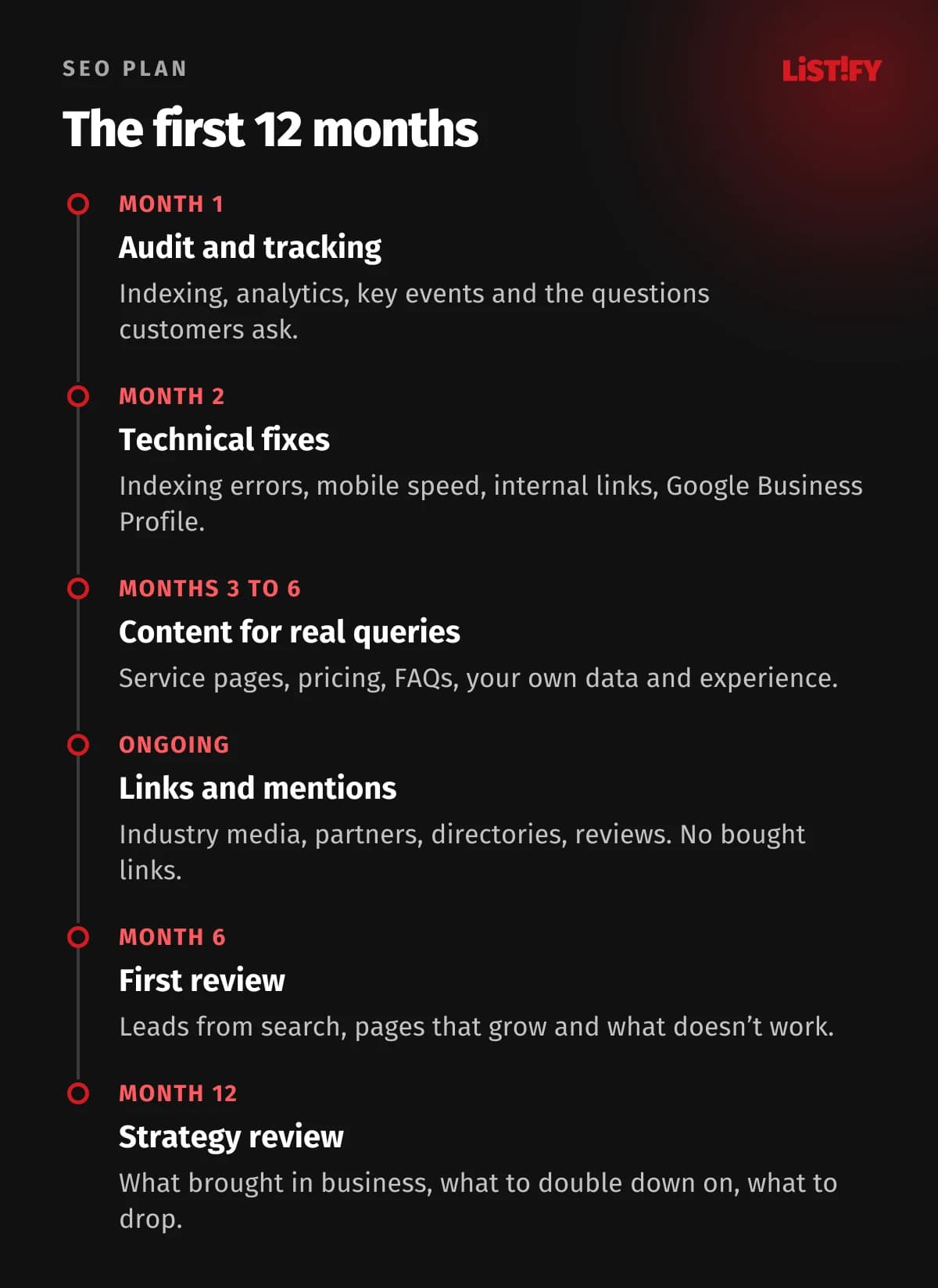
Track leads and orders from organic search, not just rankings. A keyword’s position now varies by location, device and whether an AI Overview appears. How much to budget for marketing and how to split it between SEO and ads is covered in how much to spend on online marketing.
12How long SEO takes and what it costs
For years, Google’s “Do you need an SEO?” page said that results typically take from four months to a year. In June 2026, Google removed that sentence when updating the page and gave no new timeframe. Ahrefs data shows why it’s hard to promise: only 1.74% of a million random pages it first found in September 2023 reached the top 10 within a year (6.11% when counting only new English pages), and 72.9% of pages in the top 10 are more than three years old. Older pages with links have an edge over brand new ones.
Cost depends on the state of your site and the competition in your field. A one-off audit with technical fixes is very different from monthly content and link building. Google itself says that a small local business can probably do much of the work on its own. An online store or a company facing national competition will need a specialist working on it regularly. You can get an estimate in our online marketing calculator, and other services are listed on the pricing page.
SEO and paid ads aren’t either-or. Ads bring leads right away, while SEO builds a channel that keeps working after the campaign ends. How to combine them in B2B is covered in B2B lead generation with paid ads and SEO.
13Common mistakes
- Mass-producing AI content without original information. Google treats this as scaled content abuse, and readers notice too.
- Paying for “AI optimization” tricks, llms.txt or FAQ schema. Google Search ignores llms.txt, no longer shows FAQ rich results, and says optimizing for AI search is still just SEO.
- Tracking rankings only. Rankings without leads are worth nothing. Set up key events in your analytics.
- Buying links. Google treats it as link spam, and a policy violation can cost you rankings.
- Expecting results within a month. New content needs time, and rewriting the site after every ranking swing wastes effort.
- Forgetting mobile. Google ranks the mobile version of your site, and a slow mobile site hurts rankings and sales alike.
- Ignoring Bing in B2B. On desktop it still sends almost one in ten search clicks worldwide.
14FAQ
Is SEO still worth it in 2026 now that Google answers with AI?
Yes. AI Overviews mostly take clicks from informational queries and appear far less often on buying and service queries. According to Ahrefs data from 112,309 websites, search engines still send more than a quarter of all visits, AI assistants less than half a percent. AI Overviews also rely on Google’s core ranking systems, so good SEO is also the way into AI answers.
How do I get my site into AI Overviews?
According to Google, there are no special requirements. A page must be indexed and eligible to appear with a snippet. What helps is a direct answer in the first paragraph, original experience and data, and strong rankings in classic results. Since August 31, 2026, Search Console shows how often your site appears in Google’s AI features.
Does an llms.txt file help?
Not in Google Search. In 2026, Google stated that it ignores these files and that they neither help nor harm your visibility. Google makes no claims about other AI services.
Does Google penalize AI-generated content?
Not for how it was created. Google says appropriate use of AI isn’t against its guidelines. The violation is mass-producing pages without added value, mainly to manipulate rankings. If you use AI, add your own experience, numbers and fact-checking.
How long does SEO take to work?
It depends on your site and competition. Technical fixes can show within weeks, new content and links usually within months. Google removed the “four months to a year” line from its documentation in June 2026. According to Ahrefs, only 1.74% of the pages it tracked reached the top 10 within a year.
Is FAQ schema still worth adding?
Not for expandable questions in Google results, which Google stopped showing on May 7, 2026. Questions and answers on the page still help readers and may help with citations in AI answers because they answer queries directly.
Should I optimize for Bing?
If your audience works on desktop, yes. In August 2026, Bing sent 8.91% of desktop search referrals worldwide and 8.99% of all referrals in the US, according to StatCounter. Register in Bing Webmaster Tools and use IndexNow to report new pages.
15Bottom line: what SEO in 2026 rewards
Search looks very different than it did two years ago, but what search engines reward has barely changed: a page that can be found, loads quickly and answers better than the rest. What’s new is that AI now summarizes general information on its own. The winners are sites with their own data, experience and a name people know and mention.
Start with an indexing audit in Search Console, fix the technical basics, complete your Google Business Profile if you serve a local area, and then write pages for the questions your customers really ask. You can see how we work step by step on the how it works page.
16Sources
- Google: Creating helpful, reliable, people-first content
- Google: Optimizing your website for generative AI features on Google Search
- Google: AI features and your website
- Google: Spam policies for Google web search
- Google: Search documentation updates
- Google: Search generative AI control in Search Console
- Google: Search Generative AI performance reports
- Google: Update to the site reputation policy in the EEA
- Google: Core Web Vitals
- Google: Do you need an SEO?
- Google Search Status Dashboard
- Google: Sundar Pichai at I/O 2026
- Google Business Profile Help: local ranking
- StatCounter: search engine market share
- Pew Research Center: clicks and AI summaries (2025)
- Ahrefs: AI Overviews and click-through rates (2026)
- Seer Interactive: AIO impact on Google CTR (2026)
- SparkToro: zero-click searches by country (2026)
- Ahrefs: ChatGPT vs Google traffic tracker
- Ahrefs: How long it takes to rank in Google
- Ahrefs: Search traffic study
- Ahrefs: Brand factors and AI Overview visibility
- IndexNow