Online competitor analysis: how to find out what your competitors do better in one afternoon
Most of what your competitors do online can be found in public sources, often for free. Ad libraries show their Facebook and Google ads, PageSpeed Insights shows how fast their site is, review sites show what customers complain about, and company registries show how the business is doing. Here is where to look, which tool numbers to trust and which not to, what is legal, and how to turn it all into a short list of improvements in a single afternoon.
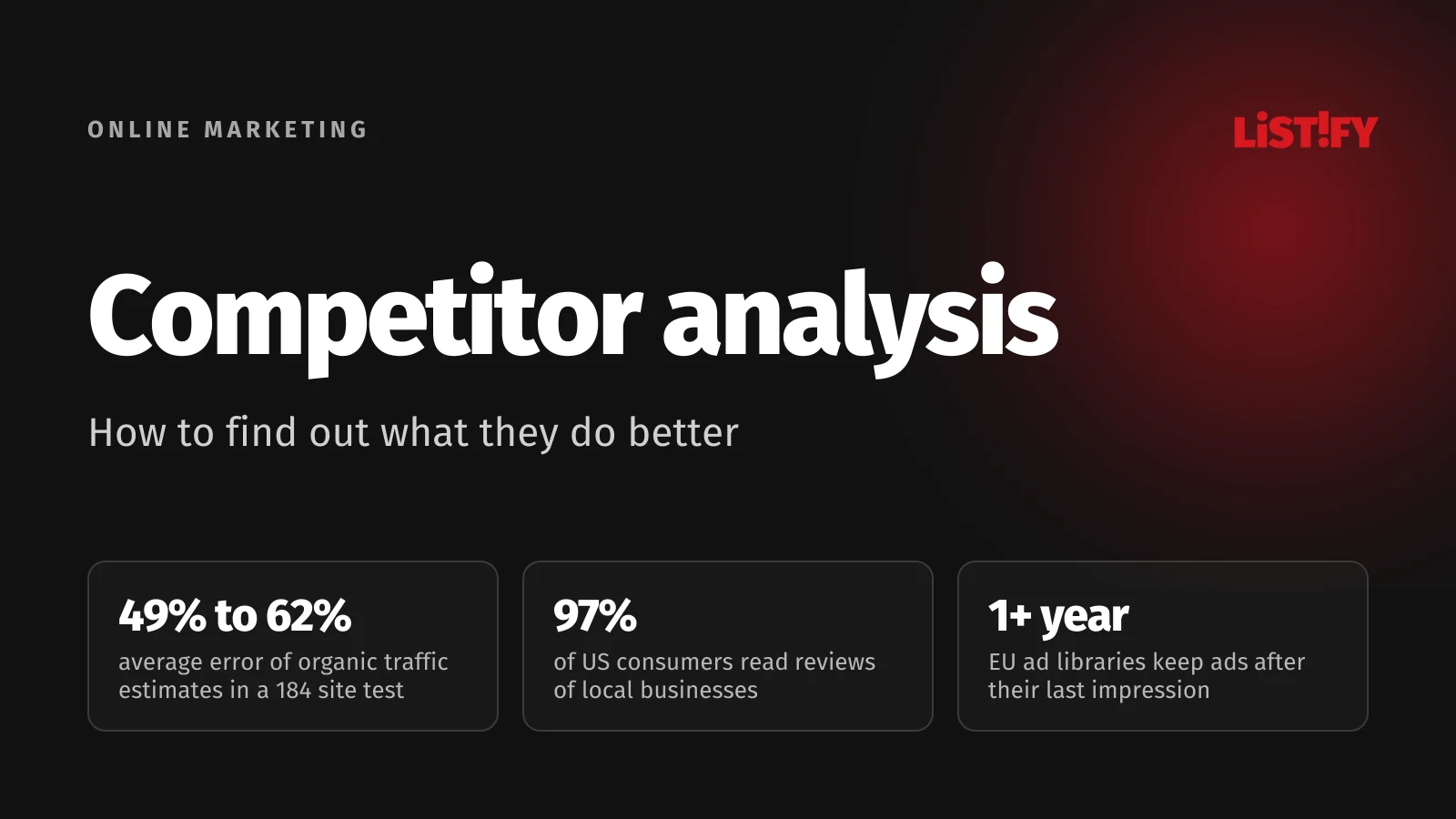
Short answer: an online competitor analysis means going through the websites, search results, ads, social media, reviews and public filings of the 3 to 5 companies that take your customers, and writing down where they do better. Ad libraries (Meta, Google), reviews and a test run through their checkout tell you the most. You can’t get their exact traffic or ad spend; tools can only estimate them. And anything a competitor has published is fair game to study, as long as you don’t use it to disparage them or copy them so closely that customers confuse the two of you.
01Who your online competitors are
Online, you have two kinds of competitors. A business competitor is a company customers consider instead of you: same industry, similar price, same market. A search competitor is any site that shows up for the same queries, including trade publications, comparison sites and directories. You learn how to sell from the first group and fight the second for attention.
The fastest way to find them: list 10 to 20 questions your customers type into a search engine. Not the names of your services, but the problems they come with, such as “flat roof leaking” rather than “waterproofing membrane.” Search them in a private browser window and note which sites keep coming up. Google handles the vast majority of search traffic almost everywhere, so start there.
- Google91.02%
- Bing4.55%
- Yahoo!1.24%
- Yandex1.01%
- DuckDuckGo0.70%
All devices. StatCounter measures visits that search engines send to sites running its tracking code, not the number of searches. In the US, Bing had 8.99% in the same month. Source: StatCounter.
People used to find similar sites with the related: operator, but it no longer appears in Google’s list of search operators. SEO tools do that job now. Ahrefs defines organic competitors as sites ranking in the top 10 for the same keywords that bring your site the most traffic, and Semrush has a similar report.
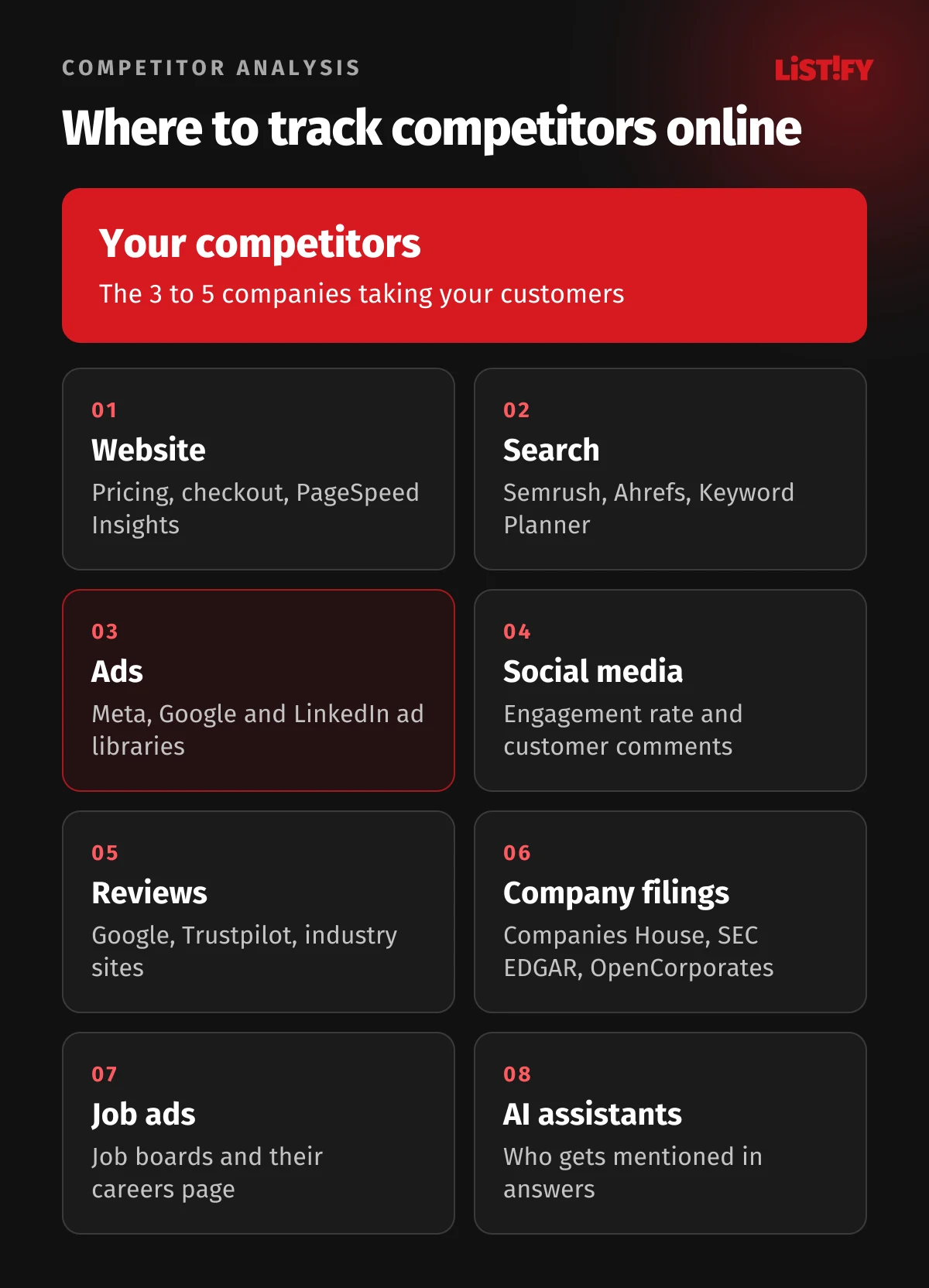
From the companies you find, pick 3 to 5: mostly direct rivals, plus one bigger company you want to catch up with and a fast-growing newcomer if there is one. Don’t start with more, or you’ll drown in data.
02Their website: what you can learn in under an hour
A competitor’s website is their storefront, and you can go through almost all of it yourself. Note down the following:
- Offer and pricing. Which services or products they push, whether they show prices, what bundles or discounts they run. According to Eurostat, two-thirds of EU companies with 10 or more employees have a website with a description of their products or a price list.
- The path to purchase or inquiry. Go through it like a customer, right up to the last step. How many form fields, whether you can buy without an account, what delivery and payment options they offer, how quickly they answer a question.
- Mobile speed. Enter their URL in PageSpeed Insights. If the site gets enough visitors, you’ll see real Chrome user data from the past 28 days. Google rates LCP of 2.5 s or less, INP of 200 ms or less and CLS of 0.1 or less as good. Smaller sites often have no field data, only a lab test.
- Technology. Wappalyzer (50 free lookups a month) or BuiltWith (free individual lookups) show the CMS, ecommerce platform, analytics, chat and email tools.
- History. The Wayback Machine has archived more than a trillion web pages. You can see how their prices, copy and offer changed over time, and what they tried and then dropped.
- Emails. Sign up for their newsletter and place a test order or create an account. You’ll see how often they write, what offers they send and how they onboard new customers.
For context, almost four in five EU companies have a website, but only about a third pay for online ads and fewer than a quarter sell online.
- Have a website (2025)79.0%
- Product description or price list on site (2025)66.4%
- Use social media (2025)63.6%
- Pay for online ads (2024)32.6%
- Sell online (2025)23.6%
EU27, companies with 10 or more employees, excluding the financial sector. Eurostat last asked about paid ads for 2024. In Czechia 82.8% of companies have a website, in Slovakia 74.4%. Sources: Eurostat websites, social media and ads, ecommerce.
You’ll learn the most from their copy. Notice the words they use, which customer objections they answer up front and how they prove you can trust them: case studies, numbers, certifications, team photos. For turning that into better copy of your own, see How to write landing page copy.
03SEO and traffic: tool numbers are only estimates
Only your competitor knows how many people visit their site. Every tool estimates. Ahrefs, for example, calculates organic traffic from rankings, search volume and an estimated click-through rate for each position. Several independent comparisons have looked at how far those estimates are from reality.
- Ahrefs48.63%
- Similarweb56.95%
- Semrush61.58%
184 websites across industries and regions, tool estimates compared with Google Search Console data for the first half of 2024. The comparison was run by Collaborator.pro, a content placement marketplace, not an academic team. Source: Collaborator.pro, December 2024.
Other comparisons point the same way. A peer-reviewed study in PLOS ONE compared 86 websites and found that Similarweb reported 19.4% fewer visits and 38.7% fewer unique visitors on average than Google Analytics, although its rankings of the sites closely tracked Google Analytics. SparkToro looked at 641 sites and found the error was “often +/-100% or more.” An older, smaller Screaming Frog test from 2016 (25 sites) showed that tools do worst on low-traffic sites: for three sites with under 10,000 organic visits, almost every estimate was at least 40% off.
So use these tools for comparisons and trends, not absolute numbers. They are good at showing which competitor is growing, which keywords they rank for, which pages bring them the most visitors and where their backlinks come from. When a tool says a competitor gets 12,000 visits a month, treat it as a ballpark figure.
What to look for in SEO data
- Top pages by traffic. Often not the homepage but guides, pricing pages or comparisons. They show which customer questions your competitor answers better.
- Keywords they rank for and you don’t. Ahrefs calls this Content Gap and Semrush calls it Keyword Gap. It is a ready-made list of topics for new pages.
- Backlinks. Who writes about them and links to them: media, directories, partners. You can reach out to some of them too.
- New pages. When a competitor adds dozens of pages on one topic within a few months, they’re getting ready to sell there.
We sort what still helps rankings from what’s myth in SEO in 2026.
| Tool | What it shows about competitors | Free | Paid from (monthly) |
|---|---|---|---|
| Semrush | Keywords, pages, backlinks, ads | 10 searches a day | $139 |
| Ahrefs | Organic competitors, keywords, backlinks | Ahrefs Free for your own verified site only | Starter $29, Lite $129 |
| Similarweb | Traffic estimates and similar sites | A limited high-level sample | Price not listed publicly |
| Google Ads Keyword Planner | Keyword ideas, including from a competitor’s URL | With a Google Ads account after entering billing details | No paid plan |
| Wappalyzer | Website technology | 50 lookups a month | $250 |
| BuiltWith | Website technology and its history | Individual lookups | $295 |
04Competitor ads: ad libraries show more than you’d expect
This is where Europe has an edge. The EU Digital Services Act requires very large platforms to keep a public ad repository (Article 39) for as long as an ad runs and for a year after it was last shown. It must include the ad content, who it was presented on behalf of, who paid, when it ran, the main targeting parameters and how many people it reached. Ad spend and results are not among the required fields, and for regular commercial ads the libraries don’t show them.
Outside the EU, you get much less. The TikTok and Microsoft libraries only cover ads shown in Europe, and LinkedIn adds targeting and impressions only for EU ads. Google’s Ads Transparency Center, launched in March 2023, lets you search ads worldwide, but it shows targeting and reach only for ads served in the European Economic Area.
| Library | What you’ll see | How far back |
|---|---|---|
| Meta Ad Library (Facebook, Instagram) | All ads targeting people in the EU, run dates, targeting by age, gender and location, and reach broken down by audience | At least a year after the last impression under the DSA |
| Google Ads Transparency Center | Search, Display, Gmail and YouTube ads, filters by date and location; in the EEA also targeting and number of recipients | At least a year after the last impression under the DSA |
| LinkedIn Ad Library | Ads, plus impressions, targeting (job title, company, industry) and run dates for EU ads | Ads since June 1, 2023, kept for a year after the last impression |
| TikTok Commercial Content Library | The ad, run dates, targeting by age and gender, number of people reached | A year after the last impression, European ads |
| Microsoft Ad Library (Bing) | Ads shown in the EEA | Since June 2023 |
What ad libraries tell you
- What lasts. An ad that has been running for months is probably paying off. Few businesses keep paying for months of ads that bring nothing in.
- What they test. Several versions of the same ad with different headlines or images mean they’re testing. A few weeks later you’ll see which one survived.
- What they offer. Discounts, free shipping, free consultations, seasonal promotions. Click through to see the landing page too.
- Who they target. In the EU, the Meta, Google and LinkedIn libraries show the main targeting parameters, such as age, region or job title.
What you won’t find: how much they spend, what they pay per click and how much the ads earn. To set a budget from your own numbers instead, read How much to spend on online marketing.
05Social media: look at reactions, not follower counts
On social media you can see how often competitors post, which formats they use and, above all, how people react. The comments are the most valuable part: what customers ask about, what annoys them and what they praise.
Follower counts say little. Followers can be bought, and on older profiles many are inactive. Engagement rate, meaning reactions divided by followers, is more useful. Here is how much it varies between networks:
- TikTok3.70%
- Instagram0.48%
- Facebook0.15%
- X0.12%
Socialinsider, 70 million posts by international brands from 2024 and 2025. Reactions divided by followers, and each network counts different reactions (likes and comments on Instagram). The same report gives lower TikTok figures (2.6% and 2.7%) elsewhere; 3.7% is from its 2024 vs. 2025 table. Source: Socialinsider.
Only compare numbers within one network and calculated the same way. Rival IQ, for instance, calculates engagement differently from Socialinsider, so their results can’t be put side by side. The best comparison is one you do yourself: for three competitors, average the reactions on their last 20 posts and divide by their follower count. What to measure on your own accounts is covered in How to measure social media success.
06Reviews: what customers dislike about competitors is your list of opportunities
Reviews are one of the most candid sources on a competitor, because the competitor doesn’t write them. Depending on your market, check Google reviews on their Business Profile, Trustpilot, industry sites (G2 or Capterra for software, Tripadvisor for hospitality) and marketplace ratings. Also note whether and how they reply to criticism.
The method is simple: pull the last 30 to 50 negative reviews of two or three competitors and group them by theme, such as shipping, communication, returns or quality. A complaint that keeps coming up is a place where you can be better, and say so on your site. If customers complain about slow replies, state on your site how fast you respond.
People do read reviews. In BrightLocal’s 2026 survey of 1,002 US adults, 97% said they read reviews of local businesses:
- Read reviews97%
- More likely to use a business after positive reviews85%
- Put off by negative reviews77%
- Only use a business with 4 or more stars68%
- Trust reviews as much as personal recommendations49%
- Used ChatGPT or other AI for local recommendations45%
1,002 US adults, SurveyMonkey panel, published February 2026. The often-quoted “88% trust reviews as much as personal recommendations” comes from the 2014 edition. Source: BrightLocal Local Consumer Review Survey 2026.
Numbers matter too. Northwestern University’s Spiegel Research Center found that a product with five reviews was 270% more likely to be purchased than one with none, based on data from a single high-end gift retailer. If a competitor has far more reviews than you, collecting reviews may be your quickest win.
07Company filings, registries and job ads: what public data reveals
Many countries publish company filings for free. In the UK, Companies House shows the registered address, incorporation date, current and former officers and filed documents, and you can set up free email alerts when a company updates its details. There is a catch: small companies and micro-entities may file accounts without a profit and loss account, so you often won’t see a small rival’s revenue.
In the US, SEC EDGAR gives free access to filings of publicly traded companies, but privately held competitors don’t file there. OpenCorporates pulls records from more than 140 government registries into one search, which helps when your competitors are spread across several countries. In the EU, national business registers publish the annual accounts that limited companies are required to file, though not every company files on time.
Other public sources worth five minutes:
- Job ads and their careers page. Who they hire tells you where they’re heading. Are they looking for a PPC specialist, an ecommerce developer or a sales rep for a new region? You’ll see the result on the market within months.
- Ownership and officers. Registries show who owns and runs the company and which other companies the same people are involved in.
- Press releases and trade media. New locations, funding, awards, partnerships.
08AI as an assistant: faster research, but check the numbers
AI has spread quickly in competitive research. In Crayon’s survey of competitive intelligence, sales and revenue leaders, 80% of teams use AI to generate sales-facing competitive content, up from 61% in 2025 and 25% in 2024. Crayon sells competitive intelligence software and doesn’t publish its sample size.
ChatGPT, Claude or Gemini handle the tedious work well: summarizing 50 reviews into recurring themes, comparing three pricing pages, drafting a comparison table or spotting changes between two Wayback Machine snapshots. But they know nothing about a competitor’s traffic, budgets or revenue, and if you ask, they may make numbers up. Even Anthropic’s documentation warns that language models sometimes produce factually incorrect text. Check every number from AI against a source.
A newer discipline is tracking how often AI assistants mention your brand and your competitors. Tools include Ahrefs Brand Radar from $199 a month and the Semrush AI Visibility Toolkit at $99 a month. Ahrefs says its prompts are modeled from its keyword database, so they aren’t real questions people typed into a chatbot. Treat the results as a rough trend.
09What is legal and where unfair competition begins
Studying what competitors have published is fine. Under the EU Trade Secrets Directive, a trade secret has to be secret, have commercial value because of that, and be protected by reasonable steps. A price list on a website, an ad in a library or accounts in a public registry don’t qualify. Article 3 also explicitly allows “observation, study, disassembly or testing of a product or object that has been made available to the public.” Buying a competitor’s product or service to try it is fine.
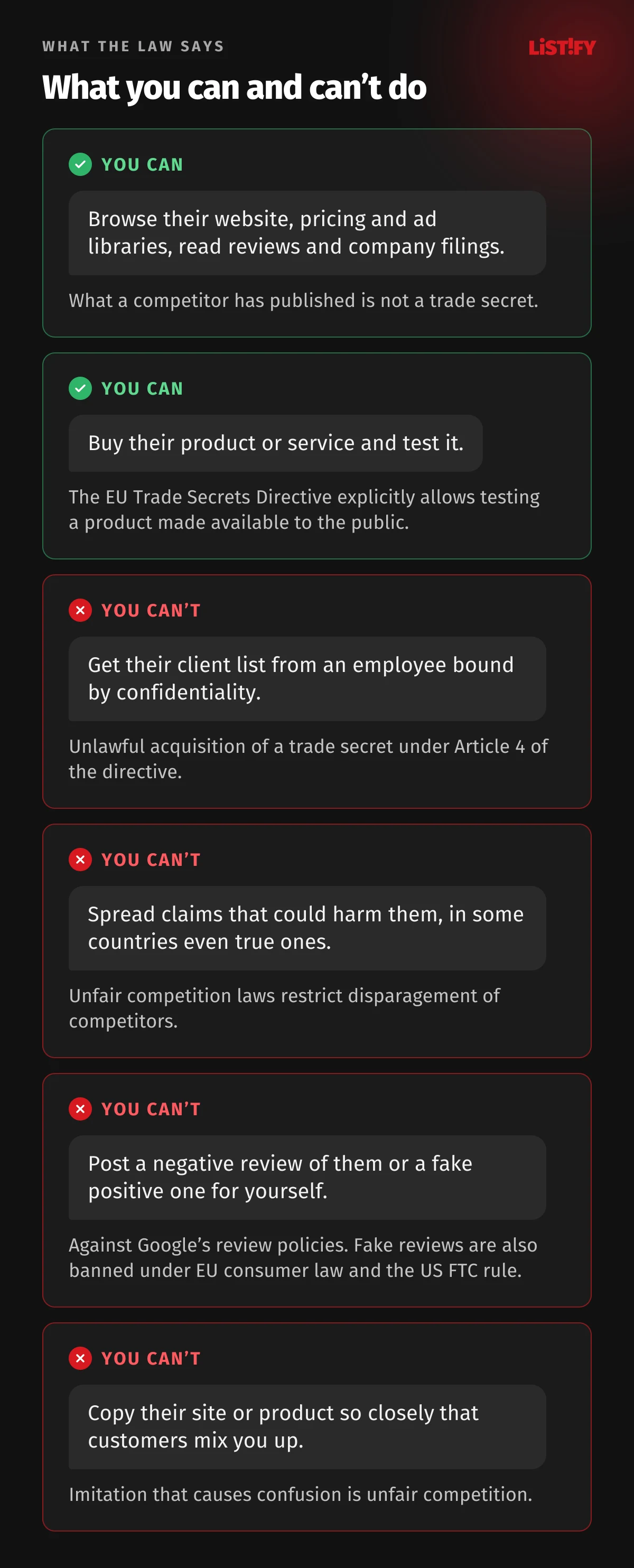
Problems start with how you obtain the information or what you do with it:
- Non-public information. Under Article 4 of the directive, unauthorized access to or copying of documents under the competitor’s control, or anything else contrary to honest commercial practices, is unlawful acquisition. That includes information from their employees who are bound by confidentiality.
- Disparagement and comparative ads. National unfair competition laws in the EU generally restrict statements that harm a competitor, and in some countries even true ones. If you want to use your findings in comparative advertising, it must compare objectively verifiable features and must not mislead.
- Copying. Imitating a competitor’s product, packaging or site so closely that customers could mix the two of you up can be unfair competition under national law, and Czech and Slovak law say so explicitly. Borrow ideas, not the design.
- Fake reviews. Since May 28, 2022, EU law bans posting or commissioning fake consumer reviews, and under the Omnibus Directive, EU countries must allow fines of up to at least 4% of annual turnover for widespread cross-border infringements. In the US, the FTC rule on fake reviews, in force since October 21, 2024, also covers AI-generated fake reviews and allows civil penalties.
- Reviewing a competitor. Google prohibits content based on a conflict of interest, explicitly including industry competitors, and content posted on a competitor’s listing to undermine its reputation.
- Scraping. Prices and copy without personal data aren’t a GDPR issue. Collecting reviewers’ names or people’s contact details is processing personal data under the GDPR, including Article 14 duties to inform them. Databases can be protected by the Database Directive. The EU Court of Justice held in Ryanair v PR Aviation that where it doesn’t apply, a site’s terms can still restrict how its data is used.
10How to analyze competitors in one afternoon
Three competitors take four to five hours. This order works well:
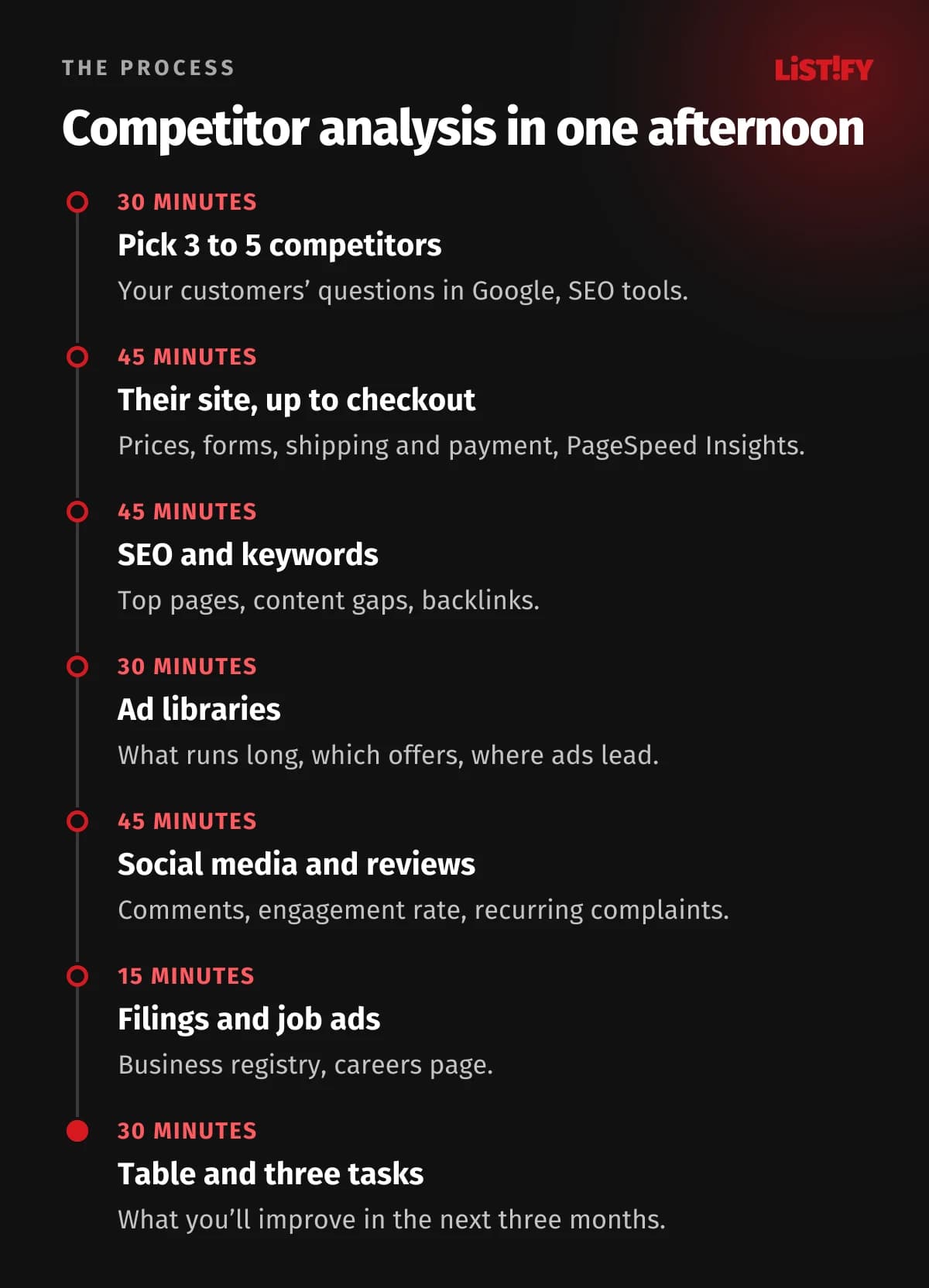
The result should be one table, not a folder with a hundred screenshots. This structure is enough:
| What you compare | Where to find it | What to look at |
|---|---|---|
| Offer and pricing | Website, pricing page, Wayback Machine | Bundles, discounts, how prices changed |
| Path to purchase | Your own test run | Number of steps, form fields, shipping and payment |
| Site speed | PageSpeed Insights | LCP, INP and CLS on mobile |
| Search visibility | Semrush, Ahrefs, Keyword Planner | Pages and keywords where they rank and you don’t |
| Ads | Meta, Google and LinkedIn ad libraries | What runs long, which offers, where ads lead |
| Social media | Their profiles | Engagement rate, customer comments |
| Reviews | Google, Trustpilot, industry sites | Recurring complaints and praise |
| Company | Business registry, job ads | Revenue, growth, who they hire |
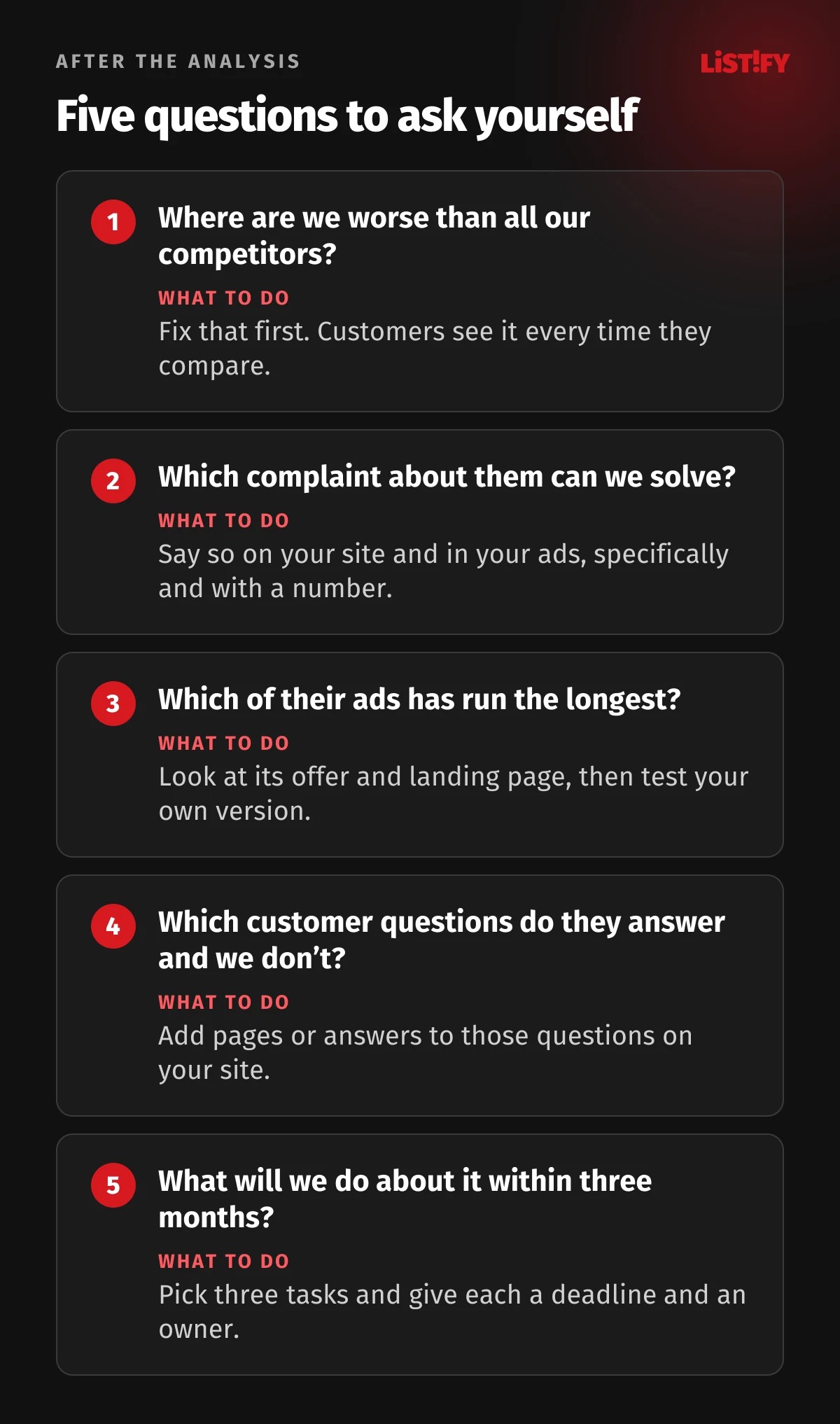
Then pick three things from the table to improve over the next three months. No more. An analysis that doesn’t change anything is just interesting reading.
Many companies also turn their findings into a SWOT analysis (strengths, weaknesses, opportunities, threats). If you do, fill it with specific findings from the table. “Strong brand” or “good service” tells you nothing. By the way, SWOT wasn’t invented by Albert Humphrey alone, as is often claimed. According to an archival study published in 2023, it came from Robert F. Stewart’s team at the Stanford Research Institute and was originally called SOFT.
How often to repeat it
A full analysis once a quarter or every six months is enough. In between, a quick monthly check will do: new ads in the libraries, new reviews and price changes. Price and page monitoring can be automated, for example with page change alerts.
What not to copy
- Mistakes. Just because a competitor does something doesn’t mean it works. Even a big company can have a slow site and a twenty-field form.
- Prices without your own numbers. Cutting prices just because a competitor is cheaper, without knowing your own costs, is the fastest way to lose money.
- Brand voice. If you sound exactly like your competitor, customers can’t tell you apart.
11FAQ
Is competitor analysis legal?
Yes, as long as you work with public information: websites, pricing, ads in ad libraries, reviews and public filings. Buying a competitor’s product to test it is also allowed under EU trade secrets law. What you can’t do is get confidential information through unauthorized access or from employees bound by confidentiality, spread harmful claims about them, post fake reviews or copy their site or product so closely that customers mix you up.
How can I see a competitor’s website traffic?
Not exactly, only they know it. Tools like Similarweb, Semrush and Ahrefs estimate it, and for organic traffic, a Collaborator.pro comparison found average errors of roughly half, more for small sites. Use them to compare competitors with each other and to track trends, not for absolute numbers.
How do I find a competitor’s ads?
In the Meta Ad Library (Facebook and Instagram), Google Ads Transparency Center, LinkedIn Ad Library and TikTok Commercial Content Library. For ads in the EU you’ll see the creative, run dates and main targeting parameters. For regular commercial ads, none of the libraries show ad spend or results.
Where can I find a competitor’s revenue?
In the public business registry of their country, if they file full accounts: Companies House in the UK, SEC EDGAR for US public companies, national registers in the EU. Small companies often file abbreviated accounts without a profit and loss account, so you may not see their revenue.
Which competitor analysis tools are free?
Ad libraries, PageSpeed Insights, the Wayback Machine and most business registries are free. SEO tools have free tiers with limits: Semrush allows 10 searches a day, and Google Keyword Planner is free with a Google Ads account. Wappalyzer and BuiltWith offer free lookups for website technology.
How often should I do a competitor analysis?
A full analysis every three to six months and a quick monthly check of ads, reviews and prices. More important than frequency is picking a few specific improvements from each analysis and actually making them.
12Conclusion: see what works, then do it your way
An online competitor analysis doesn’t require expensive tools or weeks of work. Most answers are in ad libraries, reviews and on the competitors’ own sites, for free. Take traffic numbers with a grain of salt and verify every number AI gives you. Your competitors’ customer complaints and the ads they keep running for months will tell you the most.
If you want a competitor analysis and a plan for what to do with it in search, ads and social media, we can put it together with you. See how we work and our pricing.
13Sources
- StatCounter: search engine market share
- Eurostat: enterprises and websites (isoc_ciweb)
- Eurostat: social media and advertising (isoc_cismt)
- Eurostat: ecommerce sales (isoc_ec_eseln2)
- Google: search operators
- Ahrefs: organic competitors
- Ahrefs: how organic traffic is calculated
- Google: PageSpeed Insights and CrUX data
- web.dev: Core Web Vitals
- Wappalyzer: pricing
- BuiltWith: plans
- Internet Archive: Wayback Machine
- Collaborator.pro: accuracy of Semrush, Similarweb and Ahrefs (2024)
- PLOS ONE: Similarweb vs. Google Analytics on 86 websites (2022)
- SparkToro: which traffic estimate best matches Google Analytics (2022)
- Screaming Frog: how accurate are traffic estimators (2016)
- Semrush: pricing
- Semrush: what a free account includes
- Ahrefs: pricing
- Similarweb: pricing
- Google Ads: Keyword Planner
- EU Digital Services Act
- Meta: DSA transparency measures (2023)
- Google: Ads Transparency Center launch (2023)
- Google: Ads Transparency Center help
- LinkedIn: Ad Library
- TikTok: Commercial Content Library
- Microsoft: Ad Library
- Socialinsider: social media benchmarks
- Rival IQ: social media industry benchmark report
- BrightLocal: Local Consumer Review Survey 2026
- BrightLocal: Local Consumer Review Survey 2014
- Spiegel Research Center: How online reviews influence sales (2017)
- Google: Maps user contributed content policy
- GOV.UK: get information about a company
- GOV.UK: company accounts requirements
- SEC: EDGAR search
- OpenCorporates
- Crayon: State of Competitive Intelligence 2026
- Anthropic: reduce hallucinations
- Ahrefs: Brand Radar
- Semrush: AI Visibility Toolkit
- EU Trade Secrets Directive 2016/943
- EU Omnibus Directive 2019/2161
- FTC: final rule banning fake reviews (2024)
- EU General Data Protection Regulation
- EU Database Directive 96/9/EC
- EU Court of Justice: Ryanair v PR Aviation, C-30/14
- Puyt et al.: the origins of SWOT analysis (2023)