Local SEO: turn nearby searches into relevant enquiries
A nearby customer searches for your service, checks opening hours and decides whether to contact you. Local SEO helps that decision by making your business understandable, eligible and easy to reach. Start with accurate business information and a useful service page, then assess qualified enquiries rather than one search position.
Local search includes map results, business profiles and ordinary website results. Those surfaces overlap, but they are not identical. Improving the website does not automatically repair an inaccurate profile, and a complete profile does not replace a page that answers the customer’s practical questions.
Use your real operating area and services as the scope. A repair company that visits customers needs a different presentation from a shop that welcomes visitors at a staffed location. Choosing the correct model matters more than adding every nearby city to the business name.
01Start with the local customer’s task
List the enquiries the business can usefully serve: an urgent repair, a booked consultation or a customer collecting an order. Identify where service is available, when the team can respond and any important restrictions. Search visibility for work you cannot perform adds noise to the sales process.
For an illustrative appliance repair company, the useful questions include supported brands, travel area, booking procedure and whether the customer should call about an urgent fault. These details are more helpful than a generic claim to be the city’s leading repair specialist.
Distinguish location intent from informational intent. A person asking how to reset a machine may want instructions, while someone searching for a nearby repair visit needs availability and contact information. Content can support both, but it should not pretend that every visitor is ready to purchase.
Review actual customer wording through enquiries and available search reports. Note local terminology and the questions that prevent a booking. Use this information to prioritize page improvements rather than producing pages for every keyword variation that appears in a tool.
Choose a meaningful outcome, such as an enquiry for an available service in the operating area. The broader SEO strategy guide covers discovery beyond local results; local work should connect that visibility to an answer the nearby customer can use.
02Represent the real business accurately
Google’s representation guidelines explain eligibility, naming and location requirements. Use the real business name and an appropriate category. Do not turn the name into a list of services and cities or create profiles for locations where the business does not qualify.
| Business situation | Useful presentation | Check before publishing |
|---|---|---|
| Customers visit a real location | Accurate address and visitor information | Staffing, signage and public access requirements |
| Business travels to customers | Appropriate service-area profile | Address visibility and real operating area |
| Several eligible branches | Distinct accurate information for each branch | Eligibility and consistent ownership |
| Online-only operation | Website and suitable online channels | Whether Business Profile eligibility applies |
Keep the profile under a controlled business account, with named managers and a recovery process. Record ownership when an agency helps with setup. A profile that only a former contractor can manage creates an avoidable operating problem when opening hours or contact details change.
Complete the available information carefully: services, contact details, opening hours and relevant photos. Maintain holiday or exceptional hours. Accuracy helps customers act with confidence and reduces wasted visits, even when a change does not create an immediate ranking improvement.
Handle duplicates and moves through the supported processes. Creating another profile whenever verification becomes difficult can fragment the business representation. Keep evidence of the real location and operating model so the person managing the profile can resolve issues consistently.
03Understand what local ranking can and cannot tell you
Google’s local ranking guidance identifies relevance, distance and prominence as the main factors. A useful profile can explain relevance, but you cannot rewrite a customer’s physical location. This makes a single universal citywide ranking promise unreliable.
Inspect searches from relevant locations and understand the context of each observation. A business visible near its premises may appear differently across town. Your own logged-in search is a small observation, not a complete measure of how every potential customer sees the market.
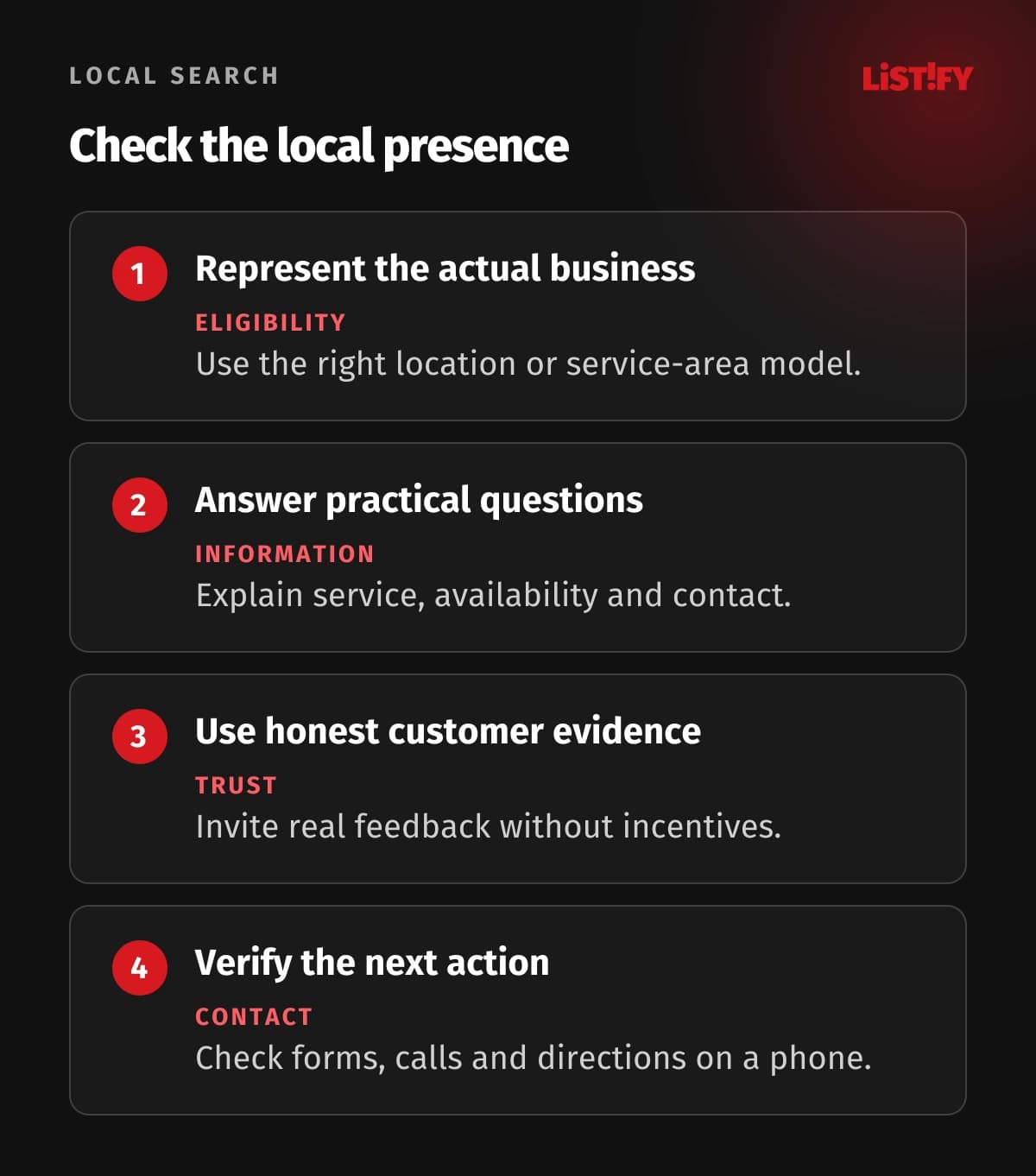
Separate profile completeness from ranking guarantees. Add information because it is accurate and useful, then review available evidence. Do not claim that a particular photo count, posting frequency or directory package mechanically secures a top position without a supported explanation.
Evaluate commercial relevance alongside visibility. An enquiry outside the service area may look like growth in a report while creating extra work for the team. Record why leads are unsuitable, and use the pattern to improve descriptions, operating areas and service pages.
Treat paid advertising as a separate acquisition activity. It can support local demand, but the spend should not be presented as buying an organic position. Keep channel reporting clear enough that the business can see what each activity contributes.
04Create location pages with genuine local value
A location page should help someone choose or reach the business. Include relevant services, contact options, travel or access information and genuine details about the branch or area served. For a staffed shop, customers may need parking and collection instructions; for home visits, they need coverage and booking conditions.
Avoid publishing dozens of pages that only exchange city names. If several areas share the same operating model and no distinct information, one well-structured service-area page may be more useful. Create a separate page when it has a real role in the customer’s decision.
Keep business information consistent across the site and managed profiles. Consistency does not mean forcing identical typography into every field; it means avoiding contradictions about the name, telephone number, location and service hours. Assign an owner to update those details after a move.
Google’s LocalBusiness documentation describes structured information about businesses, such as address and hours. Markup should match the visible, accurate page content. Valid markup can support understanding and eligibility for supported displays, but does not guarantee a rich result or ranking.
Make the mobile contact path work. Check telephone links, forms, confirmation messages and directions. A local page that loads slowly or hides the booking action can lose the value of discovery. The mobile-first design guide provides related interface considerations.
05Build customer evidence without manufacturing it
Invite honest feedback through an appropriate process after a real customer experience. Make the invitation understandable and easy to use. Keep it separate from pressure to leave a specific rating, and allow the business to learn from criticism rather than only collect flattering quotes.
Google’s contribution policy prohibits fake engagement and reviews obtained through incentives. It also addresses selectively soliciting positive reviews. Do not trade discounts for ratings or route dissatisfied customers away while sending only happy customers to the public review page.
Respond to feedback with useful, professional context. Avoid exposing order details, health information or other private data in a public reply. Move case-specific resolution to a suitable private channel while keeping the public response clear about the next step.
Use real photos that help people recognize the business and understand the service. Get appropriate permission for identifiable customers or staff and remove sensitive information from the frame. A photograph of the entrance can answer a practical question that an unrelated stock image cannot.
Pursue relevant local mentions through genuine relationships, such as an association directory or an event the business actually supports. Assess whether the page helps customers identify the business. A bulk list of irrelevant placements is a poor substitute for a credible local presence.
06Measure enquiries and maintain the essentials
Use available profile and website reporting to inspect discovery and actions, while understanding what each metric measures. A direction request, a phone-link click and a completed sale are different events. Avoid adding them together as if every action represents a new paying customer.
Connect enquiry sources to the sales process where practical. Ask the team to record relevant service, area and outcome without collecting unnecessary personal data. An appropriately tagged website link can help distinguish profile visits from other sources, provided analytics and consent arrangements fit the market.
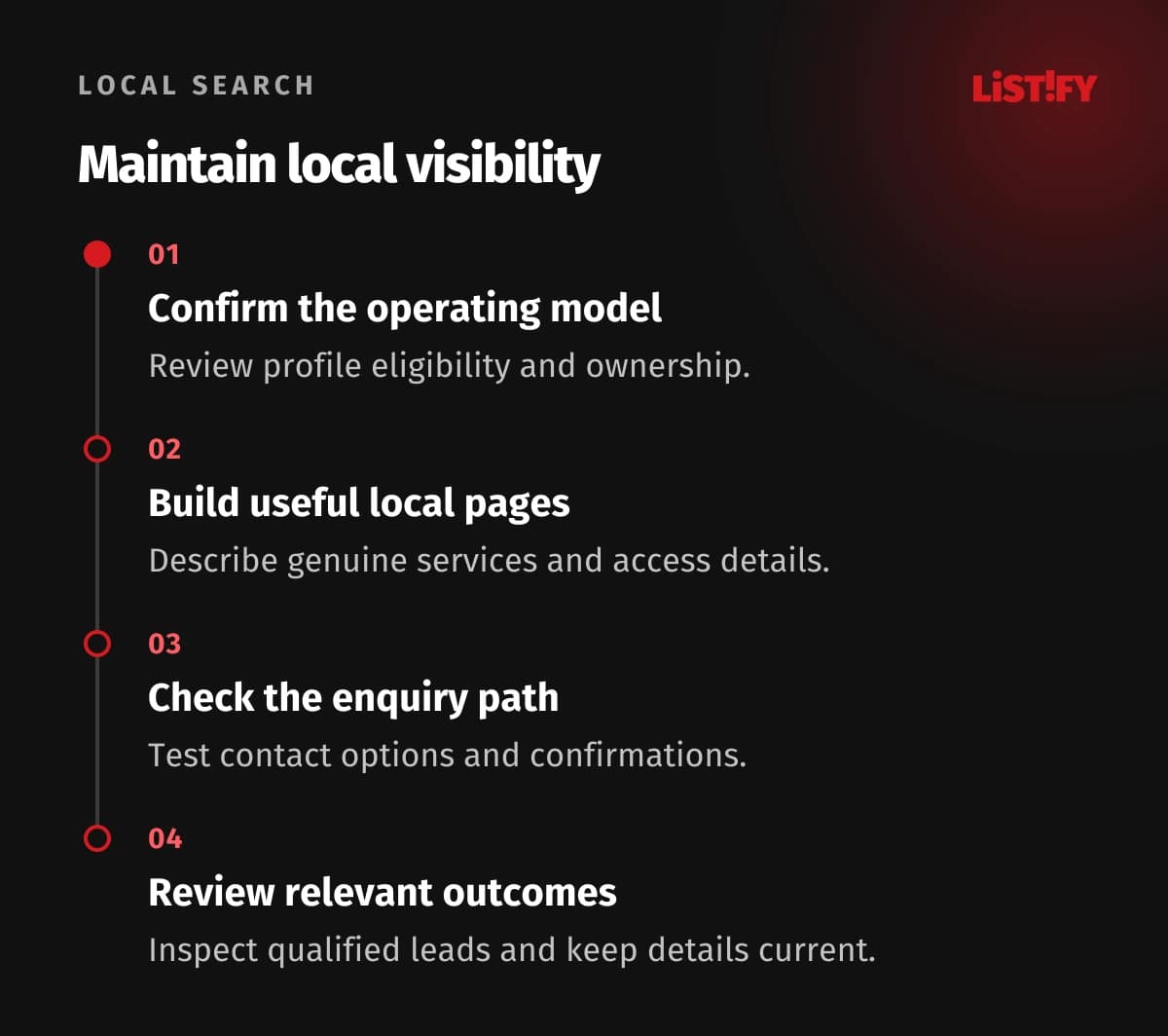
Choose a manageable review cadence and respond to meaningful changes. Update hours before holidays, revise services when capacity changes and verify contact information after a move. Keep a record of major listing edits so unexplained reporting changes can be investigated.
When visibility changes, first check eligibility, verification, accuracy and website availability. Then inspect search demand, competition and the affected geography. Avoid changing everything at once in response to one low-position screenshot; that makes the subsequent result harder to interpret.
Report progress as usable evidence: corrected information, improved service answers, working contact paths and the trend in qualified enquiries. Explain uncertainty about attribution and small samples. A clear operating picture is more valuable than a promised position that the supplier cannot control.
07Questions about local SEO
Can local SEO guarantee first place in my city?
No. Search context, distance and competition affect results. Define the target area and commercial outcome, then evaluate relevant visibility and enquiries.
Do online-only businesses qualify for a Business Profile?
Do not assume eligibility. Review Google’s current rules for the actual operating model before creating a profile or displaying an address.
Should every nearby city have a separate page?
Only when the page provides useful distinct information. Replacing a city name in otherwise identical copy adds little help for a customer choosing a service.
Can I offer a discount for a Google review?
Google’s policy prohibits incentivized review engagement. Invite honest feedback without rewards, pressure or selective solicitation of positive reviews.
Does structured data guarantee a map or rich result?
No. Accurate markup can help Google understand a page and support eligible displays. It does not guarantee presentation or a ranking position.
What matters more: calls or profile views?
Evaluate the path to qualified work. Views show exposure, while calls require context and outcome review. Neither metric alone proves revenue.
How often should the profile be updated?
Update material changes promptly and use a regular accuracy review. Hours, services, locations and contact paths should reflect the business customers will actually encounter.