How Much Should a Small Business Spend on Marketing? Work Out Your Budget in 10 Minutes
There is no single percentage that works for every business. US companies spend just under 9% of revenue on marketing on average, but half of them spend 5% or less. For a smaller business, it is more useful to work backwards: how many customers you want, how much you can afford to pay for each one, and what a click costs. This guide walks through a worked example, the minimum budgets that follow from Google's and Meta's own rules, and a template for splitting your budget.
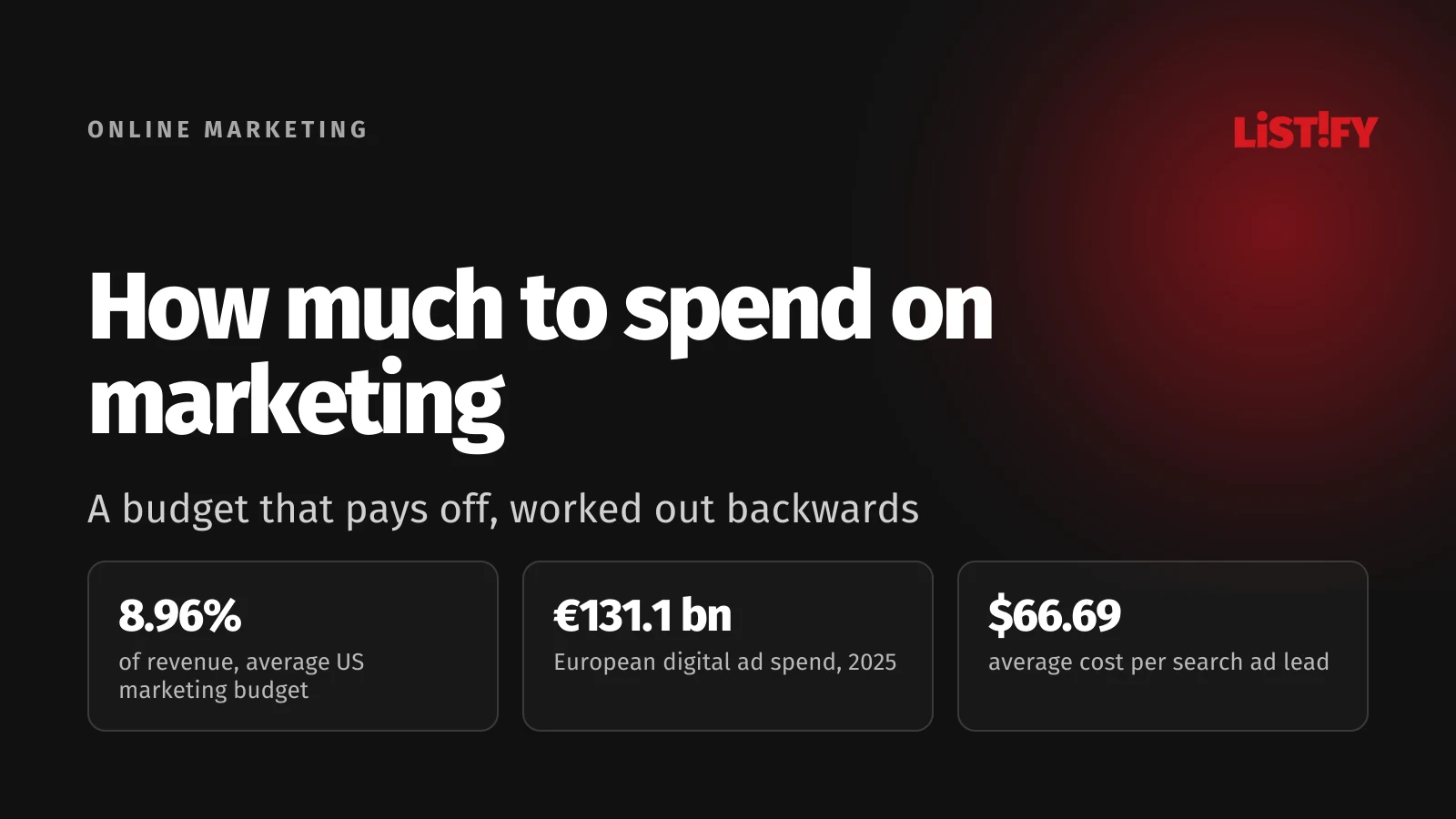
Short answer: start with enough for a search campaign to bring in at least 30 conversions a month, meaning leads or orders you can track. That is roughly how much data Google needs for automated bidding to learn who to show your ads to. The exact figure depends on your cost per click, the share of visitors who get in touch (your conversion rate) and the margin on a single sale. In our example it comes to $4,000 a month. Use percentage of revenue only as a sanity check.
This guide is for owners and managers of smaller businesses deciding how much to put into Google, Meta and other online ads. Survey and market data is current as of September 2026 and linked to its source.
01How much other companies spend on marketing
The most detailed recurring data on marketing budgets comes from The CMO Survey, run by Duke University's Fuqua School of Business, Deloitte and the American Marketing Association. In January 2026, marketing leaders at US companies reported an average marketing budget of 8.96% of company revenue. The median, however, was only 5%, so half of companies spend 5% or less. A smaller group of heavy spenders pulls the average up (The CMO Survey).
- B2C product12.0%
- B2B services10.1%
- All companies (average)9.0%
- B2C services7.2%
- B2B product7.0%
Source: The CMO Survey 2026, US companies surveyed in January 2026, based on 154 responses. The median across all companies is 5%.
The spread between business types is wide. Companies selling products to consumers put almost 12% of revenue into marketing, while B2B product companies spend around 7%. Companies with fewer than 50 employees reported more than 16%, but only 23 of them answered, so treat that figure as a rough indication. In the same survey, digital marketing spending grew 8.2% over the previous year, while total marketing spending grew just 1.7% (The CMO Survey).
Gartner lands in a similar place. Its spring 2026 survey put marketing budgets at 7.8% of company revenue, up from 7.7% a year earlier. Most of the companies it surveyed, though, have revenue above $1 billion (Marketing Dive).
Where the “7 to 8% of revenue” rule comes from
You will often read that the US Small Business Administration recommends spending 7 to 8% of revenue on marketing. In fact, the figure comes from a 2012 post by a guest contributor on the SBA blog, and that page no longer exists. It also assumed a business with revenue under $5 million and margins of 10 to 12% (archived post). Today, the SBA itself says there is “no hard and fast answer” to how big a marketing budget should be (SBA).
02Where the world's ad money goes
WPP Media expects global advertising revenue, excluding US political ads, to grow 8.9% in 2026 and reach $1.3 trillion (WPP Media). By dentsu's estimate, digital channels account for 69% of global ad spend (dentsu). The two firms measure the market differently, so their figures aren't directly comparable.
In Europe, digital advertising grew 10.5% in 2025 to €131.1 billion. Social media ads grew fastest, up 19.2% to €35.5 billion, while paid search grew more slowly than the market as a whole (IAB Europe).
Even so, most companies don't advertise online at all. According to Eurostat, only a third of EU companies with 10 or more employees paid for internet advertising in 2024, and the share rises with company size. If you do advertise, you may face fewer competitors in the auction than you expect.
- 10 to 49 employees30.6%
- 50 to 249 employees40.1%
- 250 or more employees50.5%
- All companies with 10+ employees32.6%
Source: Eurostat, dataset isoc_cismt, indicator E_ADS, 2024. The EU figure is a Eurostat aggregate; 19 member states reported data for 2024. No newer data is available yet.
03Two methods: percentage of revenue or working backwards
In practice, marketing budgets are set in one of two ways. Each is good for something different, and the best approach is to use both.
| Aspect | Percentage of revenue | Working backwards |
|---|---|---|
| How it works | Take a fixed percentage of last year's or projected revenue | Start from the number of customers you want and what you can pay for each one |
| Best for | Established businesses with steady revenue, annual planning | New businesses, new products, ads meant to bring in leads or sales right away |
| Weakness | Tells you nothing about whether ads pay off. A new business has no revenue to base it on | Needs estimates of cost per click and conversion rate, so the first month is for calibration |
| Use it for | Checking you are within a normal range | Setting your monthly budget |
Working backwards rests on one question: how much can you pay to win a new customer and still make money on them? That is your maximum cost per acquisition, or CPA. If customers buy only once, the ceiling is the gross profit on the first sale. If they come back, you can afford to pay more, because you'll earn from later purchases too.
04A worked example
Take a company that remodels bathrooms. The numbers are made up for illustration, so plug in your own. For reference, LocaliQ's data from Google Ads and Microsoft Ads campaigns puts the average search cost per click across industries at $5.42, the average conversion rate at 8.18% and the average cost per lead at $66.69 (LocaliQ). Costs vary widely by industry, often severalfold, and the most accurate numbers will always be the ones from your own account.
| Step | Calculation | Result |
|---|---|---|
| 1. Value of a job | Average remodel $15,000, gross margin 20% | $3,000 gross profit |
| 2. Cost per lead | $5 per click, 5% of visitors send an inquiry: 5 / 0.05 | $100 per lead |
| 3. Cost per customer | One in five leads becomes a job: 100 × 5 | $500 per customer |
| 4. Check | $500 against $3,000 gross profit | Pays off with plenty of room |
| 5. Monthly budget | Target of 8 jobs a month: 8 × 500 | $4,000, or 800 clicks and 40 leads |
The table shows why the percentage alone doesn't tell you much. Eight jobs would bring in $120,000 of revenue, and the ads would cost about 3.3% of it. But if the website converted 1% of visitors instead of 5%, the cost per customer would jump to $2,500 and the budget to $20,000 a month. Your website's conversion rate moves the budget you need as much as your cost per click does, and it's the easier one to change. That is why it pays to fix the page your ads send people to before adding money. We cover this in Custom website from the first pixel.
Don't forget VAT in the EU
Google doesn't charge VAT to business accounts in the EU. Under the reverse charge rule, the customer accounts for the VAT in their own country (Google Ads). A VAT-registered business can usually reclaim it, so the ads cost no more. A business that is not VAT-registered, or can't reclaim VAT, may still have to pay the tax, which adds your national VAT rate on top of every ad. Check the rules in your country.
05Minimum PPC budget for Google Ads and Facebook
PPC, or pay per click, means you pay each time someone clicks your ad. Ad platforms now set those bids automatically, and they need data to do it. If the budget is too small, the campaign never learns who to show your ads to, and you never learn anything from it. Each platform has its own rules.
| Platform | What the help center says | What it means in our example |
|---|---|---|
| Google Ads | Set the daily budget to at least 10 times your expected cost per click, or 2 to 3 times your target cost per action (the Target CPA strategy) | At least $50 a day. With a $100 target cost per lead, $200 to $300 a day |
| Google Ads, evaluation | Start new campaigns on Maximize Clicks or Manual CPC, switch to Target CPA after 30+ conversions in 30 days | 40 leads a month is enough to switch |
| Google Performance Max (a campaign type that places ads across all of Google's services) | An average daily budget of at least 3 times your cost per conversion | At least $300 a day, about $9,120 a month |
| Meta (Facebook, Instagram) | An ad set (a group of ads sharing one budget) exits the learning phase after about 50 results in the week after its last significant edit. With a cost per result goal, the daily budget should be at least 5 times that goal | At $100 per lead that would be $5,000 a week and at least $500 a day, so put everything into one ad set, or optimize for a cheaper, more frequent action such as landing page views |
So the $4,000 budget from our example is below what Google asks for with Target CPA. That's fine. For new campaigns, Google itself suggests starting with Maximize Clicks or Manual CPC and switching to Target CPA once the campaign has 30+ conversions in 30 days (Google Ads). With a smaller budget, your ads simply won't show for every search.
Google's help pages set no fixed minimum budget. Keep in mind, though, that on any given day Google can spend up to twice your average daily budget. Over a month you won't pay more than 30.4 times your daily budget, so at $10 a day the maximum is $304 (Google Ads). Meta does require a minimum budget, but the amount varies by country and campaign objective.
The practical takeaway: if your calculation comes out so low that a campaign can't collect even 30 conversions a month, don't spread the money across five channels. Put all of it into one, usually search, where people are already looking for what you sell.
06How to split the budget between channels
Search and social ads differ in how people get to you. On Google, someone is already looking for a solution. On Facebook or Instagram, you interrupt someone who was doing something else. That shows up in the numbers: in LocaliQ's data, a lead from Meta lead ads costs less than half as much as a lead from search ads. A cheaper lead isn't automatically a better deal, so compare what each channel costs you per customer.
- Search ads (Google and Microsoft)$66.69
- Meta lead ads$27.39
Source: LocaliQ benchmarks for search ads and Facebook ads, averages across industries from LocaliQ client campaigns in USD. LocaliQ doesn't publish the sample size or period.
Over the long term, it pays to split the budget into two parts: advertising that brings in leads now, and brand building, so people know you before they start searching. Researchers Les Binet and Peter Field, drawing on campaigns entered into the UK IPA Effectiveness Awards, found that consumer brands tend to do best with about 60% on brand and 40% on immediate sales activation. For B2B companies the split is closer to 46% brand and 54% activation, which the authors themselves call a rough estimate (B2B Institute, LinkedIn).
Those ratios apply to established brands planning years ahead. A smaller business that watches monthly cash flow should start with ads that bring in leads right away and pay for themselves quickly, and add brand building, such as content, social media and video, once search brings in steady leads. We cover organic social in Social media strategy and winning business customers in B2B lead generation from paid ads and SEO.
07Marketing budget template: what to include
The money you pay the ad platform is only one line item. Businesses that say marketing “doesn't pay off” have often budgeted for that line alone.
| Item | What it covers | Keep in mind |
|---|---|---|
| Ad spend | Payments to Google, Meta, LinkedIn, Microsoft | Non-reclaimable VAT or sales tax where it applies |
| Campaign management | An agency, a freelancer, or your own staff's time | A specialist's salary or fee comes on top of ad spend |
| Ads and content | Copy, banners, photos, short videos | Ads wear out, so plan to refresh them |
| Website and landing pages | The page your ads lead to, speed, forms | Has the biggest effect on cost per customer |
| Tracking | Conversion setup, Google Analytics 4, a link to your CRM (customer database) | Without it you can't tell what pays off |
| Testing reserve | A new channel, new ads, seasonal pushes | A small slice of the budget for trying ideas |
You can see how we price campaign management on our pricing page and on How we work.
08The first 90 days: how to test your budget
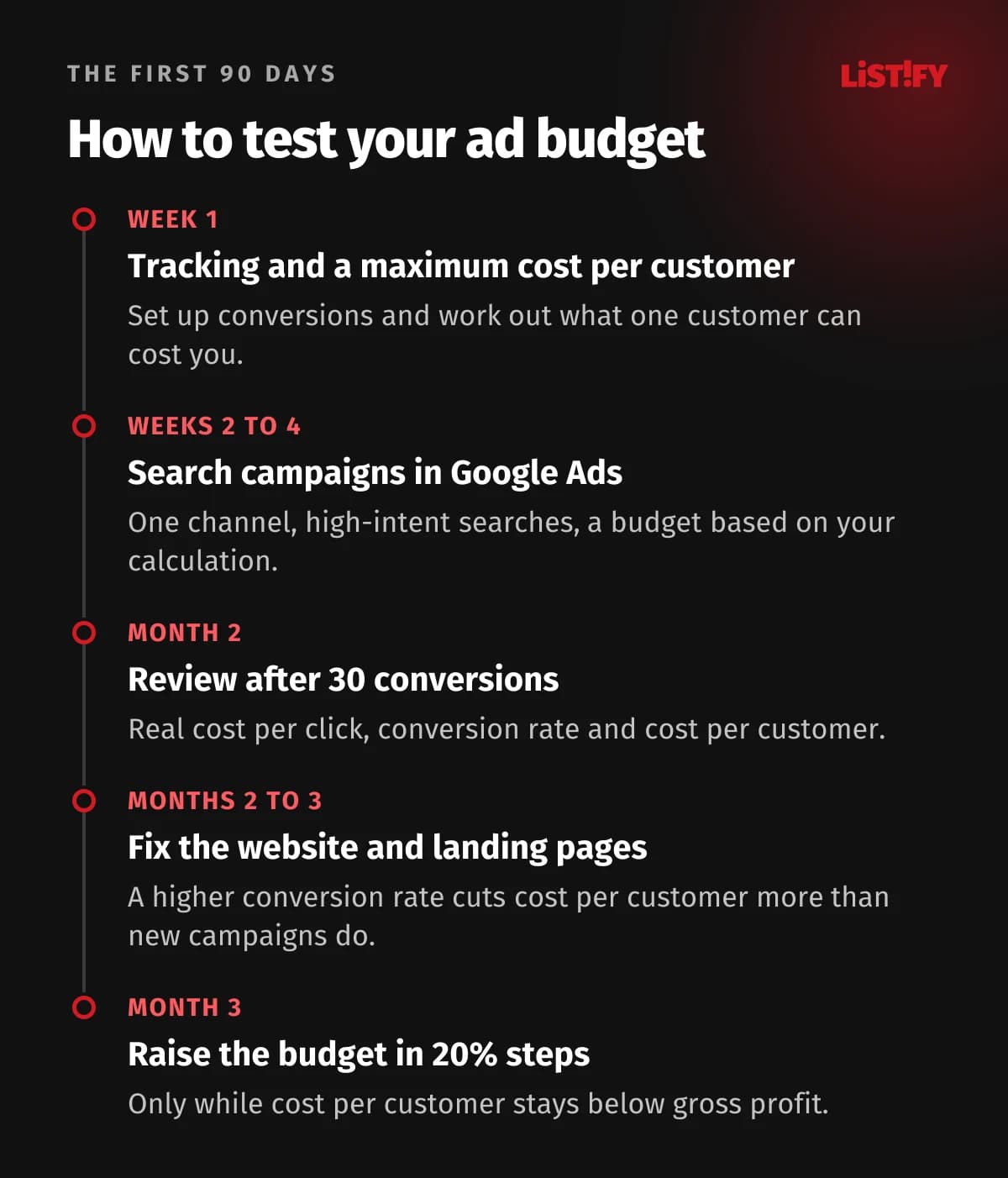
After three months, you have your own numbers instead of estimates: your real cost per click, your website's conversion rate and how many leads turn into sales. Only then does it make sense to plan a budget for the full year.
09Spend more or spend less?
Budgets often change on gut feeling. Before you add or cut money, ask yourself four questions.
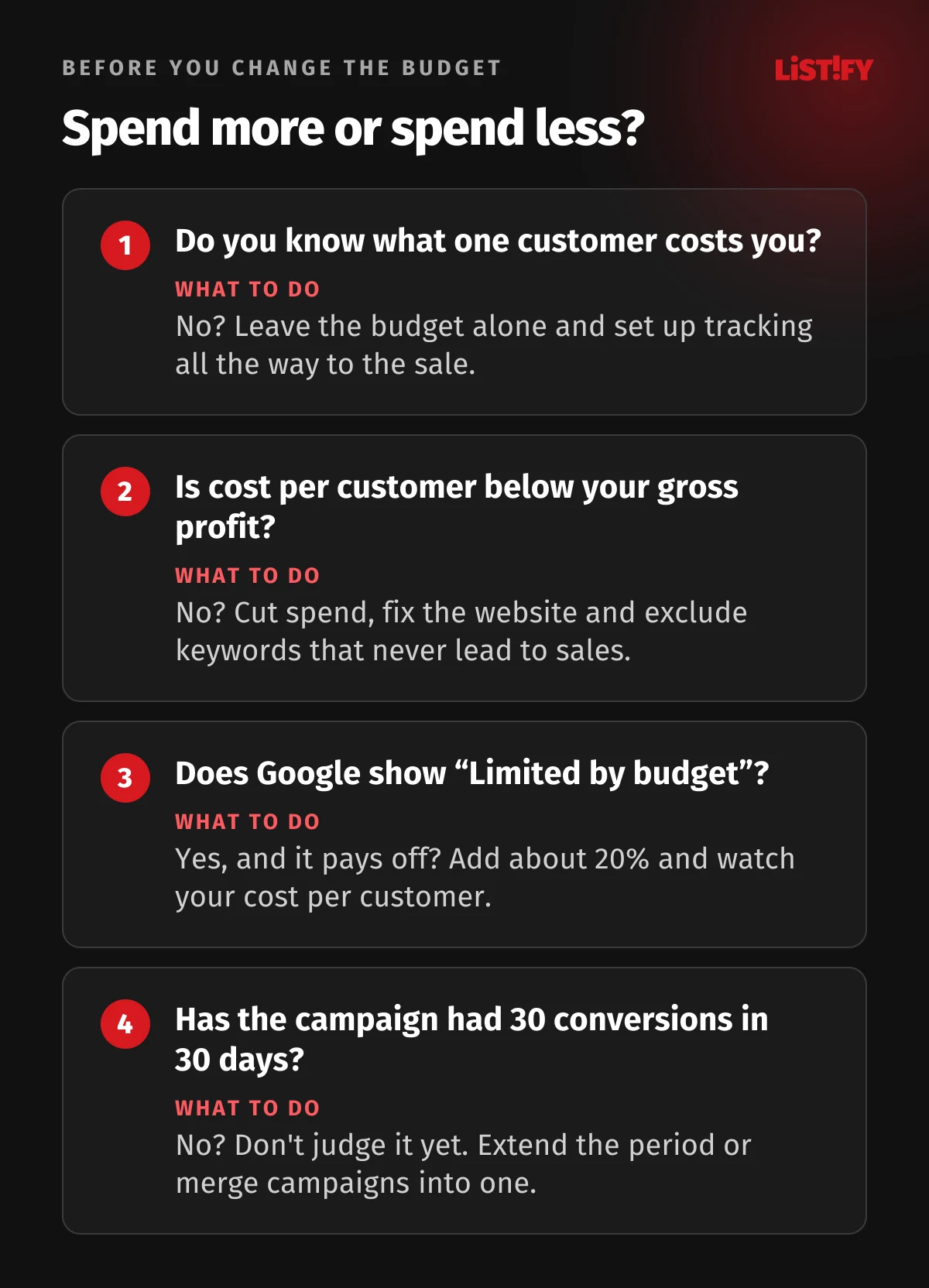
For campaigns marked “Limited by budget”, Google suggests trying a modest increase, for example 20% (Google Ads). Small steps have an advantage: you can see whether a higher budget pushes up your cost per customer faster than your revenue.
10Frequently asked questions
What percentage of revenue should I spend on marketing?
US companies spend an average of 8.96% of revenue on marketing, with a median of 5% (The CMO Survey 2026). It varies widely, from about 7% for B2B product companies to 12% for B2C product companies. Use the percentage as a check and base your main calculation on cost per customer and margin.
What is the minimum budget for Google Ads?
Google's help pages set no fixed minimum. For automated bidding to learn, though, a campaign needs roughly 30 conversions in 30 days, so your budget should cover at least 30 leads or orders a month. At $100 per lead, that's $3,000 a month.
How much should I spend on Google Ads per month?
Multiply the number of customers you want by what one customer costs you, which is your cost per click divided by your conversion rate and your lead-to-sale rate. Example: $5 per click, 5% of visitors inquire and 1 in 5 inquiries buys, so a customer costs $500 and 8 customers a month cost $4,000. Google may spend up to twice your daily budget on a single day, but no more than 30.4 times it in a month.
How much do Facebook and Instagram ads cost?
Meta has no fixed price list; prices are set by auction. LocaliQ's average cost per lead for Meta lead campaigns is $27.39. What matters most is that each ad set gets about 50 results a week; otherwise it stays in the learning phase.
Do I pay VAT on Google Ads in the EU?
Google doesn't charge VAT to business accounts in the EU. You account for it yourself under the reverse charge rule. A VAT-registered business usually reclaims it; a business that can't reclaim VAT pays it on top of the ad spend.
How long before I know if ads are paying off?
For search ads, usually 1 to 3 months. Google recommends evaluating performance over 30 days in which the campaign collected at least 30 conversions. If you have fewer, extend the period rather than judging the campaign early.
11Bottom line: work out your budget
How much should you spend on online marketing for it to make sense? Enough that a new customer costs less than the profit they bring, and enough for each campaign to gather the data it needs to learn. Percentage of revenue tells you whether you are wildly off. Your cost per click, conversion rate and margin tell you what to actually spend.
Start with one channel, track which clicks turn into sales and increase spending in small steps. If you want help working out the numbers, see how we approach online marketing.
12Sources
- The CMO Survey 2026, Topline Report and Firm and Industry Breakout Report
- The CMO Survey 2026, Highlights and Insights
- Marketing Dive: Gartner CMO Spend Survey 2026
- WPP Media: This Year Next Year, Midyear 2026
- dentsu: Ad spend forecast, May 2026
- IAB Europe: AdEx Benchmark 2025
- Eurostat, isoc_cismt
- LocaliQ: search advertising benchmarks and Facebook advertising benchmarks
- Google Ads Help: budgets, budget recommendations, target CPA, Performance Max, VAT in the EU
- Meta: learning phase and minimum budgets
- B2B Institute, LinkedIn: The 5 Principles of Growth in B2B Marketing
- Archived SBA blog post, 2012 and SBA, 2019