How to Generate B2B Leads Effectively with Paid Ads and SEO
Most business buyers have a favourite supplier before they ever get in touch. They do most of the research on their own, and by the time they send an enquiry, they often know who they want. If you are not visible in search at that moment, you are not on the list. Here is how to combine paid ads and SEO so they bring in leads that turn into deals, not just clicks.
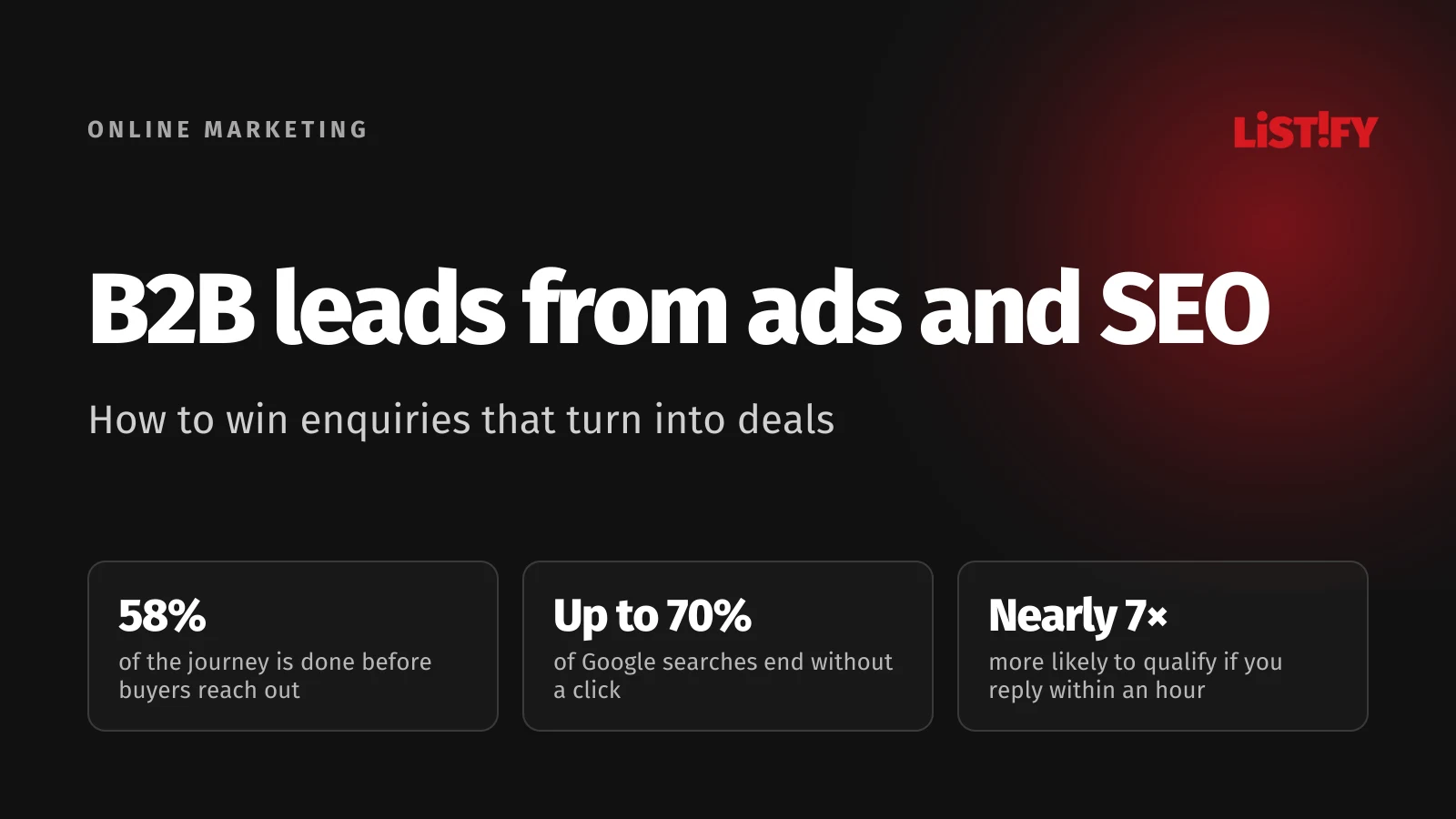
The short answer: a B2B lead is a contact at a business that has shown interest in what you sell. A reliable way to generate them is a mix of search ads (mainly Google Ads) and SEO, with LinkedIn Ads when you need to reach specific industries or job titles. Ads bring in leads from week one and reveal which searches convert. SEO turns those searches into a steady, cheaper source over time. Neither works well unless you track which leads turn into deals and reply quickly.
This guide is for owners, sales directors and marketers at companies that sell to other businesses. Figures are correct as of September 2026. Each one links to its source, and all sources are listed at the end.
01What a B2B lead is and how to sort leads
A lead is someone who has shown interest in your offer: filled in a form, downloaded a price list, called you or signed up for a webinar. In B2B, though, a lead almost never means one person has said yes. Every purchase involves a whole group of people. According to Forrester’s 2026 report, a typical buying decision involves 13 internal stakeholders and nine external influencers, and procurement is among the decision-makers in 53% of buying cycles.
That is why leads are usually grouped by how close they are to buying:
- Marketing qualified lead (MQL): has shown interest, but you don’t yet know about budget or authority. For example, they downloaded a guide or joined your newsletter.
- Sales qualified lead (SQL): a salesperson has spoken to them and confirmed a real need, a budget and a timeline.
- Opportunity: you are preparing a proposal and negotiating on price.
Don’t go looking for a standard conversion rate between these stages. Every company defines them differently, which is why published averages vary so widely. What matters is setting your own definitions and measuring them consistently over time.
02How businesses buy today
In 2025, 6sense surveyed 945 buyers in five European countries about how they chose suppliers. Its European analysis found that buyers typically made first contact with a supplier only when they were 58% of the way through the buying journey. The winning supplier was on the shortlist from day one 92% of the time, and in roughly three out of four cases the buyer chose the favourite they had picked before speaking to anyone in sales.
- Winner on the list from day one92%
- Favourite picked early won75%
- Share of journey before contact58%
Source: 6sense, European section of the Buyer Experience Report 2025 (12 Nov 2025), 945 responses from five countries. Values are rounded (92.4%, roughly 75%, 58.3%). The first two rows are shares of purchases; the third shows how much of the buying journey was already done.
Buyers aren’t keen on salespeople either. A Gartner survey of 646 buyers, reported by Digital Commerce 360 in March 2026, found that 67% would prefer to complete a purchase without dealing with a sales rep.
For marketing, that means the race is often decided before the enquiry arrives. When buyers look up how to solve a problem, what it costs and who can do it, they need to find you. That is exactly where search, both paid and organic, comes in.
03Where to reach business buyers
Search is still central to B2B research, but fewer searches end on a website. In June 2026, SparkToro and Similarweb published clickstream data showing that between 62% and 70% of Google searches in six countries ended without a click to any site. Germany was lowest, the UK highest.
- United Kingdom69.5%
- United States68.0%
- France65.3%
- Canada63.8%
- Italy63.4%
- Germany62.1%
Source: SparkToro (16 Jun 2026), Similarweb mobile and desktop clickstream panel. A zero-click search is followed by another search or by the end of the session, with no click on any result.
Most businesses still don’t pay for online advertising. According to Eurostat, only 33% of EU businesses with 10 or more employees paid for online advertising in 2024, ranging from 23% in Romania to 60% in Malta. A quarter (26%) paid for search or other contextual ads. No newer figure exists yet, as the 2025 survey did not ask about advertising.
- Malta (highest reported)60.4%
- Slovakia34.3%
- EU average32.6%
- Czechia29.3%
- Romania (lowest reported)22.8%
Source: Eurostat, dataset isoc_cismt, indicator E_ADS, businesses with 10 or more employees. The EU average is Eurostat’s own aggregate; 19 member states reported data for 2024.
The third key channel is LinkedIn. Its reach is smaller than that of search, and people aren’t actively looking for suppliers there, but it lets you target by industry, company size and job title in a way search ads can’t.
04Paid ads: leads from week one
Search ads, also known as pay-per-click (PPC) ads, are the fastest source of B2B leads because they reach people at the moment they are looking for a solution. Each channel suits a different job:
| Channel | Best for | Minimum budget | Weak spot |
|---|---|---|---|
| Google Ads | Capturing active search demand in most markets | No fixed minimum; daily spend can reach twice your average daily budget | Cost per click climbs fast in competitive industries |
| LinkedIn Ads | Targeting specific industries, company sizes and job titles | $10 a day (about €8.80 / 214 CZK); $100 minimum lifetime budget for new campaigns | Higher cost per lead; people aren’t actively searching |
| SEO | A long-term source with no cost per click | Time and work on your site and content | First results usually take months |
Target buying intent, not your industry
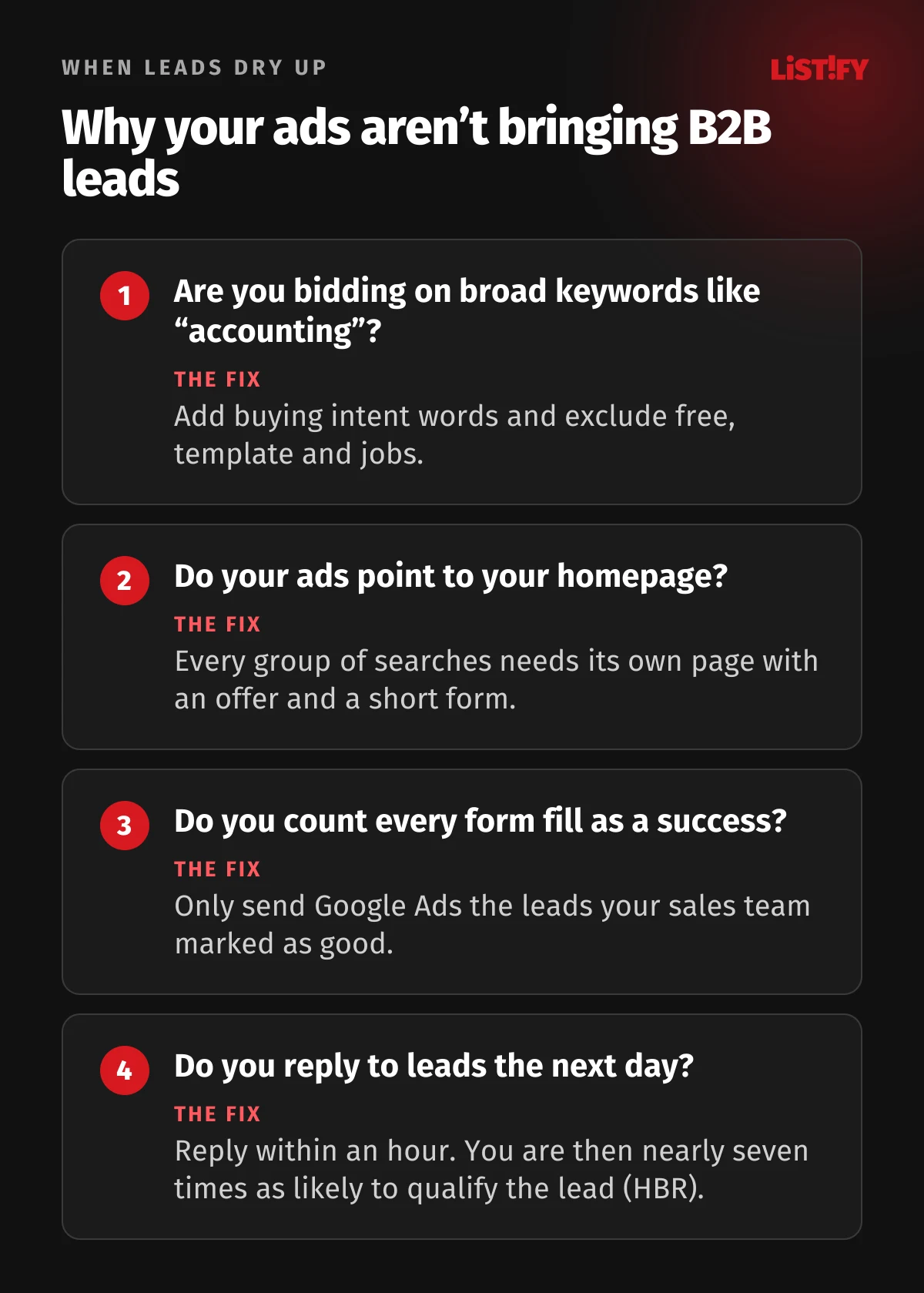
One of the most common mistakes in B2B campaigns is bidding on broad keywords. A search for “accounting” brings clicks from students, freelancers and people after an invoice template. A search for “outsourced accounting for manufacturing companies pricing” comes from someone genuinely looking for a supplier. Add qualifiers such as “pricing”, “supplier”, “quote”, “for manufacturers” or “for e-commerce”, and build a list of negative keywords: “free”, “template”, “how to”, “jobs”, “career”, “DIY”, “course”.
Give every group of searches its own page
Sending ads to your homepage wastes money. Someone who searched for “compressor servicing Manchester” should land on a page about compressor servicing in Manchester, with a price or at least a price range, case studies or testimonials from their industry and a short form. Name, company, contact details and one question are enough; your salesperson can ask the rest on the phone.
What a lead costs
There’s no single European benchmark for the cost of a B2B lead. To give you an idea: LocaliQ, whose 2026 benchmarks draw on thousands of its clients’ Google Ads and Microsoft Ads campaigns, puts the average cost per lead from search ads at $93.69 (about €82 / 2,000 CZK) for business services and $75.19 (about €66 / 1,600 CZK) for industrial and commercial companies. Costs vary a lot by industry, competition and website quality. Only your own campaign will give you a reliable number, so treat the first month as a measurement exercise.
05SEO: a slower start, cheaper leads
SEO means optimising your site for organic, unpaid search results. You don’t pay per click, but you pay in time. An Ahrefs study found that only 1.74% of a million random pages it first found in September 2023 reached the top 10 within a year, or 6.11% when counting only new, non-empty English pages. Yet of the pages that did make the top 10, 40.82% got there within a month. The right topic and a strong page can rank quickly, but most pages don’t reach the top 10 within a year.
Search itself is changing, too. Google now answers some queries with an AI summary (AI Overviews). The US Pew Research Center tracked the real browsing of 900 adults and found that when a summary appeared, they clicked a regular result on only 8% of visits, compared with 15% when there was none.
- No AI summary15%
- With an AI summary8%
- Link inside the summary1%
Source: Pew Research Center, 22 Jul 2025, 900 US adults, 68,879 searches in March 2025. Share of visits to Google results pages that included a click.
The same study found that summaries appeared on 60% of searches starting with words like who, what, when or why, but on only 8% of one- or two-word searches. So generic how-tos and definitions take the biggest hit. For short searches like “ERP supplier” or “compressor servicing”, Google shows a summary far less often. For B2B, that makes the following pages the backbone of your SEO:
- A page for each service and industry, such as “CRM for manufacturers” rather than a single “Our services” page.
- Pricing, or at least a price range. Buyers compare suppliers on price too. If they can’t find yours, they have to ask, and that’s a step they may skip.
- Case studies with a concrete result and the client’s industry.
- Comparisons and buying guides: what to consider, what things cost, what the options are. Buyers find these while they are putting their shortlist together.
- Technical basics: a fast site, clear headings, good meta descriptions and internal links between related pages.
06How to combine paid ads and SEO in one plan
Choosing between PPC and SEO misses the point. They work best together: within a few weeks, ads show which searches bring leads, and SEO can then build content around exactly those searches. Your first year might look like this:
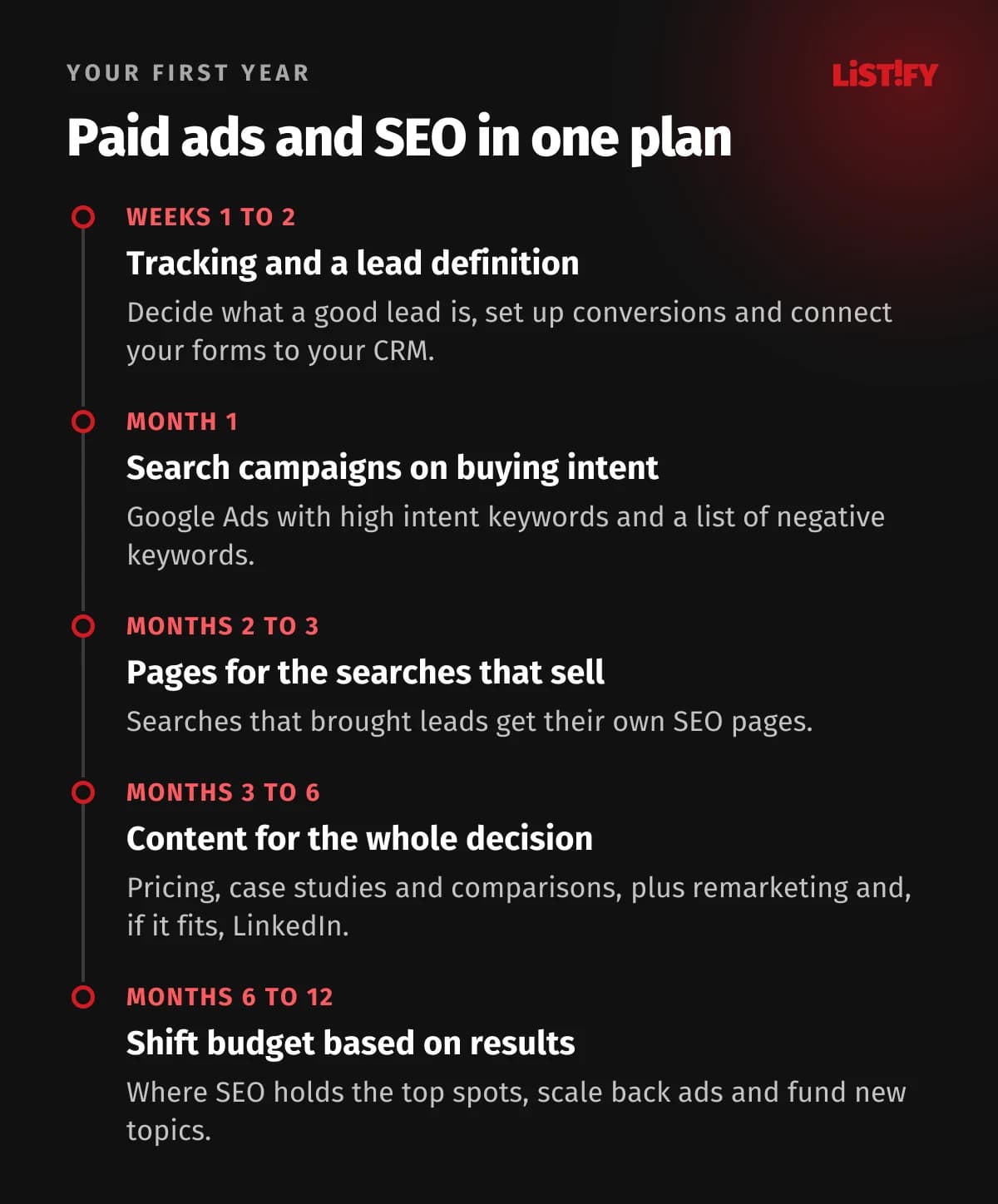
The last step matters most. Once a page ranks at the top of the organic results, you can scale back ads on the same search and move the money to new topics. Don’t switch them off blindly, though. For important searches it can pay to appear in both the ads and the organic results. Try pausing the ads for a few weeks and check whether lead numbers drop.
Don’t forget people who aren’t buying yet. According to LinkedIn’s B2B Institute, only about 5% of potential buyers are ready to buy at any given time; the other 95% will buy later. It’s an estimate based on how often businesses switch suppliers, not a measured share. Remarketing, a newsletter and useful content keep your name front of mind until they are ready to buy. For how to turn social media into a place people keep coming back to, see a social media strategy that builds a real community.
07From click to deal: speed and tracking
The best campaign won’t help if a lead sits in an inbox for three days. A study published in Harvard Business Review looked at 1.25 million leads at 42 US companies. Firms that tried to contact a lead within an hour were nearly seven times as likely to qualify it, meaning to have a real conversation with a decision-maker, as those that tried even an hour later. The authors also audited 2,241 US companies, and 23% never replied to a web enquiry at all.
The data is from 2011 and from the US, so treat the exact multiple as a rough guide. Set a few simple rules:
- Every lead goes straight into your CRM and a salesperson gets notified.
- During working hours, reply within an hour, and by the end of the day at the latest.
- Have sales mark each lead as good or poor and record how it ended.
- Feed those results back into your ad platforms. Google Ads lets you do this with offline conversion imports, so campaigns learn to find people who become customers, not just people who fill in forms.
If you track leads in a spreadsheet, sooner or later some will slip through. For signs it’s time to move to a proper system, see when your business has outgrown Excel.
What to measure
- Cost per lead: what one completed form or call costs you.
- Cost per qualified lead: the same figure, counting only leads that sales accepted.
- Lead-to-deal rate: the share of leads that become deals, for each channel separately.
- Cost per won deal and return on spend: what you put into a channel and how much revenue came out of it.
A channel with pricier leads can still be the most profitable if those leads close more often or bring bigger deals. That’s why campaigns should be judged mainly on the last two numbers.
08FAQ
What is a B2B lead?
A business, or a person at a business, that has shown interest in your offer, for example by filling in an enquiry form, calling you or downloading a price list. A lead becomes a sales qualified lead (SQL) once a salesperson has confirmed the need, budget and timeline.
Is PPC or SEO better for B2B?
They work best together. PPC brings leads from week one and shows which searches sell. SEO then builds pages around those searches, which bring in leads without a cost per click. Early on, it makes sense to put more budget into ads and shift it towards SEO as organic traffic grows.
How much does a B2B lead from ads cost?
It depends on the industry, the competition and your website. There’s no single European benchmark; LocaliQ’s search advertising benchmarks put the average for business services at $93.69, about €82. Your first campaign will give you the real figure for your market.
How long does SEO take to bring in leads?
Usually several months. According to Ahrefs, 40.82% of pages that reached the top 10 got there within a month, but most new pages don’t get there within a year. Topic choice, content quality and technical health decide the outcome.
Are LinkedIn Ads worth it for B2B?
They are when you need to reach specific industries or roles, such as heads of production at companies with more than 50 employees. Leads tend to cost more than those from search, and the minimum daily budget is $10. They work best alongside search, not instead of it.
Do AI summaries in Google mean SEO is dead?
No, but its focus is shifting. Pew found that summaries appear far more often on question-style searches, while short searches such as “ERP supplier” rarely trigger one. Service pages, pricing and case studies are therefore likely to be hit less than generic how-to articles.
09The bottom line: the supplier buyers find first usually wins
B2B buyers make most of the decision on their own and reach out with a favourite in mind. Paid ads put you in front of them straight away; SEO keeps you there for longer and at lower cost. What turns that visibility into deals is what happens after the click: a page that answers their question, a fast reply from sales and tracking all the way to the deal.
Wondering what campaigns would cost in your industry? Take a look at our online marketing services, pricing or how we work.
10Sources
- 6sense: How European B2B buying journeys differ (Buyer Experience Report 2025)
- Forrester: The State of Business Buying 2026
- Digital Commerce 360: Gartner finds 67% of B2B buyers prefer a rep-free experience
- SparkToro: zero-click searches in the UK, US, Germany, France, Italy and Canada
- Eurostat: social media and internet advertising, dataset isoc_cismt
- Google Ads Help: manage your spend
- Google Ads Help: negative keywords
- Google Ads Help: offline conversion imports
- LinkedIn: minimum campaign budgets
- LinkedIn B2B Institute: the 95:5 rule
- LocaliQ: Search Advertising Benchmarks 2026
- Ahrefs: how long it takes to rank in Google
- Pew Research Center: AI summaries and link clicks
- Harvard Business Review: The Short Life of Online Sales Leads
- ECB: euro reference exchange rate against the US dollar
- Czech National Bank: exchange rates