Custom Tire Shop Software: 30 Reasons to Build Your Own Before the Next Rush (and When Not To)
All it takes is the first frosty morning, and the phone at the front desk never stops ringing. The appointment book is a mess of cross-outs, Mr. Miller’s winter set is somewhere on a back rack, and a seasonal hire is copying a tire size off the wrong wheel for the second time. We put together 30 reasons tire shops have their own software built, grouped them into four areas and, wherever we could, backed them up with laws, industry data and real price lists. At the end you’ll also find five situations where you shouldn’t spend money on custom development.
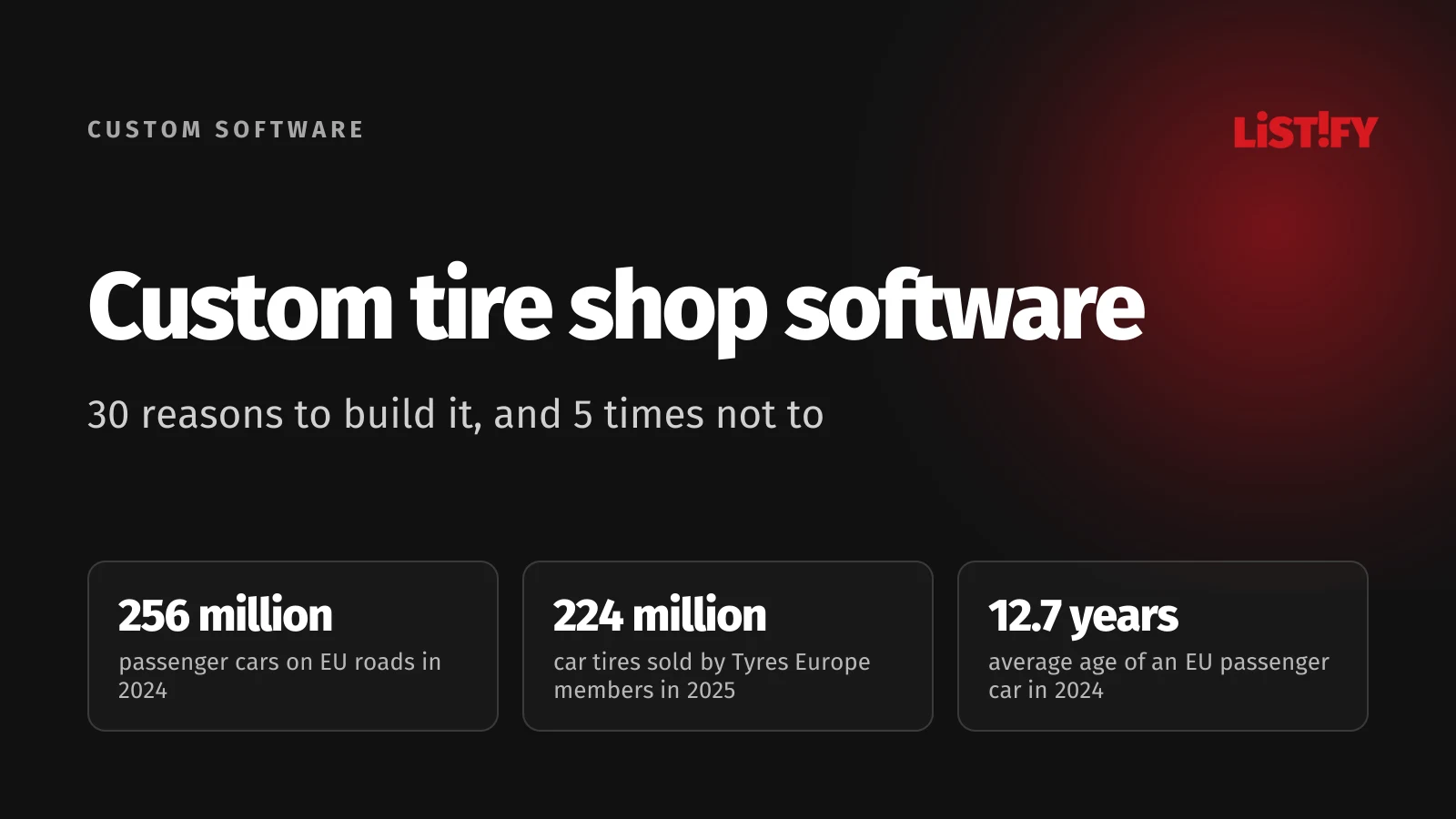
There are a lot of cars out there, and they’re getting older. According to ACEA, the EU had 256 million passenger cars on the road in 2024, with an average age of 12.7 years. In the US, S&P Global Mobility put the average light vehicle at 12.8 years in 2025. Every one of them needs tires, and in much of Europe and Canada, drivers swap them twice a year.
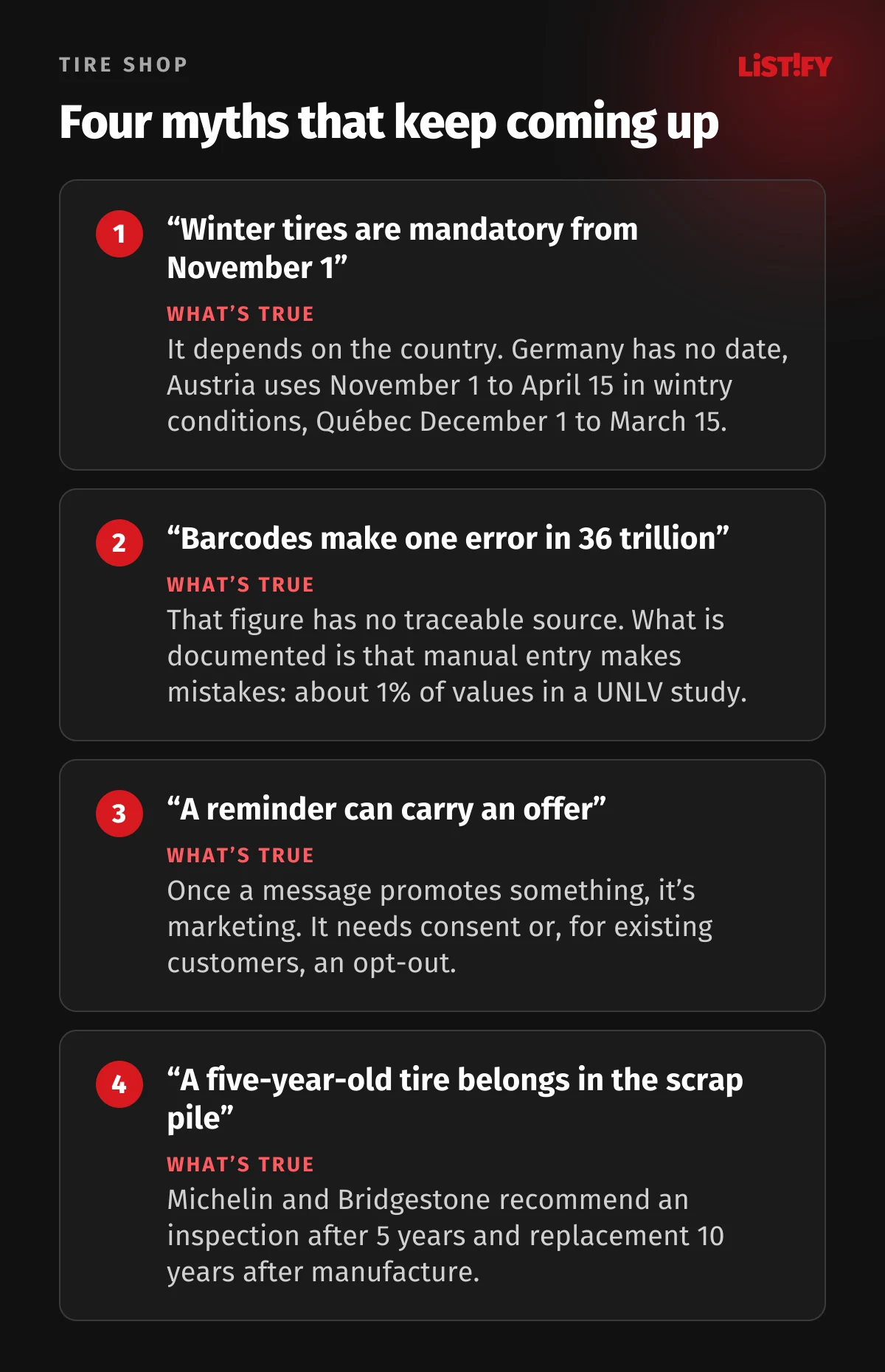
When they do it depends on the weather and on local law, and the rules are anything but uniform. Germany has no fixed date at all: winter tires are required only in wintry conditions, and the popular “October to Easter” rule is, in the words of ADAC, just a rough guide with no legal weight. Austria applies its rule from November 1 to April 15, but for passenger cars only in wintry conditions. Sweden requires winter tires from December 1 to March 31 when roads are wintry, and Québec makes them mandatory for every registered passenger vehicle from December 1 to March 15. Drivers put the swap off until the last minute, then everyone wants an appointment the same week.
- Austria9.2
- Germany10.6
- United Kingdom10.8
- France11.5
- EU average12.7
- Italy13.0
- Spain14.5
- Poland15.2
- Czechia16.5
- Greece17.8
Source: ACEA, Vehicles on European roads, January 2026. The EU average excludes Bulgaria, for which ACEA has no data.
If you’re still running the shop on paper, spreadsheets and a generic program that makes you click through five screens to open one job, that’s where you lose time when you have the least of it. Custom software means a system built around how your shop actually works: how many lifts you have, how your tire storage is organized, who’s at the front desk and what a technician needs at the car. You own the code and the data. We covered the same idea for sales teams in 50 Reasons to Build a Custom CRM. This time, we’re going straight into the bay.
01The short answer: when custom software pays off for a tire shop
- You store hundreds of tire sets. Without tracking locations, tread depth and photos, sets get lost, mixed up and disputed.
- The phone can’t keep up during the rush. Your front desk answers calls instead of serving customers, and bookings overlap.
- You have several lifts, techs or locations. Planning capacity in your head stops working the moment one job runs long.
- You copy data between programs. From the work order to the invoice, from the invoice to the accounting system, from the distributor’s price list to the quote.
- You want customers to come back for the service. Online booking, reminders and vehicle history are things customers notice right away.
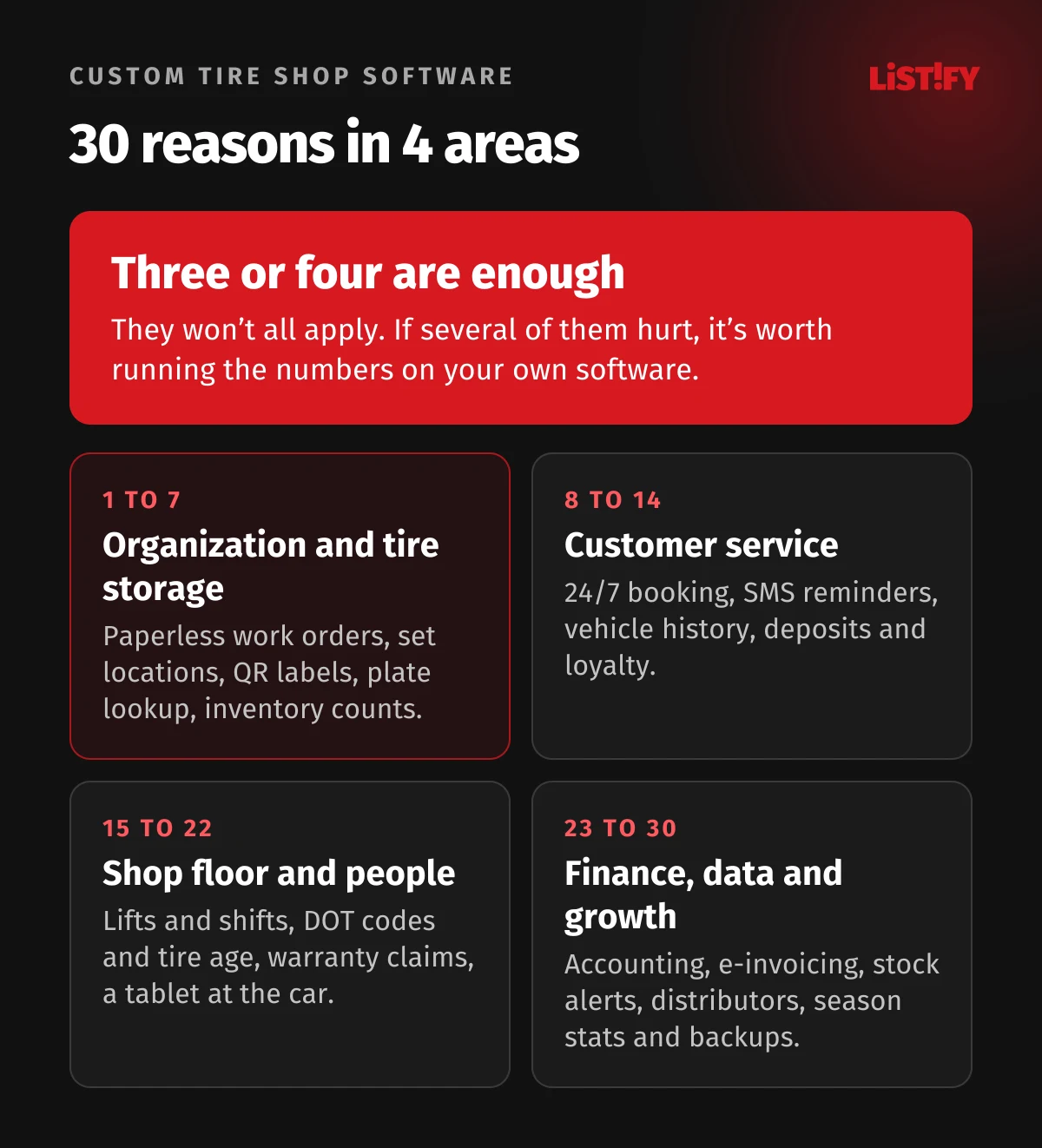
02Organization and tire storage: reasons 1 to 7
1. No more crossed-out notebooks or lost work orders. Every car gets a work order the moment it’s booked. The front desk sees what needs doing, the tech has it on a tablet at the lift, and once the job is done, it moves to billing on its own. Nothing gets copied off paper, and nothing disappears into a coverall pocket.
2. A live view of every tire and wheel in stock. New tires for sale, customers’ stored sets, wheels and leftovers from last season. Each item with its size, load and speed rating, brand, DOT code and exact rack location. When a customer calls to ask whether you have their size, you know in seconds without heading to the warehouse.
3. Tire storage in one click. Seasonal tire storage, often called a tire hotel in Europe, is steady income for many shops. In Czechia and Slovakia, for example, public price lists we checked range from roughly €25 to €85 per set per season, including VAT. With hundreds of sets, though, comes responsibility. The software records who owns each set, where it sits, what condition it arrived in (tread depth on every wheel, photos of any damage) and when the customer is due to pick it up. A dispute like “that tire was fine when I dropped it off” gets settled by a dated photo.
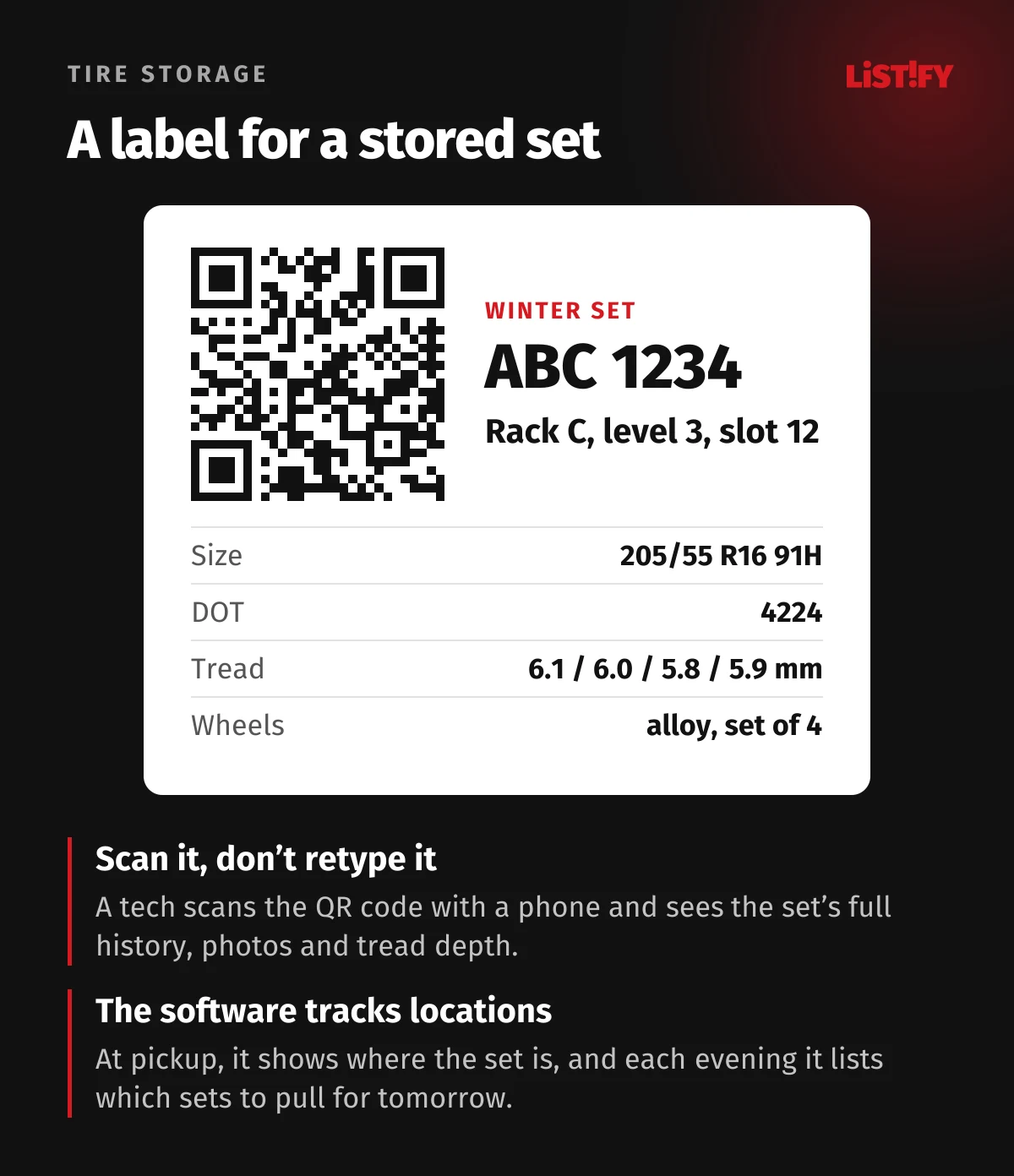
4. QR labels print themselves. When a set comes in, the software prints a label on a standard label printer: license plate, rack location, size, DOT and a QR code. A tech scans it with a phone or a scanner and sees the set’s full history. No more writing on tires with a marker.
5. Find customers by plate, name or phone number. A customer walks in and just says, “I’m here for my tire swap.” The front desk types in the plate and sees their cars, stored sets, last visit and what the tech recommended last time. If they show up in a different car, a phone number does the job.
6. Inventory counts with a scanner instead of a spreadsheet. When every rack slot has its own code and every set its own label, an inventory count is a walk with a scanner. The software compares what should be on the rack with what’s actually there and lists the differences. How much time it saves depends on the size of your storage, but no more adding things up by hand in a spreadsheet.
7. Receive new stock with a barcode scanner. Tires from your distributor come with barcodes, so all you need to do at receiving is scan them. Manual entry produces errors even with careful people: in a study at the University of Nevada, Las Vegas (UNLV) with 215 undergraduates, roughly 1% of values ended up wrong after single data entry. The often-quoted claim that barcodes make “one error in 36 trillion” has no traceable source, though, so don’t take it at face value.
03Customer service: reasons 8 to 14
8. Online booking around the clock, even on Sunday night. Customers pick a service on your website (tire swap, swap with storage, new tire installation). The software knows how long each job takes and how much lift capacity is free, and only offers slots you can actually deliver. Your front desk stops being a call center, and customers notice when they get a text, a time slot and a photo without chasing you for them.
9. SMS reminders that send themselves. The day before the appointment, the customer gets a text with the time and address, and another one when the car is ready. Text messages are cheap: Slovak gateway SMSGATE.sk, for example, charges €0.0275 per message before VAT. Just keep operational messages and marketing apart, as the examples below show.
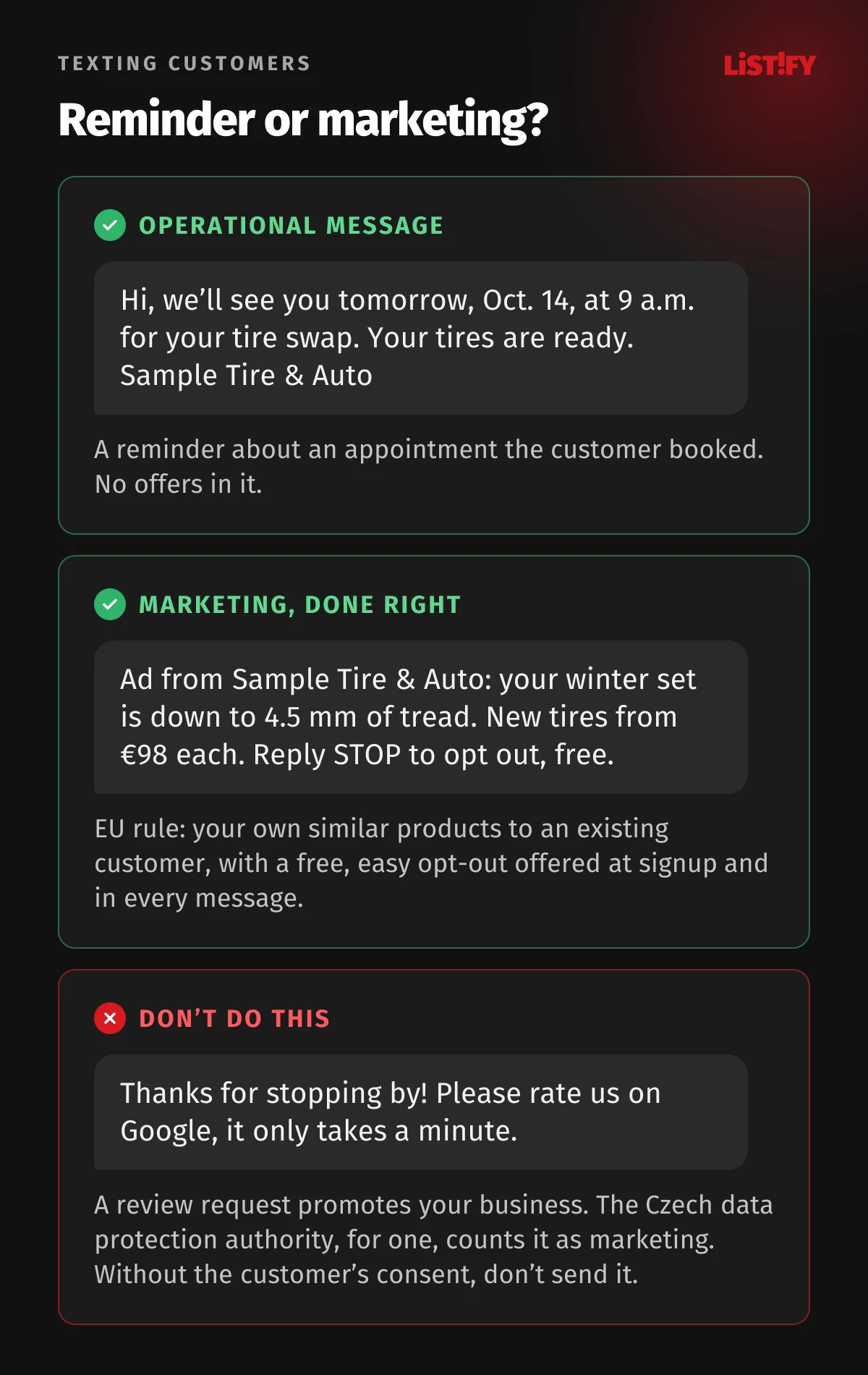
In the EU, Article 13 of the ePrivacy Directive allows direct marketing by electronic mail, which the directive itself says includes text messages, only with prior consent. There’s one exception: you can market your own similar products or services to customers whose contact details you got when you sold them something, as long as they can object free of charge and easily, both when you collect the details and in every message. Countries add their own rules on top. In Slovakia, for instance, that exception lasts only one year after the contract ends, and in Czechia, an SMS opt-out has to include a phone number, not just a link. A reminder about an appointment the customer already booked isn’t marketing. Good software keeps these message types separate and won’t send an offer to someone who has opted out.
10. Shorter waits and faster check-in. The evening before a busy day, the software lists which sets need to come out of storage and in what order. By morning, they’re waiting by the lift. At the counter, the customer confirms their plate and heads off for a coffee.
11. Full history for every customer and vehicle. Repairs, purchases, storage, tread depth measured each season, warranty claims, photos. When a customer says, “Last time you told me the front tires would last another year,” it’s right there in writing, along with the tech’s name.
12. Online payments and deposits for ordered tires. If you’re ordering an unusual size for one customer, it makes sense to take payment up front. The software sends a card payment link through your payment gateway and matches the deposit to the job. Check your local rules on real-time sales reporting, too. Czechia, for example, brings back electronic sales registration (EET) on January 1, 2027, covering cash, card and on-site QR payments.
13. Alerts when a customer’s tread is wearing down. Every time a set goes into storage, the software saves its tread depth. Directive 89/459/EEC set the EU minimum for cars and light vans at 1.6 mm, and Sweden requires at least 3 mm of tread when roads are wintry between December 1 and March 31. When a set gets close to the limit, the software lets the customer know early that they’ll need new tires next season. That message is an offer, though, so the marketing rules above apply.
14. Loyalty programs for regular drivers. Some shops already give their storage customers a cheaper swap. The software applies the discount automatically based on history, handles company rates for fleets and can offer, say, every fifth tire swap free, without anyone at the front desk having to keep count.
04The shop floor and people: reasons 15 to 22
15. An interface a seasonal hire can learn in minutes. Every season brings in people who’ve never seen your system. Custom software shows them only what they need: big buttons, tire sizes picked from a list instead of typed, and none of the fields your shop never uses. Training can then focus on the work on the car.
16. Scheduling for shifts, lifts and techs. The software knows how many lifts you have, who’s working when, and how long each type of swap takes. Bookings don’t overflow, and when a job runs long, the front desk sees right away which car to move. It can also track hours worked by each seasonal employee, which helps if contracts or local rules cap their hours.
17. Insight into output and hours worked. How many cars a day, how long a swap with balancing takes, where the bottlenecks are. The point isn’t to watch people. You need the numbers to plan: how many seasonal hires to bring on next October and how many slots to open per hour.
18. Fewer mistakes in tire sizes and DOT codes. Sizes come from a list, and DOT codes are checked as they’re entered. The date of manufacture is the last four digits: the week and the year. One catch: under 49 CFR 574.5, week 01 is the first full calendar week running Sunday to Saturday, so it doesn’t always match the ISO week numbers used in most of Europe. The software works out the tire’s age from the DOT code, so nobody has to do the math in their head.
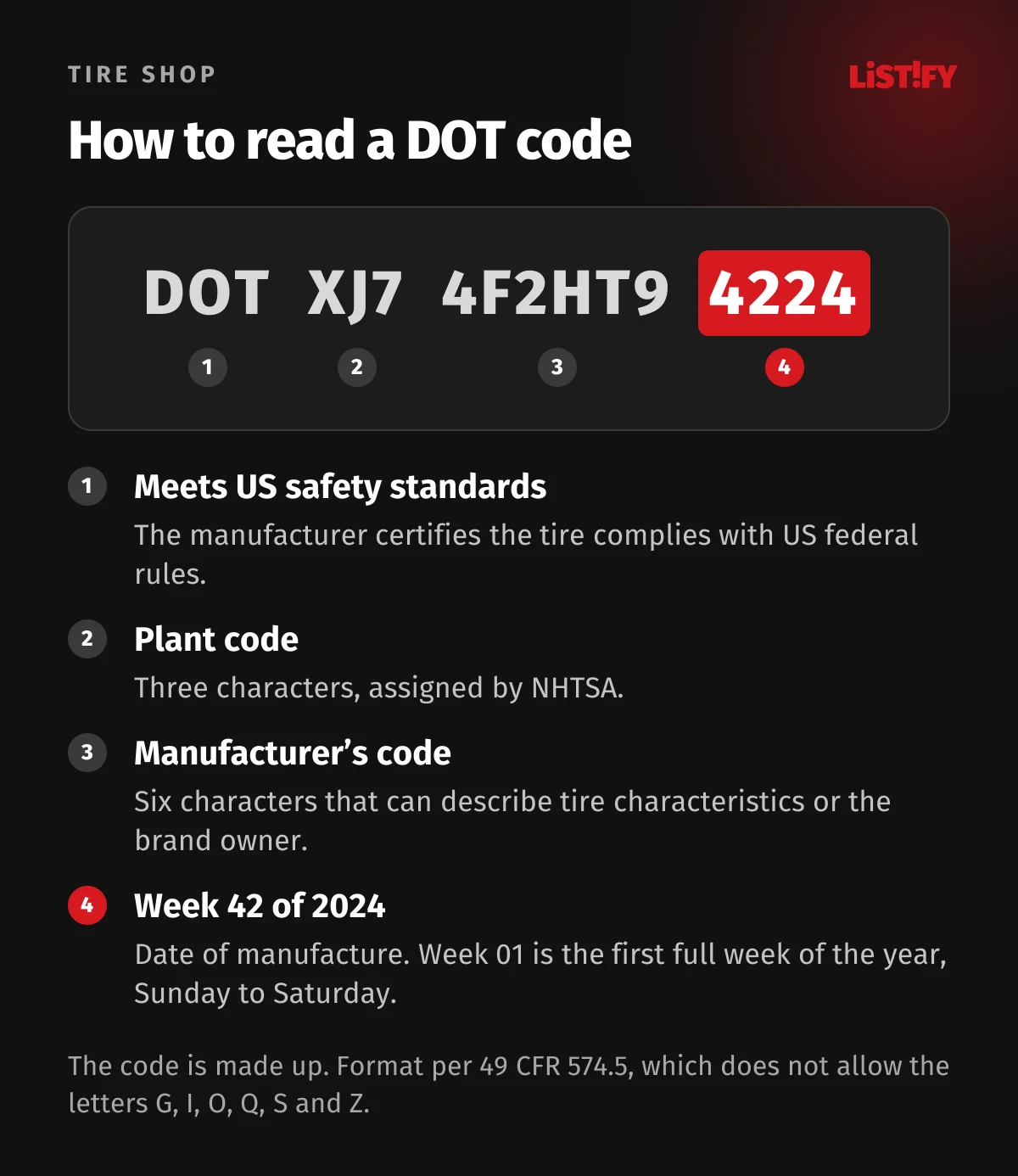
19. Keeping an eye on tire age. Laws typically regulate tread depth, not tire age. Even NHTSA in the US sets no age limit of its own and only notes that some manufacturers recommend replacement at six to 10 years. Manufacturers’ advice varies, as the table shows. The software displays each set’s age from its DOT code, so the tech and the customer don’t have to argue over a guess.
| Manufacturer | Inspection | Replacement |
|---|---|---|
| Michelin | at least once a year by a professional after 5 years of service | 10 years from manufacture, spare included |
| Bridgestone | essential after 5 years | 10 years from manufacture, spare included |
| Continental | at least once a month (routine check) | 10 years from manufacture |
| Goodyear US | not stated on the page cited | 6 years in service |
20. Warranty claims in one place. A photo of the damage, the DOT code, size, mounting date, who mounted the tire and what it sold for. Claims don’t get handled through three emails and a binder, and the software keeps track of deadlines. Photos help with repair approvals, too: according to a Cox Automotive study of 2,500 US service customers, 49% say they’re more likely to approve recommended work when they see photos or video.
21. Access from anywhere. The front desk works on a computer, techs use a tablet at the lift, and the owner checks tomorrow’s bookings from a phone in the evening. A modern web app runs in the browser, needs no installation and works on whatever devices you already have.
22. The system adapts to your shop, not the other way around. Off-the-shelf software has one workflow for everyone. If your swaps start at a wheel washer, or you have a separate line for vans and SUVs, a packaged program either can’t handle it or you end up working around it with notes. Custom software has exactly the steps you take, and nothing extra.
05Finance, data and growth: reasons 23 to 30
23. A direct link to your accounting system, with no retyping invoices. The invoice is created from the finished work order and goes straight to your accounting software. Most popular accounting tools have an interface for this, from Xero’s Accounting API to the APIs of local systems in each country. How these connections work, and what to watch out for, is covered in our article on API integration.
24. E-invoicing mandates won’t catch you off guard. More and more EU countries require structured e-invoices between businesses. Belgium has required them since January 1, 2026, and Poland has been phasing in its KSeF system since February 2026. Germany has required businesses to accept them since 2025 and phases in issuing from 2027, and France has required all businesses to accept them since September 1, 2026, with small businesses issuing them from 2027. Slovakia follows on January 1, 2027. Under the ViDA directive, e-invoices become mandatory for cross-border trade within the EU from July 1, 2030. Sales to private customers are generally out of scope, but invoices to fleets and other businesses aren’t. Software that generates invoices in a structured format is ready for that.
25. You don’t pay for features you’ll never use. Packaged programs charge monthly per location or per user and come with modules for every kind of shop. Custom software has only what you use. Once development is paid for, you pay for hosting and maintenance, not a license for every new tech.
26. Alerts when popular sizes run low. The software tracks which sizes sell best during the season and warns you when stock drops below a limit you set. Your order to the distributor goes out on time, before a customer is left waiting at the counter.
27. Direct links to suppliers and distributors. If your distributor offers an API or a regular data export, the software can pull in prices and availability and build a customer quote without anyone retyping it. We check which of your distributors support this at the start of the project. If you sell new tires in the EU, remember that Regulation (EU) 2020/740 requires you to show the customer the tire label before the sale, even when the tire is in the back and they can’t see it.
28. Season stats for smarter buying. How many swaps happened in which week, which sizes ran out, how many customers switched to all-season tires. That last figure is worth watching. Tyres Europe reports that its members sold 224.1 million replacement tires for cars, SUVs and vans in Europe in 2025, 2% fewer than a year earlier. Summer tires fell 7% and winter tires 2%, while all-season tires grew 5%, and in the first half of 2026 they were up another 9%. A customer on all-season tires doesn’t need two swaps a year, so it pays to know how many you have and to give them another reason to come in.
- Q1 202558.7
- Q2 202550.6
- Q3 202558.9
- Q4 202554.8
- Q1 202658.1
- Q2 202652.0
Sell-in by Tyres Europe members (formerly ETRMA) to the replacement market, not the whole market and not the number of tire swaps. Q1 2026 is calculated from the first half of 2026 minus Q2. Figures for earlier quarters may be revised in later reports.
29. Data that stays safe even if the front desk computer dies. The software runs in the cloud and backs itself up automatically. The UK’s NCSC advises small organizations to back up all the data they need to operate, including invoicing and customer information, and to check that the backup actually restores. The EU agency ENISA recommends backups that are regular, automated, encrypted and kept separate from day-to-day systems. In the EU, a license plate linked to a name and phone number is personal data, so Article 32 of the GDPR on security applies as well. The Court of Justice of the European Union ruled in case C-319/22 that even a VIN is personal data when whoever holds it can link it to the owner. We go into more detail in Data Security in Custom Software.
30. Add modules step by step as you grow. You can start with online booking and tire storage, add inventory and distributor links a year later, then a loyalty program or a portal for fleet customers. All on the same data, so nothing has to be migrated or retyped when you add the next piece.
06Five situations where custom software isn’t worth it
- You have one lift and a few hundred customers. An off-the-shelf online calendar handles bookings, and a spreadsheet with photos covers storage. The development cost won’t pay for itself.
- Your current tire shop software fits. If nothing slows you down and you’re just paying for a license, there’s no reason to switch. Custom makes sense when the program forces you to bend how you work.
- You don’t want to change how you work. Software speeds up a good process. A chaotic one just becomes digital chaos. Without a front desk and techs willing to try a new way, it won’t work.
- You want to start in mid-October. Training your front desk on a new system while the phone rings every two minutes doesn’t work. Launch between seasons, when there’s time to train.
- You don’t have the budget for even a first module. Online booking with shop capacity and SMS reminders starts at €3,590 (CZK 90,000) before VAT with us. If that’s out of reach, start with an off-the-shelf tool and come back to it when the shop grows.
A simple calculation helps: how many hours a week your front desk spends on the phone, how many sets you hunt for each season, how many invoices you retype. Our article on how to calculate software ROI walks you through it.
07What it costs and how to start so the system is ready for the season
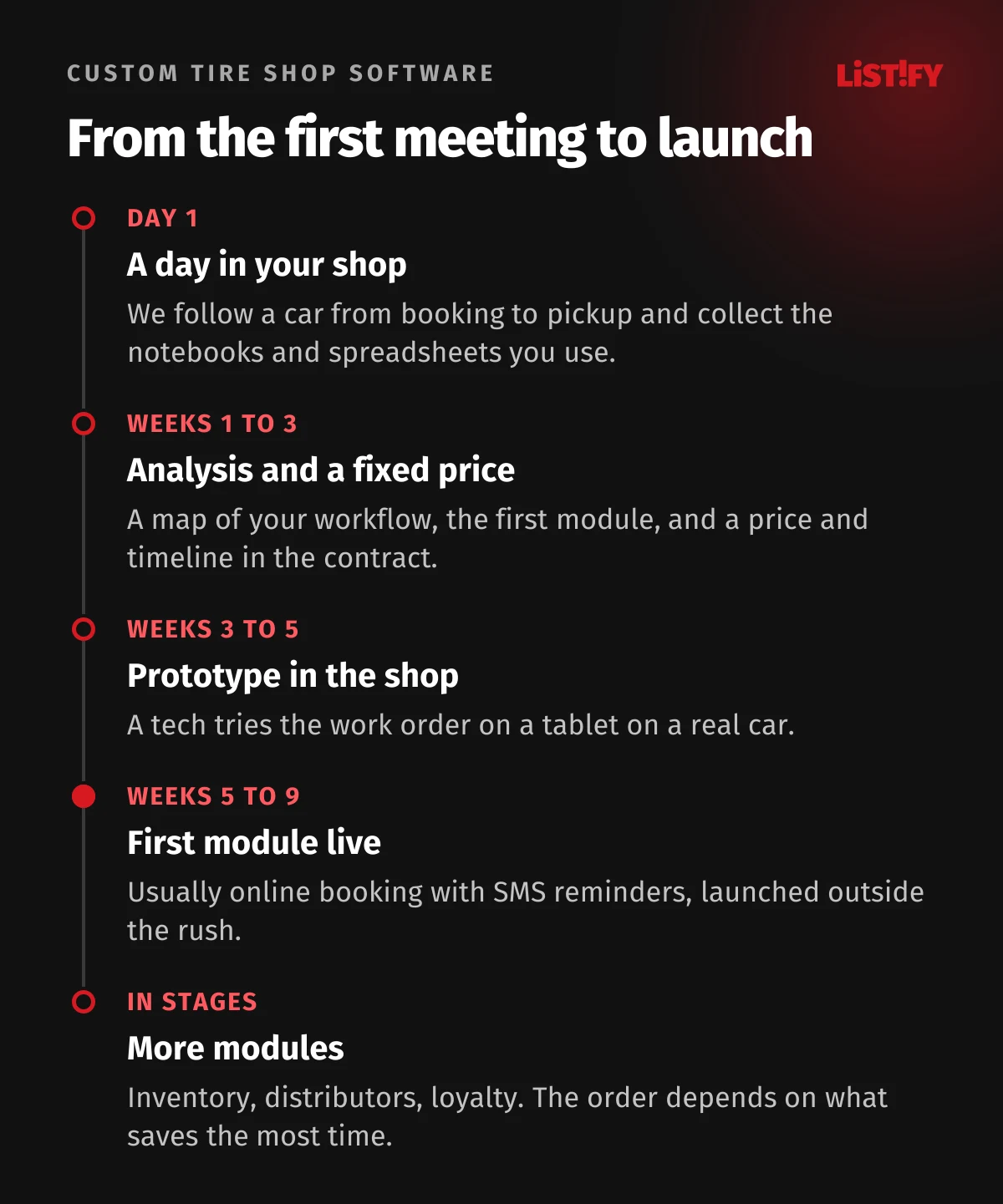
We build online booking with shop capacity, SMS reminders and confirmations from €3,590 (CZK 90,000) before VAT, usually in 5 to 9 weeks. A complete system for an auto repair or tire shop, with work orders, inventory, vehicle history and tire storage, starts at €11,990 (CZK 300,000) and is built in stages. Hosting and maintenance start at €90 (CZK 3,000) a month, with no per-user licenses. You get the exact price and timeline after the analysis, and we put both in the contract. You’ll find more on our pricing page and in how we work.
Timing matters more than price. The system needs to be running before the first wave of customers hits, so your front desk has time to get comfortable with it.
If your data lives in spreadsheets or an old program, it’s worth reading up on data migration pitfalls before you start.
08Frequently asked questions
How much does custom tire shop software cost?
With us, online booking with shop capacity and SMS reminders starts at €3,590 (CZK 90,000) before VAT. A system with work orders, inventory, vehicle history and tire storage starts at €11,990 (CZK 300,000). Hosting and maintenance from €90 (CZK 3,000) a month, with no per-user licenses.
How long does development take?
The first module, usually online booking, typically goes live in 5 to 9 weeks. We add further modules in stages and launch them outside the spring and fall tire swap seasons.
Can I text customers without their consent?
A reminder about an appointment they booked, or a message that their car is ready, is an operational message. In the EU, offers for your own similar products or services can go to existing customers whose contact details you got from a sale, as long as you offered them a free, easy way to opt out when you collected their details and do so again in every message. Anything else, including review requests, needs prior consent. National rules add details, so check yours.
Can the software read DOT codes and track tire age?
Yes. It checks the code as it’s entered, calculates the week and year of manufacture from the last four digits and shows each set’s age, so you can flag tires that are due for inspection or replacement under the manufacturer’s recommendations.
Will it connect to my accounting software?
Yes, as long as your accounting software has an API. Xero’s Accounting API is one example. We confirm the specific integration in the first call.
Who owns the code and the data?
You do. Once paid for, the source code and data are yours, and the software runs on a cloud account in your name. If you ever switch vendors, you don’t lose anything.
Which part of the job worries you most before the next rush? Tell us how your shop runs today, and we’ll work out together where to start.