Custom Restaurant Software: 30 Reasons to Build Your Own (and 5 Times Not To)
It’s 7 p.m. on a Friday. The phone won’t stop ringing, the delivery tablet keeps spitting out tickets, and a server is flipping through the reservation book to find out who was promised the table for six. The braised beef sold out an hour ago, but your website is still selling it. We put together 30 reasons restaurants, cafés and delivery-only kitchens get their own software built, grouped them into four areas and, wherever we could, backed them with figures from laws, official statistics and published price lists. At the end, you’ll find five situations where building custom software isn’t worth it.
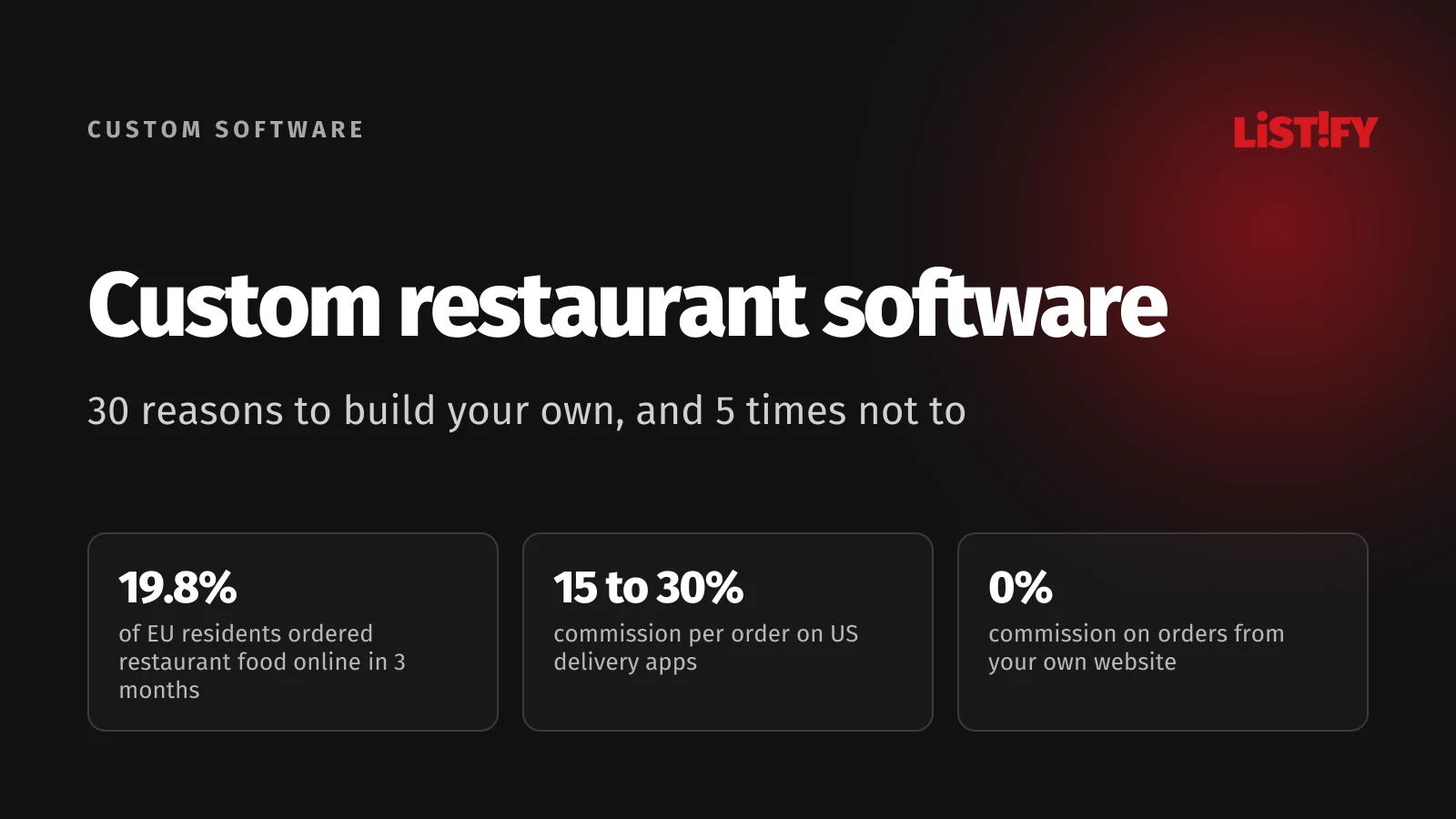
Ordering food online is now an everyday habit for millions of people. According to Eurostat, 19.8% of people aged 16 to 74 in the EU ordered delivery from a restaurant, fast-food chain or caterer online in the three months before the 2024 survey. In the Netherlands it was 46%, in Ireland 40.5% and in Czechia 29.3%. The catch is that when an order comes in through a delivery app, the customer relationship stays with the app. Reservations end up in a paper book, sales in the POS, and only your servers know who your regulars are.
Margins don’t leave much room for that. According to Eurostat, EU food and beverage businesses kept a gross operating margin of just 11.4% of revenue in 2024, and that’s before depreciation, interest and taxes. When a quarter of an order goes to a delivery platform, or a Friday table for six stays empty, you feel it right away.
Custom software means a system built around how your restaurant actually runs: how many tables and sales channels you have, how you handle daily lunch specials, how you deliver and how you invoice corporate clients. You own the code and the data, and you pay no percentage on orders. We covered a similar topic for repair shops in Custom Tire Shop Software. This time we’re heading into the kitchen and onto the floor.
01The short answer: when your own system pays off
- A big share of your orders comes through delivery apps. You pay commission even on regulars who would happily order from you directly, and you don’t have their contact details.
- Reservations come in by phone at the worst possible moment. Servers answer calls instead of serving, and tables get double booked.
- You update your menu, prices and allergens in three places. On your website, in the POS and on every platform, and never quite the same way.
- You also cook for businesses. Weekly lunch orders, catering and monthly invoices are pieced together from emails and spreadsheets.
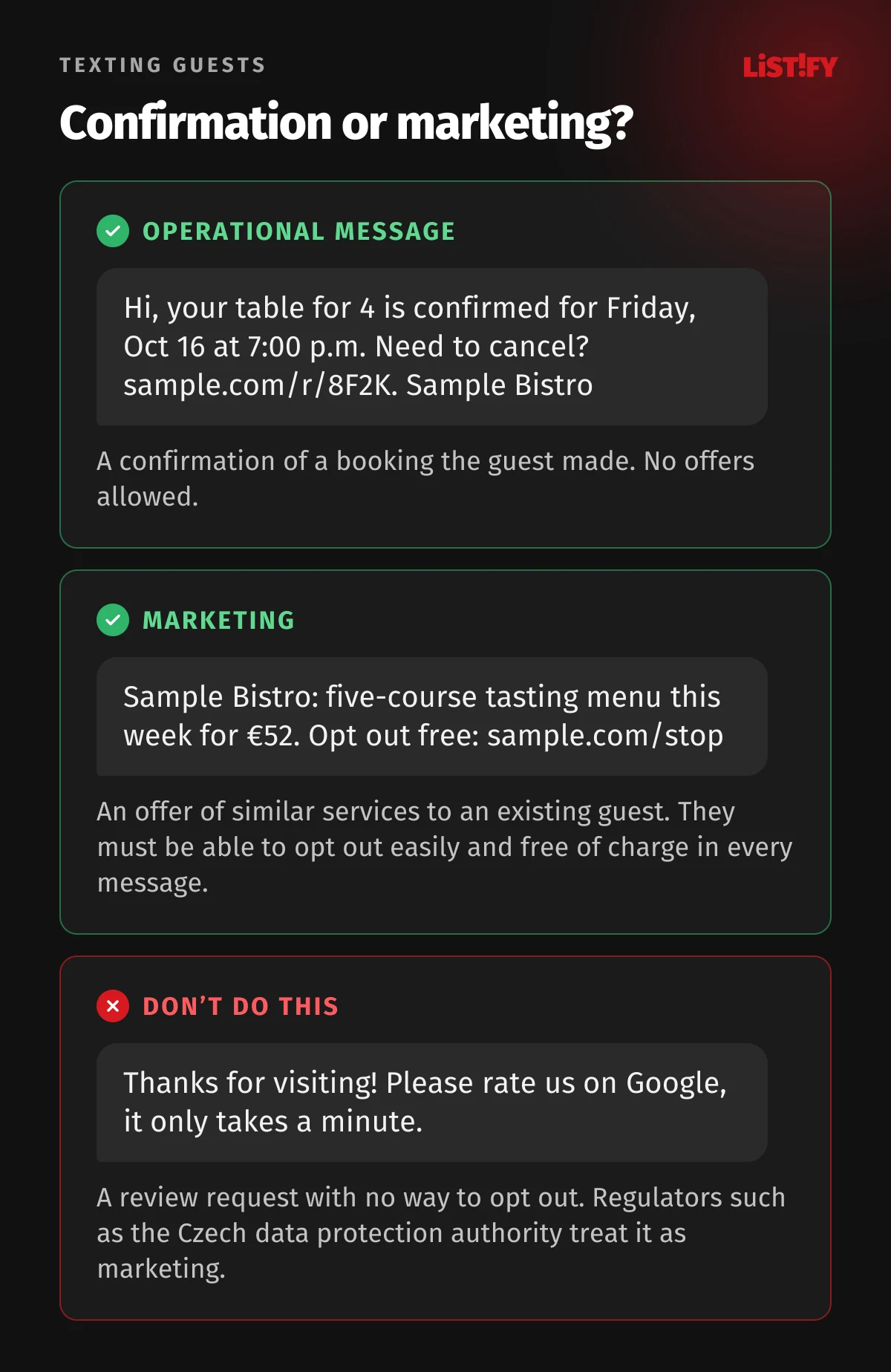
- New rules keep coming. Fiscal receipts, VAT changes, e-invoicing and tip reporting are easier when every order already lives in one system.
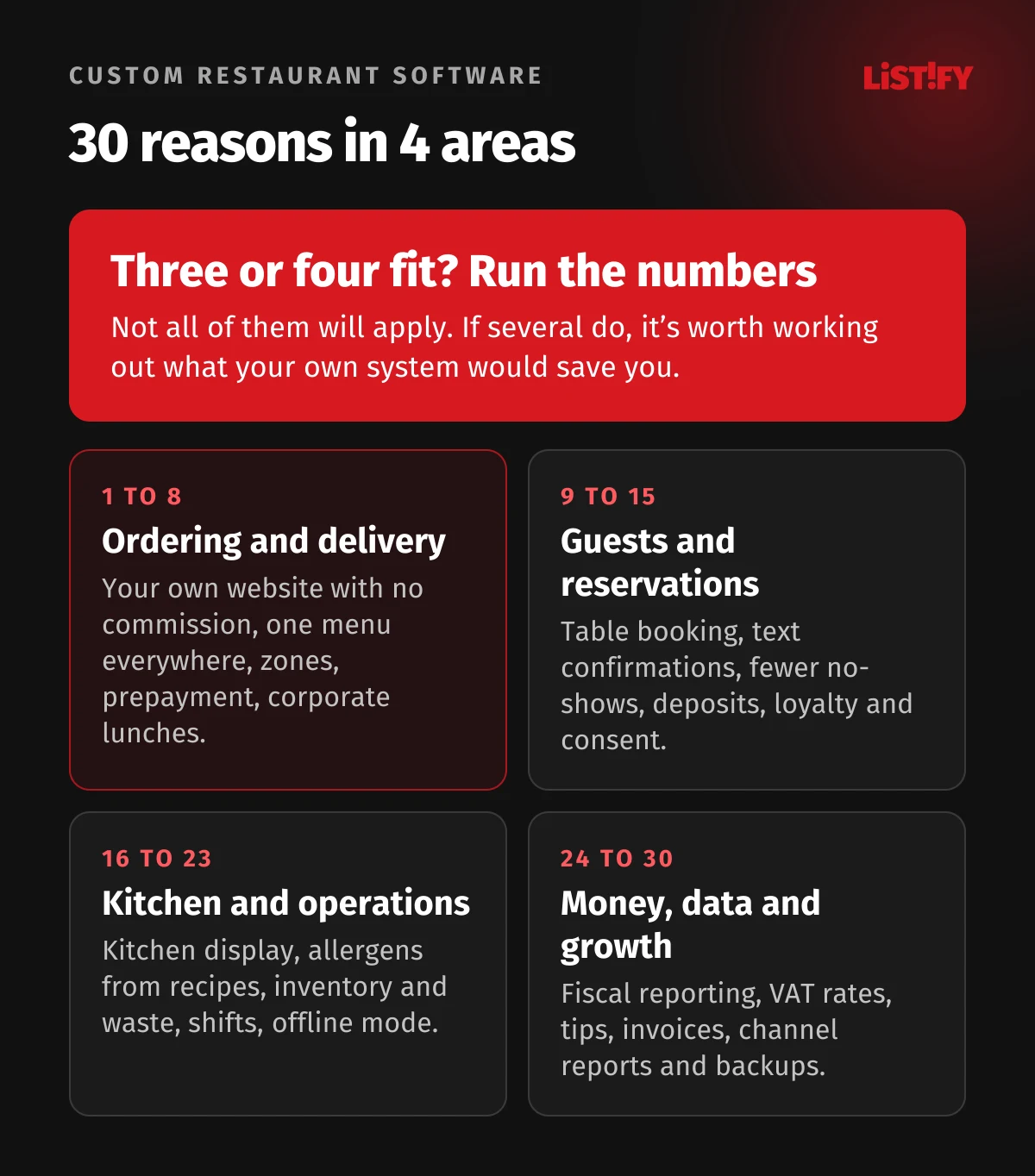
02Ordering and delivery: reasons 1 to 8
1. Commission-free orders on your own website. Delivery apps charge a percentage of every order. In the US, Uber Eats currently charges 20% on its Lite plan, 25% on Plus and 30% on Premium, and DoorDash charges 15%, 25% or 30% depending on the plan. In the UK, Uber Eats charges 30% plus VAT on orders its couriers deliver (33% on Uber One orders), plus a £650 activation fee. DoorDash’s own pricing page even quotes the objection restaurants raise, “30% commission will kill my margins,” and calls it “the right question to ask.” On your own website, you pay no commission per order, just the card processing fee, which in the EU starts at around 1% to 1.5% of the payment, plus a flat monthly fee for hosting.
- DoorDash Basic (US)15.0%
- Uber Eats Lite (US)20.0%
- DoorDash Plus, Uber Eats Plus (US)25.0%
- DoorDash Premier, Uber Eats Premium (US)30.0%
- Uber Eats delivery (UK, plus VAT)30.0%
- Own website, Stripe fee on a €25 order (EEA)2.5%
Published price lists: Uber Eats US and UK as of October 7, 2026, DoorDash as archived on August 14, 2026. Stripe charges 1.5% plus a fixed €0.25 for standard EEA cards, which is 2.5% of a €25 order. Some US cities cap commissions, see reason 2.
To be fair, the platform also pays the courier out of that commission and brings you customers you wouldn’t reach otherwise. Your own website doesn’t replace the apps. It takes over the guests who already know you. As a rough model: if a third of 300 monthly delivery orders at €25 moves to your own site, a 25% commission saves you about €560 a month even after card fees. That’s over €6,700 a year, enough to pay back a €3,590 ordering module in about eight months, hosting included.
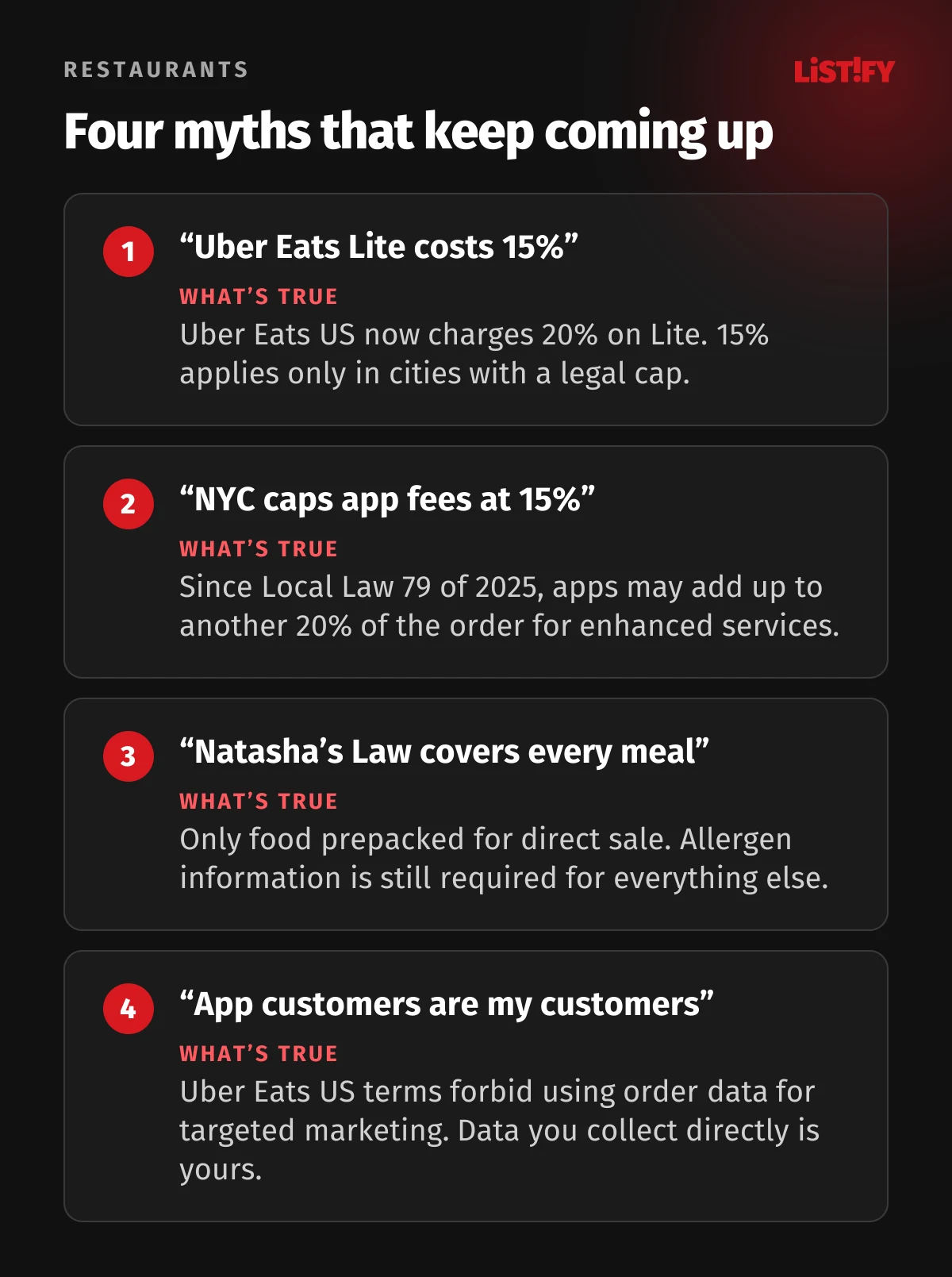
2. The guest belongs to you, not to the app. Read the fine print. The Uber Eats merchant terms for the US forbid restaurants from merging order data with other data or using it for targeted marketing, while explicitly allowing them to use data collected directly from customers under their own privacy policy. New York City tried to force delivery apps to share customer names, emails and phone numbers with restaurants, but according to Reuters, as published by Insurance Journal, a federal appeals court struck the law down 3 to 0 in August 2026. Even NYC’s fee caps have loosened: Local Law 79 of 2025 keeps the 15% delivery cap but lets apps add an “enhanced service” fee of up to another 20% of the order price, as long as they also offer a basic package within the old caps. The only reliable way to know your guests is your own ordering channel.
3. One menu for your website, QR code, POS and delivery apps. Price, description, photo, portion size and allergens are entered once and show up everywhere. When the chef taps “sold out,” the dish disappears from your website, the QR menu on the tables and, where the platform allows an integration, from the delivery apps too. No more calling guests to apologize because the last portion got sold twice.
4. Special requests reach the kitchen exactly as written. “No onions,” “sauce on the side,” “half and half.” Online orders tend to be more complex than phone orders. A study published in Management Science analyzed 160,168 orders from one US pizza place and found that items ordered online were 14% more complex on average, with more toppings, swaps and instructions per item than items ordered by phone. Re-keying orders like that from a delivery tablet into the POS invites mistakes. Your own system sends them straight to the kitchen.
5. Delivery zones, fees and drivers. The system knows your delivery zones and charges by distance, refuses orders to addresses you don’t serve and shows drivers only the orders that are ready, in route order. Guests get a text with the estimated arrival time and don’t need to call and ask where their food is.
6. Online payment up front and less cash on the road. When guests pay by card at checkout, drivers don’t carry cash or change. In the EU, online card payments go through strong customer authentication under the PSD2 payment services directive. The regulatory technical standards let payment providers skip the extra step for small online payments up to €30, within cumulative limits, but it’s the payment provider, not the restaurant, that decides, so your checkout has to handle the verification step smoothly.
7. Pickup at a set time. Guests choose a pickup time and the system offers only the slots the kitchen can handle at peak. At 12:15, ten people aren’t waiting for ten boxes at once, and you know how many portions to prep ahead.
8. Corporate lunches and catering without spreadsheets. Employees order lunch for the whole week on Monday, the kitchen sees portion counts, and the company gets one invoice at the end of the month. B2B marketplaces work too, but they also take a cut: Just Eat for Business deducts its commission from each order subtotal and pays restaurants once a month, on the 24th. Your own system handles spending limits per company and catering orders from inquiry to invoice.
03Guests and reservations: reasons 9 to 15
9. Online table booking, even late on a Sunday. Guests pick a day, time and party size, and the system offers only tables that are actually free, including combined tables for larger groups. Servers see the floor plan with notes such as “birthday” or “high chair,” and the phone rings less on Saturday night.
10. Confirmations and reminders that send themselves. Right after booking, the guest gets a text or email with a confirmation and a cancellation link, and a reminder the day before. Texts are cheap: a European SMS gateway such as SMSGATE.sk charges under 3 euro cents per message, excluding VAT. In the EU, Article 13 of the ePrivacy Directive allows direct marketing by electronic mail, which the directive itself says includes text messages, only with prior consent. There’s one exception: you can market your own similar products or services to customers whose contact details you got when you sold them something, as long as they can object free of charge and easily, both when you collect the details and in every message. A plain confirmation of a booking the guest made isn’t marketing. Add “try our tasting menu this week,” and it is. Good software keeps these message types separate.
11. Fewer empty tables from no-shows. Hard data on no-shows is scarce, and many figures in reservation software marketing come without any methodology. One of the better sources is a survey by POS maker Zonal and research firm CGA of more than 5,000 British adults, published in November 2024: 14% of guests said they don’t honor reservations or tell the venue they need to cancel. They also said what would make them show up, or at least let you know:
- Simple cancellation process30%
- Rewards and incentives28%
- Reservation reminders25%
- Deposits21%
- Loyalty schemes17%
Survey by POS maker Zonal and CGA of more than 5,000 adults in the UK, November 2024 (archived press release). Stated behavior, not measured bookings.
The top answer, a simple way to cancel, and the third, a reminder, are among the cheapest features to build. A one-tap cancellation link in the reminder text frees the table right away, so you can give it to the next walk-in.
12. Deposits and cancellation terms that hold up. For large parties or New Year’s Eve, a deposit makes sense. In the EU, saving a card for a later no-show charge has to pass strong customer authentication, and your payment gateway handles the technical side. What the system adds is the paper trail: the guest sees the terms right in the booking form, gets them again in the confirmation, and the system stores exactly what they agreed to. In Czechia and Slovakia, for example, consumers’ usual 14-day right to cancel online purchases doesn’t apply to restaurant bookings for a specific date, but any cancellation fee has to be agreed in advance, and a court can cut one that is unreasonably high.
13. Review requests after the visit, done right. Google reviews are gold for a restaurant, and an automatic “How was your meal?” text is tempting. But at least one EU regulator treats it as marketing. The Czech data protection authority, for one, states in its 2025 annual report that feedback surveys are commercial communications, and it put them on its 2026 inspection plan. Send them only to guests who could opt out when they booked and can opt out again in every message.
14. Loyalty without paper punch cards. The system knows who comes in every week, who’s celebrating a birthday and who always orders the same wine. It hands out rewards automatically, with no stamps and no math at the register. This is an easy place to stand out: according to Eurostat, only 19.7% of EU accommodation and food service businesses with at least ten employees used customer relationship management (CRM) software in 2025, and only 10.2% personalized their website for regular visitors. Restaurants on their own are likely below those figures, because hotels pull the average up.
- Website with online ordering or bookingEU: 48.0%Czechia: 59.4%
- Sales via own website or appEU: 32.5%Czechia: 35.6%
- Sales via online marketplacesEU: 27.7%Czechia: 28.1%
- CRM softwareEU: 19.7%Czechia: 16.5%
- Personalized content for regularsEU: 10.2%Czechia: 9.6%
Accommodation and food service businesses with 10 or more employees, 2025 survey. Eurostat doesn’t publish food service separately, and accommodation scores higher on every indicator, so restaurants fall below these numbers. Source: Eurostat, tables isoc_ciwebn2, isoc_ec_eseln2 and isoc_eb_iipn2.
15. Guest consent you can prove. If you want to send news and offers, you need to be able to show that the guest agreed. The system records when and where each guest gave or withdrew consent, and it stops all marketing to anyone who opts out.
04Kitchen and operations: reasons 16 to 23
16. A kitchen display instead of paper tickets. Orders from the dining room, your website, table QR codes and delivery apps line up on one screen by pickup time. The cook sees notes, allergens and how long each order has been waiting. Tickets don’t get lost or greasy, and nobody has to collect them from several printers.
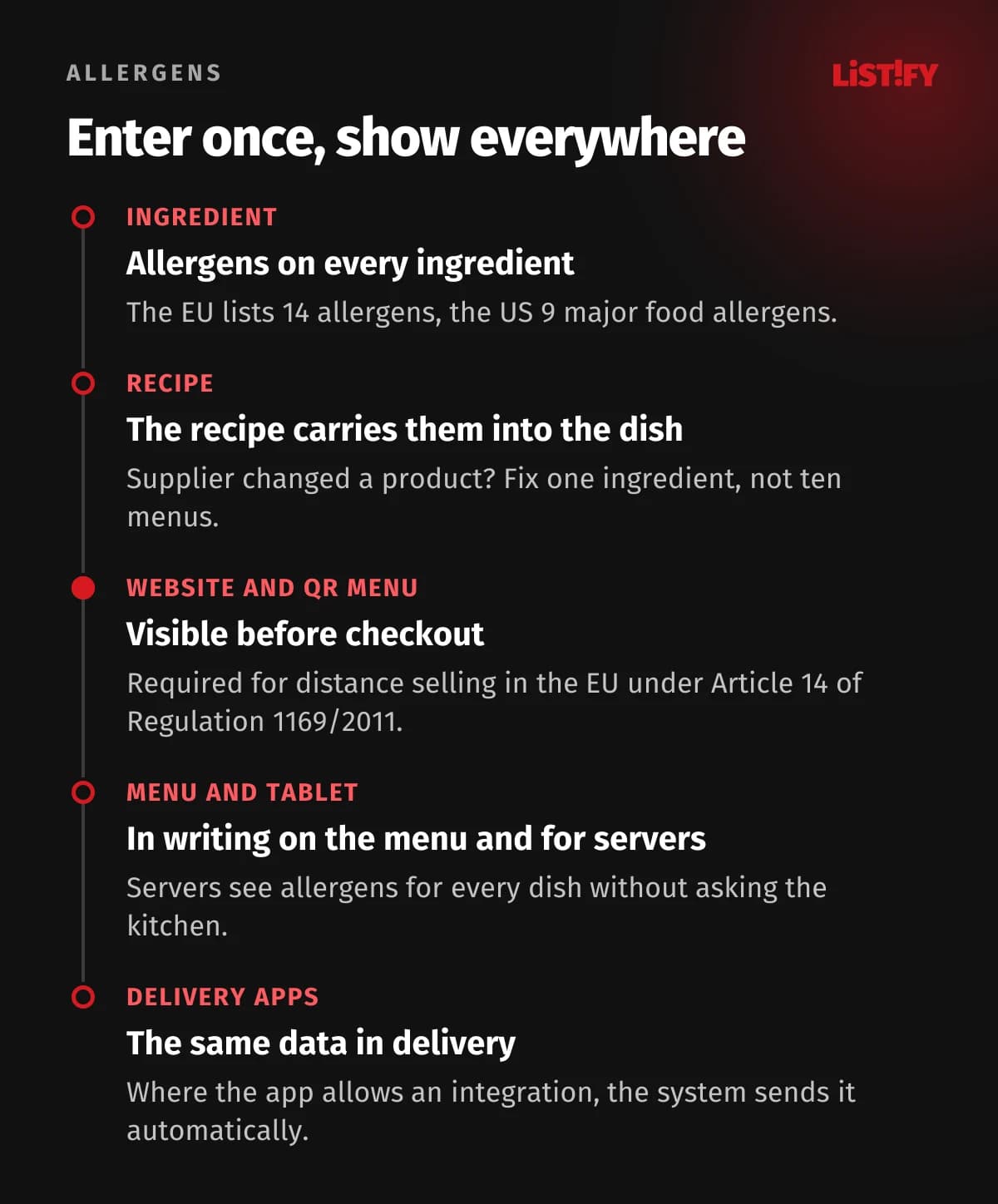
17. Allergens from the recipe, not from memory. In the EU, restaurants must provide allergen information for food that isn’t prepacked (Article 44 of Regulation (EU) No 1169/2011), and when food is sold online, that information must be available before the purchase is completed and again on delivery (Article 14). The regulation itself explains why: “most food allergy incidents can be traced back to non-prepacked food.” In England, Wales and Northern Ireland, Natasha’s Law requires full ingredient labels on food prepacked for direct sale, and for online and phone orders, the Food Standards Agency says allergen information must be given before purchase and at delivery, and should be available in writing at some point in between. In the US, sesame became the ninth major food allergen on January 1, 2023, and the FDA Food Code calls for written allergen notification for unpackaged food in places that have adopted the 2022 edition. The system handles all of this the same way: allergens are entered for each ingredient, the recipe carries them into the dish, and the dish carries them into every menu at once.
18. Portion sizes and ingredients in one place. When portion size, recipe and price live in one database, the menu on the table, the website and the label on the delivery box always match.
19. Inventory, food cost and less waste. The system deducts ingredients based on recipes, shows the cost of each portion and logs separately what’s thrown out from storage, during prep and from plates. Measuring pays off: in a 2019 Champions 12.3 study, 114 restaurants in 12 countries cut kitchen food waste by 26% on average within a year and saved $7 for every $1 invested. The UNEP Food Waste Index Report 2024 estimates that food service worldwide wastes 36 kg per person a year, though UNEP itself calls the estimate highly uncertain. And the EU’s Directive (EU) 2025/1892 requires member states to cut food waste per capita in retail, restaurants and households by 30% from the 2021 to 2023 average by the end of 2030. The target applies to countries, not to individual restaurants, but pressure to measure will grow.
20. Shifts and part-timers without recalculating. Shift schedules on staff phones, shift swaps with manager approval and automatic checks against your country’s limits on hours, breaks and notice periods. The system flags who is close to a limit before you put them on the schedule.
21. Table orders on a tablet or by QR code. Servers don’t re-key orders from a notepad, and guests can order and pay from their own phones. Both go straight to the kitchen and to the table’s check. Servers see allergens and wine pairings for every dish, so they don’t have to run to the kitchen to ask.
22. Service keeps going when the internet drops. Where fiscal rules require real-time reporting, a lost connection can’t stop service. Under Czechia’s new sales reporting law, sales data that couldn’t be sent must follow within 48 hours of the sale. Slovakia’s eKasa law allows 96 hours from the first attempt to send. The system keeps orders and sales in an offline queue and sends them automatically once the connection is back.
23. The software fits your restaurant, not the other way around. A pizzeria with delivery, a café with takeout and a lunch canteen each work differently. Off-the-shelf software has one workflow for everyone, and the exceptions end up as notes. Custom software has exactly your steps: your menu types, your delivery zones, your rules for employee meal vouchers and corporate accounts.
05Money, data and growth: reasons 24 to 30
24. Fiscal reporting straight from the system. In Slovakia, restaurants already report every sale to the tax authority in real time, and Czechia joins them on January 1, 2027, covering every in-person payment, including card and QR payments at the table, with fines of up to CZK 500,000. Prepayments through an online gateway are not reported. Slovakia replaced its eKasa law on January 1, 2026 with Act No. 384/2025, and since May 1, 2026, businesses must accept cashless payment for any sale over €1. When the reporting is built into the POS of your own system, it knows which payment to report and which not to.
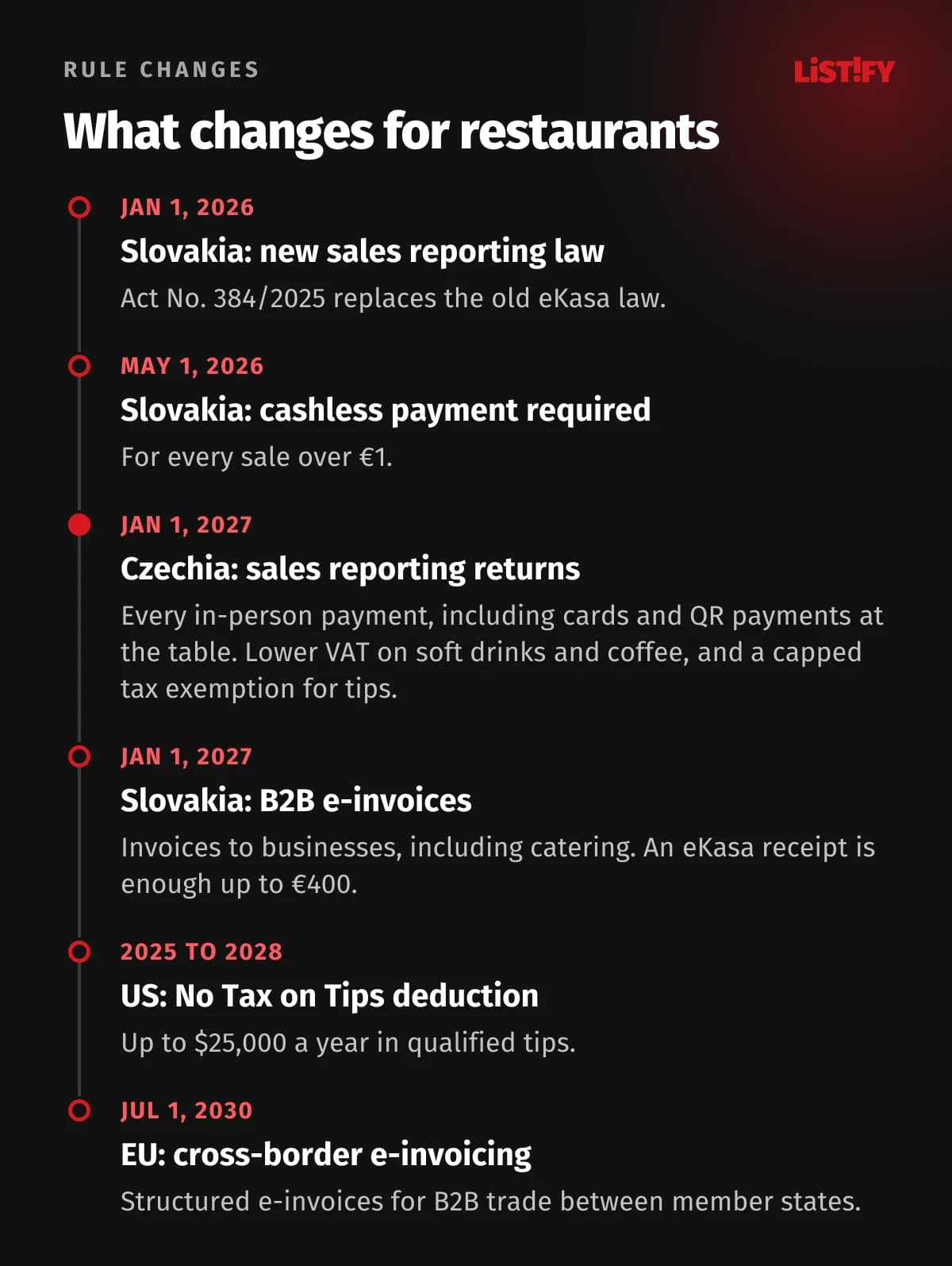
25. The right VAT rate on every item. VAT rules in restaurants are rarely simple. In Slovakia, according to the Financial Administration, food served on site is taxed at 5%, soft drinks at 19% and alcohol at 23%. Prepared takeout and the restaurant’s own delivery count as goods, which the tax office told Podnikajte.sk are taxed at 19%. In Czechia, coffee, tea and soft drinks served in restaurants move from 21% to 12% on January 1, 2027, under the same law that brings back sales reporting. When every item and every sales channel has its own rate, a rate change takes one setting, and nobody rewrites the menu on New Year’s Eve.
26. Tips tracked per person. Tip rules are changing too. In the US, the No Tax on Tips deduction lets eligible workers write off up to $25,000 in qualified tips a year for 2025 through 2028, and employers must report certain tips and each recipient’s occupation to the IRS. In Czechia, starting January 1, 2027, employees’ voluntary tips for dine-in service will be exempt from income tax up to 7% of the restaurant’s monthly food service revenue, shared across all staff. Either way, the system assigns card and cash tips to the people on shift, keeps them separate from sales and watches the limits.
27. Invoices and accounting without re-keying. The invoice for a catering job or a month of corporate lunches is generated from the orders and sent to your accounting software automatically. Under the EU’s ViDA directive, structured e-invoices become mandatory for cross-border B2B transactions from July 1, 2030, and member states may require them domestically even earlier. Slovakia does from January 1, 2027. Software that generates invoices as structured data is ready for that. A PDF alone won’t count. We explain how integrations work in API Integration Best Practices.
28. See how much each channel really earns. How many orders came through your website, how many through apps and how many at the table, what the average check was and what was left after commissions. Which dishes sell at lunch and which at dinner, which tables fill up and which stay empty. That’s how you plan the menu, shifts and purchasing, not on a hunch after a busy weekend.
29. Your data stays safe, even if the bar computer dies. The system runs on your own cloud account, in the EU for European restaurants, and backs up automatically. A guest’s name and phone number are personal data, so Article 32 of the GDPR applies to how you protect them. We go into more detail in Data Security in Custom Software.
30. Add modules as you grow. Most restaurants start with ordering on their own website, because it saves commission from day one. Reservations, a kitchen display, inventory or corporate lunches come next, all on the same data. A second location is a matter of settings. The software stays the same.
06Five situations where custom software isn’t worth it
- You run a small place with one register. According to Eurostat, 88% of food and beverage businesses in the EU had fewer than ten people in 2024. For many of them, an off-the-shelf POS with an online ordering add-on is the sensible choice.
- Delivery apps bring you new guests and you have no drivers of your own. The platform pays the courier out of its commission, and as DoorDash argues, many app orders come from customers who wouldn’t have found you otherwise. Without your own delivery or a pickup counter, your own website saves less than it seems.
- Your guests call and walk in. According to Eurostat, only 6.6% of people aged 55 to 74 in the EU ordered restaurant food online in the 2024 survey. A restaurant with an older regular crowd doesn’t need to start with online ordering.
- You don’t want to change how you work. Software speeds up a good process and just digitizes a chaotic one. It won’t work unless the floor and the kitchen are willing to try a new routine.
- You don’t have the budget for a first module. Ordering on your own website starts at €3,590 (CZK 90,000) before VAT with us. If that’s out of reach, start with an off-the-shelf tool and come back when the business has grown.
A simple calculation helps you decide: how much you pay each month in commission on regulars, how many hours a week your staff spend on the phone and how many orders and invoices get re-keyed. We walk through it in How to Calculate Software ROI.
07What it costs and how to get started
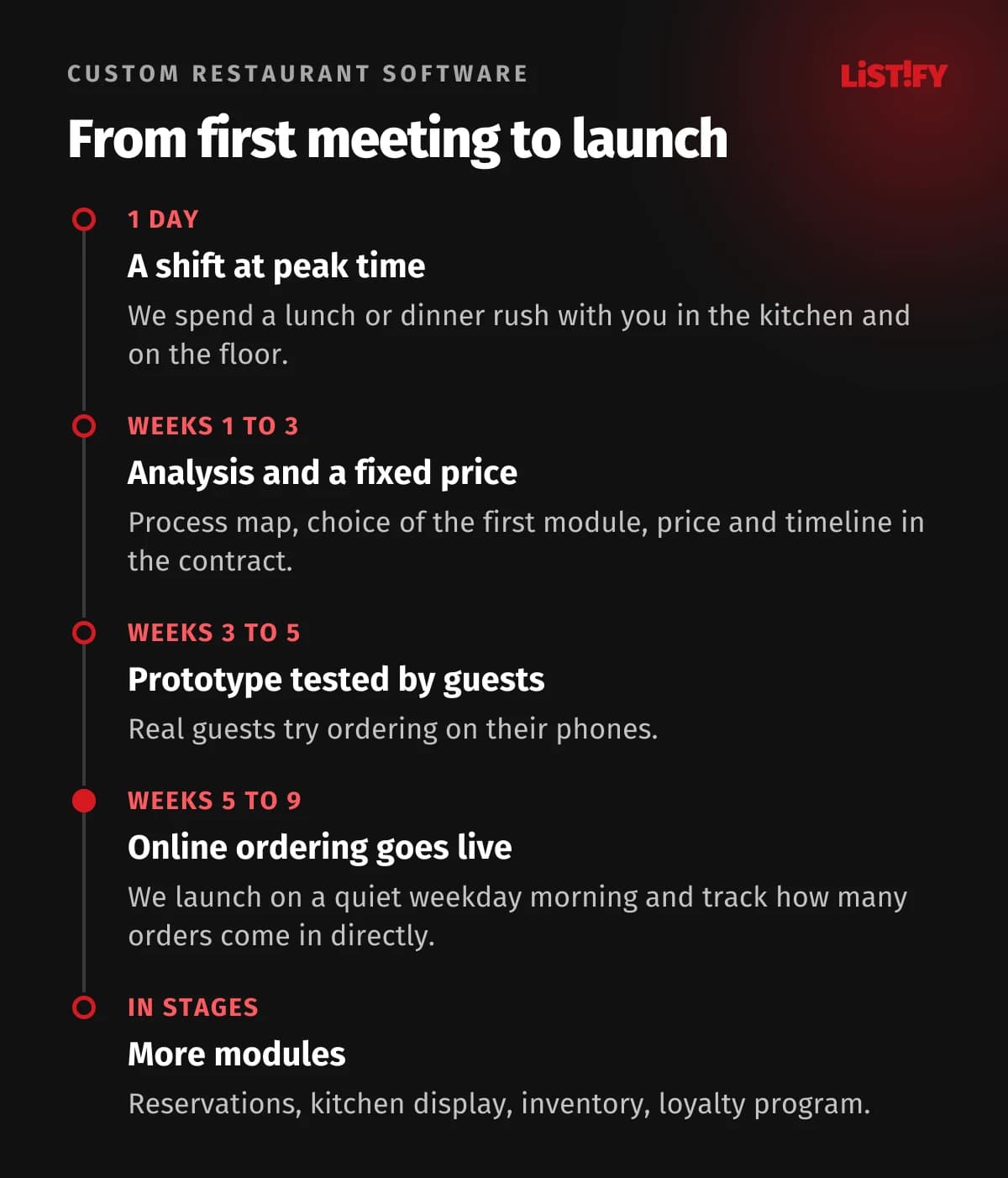
We build online ordering on your own website, with menu, cart, card payments, delivery and pickup and a kitchen connection, from €3,590 (CZK 90,000) before VAT, usually in 5 to 9 weeks. A full restaurant system with reservations, kitchen display, delivery, catering and a loyalty program starts at €9,990 (CZK 250,000) and is built in stages over 10 to 18 weeks. Hosting and maintenance start at €90 (CZK 3,000) a month, with no percentage on orders. You get an exact price and timeline after the analysis, and we put both in the contract. See our pricing and how we work for details.
We take the first step on site, in your restaurant. Restaurant software has to survive a Friday night rush, so that’s where we start.
If your menu, guest list or loyalty points live in spreadsheets or an old system, read up on what to watch out for during data migration before you start.
We took the same approach for accommodation. For commission-free direct bookings, online check-in, tourist tax and guest registration, see Custom Booking System for Hotels and Guesthouses: 30 Reasons.
08Frequently asked questions
How much does custom restaurant software cost?
Online ordering on your own website, with card payments, delivery and a kitchen connection, starts at €3,590 (CZK 90,000) before VAT with us. A system with reservations, kitchen display, catering and a loyalty program starts at €9,990 (CZK 250,000). Hosting and maintenance from €90 (CZK 3,000) a month, with no percentage on orders.
How long does development take?
The first module, usually online ordering, goes live in 5 to 9 weeks. We add further modules in stages and launch them on a quiet weekday morning, never on a Friday night.
Do I have to leave the delivery apps?
No. The apps can keep running and bringing in new guests. Your own website mainly takes over the regulars you currently pay commission on for no good reason. You then see orders from every channel in one place.
Can the system handle fiscal reporting such as Czech sales reporting or Slovak eKasa?
Yes. Czechia has published technical documentation for POS developers ahead of its January 1, 2027 start, so reporting can be built right into the system. In Slovakia, we connect to a software-based online cash register that allows integration. The free virtual cash register can’t be connected, because the law limits it to the Financial Administration’s own apps.
Can I text guests without their consent?
A confirmation or reminder of a booking the guest made is an operational message, as long as it contains nothing else. Offers and review requests are marketing. In the EU, you can send them to existing guests only if they could opt out when you collected their contact details and can opt out in every message. Otherwise, you need consent you can prove.
Who owns the code and the data?
You do. Once paid, the source code and data are yours, and the system runs on your own cloud account. If you ever switch providers, you keep your guests and your order history.
What’s costing you the most money or sanity right now: commissions, the phone or re-keying orders? Tell us how orders and bookings come in today, and we’ll suggest where to start.