AI in UX Design: Tools That Actually Help
A screen takes minutes to generate, yet customers still cannot finish their orders. AI helps UX design when it shortens the path from a real problem to a validated solution. Choose tools around the work you need to improve, and include review time in the budget. Here are practical options and the responsibilities that still belong to an experienced team.
A business owner rarely needs another generator of attractive screens. You need clients to find the right service, employees to approve a job correctly or shoppers to complete a purchase. AI can make preparation easier. Whether the design works is still determined by real people doing a specific task.
01Start with a task that is not working
Before choosing a subscription, write one sentence: who is trying to do what, and where do they get stuck? For example, “new customers cannot tell which support package includes an on-site visit”. That brief leads to offer comparisons and a test of understanding. “Build a modern homepage with AI” mainly leads to a discussion about appearance.
Choose a success measure as well. An order journey might focus on completion without help, an internal system on corrections, and a lead generation website on the share of relevant enquiries. The number of generated alternatives says little about value. We explain the distinction between appearance and successful use in our article on UI and UX.
If you do not yet know where the problem starts, build a customer journey map. Connect the website visit with ordering, communication and service delivery. This helps you choose the part of the journey where another design iteration is worth pursuing.
02Three tools for three different jobs
| Tool | When to consider it | What your team must verify |
|---|---|---|
| Figma Make | You need to demonstrate an interactive version of a workflow quickly. | Whether it reflects your rules, states and real tasks. |
| Dovetail | You have interviews and feedback that are difficult to search. | Whether a conclusion matches the source and the relevant customer segment. |
| Maze | You want to collect responses from real participants systematically. | Recruitment, the study brief and the quality of follow-up questions. |
Do not automatically buy all three. A smaller business can start with a single prototype and a few interviews reviewed by a person. An additional tool should remove a specific bottleneck. If your team has no customer evidence, a more expensive synthesis platform will not create it.
03Figma Make: a faster prototype for the right question
Figma Make creates interactive prototypes or web apps from prompts and attached designs, with further editing available. For UX work, its useful role is to help compare specific journeys. A generated result does not automatically establish that a product is ready for customers.
Provide existing components, real rules and representative content. A maintained design system helps with repeated elements. A booking prototype needs more than a screen of available appointments. Include an unavailable slot, a service change, a previous step and a failed submission. Otherwise, you test only the ideal journey and discover the difficult parts during development.
Before showing the prototype to customers, check that it performs the intended steps and cannot be mistaken for a real order that was never submitted. Our guide to wireframes and interactive prototypes explains how to separate design, usability testing and technical validation.
04Dovetail: find evidence faster, then check its meaning
Dovetail offers AI summaries for question-style searches, surfacing patterns and supporting evidence. It is worth considering when you work with substantial customer material, particularly if several people need to revisit the findings.
For example, ask what prevents new customers from completing registration, and separate their responses from those of experienced users. Open the source passage for an important conclusion. Was the person describing a real experience, a hypothetical preference or an issue with a different service?
The most frequent theme is not necessarily the most costly problem. One permissions failure may matter more than many comments about button colours. Priorities should therefore include severity, the affected segment and confidence in the evidence. An AI summary should not independently decide your product roadmap.
05Maze: real participants and better prepared questions
Maze AI Moderated studies conducts interviews and asks follow-up questions based on participants’ answers. At the time of verification, its documentation listed Enterprise availability. This is not research with synthetic customers: you still need to recruit the right real participants.
Check language and device support: the documentation lists English and Czech, but not Slovak. Mobile browser participation is supported, while screen sharing on phones and tablets is not. Choose the study format accordingly.
Give the first study one objective, such as understanding why business customers do not understand your billing arrangements. Ask participants to describe a recent real situation. “Would you like our faster ordering process?” provides limited evidence because it already suggests the desired answer.
Run a pilot interview before expanding the study and read the full conversation. Discussion instructions let you specify what the moderator should explore. Your review should catch ambiguous tasks, leading follow-ups and sensitive topics that an automated conversation did not handle appropriately.
Unsure whether you need a tool, a new design or research first? Tell us about one problem on your website or in your application. Listify can propose a useful first step and a way to assess the result.
06Prepare the context before uploading your data
A useful brief identifies the audience, task, service rules, content examples and constraints. Separate verified findings from assumptions. Ask explicitly for uncertainties and for an explanation of which design choices follow from the supplied evidence. This helps prevent the team from debating a supposed customer need that the model invented.
Remove information from recordings and screenshots that the task does not require. Check the business account, permissions, retention, processing terms and access for external collaborators. A label such as “Participant 7” is not sufficient if the rest of the transcript clearly identifies that person. Agree on an approved method for sensitive material before uploading it.
Start with a copy containing illustrative data. Even a convincing prototype may contain a public sharing link, an automatically created account or a form connected to another service. Check sharing and storage before adding real client information. The point is to keep the experiment useful without accidentally turning sample work into a live customer process.
07An illustrative example: booking a service visit
A company receives calls from customers who did not finish an online booking. The working hypothesis is that they cannot distinguish a consultation from an on-site visit. First, review relevant calls and observe an actual booking attempt. AI can help organise the material or draft alternative explanations, but you are still investigating the cause.
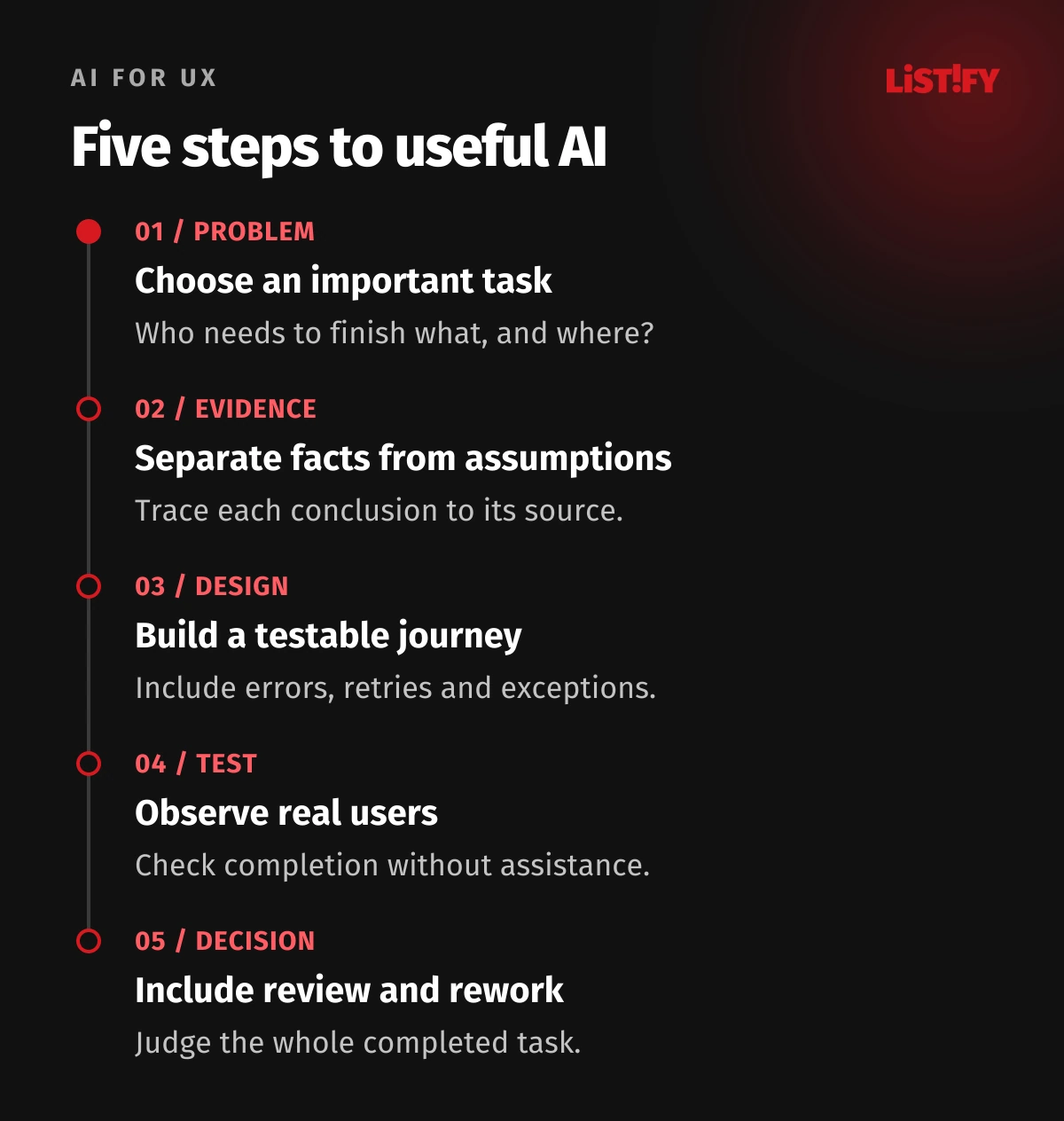
Compare two offer structures in a prototype. Give the participant a scenario: they need equipment repaired at a branch and want to understand the next steps. Observe whether they choose the appropriate service, understand the price or quotation process, and can change the appointment. If only the appearance improves while people still select the wrong service, the design needs more work.
This is a process illustration, not a reported Listify client result. The same reasoning applies to a manufacturing enquiry, invoice approval or entry into a client portal.
08Measure savings after review and rework
Compare the same task against the same expected standard. Record preparation, production, review, corrections and handover. A screen that appears instantly but requires a complete rebuild is not a saving across the whole process.
- Define acceptance criteria before starting the pilot.
- Include an ordinary task and a more difficult exception.
- Record errors caught during review and errors that escaped it.
- Include subscriptions, credits, training and evidence management.
- Decide whether to continue based on completed work and quality, not the speed of the first demonstration.
Time saved does not automatically mean money saved. It may release capacity while the company’s costs remain unchanged. Decide in advance how that capacity will be used. Our AI for business services explain how we approach tools, training and implementation as part of a working process.
09What to expect from the team delivering your UX
Ask for a clear brief, traceable evidence, reasons for important design decisions and a record of validation. Empty, error and edge states should be described alongside the normal journey. Agree who checks the content, accessibility, technical feasibility and connections to your existing systems.
| Deliverable | Acceptance question | Who uses it |
|---|---|---|
| Research synthesis | Can an important claim be traced to the original evidence? | Product team and management |
| Interactive design | Can a real user complete the agreed task? | Designer, customer and developer |
| Development brief | Does it describe rules, errors and unvalidated areas? | Development and testing |
| Pilot assessment | Does it include review, rework and handover time? | Budget owner |
A supplier should explain where AI was used and how a person checked the result. You do not need to pay for a count of prompts or a list of fashionable tools. A useful deliverable supports a decision, implementation and a later assessment of the outcome. If the site is already live, a UX audit may be the right starting point.
10Frequently asked questions
Will AI replace a UX designer?
It can handle parts of preparation, evidence search and drafting alternatives. Someone still needs to frame the problem correctly, assess the evidence and observe real users. Responsibility for the design does not disappear.
Which tool is best for a small business?
Choose the one that addresses your current bottleneck and fits the team’s workflow. A simple prototype and a few interviews may be enough for an initial service test. A research platform becomes worthwhile according to the volume of evidence and recurring need.
Can we generate personas instead of conducting interviews?
Generated personas can suggest hypotheses to investigate. They are not evidence that your customers behave that way. Do not use them as a replacement for real research or as proof of demand.
Is an AI-generated prototype ready to launch?
A working demonstration alone does not establish readiness. You need to check data, permissions, accessibility, integrations, failure states and operational ownership against the application’s actual purpose.
Do we need a new website to use AI in UX?
No. Start with one troublesome step in the existing journey. Investigate the cause, propose a limited change and assess its effect. A complete redesign is not an automatic requirement.