How to Measure AI Project Value and Move Beyond Experiments
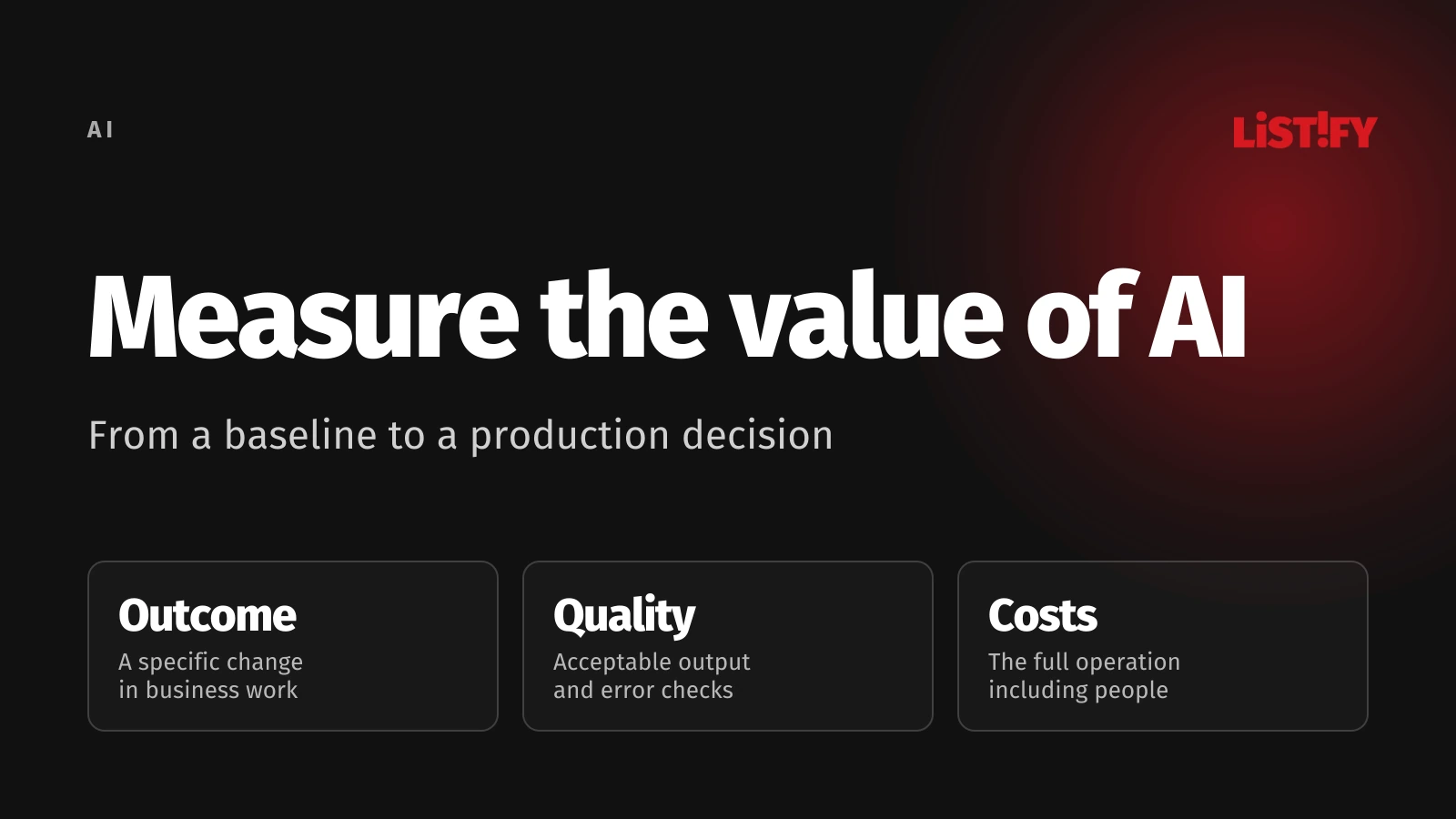
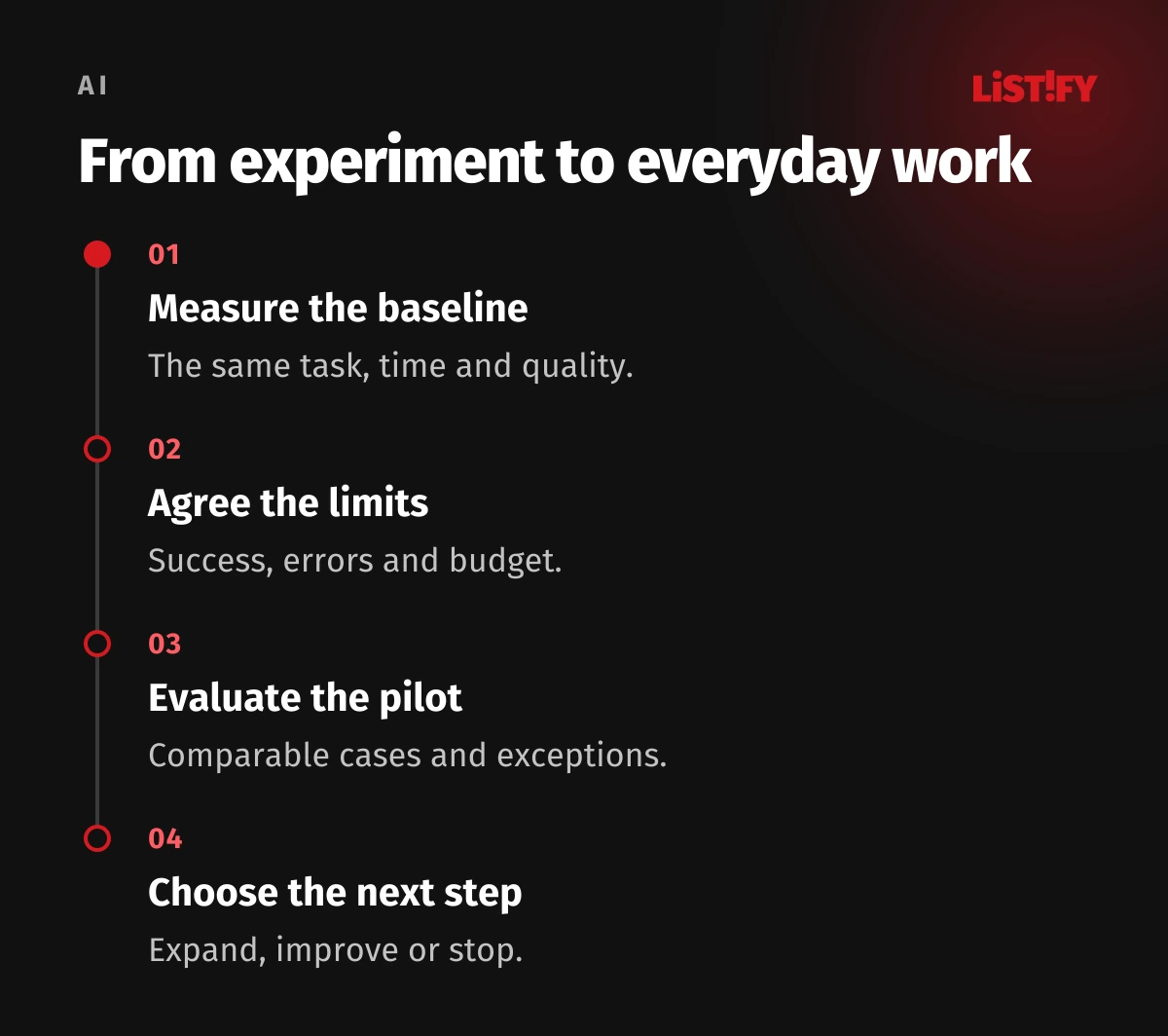
An impressive AI demonstration does not establish business value. You need a baseline, a realistic allowance for review and rework, and an agreed result that would justify further investment. A useful pilot ends with a decision: expand, improve or stop.
Counts of models tried, accounts created or prompts submitted describe activity rather than value. This guide addresses the decision about a specific AI project. For team learning, see our separate guide to evaluating AI training. Here, the unit of analysis is the complete working process, from incoming information to an accepted result.
01Start with an outcome and a process owner
“We want to use AI” is not an investment brief. “Reduce the time needed to prepare a draft quote while keeping its line items correct” is more useful. Identify the user, define an acceptable result and specify where the tool’s responsibility ends. Include situations that must be handed to a person.
The process owner decides whether the change works in everyday operations. A supplier can deliver the technical solution, but cannot define business success alone. Sometimes a better form or ordinary process automation achieves the same goal. Include that simpler alternative in the comparison.
02Measure the baseline before changing the process
Choose real cases from ordinary operations, including awkward ones. Record volume, difficulty, active work, waiting, rework and reasons for rejecting an output. End-to-end turnaround and hands-on effort are different measures. AI may make drafting faster while the customer still waits for the same approval bottleneck.
UK guidance on evaluating AI interventions emphasises early baseline collection and a meaningful comparison. Our practical application is to avoid changing the task, case mix and measurement method simultaneously; otherwise the reason for a difference becomes difficult to establish.
03Combine speed, quality and actual adoption
| Area | Useful measure | Essential context |
|---|---|---|
| Process outcome | Correctly completed cases | A consistent definition of completion |
| Human effort | Time including review and corrections | Role and case difficulty |
| Quality | Proportion of acceptable outputs | Sample, criteria and error severity |
| Adoption | Eligible cases actually using AI | Reasons people bypass the tool |
| Economics | Full cost per correct case | Volume, operation and implementation |
Select one primary outcome and several conditions that must not deteriorate. For drafted replies, that might be time to an acceptable resolution while maintaining factual accuracy. Separate a minor stylistic edit from an incorrect price or permission decision. Combining them into one average error count can hide a material difference in impact.
NIST’s Measure guidance links measurement to specific risks and calls for documenting what cannot be measured. A universal “AI accuracy” percentage is therefore insufficient. State the task, evaluator, sample size and acceptance criteria behind the result.
04Design a pilot that supports a fair comparison
Agree the duration or required case volume, accountable people and decision rules before starting. Distinguish the team’s learning period from more stable use. Where appropriate, allocate comparable cases between the current and proposed workflows, accounting for staff experience and task difficulty. A simple comparison between two months can be distorted by seasonality or a different team.
Keep a separate evaluation set that is not continuously used for tuning. Record the model, prompt and source-data versions. A pilot supports conclusions within its tested scope. Success on Czech internal documents does not automatically establish reliability on contracts from other jurisdictions.
05Include the complete operation, not only model usage
Separate implementation from recurring operation. Implementation includes data preparation, business software integration, evaluation, training and workflow changes. Operation includes subscriptions or usage, infrastructure, human review, corrections, monitoring and knowledge maintenance. Avoid counting the same human effort in several cost categories.
Calculate a less favourable scenario with lower adoption, longer review or higher operating costs. A cheap model request does not make a cheap process if a person rewrites the result every time. For revenue-generating projects, use the contribution after associated costs rather than treating all additional revenue as a net benefit.
06A model: released capacity is not automatically cash
Assume 600 comparable cases per month. The existing process takes ten minutes per case; the proposed one takes four, including review and average rework. Every case in the model actually uses the new workflow, with comparable quality. These are illustrative assumptions, not measured Listify client results.
| Monthly input | Without AI | Illustrative AI workflow |
|---|---|---|
| Comparable cases | 600 | 600 |
| Human effort per case | 10 minutes | 4 minutes including review and rework |
| Total human effort | 100 hours | 40 hours |
| Labour valued at CZK 500/hour | CZK 50,000 | CZK 20,000 |
| Additional licences, operation and upkeep | CZK 0 additional | CZK 10,000 |
| Modelled monthly difference | Comparison baseline | CZK 20,000 |
- 300 casesWithout AI: 50AI including review: 20
- 600 casesWithout AI: 100AI including review: 40
- 900 casesWithout AI: 150AI including review: 60
Illustration: ten versus four minutes of human work per case at equal quality. The chart shows capacity, not cash savings, and excludes licences, implementation and upkeep.
The difference is 60 hours of capacity. At an illustrative labour value of CZK 500 per hour and CZK 10,000 of additional monthly costs, the result is 60 × 500 − 10,000 = CZK 20,000. With implementation costing CZK 120,000, simple modelled payback is six steady-state months. That requires the capacity value to be realised and excludes ramp-up and the time value of money.
If payroll stays unchanged and the capacity is unused, no labour cash saving has occurred. More completed cases or shorter queues may still be valuable, but need evidence. At half the case volume, released capacity falls to 30 hours and the modelled difference falls to CZK 5,000 if the additional operating cost remains unchanged.
07Make a specific production decision
Close the pilot against the agreed criteria. Expand the verified scope, address a specific weakness, or stop when benefits do not justify costs and risks. AI customer support needs a working human handoff. AI agents also need bounded permissions and control over consequential actions.
Want to evaluate your own AI idea? Send Listify the task, approximate monthly volume and current workflow. We can propose what to measure, how to compare approaches and which evidence is needed for the next investment decision.
08Keep measuring after launch
Handover should identify an outcome owner, operational contact, spending limit, incident route and fallback to the previous process. Include outcomes, quality, adoption and complete costs for the same reporting period in business reporting. The report should support decisions rather than simply show growing request counts.
Repeat relevant evaluation after changes to the model, source material or workflow. Examine cases that never entered the tool as well. If staff bypass it because it is slow or untrusted, the performance of a small enthusiastic group does not describe organisation-wide operation.
09Frequently asked questions
What is the best measure of AI value?
The outcome of the specific process at acceptable quality and full cost. Time, qualified cases or error rates may be appropriate depending on the task. Prompt count alone does not demonstrate business value.
How many cases does a pilot need?
There is no universal sample size. It depends on task diversity, outcome variation and the consequences of errors. A small pilot can reveal a problem without establishing reliability for rare cases. Agree the scope beforehand.
Can saved hours be reported as cash savings?
Only when the cash effect is evidenced. Multiplying hours by a rate values capacity. Reduced supplier costs, avoided overtime and capacity used for additional work have different economic implications.
Is a stopped pilot a failure?
Not necessarily. Early evidence of unacceptable quality or weak economics can prevent a larger unsupported investment. Preserve the findings so the next attempt does not repeat the same mistakes.
What should we send Listify first?
Describe the task, current workflow, monthly volume, main errors and desired outcome. Explain what data exists without sending sensitive attachments. We can propose an evaluation approach and required evidence.