A/B testing websites: How to get results you can act on
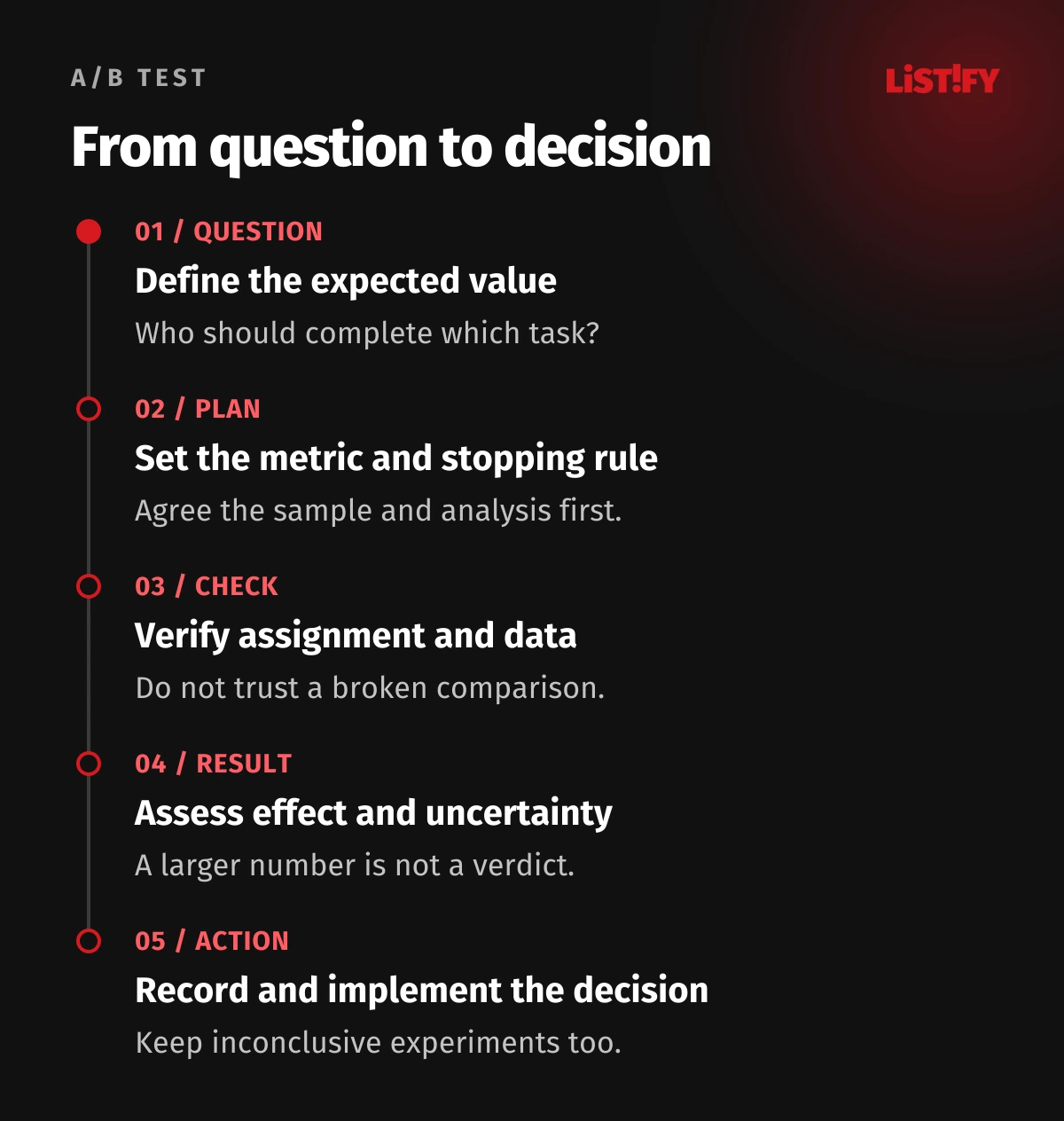
Two versions of a page, two different numbers and a winner announced too soon. That is how chance becomes an expensive business decision. A useful A/B test starts with a commercial question, assigns participants correctly and ends with an assessment of uncertainty and implementation costs. Here is what to prepare and when a different method makes more sense.
You can test an offer, the order of information or an entire checkout step. The objective is to learn whether a specific change helps the right people complete an important task. A collection of positive dashboard results is not enough to justify a rollout.
01Start with a problem worth making a decision about
A hypothesis should explain why the change could work. For example, customers misunderstand installation requirements, so you place a clear explanation before the enquiry form. You expect more qualified enquiries from people the service can actually help. This identifies the affected audience and the outcome to measure.
Look for evidence in calls, complaints, observation and your customer journey map. Heatmaps and behavioural analytics identify places to investigate, but clicks alone do not explain motivation. A button colour experiment needs a reason to suspect that people cannot recognise the action.
You can change a coherent group of elements together. The experiment then estimates the effect of that package, rather than each headline independently. Define what a successful result would actually teach you before building the variant.
02An A/B test is not a comparison with last month
Variants run concurrently and participants are assigned randomly. This helps separate their effects from seasonal demand, a different campaign or changing stock. Comparing performance before and after a redesign cannot isolate those influences by itself. It is useful monitoring, but it may not establish that the redesign caused an increase.
Choose the unit of assignment. This might be a user on a public website or an entire organisation in collaborative business software. A person should not switch versions on every page load. Handle sign-in, browsers and devices according to the available measurement capabilities, and record the limitations that remain.
Do not compare only people who clicked after seeing the variant. The change may itself affect whether they click, making that selected population misleading. Define eligibility before launch in a way that matches the experiment you intend to run.
03Choose one primary metric and monitor side effects
The primary metric should answer the business question. Examples include qualified enquiries per assigned visitor or paid orders within a defined completion window. Specify the numerator, denominator and timing. A button click is an intermediate action, not automatically a commercial outcome.
| Metric role | Example | Purpose |
|---|---|---|
| Primary outcome | Qualified enquiries per assigned user | Answers the commercial hypothesis. |
| Guardrail | Submission errors or page performance | Detects damage to an important part of the service. |
| Diagnostic measure | Form opens and individual steps | Helps explain how the change works. |
| Data quality | Assignment records and complete events | Checks whether the comparison is trustworthy. |
Apply the same qualification rules to both enquiry groups. If sales staff assess quality later, allow comparable time for both groups to mature. Otherwise, the last participants may look worse simply because nobody has contacted them yet. Our guide to UX metrics explains how to choose useful indicators.
04Plan the sample and stopping rule before launch
There is no universal requirement of one week or one hundred conversions. Sample size depends on the baseline, the effect you need to distinguish, variability and statistical method. Smaller effects generally require more information. Base the calculation on eligible traffic, not every page view on the website.
Identify the smallest improvement worth implementing and maintaining. Microsoft’s pre-experiment guidance covers hypothesis preparation and readiness. For your project, document the sample plan, duration, analysis method and conditions for stopping. The person approving the test should understand what decision it can support.
Include the relevant business cycle and outcome delay. A B2B sale that closes next month cannot be judged from tomorrow’s revenue. If the required test would take too long, change the question or the validation method. Reducing the standard merely to produce a winner does not solve the information problem.
05Check assignment and measurement before going live
Exercise both variants on supported devices, including errors and back navigation. Check that the experiment does not slow the page, flash both designs or alter consent and tracking in only one group. An A/A check with identical content can help assess new experimentation infrastructure, although passing it does not prove the system is flawless.
Microsoft describes Sample Ratio Mismatch as a warning that observed group sizes differ from the expected assignment in a way that chance does not reasonably explain. This does not mean groups must contain exactly equal numbers. Investigate a meaningful mismatch before using the experiment to make a decision.
Check missing records, redirects and inconsistent identity handling. Prepare your underlying events using our guide to website measurement with GA4. A dashboard full of percentages cannot replace clear definitions and a working data path.
Have a proposed change but are unsure whether you have enough data? Send Listify the page URL, its objective and approximate traffic. We can suggest a validation approach and the measurement work needed to support it.
06Monitor harm during the test without declaring a daily winner
Operational monitoring begins immediately. Stop a broken ordering process or a serious accessibility problem according to the agreed safety rule. Protecting users is a different decision from announcing success at the first favourable statistical result.
For a conventional fixed-plan test, repeatedly checking significance and stopping at the first success increases the risk of a false conclusion. Evan Miller illustrates this problem. Continuous decision-making requires a method designed for it. Check what your experimentation tool actually calculates rather than assuming its green indicator is sufficient.
Record the implications of any change to the objective or variant during the run. Concurrent experiments may interact along the same customer journey. For a small team, limiting that overlap and maintaining a change log is often more practical than trying to untangle several simultaneous changes later.
07An illustrative result: a larger number is not yet a winner
Consider invented data with 2,000 assigned users per variant. A produces 80 conversions and B produces 90. Those rates are 4% and 4.5%, a difference of 0.5 percentage points or a 12.5% relative increase. These figures are neither a recommended sample size nor the outcome of a Listify client project.
- Variant A: 80 / 2,0004.0%
- Variant B: 90 / 2,0004.5%
Illustrative data, not a client experiment. A 0.5 percentage point difference is a 12.5% relative increase. The chart does not show statistical uncertainty and cannot establish a winner by itself.
The decision also depends on estimation uncertainty, data quality and the prespecified analysis. A p-value is not the probability that a variant is bad. Even a statistically convincing small improvement may fail to cover additional servicing costs. Check lead quality, cancellations and other effects that a conversion count does not capture.
If the evidence is inconclusive, say that it does not support a decision. That is different from demonstrating equivalence. The next step depends on costs, risk and the range of effects that remains compatible with the data. Do not silently turn an uncertain result into “no difference”.
08When a different validation method is more useful
| Situation | Useful first step | What it cannot establish |
|---|---|---|
| Little relevant traffic | Observe customers completing a real task | An exact future conversion uplift. |
| Submission is demonstrably broken | Fix and verify the complete journey | A reason to retain a broken control. |
| Unclear offer or a new product | Interviews and prototype validation | That praise proves willingness to pay. |
| Reliable tracking and sufficient traffic | A planned controlled experiment | That one winner works everywhere forever. |
With forms, you may first discover a specific data-loss problem or an ambiguous question. A UX audit separates a defect requiring repair from a hypothesis worth comparing. You do not need a large experiment before removing a verified obstacle.
09Implement the decision and remove the experiment
Keep a record of the hypothesis, variants, dates, population, actual counts, primary metric, uncertainty, limitations and decision. Preserve inconclusive and unsuccessful experiments too. Otherwise, a new team may spend time asking the same question without knowing what was previously learned.
For variants on different URLs, follow Google’s website testing guidance: do not deliberately serve a different experience to crawlers, use appropriate canonical links and use 302 for temporary redirects. Remove obsolete variations and testing code when the experiment ends.
After rollout, monitor functionality and commercial performance. An experimental winner may not deliver the same effect with a different offer, season or audience. Turn the learning into the next specific question instead of treating it as a permanent rule for every page.
10Frequently asked questions
How much traffic do we need?
It depends on baseline performance, desired sensitivity and method. Count eligible experiment participants, not every site visit. A single recommended number without those inputs would be misleading.
Can we stop when the tool announces a winner?
Only when that matches the chosen analysis method and the data and operational conditions are satisfied. Check whether the tool supports continuous decisions and how it handles multiple metrics.
Must we test every headline independently?
No. You can compare a coherent change to the whole offer. The finding then applies to the package and cannot identify the contribution of each individual word.
What if clicks rise but enquiry quality falls?
Use the prespecified business objective and guardrails. Clicks are an intermediate step. More unsuitable enquiries can increase workload without creating useful sales.
Does A/B testing suit a small business website?
Sometimes, but low volume may require a very long wait. Consider checking measurement, fixing verified errors and testing usability first. The objective is a sound decision, not mandatory use of one method.