Protecting your online store during Black Friday and Christmas
Before peak season, establish the load your store can handle, the controls protecting it and who will make decisions when something fails. A larger server alone cannot fix a payment provider’s limit or a security rule blocking customers. Build a shared operating plan for technical teams, marketing, fulfillment and support, with tested boundaries and a way to limit operations.
A campaign launches, traffic climbs and orders stop reaching the warehouse. The website still responds. The cause might be an overloaded database, a partner limit or a security rule introduced the previous evening. In this illustrative incident, a prepared operating process matters more than improvisation.
Our Black Friday and Christmas store checklist covers the functional customer journey from advertisement to dispatch. Here we address capacity, defensive controls and coordination during peak demand. The aim is to find weak points and prepare a response, not promise an outage-free season.
01Give the season its own operating brief
Document campaign dates, promoted products, expected peaks and planned changes. Use the strongest comparable previous period, rather than only a monthly average. Record uncertainties: a new campaign can attract a different audience performing different operations. A single concurrent-user figure does not describe the load on search, checkout and administration.
Identify essential outcomes: accepting an order, confirming payment, reserving stock and handing work to the warehouse. Each needs an owner and an acceptable delay. Crossing that boundary should trigger a decision, not just a red number on a dashboard. Marketing, fulfillment and engineering should work from the same plan.
02Find the weakest link across the order workflow
| Area | Verify before the event | Owner |
|---|---|---|
| Application and database | Real throughput, slow operations and capacity headroom. | Development and operations. |
| Traffic protection | Rules, exceptions and effects on real customers. | Security and application operators. |
| External services | Limits, support availability and behavior under restriction. | Owner of each integration. |
| Fulfillment and support | Processing capacity and current limitation notices. | Operations manager. |
| Campaigns | Who can adjust incoming customer traffic. | Authorized marketing coordinator. |
A CDN can offload static content without accelerating every order write. Adding application servers cannot increase another company’s API capacity. Check account quotas and how long extra capacity actually takes to become available. Our guide to scaling a growing application explains the underlying planning.
03A load test should answer an agreed question
Agree the authorized test scope, environment and stopping conditions. Do not generate load against production or third-party services without agreement. Prepare a realistic mix of browsing, search, cart changes and orders. Tests must not trigger real shipments, unintended payments or customer messages.
Microsoft recommends performance tests with measurable objectives and realistic operating conditions. Measure completed operations, errors, response times and queue age. Averages can hide customers experiencing long delays, so examine the distribution and its causes.
Include sustained load, a sudden increase and recovery after restriction. Test less-warm caches and a realistic volume and structure of data. Fix the identified bottleneck, then verify again. Our web application performance guide explains diagnosing individual operations.
04Distinguish customer demand, attacks and protection mistakes
High traffic is not automatically an attack. Conversely, a small number of expensive requests may exhaust a sensitive part of the application. Operational reporting therefore needs request types, errors and effects on orders. If genuine buyers are being rejected, the count of blocked requests alone is not evidence of successful protection.
Cloudflare describes its WAF as filtering web and API requests through rules, while documenting DDoS protection separately. Specific capabilities depend on the service and plan. Neither layer replaces application fixes, correct permissions or a prepared operations team.
Before the event, validate new rules against actual user journeys. Pay particular attention to login, forms and server-to-server partner confirmations. An exception for a legitimate integration must preserve its verification, such as the provider’s documented signature check. Turning off protection wholesale at the first problem is not a prepared fallback.
05Payment, delivery and email services have their own limits
For each critical provider, record the account owner, plan, verified limits and escalation route. Determine whether a limit applies to the whole account, a particular operation or concurrent requests. For example, Stripe documents several API limit types. Its values cannot automatically be applied to another gateway or your particular workload.
Prepare for temporary unavailability through controlled waiting, safe retries and final-state reconciliation. When payment is uncertain, do not casually encourage another attempt that might create a second operation. Our API integration guide covers the behavior to establish.
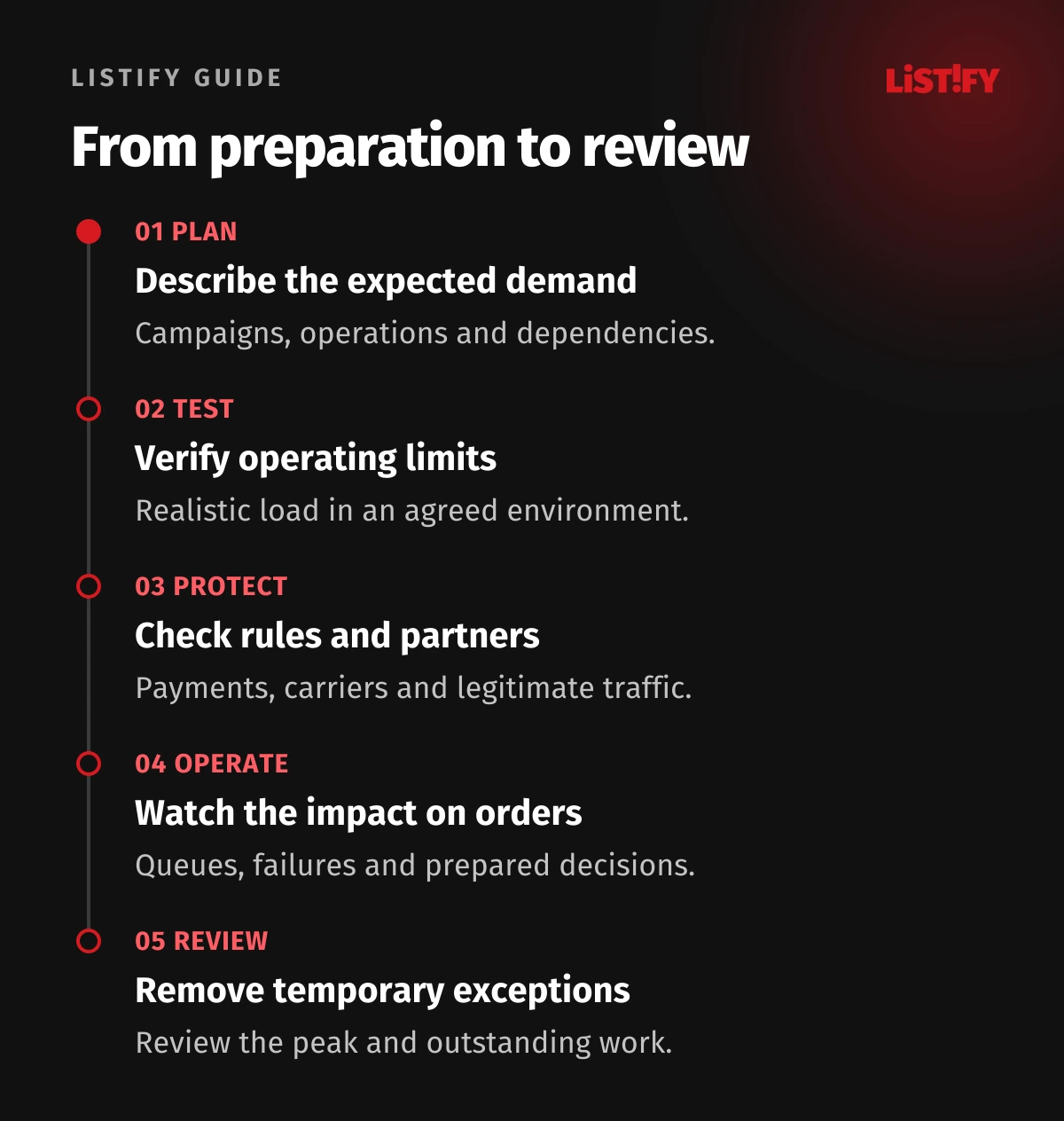
06Manage pre-event changes according to risk
Schedule substantial work with room for verification afterwards. Immediately before the peak, avoid unrelated changes whose value does not justify the risk. A change restriction must not prevent an urgent security fix, however. That needs an authorized decision maker, validation and a prepared response if it causes trouble.
The change record should also cover protection settings, payment configuration, DNS and third-party extensions. Preserve the necessary state and establish what can be reverted without losing new orders. Our server, HTTPS and cloud security guide covers the foundation. Operators must know what changed most recently and who changed it.
07Monitor business impact and make explicit decisions
| Signal | Distinguish first | Prepared decision |
|---|---|---|
| Outstanding orders are getting older | Capacity, invalid data or an unavailable partner. | Limit intake, restore transfer or correct the particular defect. |
| More uncertain payments | Delayed confirmation versus actual rejection. | Reconcile status and restrict the affected route. |
| Protection blocks more requests | Attack traffic versus legitimate activity. | Adjust the specific rule and validate its effect. |
| Warehouse processing falls behind | Technical failure versus fulfillment capacity. | Update promised timing and, if needed, order intake. |
Assign each decision to a person, deputy and communication channel. Agree who can pause a campaign, restrict a payment method or publish a service notice. Record change times so outcomes can be evaluated afterwards. Too many simultaneous fixes without coordination make the situation harder to understand.
08Prepare limited operation and safe recovery
Make the fallback specific: for example, leave the catalog available while stopping new orders that cannot be stored safely. A confirmation page must not be confused with actual order acceptance. Payments and reservations need explicit handling of unfinished cases, so unclear messages do not prompt customers to place another order.
Verify recovery and contacts before the event. The copy must contain the necessary components and remain accessible to an authorized person if the main account is unavailable. Restoring the whole database can remove newer orders while their payments remain at the gateway. Our backup and verified recovery guide explains the implications. Suspected compromise also requires coordination with incident response.
09Remove temporary exceptions after the season
Compare expectations with actual operations: where waiting occurred, which steps needed manual intervention and whether contacts worked. Separate outages from slowness and warehouse problems. Without that context, technical graphs can look healthy while customers do not receive orders as promised.
Review temporary permissions, security exceptions and expanded services. Reduce capacity according to the remaining workload: exports, returns and support can continue after the campaign. Retain scenarios and test results for the next peak. Through maintenance and support, Listify can help define a seasonal review and the resulting improvements.
10Frequently asked questions about seasonal store protection
Is increasing hosting capacity enough?
Only if you have established that hosting capacity is the constraint. The problem may be the database, application, an external API or fulfillment. Additional resources should follow measurement and validation of the complete order workflow.
Do we need both a WAF and DDoS protection?
The scope depends on your workload and architecture. They address different protection needs, although providers may bundle them. First establish what you already have, where traffic passes and who manages rules. A product name alone does not establish specific coverage.
Can we load-test a payment provider in test mode?
Only under the provider’s rules and agreement. A sandbox may have different capacity and behavior from production. Your own system can often be load-tested with a prepared partner simulation, while the actual integration is validated separately.
Should we immediately stop ads when something fails?
Decide according to impact and agreed conditions. If new orders cannot be accepted safely, additional traffic may worsen the situation. Technical coordination and marketing should have a shared process instead of waiting for improvised authorization.
What should we prepare for a seasonal review?
Provide the store URL, campaign plan, previous peak and critical service list. Add known problems and responsible contacts. Listify can help define the verification scope; an event date alone cannot justify a promise to fix every issue before it.