Deepfakes and CEO fraud: Verify who is really requesting a payment
When a caller claiming to be your CEO demands an immediate payment, how convincing they sound is not the deciding factor. What matters is whether the request passes your agreed checks. Deepfakes can imitate a voice or image, but your defense need not depend on spotting the imitation. Build a process that protects payments even when the person appears credible.
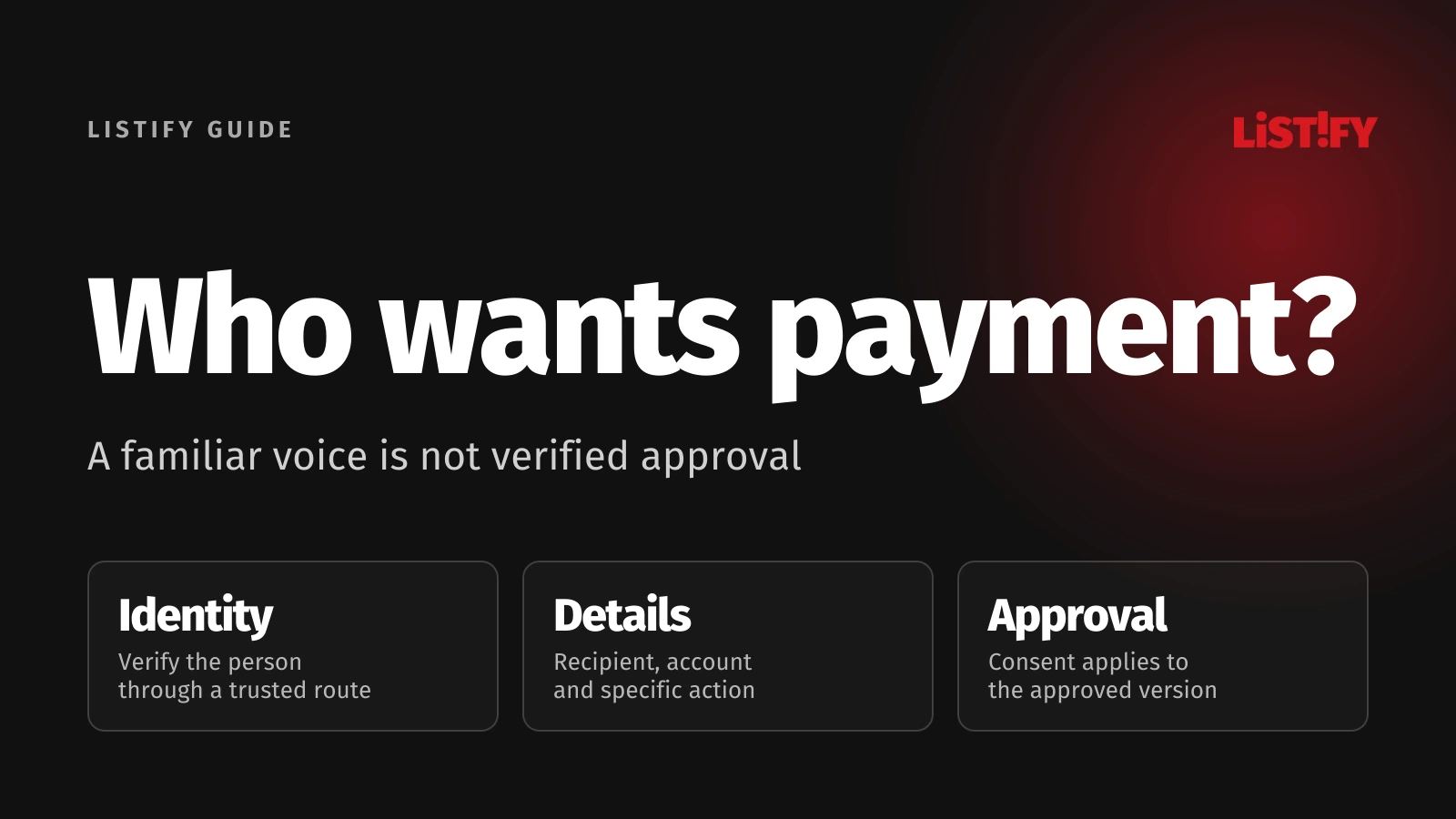
The finance team joins a video meeting. Familiar faces appear on screen and an executive asks for an exceptional payment. If that meeting replaces formal approval, the company relies on the appearance of communication instead of evidenced authorization. This is an illustrative scenario, not a client incident.
CEO fraud exploits supposed executive authority to obtain money, information or another sensitive action. It does not require AI or a compromised account. Deepfakes are one tool that can reinforce the deception. Our phishing and social engineering guide explains the broader context.
01Separate recognizing a person from authorizing an action
A familiar face, displayed name or knowledge of a project does not establish that you should perform the requested operation. Even the real CEO may need a second approval. Apply the same rule to email, calls, video meetings and work chat. Otherwise, an attacker can choose the channel with the weakest control.
You do not have to prove fraud before pausing a sensitive request. Missing the verification required for that action is sufficient. The employee is then following a normal business process, rather than arguing about whether they recognized the boss. Executives must follow that process themselves, including in genuinely urgent situations.
02Notice changes to the process, not just visual glitches
Warning signs include a new account number, unusual recipient, demand for secrecy or instruction to bypass an approver. Urgency alone does not prove fraud. It is a reason to preserve controls precisely when pressure could otherwise remove them. Fluent language and correct customer names do not guarantee legitimacy.
The FBI has warned about AI voice impersonation. The practical implication is not to use voice familiarity as the sole proof of identity. Visual defects may raise suspicion, but their absence does not authorize a payment. An automated detector also cannot replace the company’s approval process.
03Verify outside the channel that delivered the request
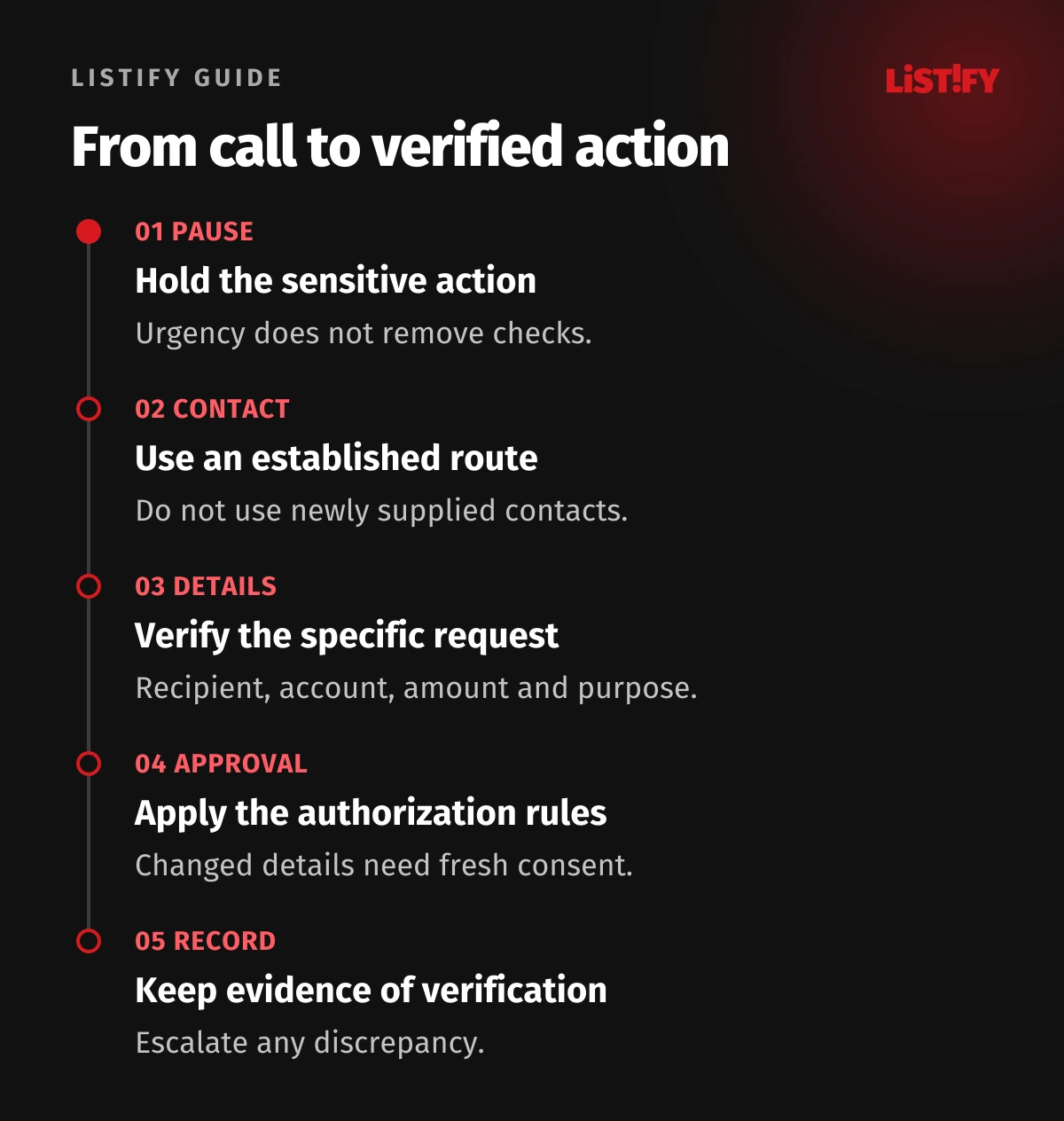
Pause the sensitive action and contact the requester using a route known before the message arrived. For a supplier, use a previously verified contact record, not the number on the new invoice. For an executive, initiate a separate trusted contact or confirm in person, followed by approval in the agreed system.
The UK government’s Business.gov.uk guidance recommends checking payment-detail changes through a trusted contact, rather than replying to the same suspicious thread. Two channels are not necessarily independent: email and chat may belong to the same compromised identity.
Name the specific action, recipient and changed detail during verification. A vague question such as “Did you send something to accounting?” is insufficient. If the requester is unavailable, use the agreed deputy. An unavailable approver must not automatically create an emergency bypass.
04What a video meeting establishes, and what it does not
| Observation | What it does not establish | Useful control |
|---|---|---|
| The voice sounds like a familiar executive | That the real executive requested this particular payment. | Separate verification and approval of specific details. |
| Several colleagues appear on screen | That every displayed participant independently authorized the action. | Separate approvers in the business system. |
| The person knows an internal project | That they are authorized to act on its information. | Check role, purpose and action scope. |
| The recording has no visible defects | That it is genuine and contains a currently valid instruction. | Verify provenance and the current request. |
The rules must also work during leave, business travel and financial closing. Document deputies and how to pause a request without losing its evidence. In a small team, separate preparation and approval proportionately. If no second authorized person is available, decide beforehand which operations must wait.
Even a genuine recording may contain an old or conditional instruction. Verify the current decision, not merely the origin of a voice. Put the request into a record that the approver opens through the usual route in your business application. A link supplied during the suspicious call does not replace that trusted route.
05Dual approval must check the actual details
The second approver must do more than confirm the first click. They need the recipient, account, amount, purpose and supporting records, including changes since the previous check. If bank details change after approval, the previous consent must not masquerade as consent to the new destination. Enforce the rule in the system, not only in a training presentation.
Where practical, separate permission to change supplier master data from permission to release payment. Record who approved what and when. Set thresholds according to business impact and responsibility. This article does not prescribe banking limits or establish the legal effect of a particular approval arrangement.
06Technical security protects accounts; the process protects decisions
Secure email, identity management and financial systems. Limit administrative rights, remove former employees’ access and review unusual changes. SSO, MFA and user management help reduce account takeover. Strong authentication still cannot prevent someone voluntarily authorizing a transaction because of a fraudulent explanation.
SPF, DKIM and DMARC address part of email-domain protection. They do not prove that every request is honest or eliminate misuse of a real mailbox. For sensitive information, add restricted exports, roles and traceable history. Our custom software data security guide explains related controls.
07Rehearse a convincing call and an unavailable verification route
An approved exercise does not need a clone of a colleague. Tell participants that the illustrative call sounds entirely convincing and ask them to walk through the decision. Then change one condition: the executive has no signal, the second approver cannot see the documents, or the account mentioned in the call differs from the application. Test whether the operation pauses, not whether somebody notices a visual flaw.
The exercise must not transfer real money or collect passwords. Verify how a deputy is used and how differences between spoken instructions and approval details are recorded. Follow-up employee training in the system should demonstrate this work. Fix the gaps found; promptly reporting uncertainty should be a successful outcome.
08Respond promptly to suspicion or a completed transfer
Pause related operations and notify the designated owner. If money has already been sent, contact your bank immediately through a verified route and ask it to address the fraudulent transfer. The FBI’s BEC guidance also emphasizes immediate contact with the financial institution. Recovery of funds cannot be promised.
Preserve original messages, call details, transaction references and a timeline. Avoid circulating sensitive attachments widely or deleting evidence to tidy up the incident. Report suspected crime to the appropriate law-enforcement authority in your country. The technical team should assess account compromise, active sessions and permission changes in parallel. If corporate email is unavailable, use the pre-agreed alternative contact route.
09Make approval independent of how a voice sounds
| Procedure element | Make it specific |
|---|---|
| Verification trigger | A changed recipient, account, permission or exceptional sensitive action. |
| Independent check | The trusted contact source and details to be verified. |
| Approval | Responsible roles, deputies and rules after details change. |
| Reporting and response | Bank contact, internal coordinator and evidence location. |
Bind consent to a specific version of the request in your application. The approver sees the same identifier, amount and recipient as the person preparing payment. Changing those details should return the record for review. Also check that the requester cannot create the second approval under another shared identity. This addresses a controllable part of the problem even when you cannot recognize synthetic speech.
Within an agreed security audit scope, Listify can assess the application, permissions and associated processes. Describe the approval route and systems for an initial conversation. This article does not offer specialist media forensics or bank fund-recovery services.
10Frequently asked questions about deepfakes and CEO fraud
Can I identify fraud by listening or watching?
You may notice anomalies, but failing to spot one does not establish identity. Use pre-agreed independent verification and approval for the particular action. Do not wait for technical proof of a deepfake when the sensitive request has not been properly verified.
Is calling the number in the incoming message enough?
No. The same fraudster may have supplied it. Use a number or route verified previously, or contact the person directly. Independence of the source matters more than simply switching to another communication application.
Would a shared secret word help?
It can supplement controls, but may leak or become outdated. It does not replace permissions, supporting records and approval of payment details. Do not rely on facts easily found in public profiles or ordinary company conversations.
Does this affect small companies too?
Yes. Access to payments and data matters more than team size. A small company needs a simpler but usable procedure: a trusted contact, clear deputies and a way to pause sensitive actions when the evidence does not match.
Do we need to buy a deepfake detector?
Start by checking your process. A detector may provide another signal, but its result has limitations and does not establish a payment’s business legitimacy. Request evidence for the intended use and retain independent approval controls.