International marketing: How to localize campaigns for a new market
A campaign is ready for a new market when the offer makes sense locally and your business can deliver on it. Translating an ad is only one task in that process. This guide explains how to choose a first market, adapt the full customer journey, run a focused pilot and judge results beyond the cost of a lead. It applies to Czech businesses expanding abroad and to teams entering another market from anywhere.
The ads are live, the landing page reads well and inquiries are arriving. Then a prospect receives an automated email in the wrong language, cannot find a delivery estimate or waits three days for a sales response. The advertising may be doing its job. The customer experience is where the expansion breaks down.
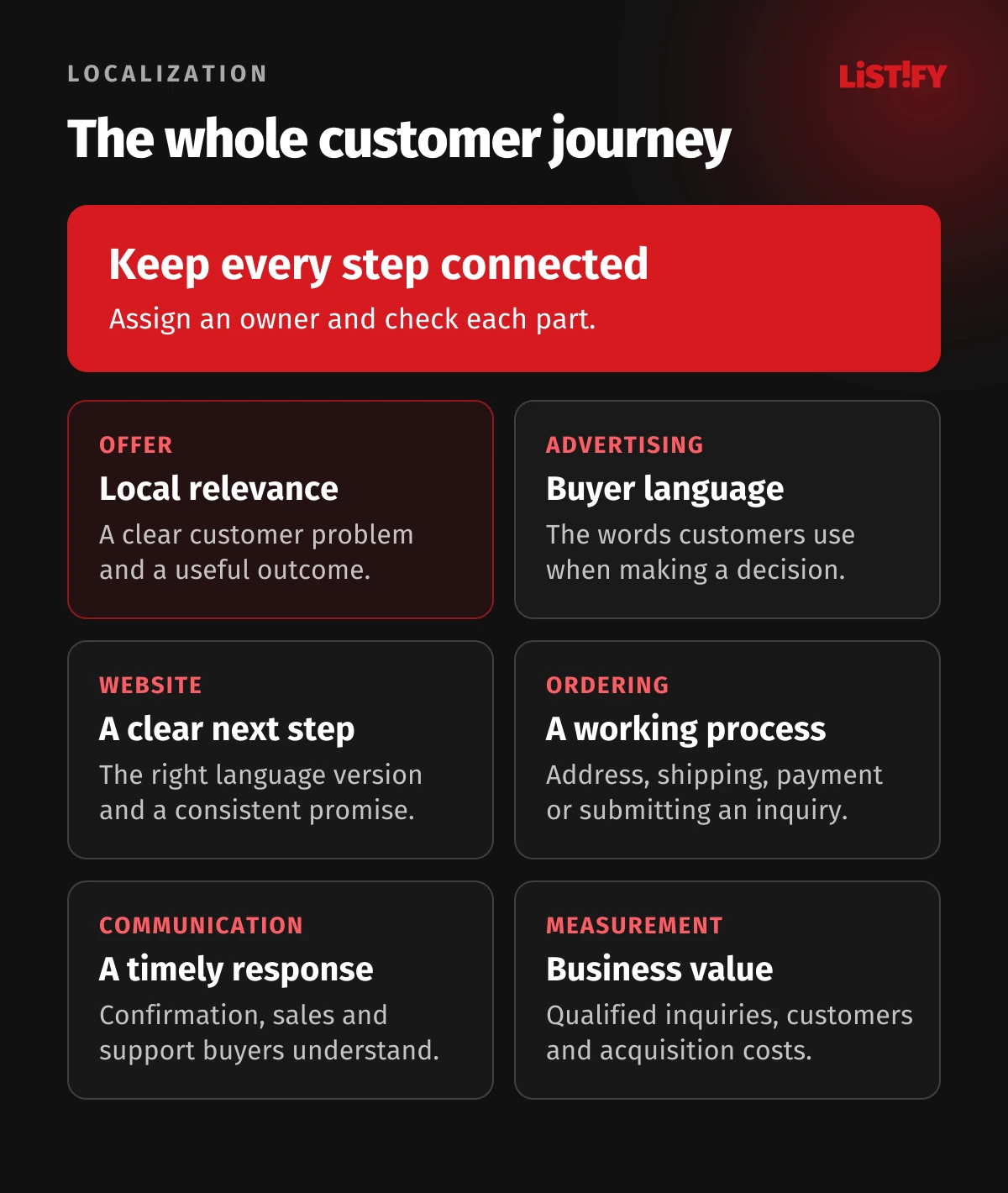
Localization connects the message to the service behind it. It covers the offer, website, checkout or sales process, support and measurement. Platform documentation was checked on October 23, 2026. The financial example and pilot schedule below are illustrative planning tools, not client results or promised returns.
01Choose the market you can learn from and serve
Population size is a poor starting point on its own. A useful first market has customers with a problem you solve, a practical way to reach them and a service model you can sustain. A smaller market where your team can respond quickly may teach you more than a large one where delivery and support are still unresolved.
Build a short evidence sheet for each candidate. Separate demand signals, service readiness and economics. Demand signals might include existing orders, conversations with buyers and relevant local searches. Service readiness includes language coverage, delivery, payment methods and available staff. Economics includes the contribution left after fulfilling the order, rather than revenue alone.
Mark the difference between evidence and assumptions. One enthusiastic conversation is useful, but it is not proof of repeatable demand. The first campaign should test your most important remaining uncertainty. If you enter five countries at once, you may spread the budget too thin to understand why any one of them worked.
Decide what you are willing to learn even if the pilot does not lead to expansion. Finding that your offer needs a different service package is a useful result. Spending the entire budget without a clear explanation of who responded is not.
02Research the words buyers use, not just their translations
A translated keyword can be grammatically correct and commercially unhelpful. Buyers may use another category name, describe the underlying problem or search for a specific outcome. Read local product categories, examine relevant search results and listen to sales conversations. Distinguish people researching a topic from people selecting a supplier.
Create a small working vocabulary for the first offer: the customer problem, the solution category, common objections and the desired outcome. Ask someone who understands both the market and the industry to review it. Native fluency alone does not guarantee that specialist terms sound natural to the intended buyer.
Our guide to online competitor analysis explains how to structure the research. Use competitors as evidence, not as a script. They may serve a different segment or have delivery capabilities you do not share. Your output should be a testable statement about a specific customer and a specific reason to buy.
03Adapt the offer before polishing the ad
The same product may need a different explanation in another market. Some buyers already understand the category and want to compare providers. Others first need to see how the service fits their workflow. Treat this as a question about a customer segment, not a national personality trait. Test the explanation with people who might actually buy.
Decide which parts stay consistent and which need local ownership. The product, service standard and visual identity may remain shared. Examples, packaging, currency, units, opening hours and the purchasing process may need changes. Any adjustment to a promise should be approved by the person responsible for delivering it.
| Area | Question to resolve | Useful output |
|---|---|---|
| Offer | Does this solve the same problem for this segment? | A clear reason to choose the service |
| Price and delivery | Can buyers understand the final cost and timing? | An offer they can evaluate |
| Proof | Is the evidence relevant and accurate? | A case study or demonstration with context |
| Support | Who will respond, in which language? | An owner and an agreed process |
This work also makes copy review easier. A reviewer can check whether the headline expresses the agreed offer instead of choosing between attractive phrases with different promises. Keep those decisions in a shared brief so that ads, sales presentations and the website stay aligned.
04Localize the journey all the way through
After the click, the page should continue the language and promise of the ad. Check the form, confirmation message, automated email, calendar invitation and sales proposal. For software, include registration, first login and the help available when someone gets stuck. A polished landing page cannot compensate for an unreadable next step.
For commerce, test stock information, the cart, address entry, shipping, payment and order confirmation. Google Merchant Center expects language and pricing consistency through checkout; supported currency conversion has specific exceptions. Review the applicable checkout requirements before launching product campaigns.
Try the form with real local formats. A Czech postal-code rule, a fixed phone-number length or a mandatory field that does not apply locally can block a valid customer. Microsoft’s international address guidance explains why one rigid format does not work everywhere. A short test with a local user is often more revealing than another pass over the headline.
Include error states in the test. What happens after a failed payment, an unavailable appointment or an incomplete address? These messages need to be as understandable as the happy path. They often appear at the moment when the customer is deciding whether to keep trying.
05Separate geography, language and your service area
A person can live in one country, browse in another language and buy on behalf of a business elsewhere. Make three separate decisions: where you want to reach people, which language you will use and where you can actually fulfill the offer. Confusing these decisions creates inquiries that look relevant but cannot become customers.
Google Ads location options distinguish presence from a broader combination of presence and interest. The broader default may not fit a tightly local service. Review both the settings and the geography of actual results using Google’s location-targeting guidance.
There is also a recent change to check: Google describes a rollout from September 2026 that matches language automatically from ads for Search and the Search part of Performance Max. Other channels differ. Consult the current language-targeting rules for your campaign type.
Keep the pilot organized so you can identify the market, offer and objective behind each result. A separate advertising account is not automatically necessary for every language. What matters is that you can see the relevant spend, interpret outcomes and control the experiment’s budget without guesswork.
06Give each language version a stable home
Customers should be able to return to the right version from a saved link. Use stable URLs and a visible language switcher. Google recommends separate URLs and cautions against automatic redirects that can hide versions from users or crawlers. See its multilingual-site guidance.
Use reciprocal hreflang references for equivalent versions, including self-references. Do not label a different service page as a translation. Hreflang helps distinguish alternatives; it does not guarantee rankings. Google’s localized-page documentation describes the implementation.
The maintenance process matters as much as the initial setup. When a Czech offer changes, who updates the other versions? Record the page owner, last review and corresponding pages. A shared content system helps only if someone is responsible for keeping the actual claims current. Use our SEO audit guide to check technical and content obstacles before expanding the site.
Treat the language switcher as part of the customer journey. If someone switches while reading a service page, the useful destination is its corresponding version, when one exists. Sending every visitor to a generic homepage forces them to find the same information again.
07Make your evidence understandable to a new buyer
A company entering a market often lacks local recognition. Show who provides the service, how the engagement works and what the buyer can expect to receive. A Czech case study can still be persuasive abroad if it explains the industry, starting problem, scope and outcome. Do not imply a local office or customer relationship that does not exist.
Label translated testimonials and preserve their meaning. If you do not yet have a relevant case study, use a product demonstration, a sample deliverable or a clear explanation of the process. Identify hypothetical examples as such. Generic claims about superior quality do not fill the evidence gap. Our guide to testimonials, case studies and reviews explains how to build useful evidence without empty claims.
Ask a local reader what would stop them taking the next step. The missing detail might be a compatible integration, an available meeting time or an explanation of invoicing. These practical uncertainties can matter more than a subtle stylistic difference between two ad headlines.
08Measure the business result by market
Agree on the definitions of an inquiry, a qualified opportunity and a new customer before launch. Apply comparable qualification rules across markets. Otherwise, one sales team may count every form submission while another counts only booked meetings. A dashboard can look precise while comparing different things.
For B2B, connect campaign reporting to the later stages of the opportunity. Google Ads supports values associated with qualified or closed leads; its conversion-value guidance explains the options. Validate attribution and use only data you are permitted to process for the intended purpose.
Keep original currency separate from reporting currency. A value of 100 is ambiguous without its unit. Google documents currency handling in its conversion currency guidance. Your financial view should also distinguish revenue, contribution after variable costs and actual profit.
Compare customer groups that have had a similar opportunity to mature. If a sale usually takes weeks, the first Friday is too early for a final commercial verdict. A useful marketing report for executives shows costs, quality and open opportunities, including what is not yet known.
09Worked example: a cheaper lead can cost more
Consider two fictional markets observed over the same period. Each receives EUR 1,500 in advertising spend. Market A produces 60 inquiries and six customers. Market B produces 30 inquiries and nine customers. Assume each new customer contributes EUR 400 after variable fulfillment costs, before advertising and fixed costs. These inputs are chosen only to explain the calculation.
| Measure | Illustrative market A | Illustrative market B |
|---|---|---|
| Advertising spend | EUR 1,500 | EUR 1,500 |
| Inquiries | 60 | 30 |
| Cost per inquiry | EUR 25 | EUR 50 |
| New customers | 6 | 9 |
| Ad cost per customer | EUR 250 | EUR 166.67 |
| Contribution after advertising | EUR 900 | EUR 2,100 |
- Market A250.00
- Market B166.67
Fictional teaching example: EUR 1,500 / 6 customers and EUR 1,500 / 9 customers. Lower is better in this comparison. These are not benchmarks or campaign results.
Market A has half the cost per inquiry, yet it costs more to acquire a customer in this example. That does not prove market B will remain stronger. A small number of sales, a different customer mix or later refunds could change the conclusion. The point is narrower: cost per lead alone cannot settle an expansion decision.
Before increasing spend, include translation, account management, support and sales costs. Some are one-time investments; others increase with volume. Our guide to setting an online marketing budget helps structure that discussion. Do not present contribution after advertising as net profit.
10Run a pilot that answers one clear question
A useful question is: can we acquire qualified inquiries from manufacturing companies in this market and respond to them on time? “Will international marketing work?” is too broad. The specific question helps you choose the audience, offer, measurement and next decision. The broad one encourages too many simultaneous changes.
Set a spending limit and write the continuation criteria before launch. Separate operational stop conditions, such as broken tracking or unavailable support, from commercial evaluation. A weak first day may not tell you much. Repeated inquiries from people you cannot serve are a reason to inspect the offer and targeting.
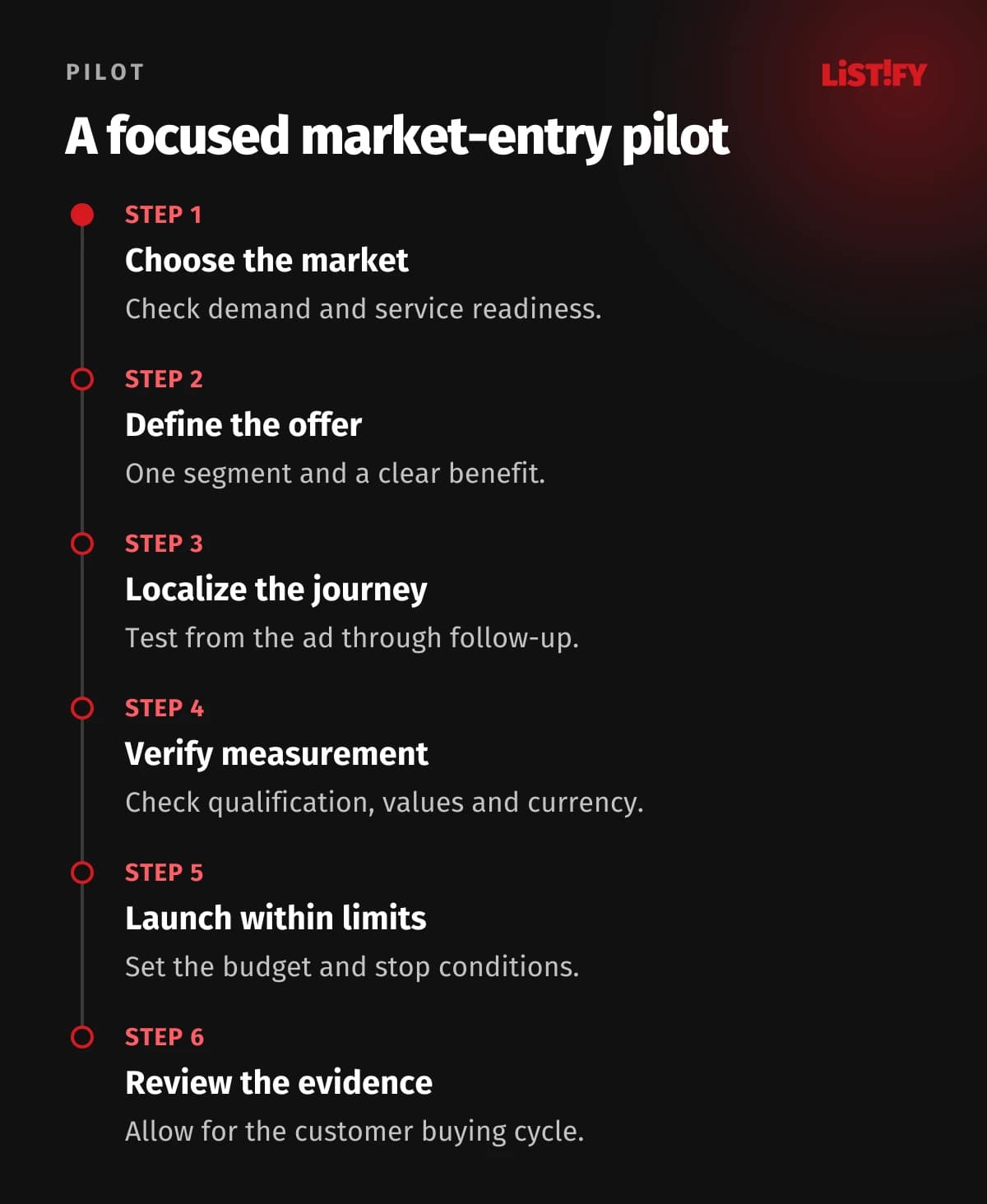
The six-step sequence below could be organized over six weeks, but it is only a planning example. A long B2B sales cycle may need much more time to produce closed deals. In that case, the sixth-week review evaluates readiness and opportunity quality, not final profitability.
11Scale at the pace the business can support
A successful campaign can outrun the operation behind it. If sales cannot respond or support relies on unclear translations, extra spend magnifies the problem. Before expanding, check service availability and delivery promises alongside the advertising metrics.
Assign one market owner to connect marketing, sales and operations. That person does not need to do every task, but should be able to see the whole journey. A short recurring review should cover objections, lost deals, website problems, offer changes and the next action with a named owner.
When you add another country, revisit the assumptions. An effective English page does not establish demand everywhere English is understood. You can reuse the operating process and measurement structure. You still need evidence for the offer, demand and service model in the next market.
Keep a decision log as the pilot develops. Record what changed, why and which result you expect to observe. Without that record, a better week can be credited to the latest headline even when the real change was a faster sales response or a different mix of inquiries.
12A practical launch checklist
- One target segment, one offer and a clear question for the pilot.
- Local terminology and copy reviewed by an industry-aware speaker.
- A tested journey from the ad through ordering or the sales response.
- Named sales and support owners, including a process for requests you cannot serve.
- Verified measurement, currencies, qualification rules and attribution.
- A budget cap, operational stop conditions and a review date suited to the buying cycle.
A missing item does not have to stop all preparation. Identify the specific gap and assign someone to close it. The purpose is to launch an experiment that produces useful evidence, including evidence that a particular market is not ready for investment.
13Questions about localizing international campaigns
Can we just translate our existing ads?
Translation can provide a starting draft. Before launch, validate local terminology, the offer, landing pages, forms and follow-up communication. Buyers need a coherent service through the completed order or sale.
Do we need a separate website for every country?
Not necessarily. You need clearly accessible language or regional versions and correct relationships between equivalent pages. Choose domains and URL structure around the markets, content workflow and operating model.
How much should the first campaign cost?
Work backward from the pilot question, relevant traffic costs, contribution margin and buying cycle. Include localization, measurement and service costs. There is no single budget that is meaningful for every country and industry.
Can AI help with localization?
Yes. It can help draft copy and alternatives. A person who understands the language and industry should review the final offer and customer journey. AI cannot establish local demand or confirm that your company can deliver its promises.
How should we choose the first market?
Combine evidence of demand with service readiness and delivery economics. The largest market is not automatically the best experiment. A market where you can identify and fix problems quickly can be a better starting point.
When should we judge the results?
Fix technical problems immediately. Judge commercial outcomes after a period that reflects the buying cycle, using comparable data. In B2B, separate early signs of opportunity quality from deals that close later.
Is a low cost per lead a sign of success?
It is only one signal. Check whether the inquiries fit the offer, become customers and leave sufficient contribution after costs. Cheap contacts outside the target segment can consume sales capacity without creating value.
14Sources and model limitations
Technical details are based on the linked primary documentation from Google Ads, Google Search Central, Merchant Center and Microsoft, checked October 23, 2026. Available settings can differ by campaign type and rollout stage.
The financial table, chart and six-step pilot are original illustrative tools. They are not market statistics, a recommended spending level or published Listify client results. Use your actual costs, service capacity and sufficiently mature business data for an investment decision.