Testimonials, case studies and reviews: build trust with evidence
A testimonial should help a customer assess the risk they feel before buying. A familiar logo, a positive quote and a detailed case study do different jobs. Putting them all on a references page does not guarantee that visitors will find the answer they need. Here is how to choose useful evidence, collect specific feedback, describe outcomes accurately and put the right proof beside the decision it supports.
This guide is for businesses that want to make better use of real work and genuine customer experiences. It contains no invented client stories, attributed quotes or promised conversion increases. We checked the linked Google policies on October 23, 2026. The interview, documentation and placement advice is an editorial workflow, rather than legal guidance.
If you are preparing an entire new website, also use our website content checklist. Plan testimonials alongside the offer and page structure, so they relate to what your business actually sells.
01Different kinds of proof answer different questions
Someone choosing a supplier rarely wants to know only whether its customers are happy. They need to judge whether the company understands their situation, can deliver the agreed scope and will be straightforward to work with. Choose evidence around that uncertainty. A short quote can describe communication well without explaining the technical outcome of a project.
| Format | What it can support | What it does not establish alone |
|---|---|---|
| Client logo | A specific, documented business relationship | Project scope, endorsement or results |
| Client quote | One person’s experience | The typical outcome for every customer |
| Case study | Context, decisions and a documented outcome | That the same approach will work everywhere |
| Public review | An experience published on another platform | A complete picture of every engagement |
| Work sample | The appearance or operation of a deliverable | The quality of the entire engagement or its return |
Start with one well-explained example for a core service. A wall of famous logos may look impressive, but it does not tell a buyer whether you built a whole system or changed a single page. Describe your role accurately. That detail lets the reader decide how much weight to give the example.
02List the concerns customers raise before buying
Talk to sales, support and the people delivering the work. Record questions that recur before a contract is signed: do you understand our industry, will operations be disrupted, who will communicate with us, and what happens if the scope changes? These questions give you a more useful brief than “we need more testimonials.”
Match each concern to available evidence. That could be an approved comment about the working relationship, an account of a handover, a project photograph or a record that a requirement was met. Mark the gaps too. If you can document the appearance of the result but not a cost saving, do not claim a saving because it would make a stronger headline.
Choose the most important concern for each service. Precision and handover may matter for custom manufacturing; support availability may matter for an ongoing contract. The same quote does not need to appear everywhere. Different pages serve different decisions.
The output is a simple map: customer question, suitable evidence, source and intended page. Missing evidence becomes a research task, rather than an invitation to fill the space with a confident claim.
03Choose a relevant situation, not just a recognizable name
Your best-known client may not be the most persuasive example for every reader. The owner of a small service business may recognize their own situation in a project with a similar team, constraints and way of working. A large brand can be interesting, but the reader still needs to understand what connects that experience to their decision.
When choosing a case study, compare the problem, scope, operating environment and your company’s role. A useful project does not require spectacular numbers. A clearly explained transition that preserved an important process can teach more than an isolated revenue graph nobody can account for.
Create a shortlist and check whether each project has supporting material and somebody who can confirm it. Consider whether it still represents your current offer and whether you provide the services described. Company history and current capabilities are related, but they are not identical.
If the client cannot be named, consider an honestly anonymized account with its limits made clear. Do not combine several projects into one supposed client story. Readers would reasonably assume it describes a single experience, when nobody actually had that experience.
04Use interviews to collect a specific experience
Instead of asking “Were you happy?”, ask the customer to describe what happened. What did they need to solve? What concerned them? What did they experience during the work? What would they tell another business facing the same decision? Open questions leave room for an answer you have not written in advance.
Keep opinions separate from verifiable claims. “Communication was clear for us” is a personal assessment. “We always received an answer within an hour” is more specific and may require checking the period and exceptions. Do not edit the latter into a permanent service promise based on one engagement.
- Ask about the original problem and constraints.
- Invite the client to describe a particular moment or change.
- Explore what was difficult and how it was handled.
- Check the name, role, dates and scope of the work.
- Send the selected quote and its context for explicit approval.
Editing should remove clutter, not alter meaning. If a quote is translated, retain the original and have the meaning of the published version checked. The customer should understand where their words will appear and how they will be presented.
05Build a case study around context and decisions
A useful case study lets readers judge whether an experience is relevant to their own circumstances. Start with the problem and baseline. Explain the scope of your work, important decisions, outcome and limitations. Mention tools when they explain a choice or a consequence for the client, rather than treating a technology list as the story.
| Section | What to supply from real records |
|---|---|
| Situation | Business type, process, constraints and period |
| Baseline | The observed problem and how it was identified |
| Brief | What was to be delivered and what was excluded |
| Approach | Important decisions, collaboration and difficulties |
| Outcome | Verified change, source and evaluation date |
| Limits | Other influences, exceptions and unresolved questions |
Do not automatically omit the difficult part. A factual account of a scope change or an unsuccessful first proposal can explain how your team works. You do not need to publish every internal detail, but a frictionless story without a meaningful decision gives buyers little to assess.
End with a relevant next step, such as a related service or a discussion of the reader’s situation. They may not want a copy of the solution described. Show how a conversation about their own problem would begin. Our project portfolio shows different types of deliverables.
06Give results a source, a period and clear limits
For every number, obtain the original evidence, definition and time period. “More leads” could mean more forms, more suitable prospects or more signed contracts. Those outcomes are not interchangeable. Agree with the client on what was measured and who can confirm it before publishing the claim.
A before-and-after comparison can be informative, but it does not isolate the effect of a price change, advertising campaign, season or capacity increase. If you cannot separate those influences, describe the observed development and the limitations. Do not attribute the whole difference to your work simply because it happened in the same period.
Missing numbers do not need to be replaced with estimates. You can document a specific operational outcome: an approval process introduced, a language version delivered or a defined set of records brought together. Distinguish a delivered capability from its long-term commercial value. The first may be confirmed while the second is still being assessed.
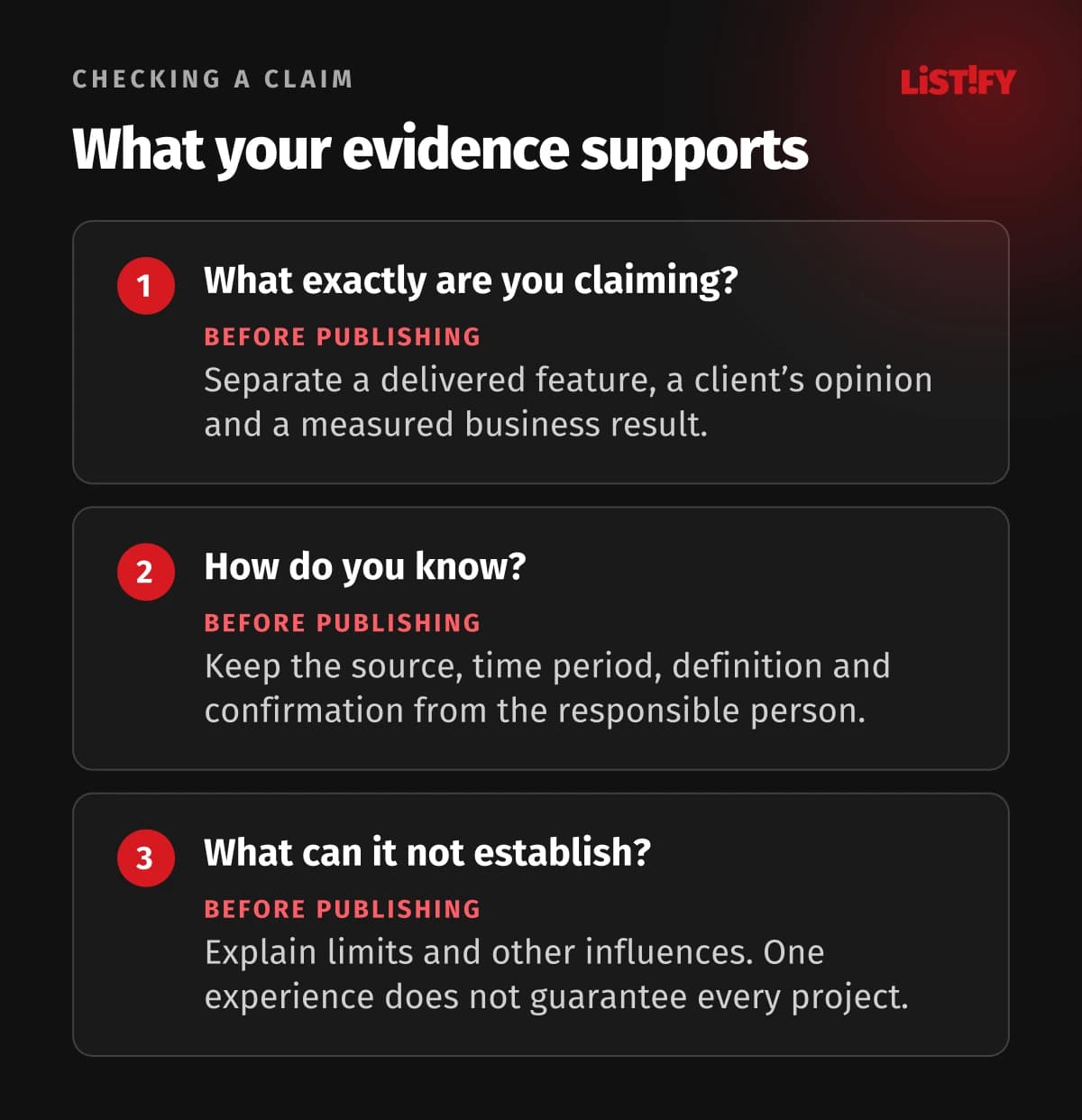
07Create a simple approval and evidence register
For each item, record the original file or link, contact person, approved wording, agreed use and review date. Confirm names, job titles, photographs and logos separately. The practical aim is to avoid copying material from a presentation when nobody knows what the client agreed it could be used for.
Give one person responsibility for the register. Sales may arrange the interview, a writer may edit the quote and a designer may crop a photograph, but somebody needs to check the complete publication. An approved sentence can take on a different meaning under a new headline. Keep the version that was actually published as well as the underlying material.
Revisit the label when the quoted person changes roles or the business relationship changes. An older testimonial can remain useful if its period is clear. It should not imply a current relationship that no longer exists.
For sensitive, contractually restricted or regulated projects, have the relevant person assess the specific conditions. This editorial workflow does not replace legal review of particular materials. One ordinary testimonial cannot establish a universal rule for every industry.
08Ask for public reviews without steering the outcome
Google requires genuine experiences and prohibits incentives and selectively seeking only positive reviews. Do not send satisfied customers to Google while routing dissatisfied customers into a private-only form.
Choose a suitable point after the customer has had the experience, and apply a consistent rule for whom you ask. Keep the request short, voluntary and free of demands for a particular star rating. Ask for the customer’s own experience, without specifying the content or wording, and do not write the review for them.
Business Profile provides a review link and QR code. Check that they lead to the correct location. A link on a receipt or in a message should make the process easier, without pressuring the customer to publish a rating before their issue is resolved.
Keep review requests separate from case-study discussions. A review is the customer’s own contribution to a platform. A case study is content prepared and verified for your website. They need different processes and different expectations.
09Respond to criticism for the writer and future readers
Business replies to reviews are public. Write so that someone unfamiliar with the situation can understand the response. Check the facts internally first. Then acknowledge the specific issue, explain the next step and move private details to a suitable private channel.
Do not publish a customer’s phone number, order details or internal history to prove your side of the story. Avoid promises you do not have the authority to deliver. If you are still investigating, say so plainly and explain how the issue can be taken forward. A generic apology pasted repeatedly tells readers little about whether you understood the problem.
Reviews can be reported for policy violations, not simply because you disagree with them. Reporting does not guarantee removal. Record the reason and supporting evidence. Creating your own positive reviews to counter criticism is not an acceptable response.
Look for recurring themes. If customers repeatedly mention unclear prices, slow communication or missing information before a visit, the solution may require a service or website change. Replying to feedback does not remove the operational cause of a complaint.
10Place evidence beside the decision it supports
Put a relevant service testimonial on that service’s page. Link an explanation of a difficult transition to a case study showing how the process worked. Near a form, a concise explanation of what happens next may be supported by a relevant customer experience. You do not need to fill every available space with praise.
Design for two levels of attention. A visitor should quickly understand who is speaking and what the experience concerns. Someone wanting detail should be able to read the full account or reach the original public review. A screenshot with tiny text and no source makes that unnecessarily difficult.
Check readability, length and controls on mobile. Do not hide essential evidence only inside an automatically rotating carousel. Give images useful alternative text; a picture of stars is not a substitute for an understandable explanation of the rating’s source.
Testimonials should also support, rather than replace, the offer. Customers still need to know what you sell, who it suits and how to proceed. Our article on why a pretty website is not enough explores how content and customer decisions fit together.
11Maintain the evidence and avoid promising search stars
Set a review schedule that matches how quickly the business changes. Check links, job titles, product versions and whether claims still match their supporting records. If a public review disappears or changes, inspect any version reproduced on your website. Historical work can remain useful with a clear date and description of its scope.
Do not promise that a review widget will automatically add stars to Google results. Reviews controlled by the reviewed business are ineligible for this feature for LocalBusiness and Organization, including third-party widgets. This concerns a particular search feature; it does not prohibit publishing customer experiences on your website.
For an external widget, also check performance, what it loads and its behavior when optional technologies have not been accepted. Involve a developer and the person responsible for privacy where the implementation requires it. An editorial need should not automatically determine a technical integration.
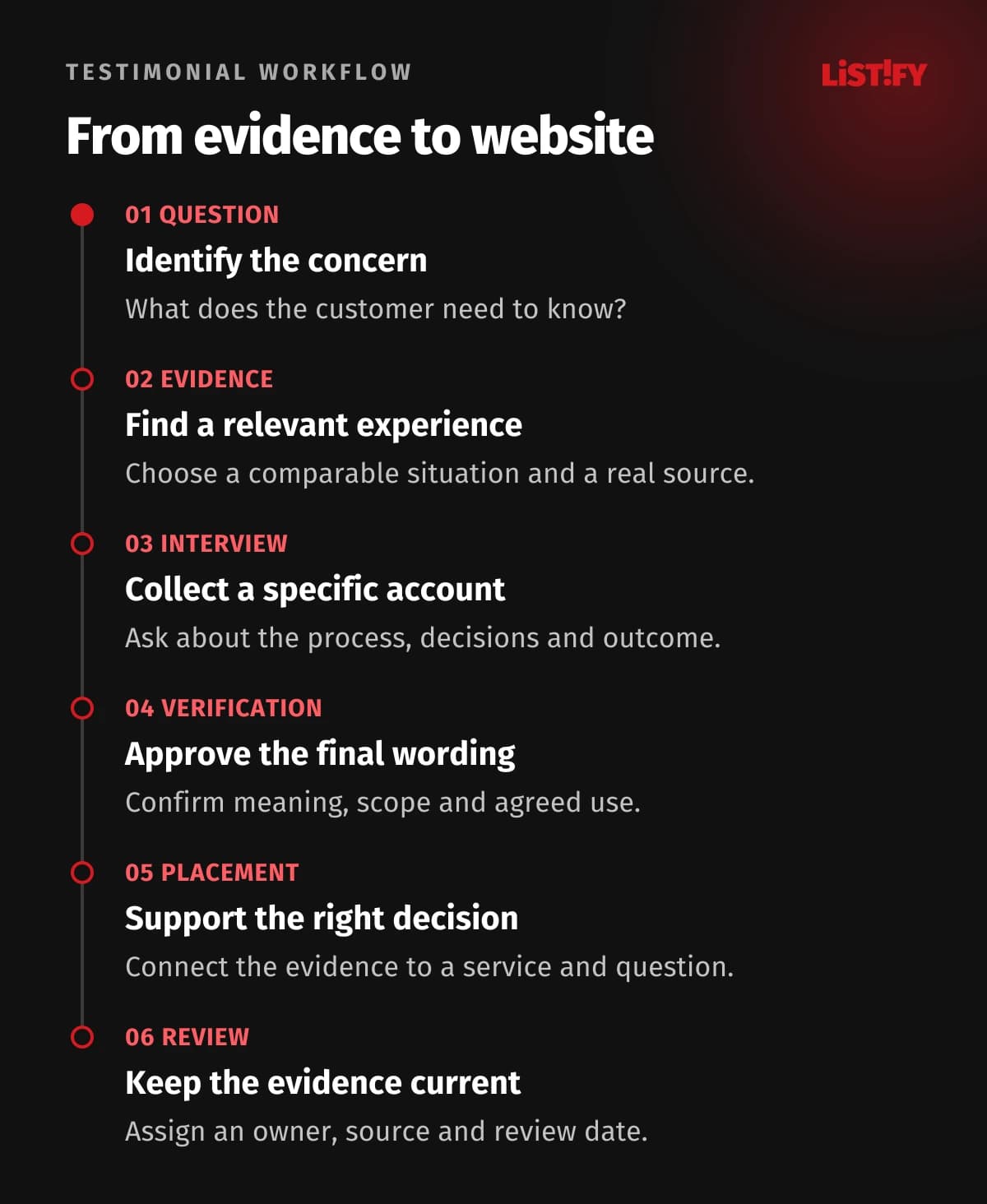
12Measure whether the content helps people decide
Write down what you want to learn before making a change. You might ask whether visitors to a service page use its case study and whether sales receives better-informed questions. Opening a case study is useful behavioral information, but it does not prove the study caused a sale. Our SEO audit guide helps distinguish search visibility from problems after the visit.
With sufficient traffic and suitable measurement, you can compare versions with one main change. At lower volumes, a few customer conversations and a record of recurring objections may provide more practical evidence. Do not force small numbers to support a conclusion they cannot justify. Record changes in campaigns, prices and the offer as well.
Ask sales which examples customers actually mention and what remains unclear after reading them. Use the answers to improve context, rather than simply add more logos. The most useful first change may be a small clarification.
Start with one service. Identify the main concern, find supporting material, prepare an approved quote or case study and place it where it belongs. Assign an owner and review date. Once the process works, extend it to other parts of the website.
13Frequently asked questions
How many testimonials does our website need?
There is no universally correct number. Start with evidence for your most important services and customer concerns. A few specific, traceable experiences can be more useful than a long gallery without context. Add examples to cover missing situations, rather than to fill a template.
What if we do not have measurable business results?
Describe the documented scope, starting problem, decisions and deliverable. Include an approved customer experience where available. Do not present a delivered feature as proven return on investment, or replace missing figures with an estimate that looks like a measured result.
Can we publish an anonymous case study?
Yes, if it truthfully describes specific work and explains the anonymity. Retain useful context within what you can publish, and keep the supporting evidence internally. Do not combine several projects into one supposed client. An anonymous account naturally gives readers less opportunity for independent verification.
Can we draft a quote for a client?
You can help edit their genuine account and send the final wording for approval. Do not assign them an experience they never described. A public platform review should be written in the customer’s own words; it serves a different purpose from collaboratively prepared website content.
Should we answer a short negative review?
Decide based on its substance and whether a useful response is possible. Check the situation, explain the next step briefly and keep personal details private. Avoid arguing over every adjective. The response should show future readers how your business handles a concern.
What if a client changes their mind about publication?
Find the approval and agreed scope, understand the reason and review the specific material with the responsible person. You need to know which pages and other assets use it. That is why a maintained register is useful, rather than scattered files with no owner.
How can we tell whether testimonials work?
Look for evidence that they help people understand the offer and make suitable inquiries. Interpret the available data carefully: a case-study click does not establish the cause of a sale. Combine website behavior, sales feedback and the actual questions customers ask.
14Sources
Official Google policies and help pages checked on October 23, 2026. The case-study outline and workflow are editorial recommendations, not published client results.