TikTok for businesses: What to try beyond dance trends
Customers keep asking how to recognise a good installation, why two quotes differ or what to prepare before ordering. Those questions can become useful TikTok videos. Start with a clear answer and a demonstration, then test whether you can reach a relevant audience.
01Check who you can help and what you can show
A company account needs a reason for a prospective customer to pay attention. A manufacturer could compare materials, an accountant could explain which records to prepare, and a software company could demonstrate the removal of repetitive data entry. These are sensible hypotheses to test, not formats with guaranteed performance.
Explore searches and videos related to your field. Look for the language, problems and questions of relevant people. Read the comments as well as checking view counts. Are people asking about buying or using the product, or simply reacting to a joke? A large audience in a market you do not serve may offer little commercial value.
Choose one main purpose before testing: enquiries for a particular service, shop visits or suitable job applicants, for example. Each requires different content and measurement. If you lack useful footage, someone to check technical answers or time to respond, start with a small series. A commitment to daily posting cannot replace those resources.
For a wider plan across channels, read our guide to a social media strategy that builds a community.
02Choose formats that help customers make decisions
A useful series has a repeatable question or structure. You do not need a completely new visual approach for every video. Select a few formats and address a specific customer situation in each. The following are illustrative ideas, not claims about real client results.
| Format | Illustrative idea | Value for the viewer |
|---|---|---|
| Process demonstration | Checking a joint before handover | Understanding workmanship |
| Comparison | Two materials for damp conditions | A useful selection criterion |
| Objection explained | What affects installation costs | Understanding a quotation |
| Common mistake | A missing measurement on an order | Avoiding a preventable problem |
| Customer preparation | What to prepare before a service visit | A practical next step |
For a comparison, explain when your conclusion applies. The more expensive material is not necessarily right for every job. Keep conditions comparable in before-and-after demonstrations and label illustrative work honestly. Explaining a solution's limitations can be as useful as showing its strengths.
03Build the script around one piece of evidence
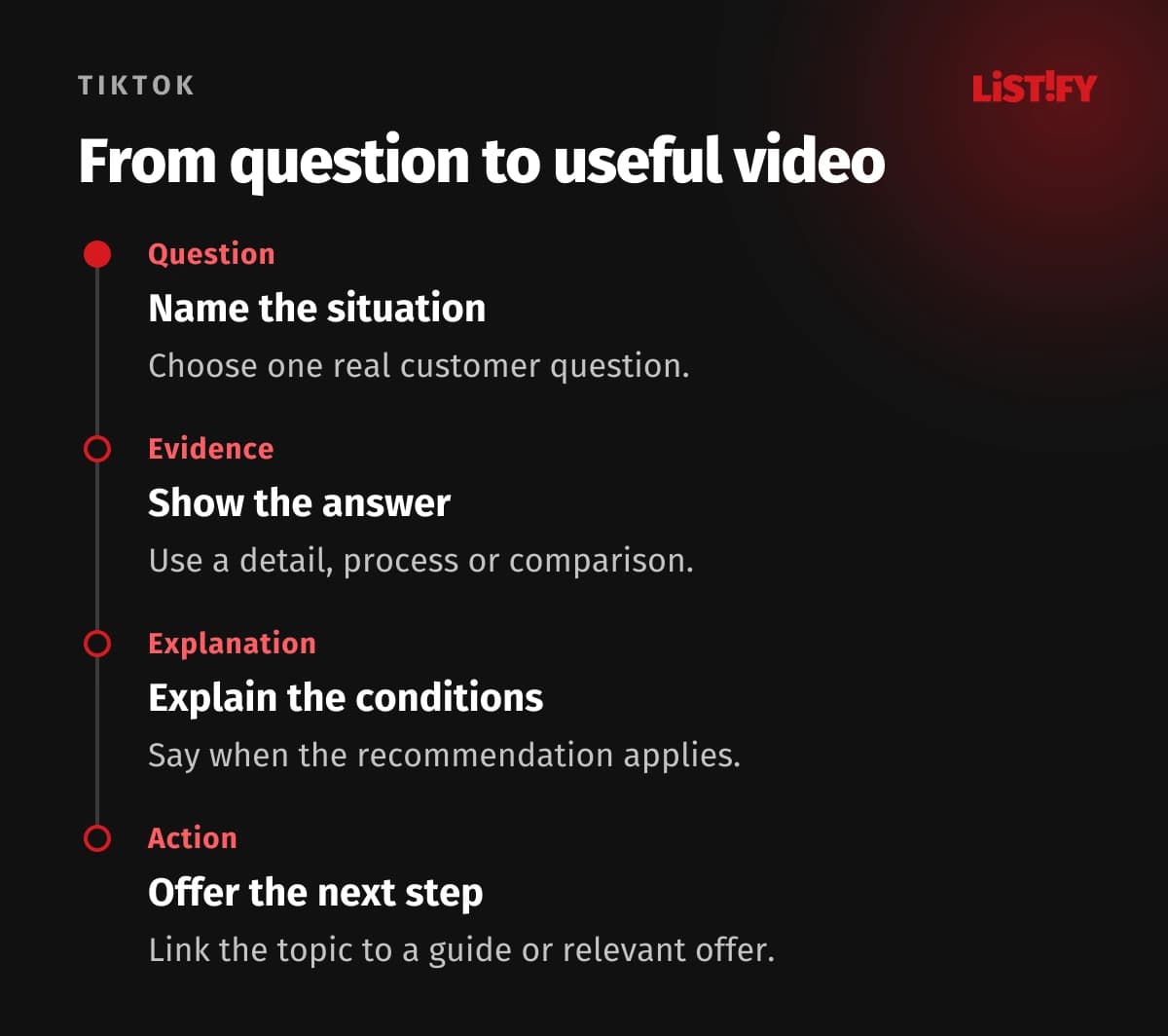
Open with a specific situation: “We need this measurement to prepare an accurate quote.” Show how to take it and where to enter it. Finish with one relevant action, such as opening the guide. Viewers should receive a useful answer even if they never click through.
Skip the long company introduction and catalogue of services. The opening shot can show the detail you are about to explain. On-screen text and speech should develop the same point. If the opening promises a comparison, deliver an actual comparison rather than ending with a request to buy.
TikTok's advertising creative guidance recommends a vertical 9:16 format, attention to interface safe zones and a clear structure with a call to action. These recommendations concern ads. For organic videos, test length and treatment with your own audience instead of treating advertising guidance as a guarantee of reach.
04Organise production around the team's capacity
Collect questions from sales, service and support. For each, prepare a short answer, a demonstration and a person who can confirm its accuracy. Film several related examples in one session. Keep clean footage without music or captions so that future edits remain practical.
Simple equipment can be sufficient if the important detail is visible and speech is clear. Check captions on a phone. Assign responsibility for technical accuracy and final publication approval. One person can cover both roles, but neither should be left undefined. Decide who responds to questions and passes commercial interest to a colleague.
The TikTok Creative Center provides inspiration including Top Ads and trends. Use it to study approaches. Another company's successful ad does not establish that the same idea will generate enquiries for you. Do not copy footage without permission or repeat claims you have not checked.
05Check music, commercial disclosure and permissions
Select music with the appropriate permission. TikTok's Commercial Music Library supports selection by region and placement, with tracks available for organic and paid content under the relevant terms. Do not assume that permission to use a track on TikTok also covers other platforms.
TikTok requires commercial content disclosure when promoting a brand, product or service. Its process distinguishes your own brand from another brand. Follow the official disclosure instructions and include this check in paid creator collaborations.
Agree with people how their image and footage will be used before filming. Remove customer details, credentials and internal prices from screen recordings. With a creator, put the deliverables, approval process, editing rights and paid advertising permissions in writing. Receiving a finished file does not by itself establish where or how long you may use it.
06Give interested viewers a clear next step
A video about choosing a material should lead to a relevant guide or offer. Sending everyone to a general homepage makes them start searching again. Prepare a mobile page on the same subject, with a clear offer and a reasonably short form. Check the availability of a particular link type or advertising objective in your account and market.
Plan the connection to your company website before publishing. Test the complete journey on a phone, including form submission and enquiry assignment. Decide who handles messages and comments. Traffic alone will not fix an unclear offer or an enquiry that nobody answers.
07Run the first test as comparable series
A four-week test can be a practical planning choice. It is not a platform requirement or a promise that results should arrive within that period. Choose three formats and make several comparable videos for each. Avoid judging the entire channel on a single unusually strong or weak post.
- Define the audience, main action and maximum production effort before starting.
- Use the first series to test three customer questions at a similar production standard.
- Change one substantial element based on the response, such as the opening or specificity of the demonstration.
- Use the next series to check whether the result repeats, then decide whether to continue.
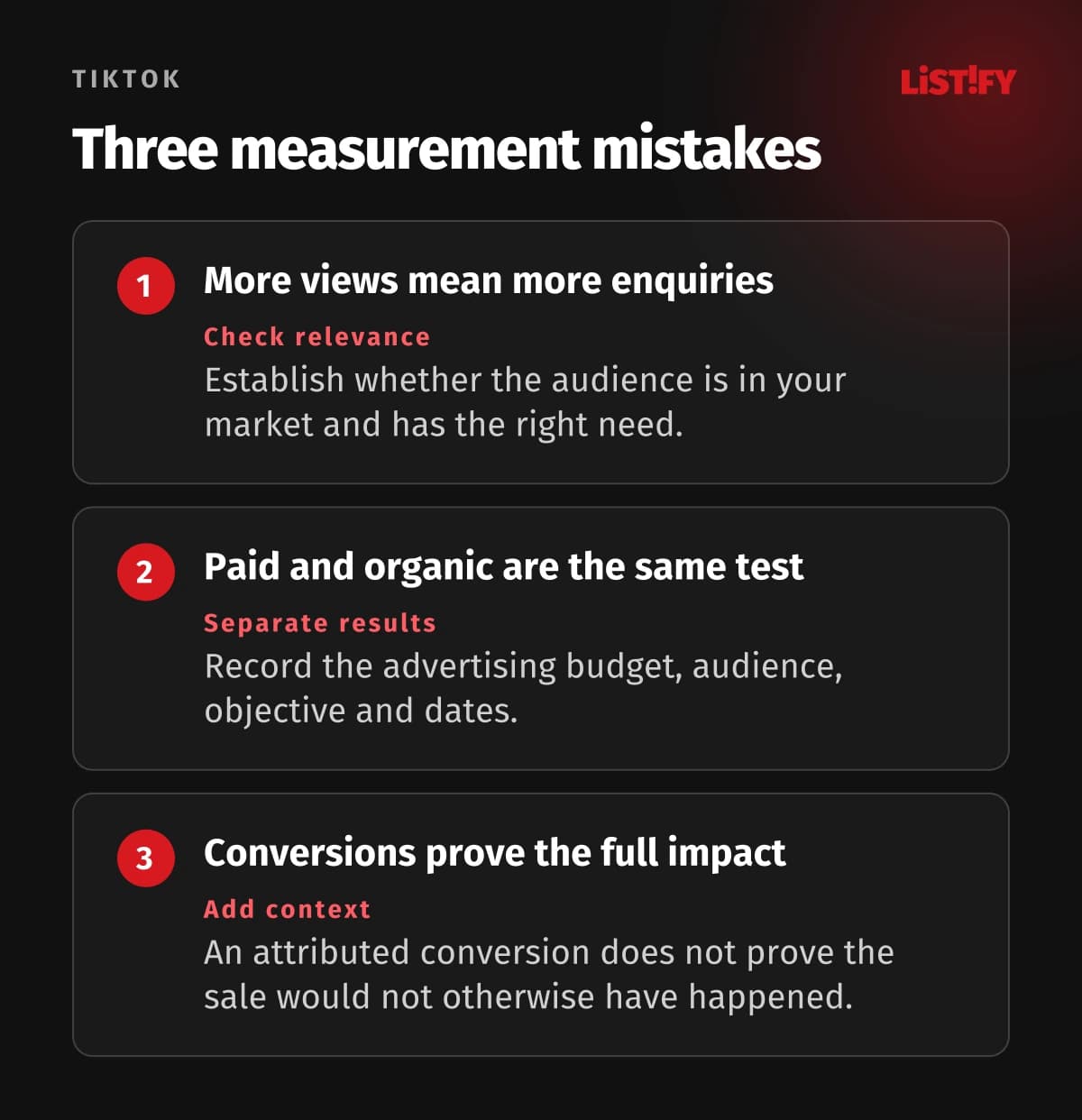
Record organic publishing and paid promotion separately. If you advertise a video, log the budget, targeting, objective and dates. Organic viewing and paid delivery are not equivalent tests. Include production capacity when planning digital marketing, because you will need a continuing supply of material.
08Assess business relevance as well as views
Track three levels: attention to the video, expressed interest and business outcomes. Choose comparable measures from the statistics available to you. Distinguish a compliment from a practical question or buying intent in the comments. Record the topic and source of enquiries where you can establish them.
Tagged links help track website visits but cannot capture every contact. Someone may watch a video and search for the company later. Asking how they heard about you adds context; it is not precise proof of a particular post's contribution. Reported conversions do not automatically show that those purchases would otherwise never have happened.
Include expert time, filming, editing, responses and advertising spend in the review. Continue formats that attract relevant interest with manageable effort. If the content repeatedly reaches the wrong market or unsuitable customers, change the subjects and offer. Ending a test without expanding its budget is a valid decision too.
For more on choosing metrics tied to business results, see how to measure social media success.
09Frequently asked questions about business TikTok
Does the owner have to appear on camera?
No. You can show hands at work, product details or a narrated screen recording. Choose a treatment that explains the subject clearly and that your team can produce repeatedly.
Can TikTok work for B2B?
It can be worth testing if you can find a relevant audience and a useful subject. Check the specific need and route to a commercial conversation. The B2B label and a large view count do not settle that decision.
How often should we publish?
Choose a frequency that leaves time for accuracy, replies and evaluation. A smaller regular series is more useful for learning than a burst of production followed by unanswered questions.
Should we advertise our most-viewed video?
Not automatically. Review audience relevance, the commercial message, permissions and landing page first. Then set a separate objective and budget for the advertising test.
10Build a series from your customers' questions
Send us the questions customers ask most often, the service you want to promote and your filming options. We can discuss a content test, the next step on your website and how to assess the response.