Custom Booking Software for Gyms, Studios and Wellness: 30 Reasons to Build It (and When Not To)
Monday, 5:40 p.m.: 16 people are booked into the 6 p.m. spin class, two cancel by Instagram message, and nobody on the waitlist hears about the open spots. Meanwhile, a client at the front desk has just run out of class credits, and someone with an aggregator booking wants to join a full class. We’ve put together 30 reasons gyms, yoga and Pilates studios, spas, salons and sports facilities have their own booking software built. They’re grouped into four areas, and most are backed by laws, statistics and published price lists. At the end, you’ll also find five situations where you shouldn’t spend money on custom development.
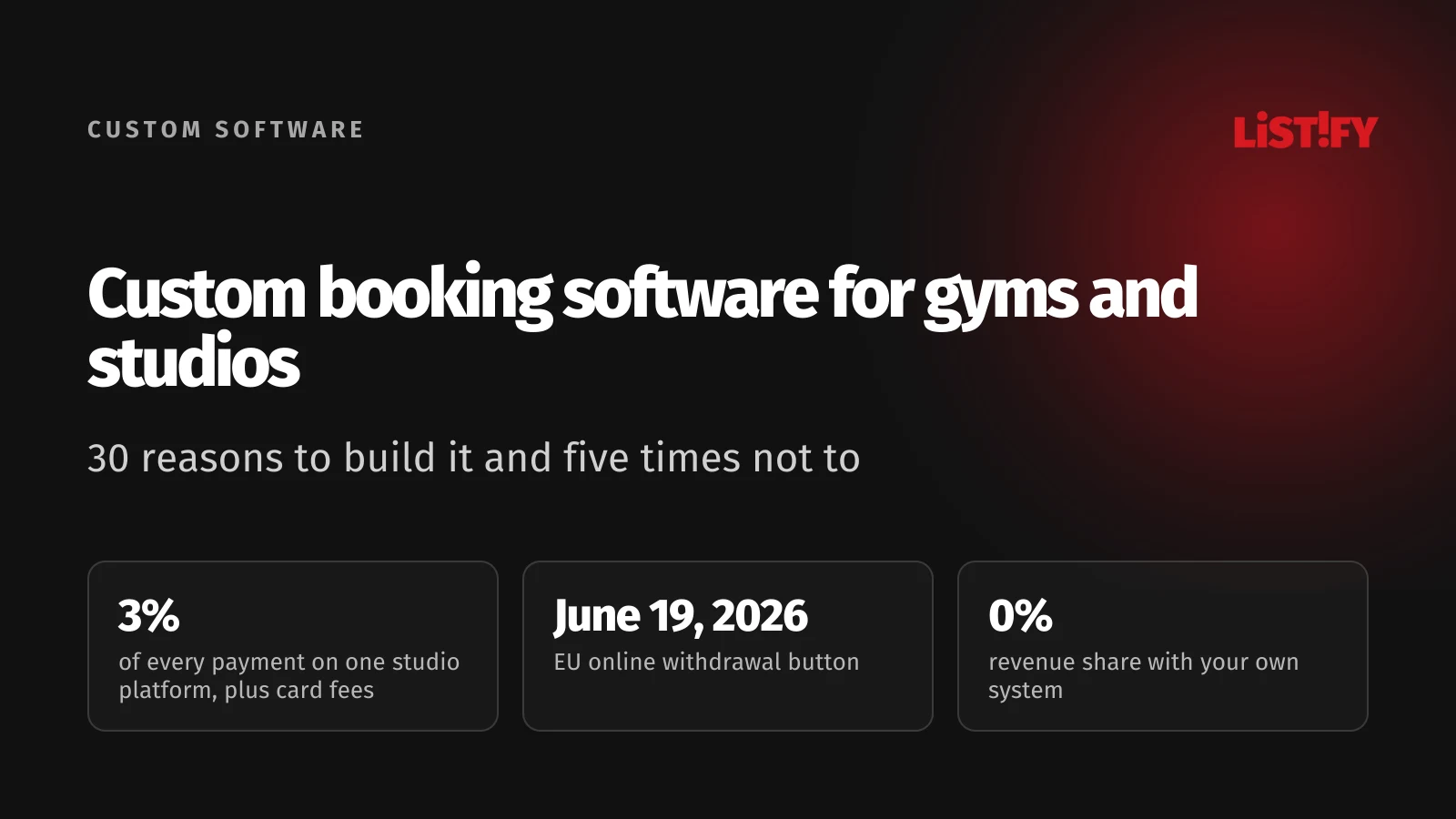
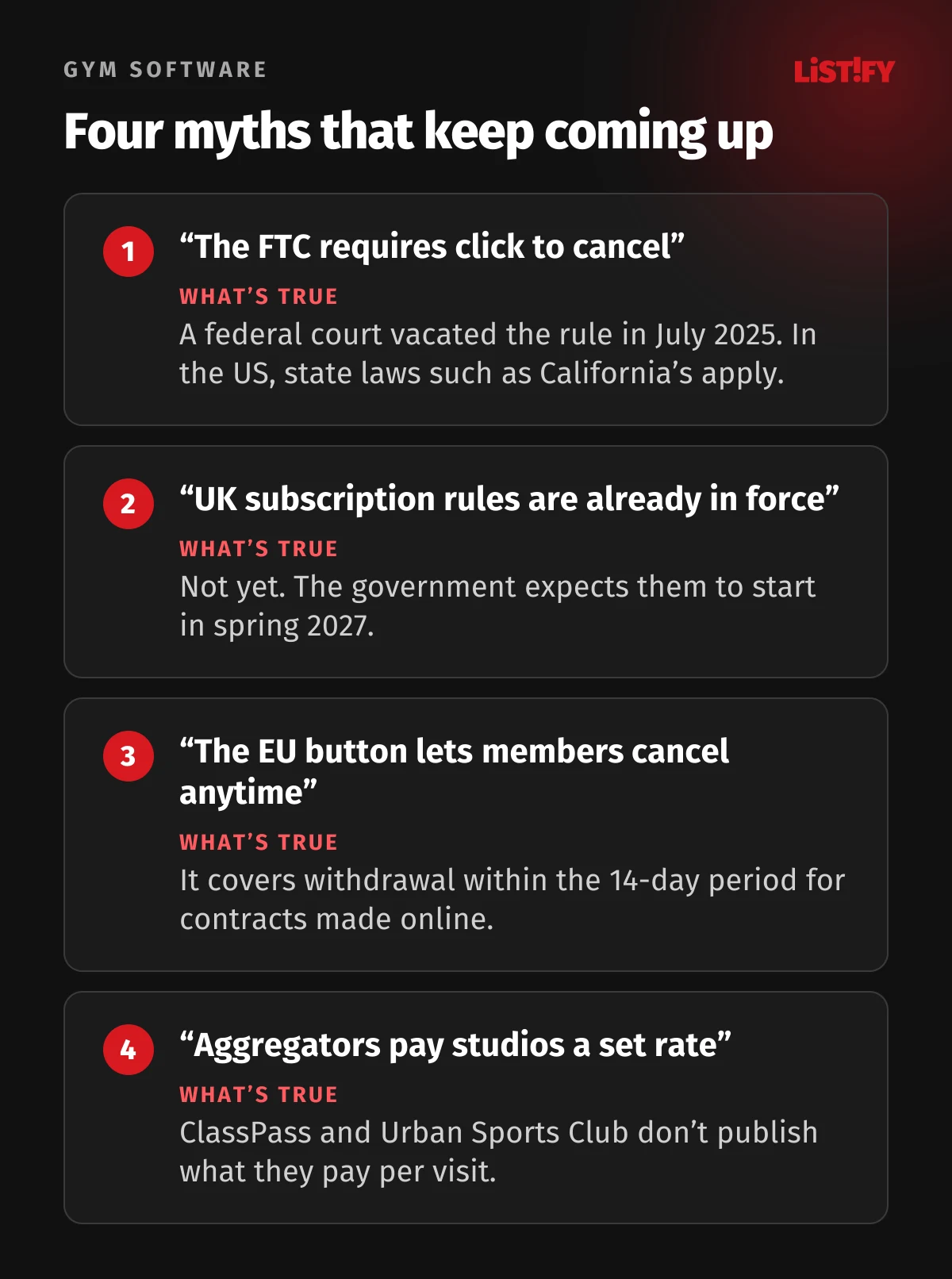
Fitness is mostly small business. According to Eurostat, the EU had 51,909 enterprises running fitness facilities in 2024, with 253,819 people working in them, or about 5 per business. Across sports activities as a whole, 94% of EU businesses have fewer than ten people (Eurostat, our calculation). The market keeps growing, too: EuropeActive and Deloitte count 75.5 million health club members in Europe at the end of 2025, up 5.8% in a year, with club growth driven mainly by chains.
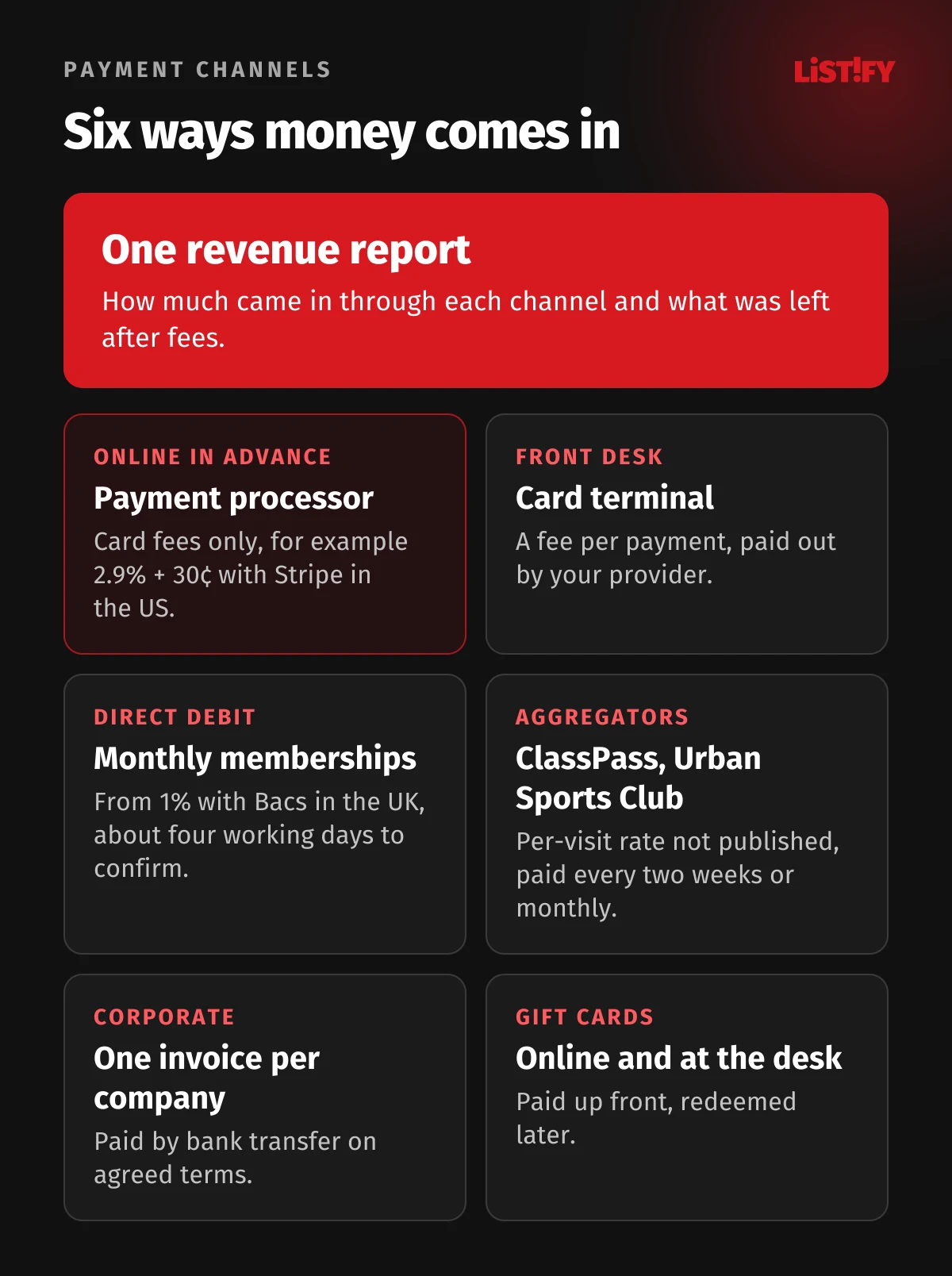
Money reaches a studio through many channels: online in advance, by card at the front desk, through aggregators like ClassPass or Urban Sports Club, by direct debit and on corporate invoices. Each has its own fees and rules, and the rules on signing up and canceling online are tightening. In the EU, consumers who buy online have been entitled to an online withdrawal button since June 19, 2026, California already requires click to cancel, and the UK expects its subscription contracts regime to start in spring 2027.
Custom booking software is built around how your studio actually works: the passes and memberships you sell, how you cover instructors, how many spots you open to aggregators and how you bill companies. You own the code and the data, and you don’t pay a percentage of your revenue or a fee per member. We’ve covered the same question for restaurants and hotels; this time we’re heading to the front desk and the studio floor.
01The short answer: when your own system pays off
- Bookings come in by text, DM and phone. The front desk copies them into a spreadsheet, and people on the waitlist don’t hear about open spots.
- You track class packs and memberships by hand. How many classes are left, whose membership ends and whose payment failed only come up at the desk.
- Your software takes a cut. Some studio platforms charge a percentage of every payment on top of card fees, and features like text reminders sit in pricier tiers.
- Clients pay you in half a dozen ways. Online, at the desk, through aggregators, by direct debit, through corporate deals and with gift cards, each with its own report.
- Subscription rules are tightening. The EU online withdrawal button and California’s click to cancel already apply, and UK renewal reminders are expected from spring 2027. Your checkout has to keep up.
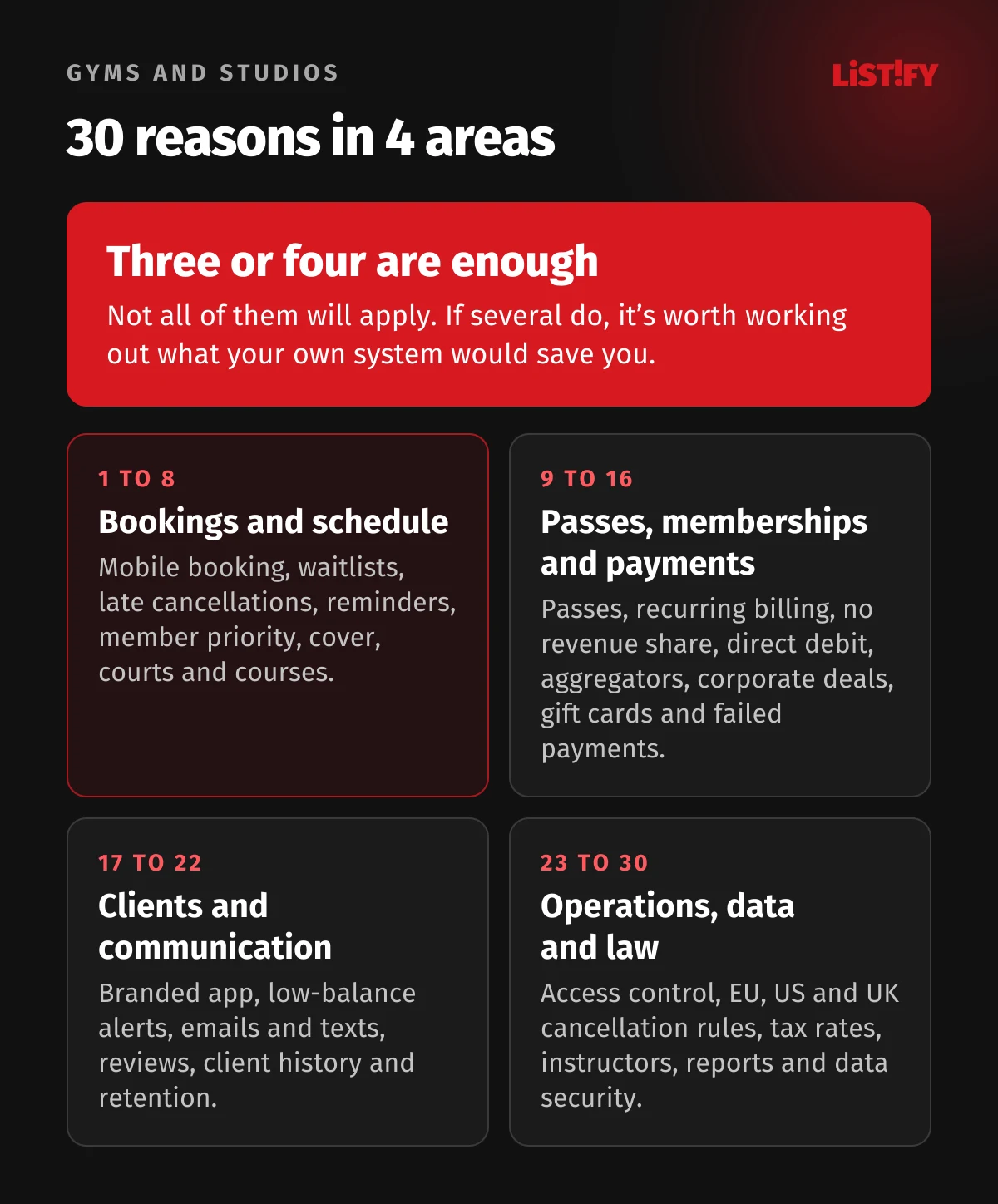
02Bookings and schedule: reasons 1 to 8
1. A schedule clients book on their phone. Clients open the schedule, see open spots and book a class in two taps. Booking has to be faster than sending a DM, or nobody will do it. That’s why we build it around how your clients book: a class, a massage, a court or a trainer, with or without payment.
2. A waitlist that fills itself. When someone cancels, the first person on the waitlist gets the spot and a message. Big platforms do this too: Mindbody moves the next waitlisted client into the class automatically. The difference is the rules. In your own system, you decide who gets priority, how long someone has to confirm and whether the waitlist closes an hour before class.
3. Late cancellation and no-show rules. ClassPass shows what clients are used to. There, reservations can generally be canceled free of charge up to 12 hours before the start, and after that the user pays a late cancellation or missed class fee. Frequent cancellations can also lead to restricted access. Your system enforces the window, deducts a class from the pack or charges the fee, and can limit advance bookings for repeat no-shows.
4. Reminders so clients show up. There’s no solid public data on how many people miss fitness classes. For medical appointments, though, a Cochrane review of eight randomized trials reports overall attendance of 78.6% with text message reminders and 67.8% without. For fitness, that’s an analogy, not a measurement. Some platforms reserve text reminders for higher tiers: Mindbody includes email reminders on all plans and text reminders only on Accelerate plans and above. Your system sends reminders when you choose and adds a cancel link for classes with a waitlist.
- No reminder67.8%
- Text message reminder78.6%
- Phone call reminder80.3%
Cochrane review (2013, 8 randomized trials, 6,615 participants, overall attendance rates) on healthcare appointments, not fitness classes. Source: PubMed 24310741.
5. Your members come first. Aggregators bring new clients, but they also take spots in your most popular classes from people who already pay you every month. ClassPass itself notes in its help center that some studios open bookings to their own members before its booking window opens. Your system can set the booking window by client type: members a week ahead, everyone else three days.
6. Instructor subs without the phone tree. Your spin instructor calls in sick at 2 p.m. The system shows who’s free and qualified, the substitute confirms in the app and everyone booked gets a message. If the class is canceled, the system returns the credits and offers another slot.
7. Courts and rooms by the hour. Tennis and squash courts or a rentable studio room are booked by the hour, with peak and off-peak pricing and payment up front. The system keeps courts and rooms in one calendar, blocks double bookings and takes the payment at booking.
8. Courses by the term and kids’ sign-ups. Dance, swimming or martial arts courses for kids are sold by the term and booked by parents. That means sign-up forms, installments, attendance per session and receipts parents may need for an employer benefit or a tax claim. A drop-in booking tool rarely covers all of it.
03Passes, memberships and payments: reasons 9 to 16
9. Passes that match your price list. A 10-class pack, a monthly pass, prepaid credit, a family pass or gym plus sauna. Clients don’t always pick the pass that suits them. In a well-known 2006 study of three US health clubs, DellaVigna and Malmendier found that members on flat monthly fees over $70 went 4.3 times a month on average, paying more than $17 per visit when a 10-visit pass would have cost $10 per visit. Your system knows your pass types, tells clients when three classes are left and can show which option fits how often they come.
10. Recurring billing without chasing payments. Monthly memberships are charged automatically. Under the EU rules on strong customer authentication (Article 14), the client has to authenticate with their bank for the first payment in a series of the same amount, and the bank may skip authentication for the payments that follow. According to a European Commission answer published by the European Banking Authority, payments the merchant initiates under the client’s mandate aren’t subject to strong authentication at all, but setting up that mandate online is. Even then, Stripe warns that exemptions aren’t guaranteed and the bank may still ask for authentication. Your system stores the mandate at the first payment, watches for expiring cards and sends a link to update the card when a payment fails.
11. No percentage of your revenue. Some studio platforms take a cut of every payment. Arketa charges its Individual plan $49 a month (billed annually) plus a 3% transaction fee on top of Stripe’s fees, which in the US are 2.9% + 30¢. On $100,000 a year in client payments, that 3% alone comes to $3,000, before a single card fee. Mindbody charges 20% of a new client’s first purchase through its app, capped at $30. With your own system, you pay only the payment processor.
- Arketa Individual, 3% plus Stripe$6.20
- Own system, Stripe card$3.20
- Own system, ACH direct debit$0.80
Illustrative calculation from public US price lists as of October 7, 2026: Arketa 3% plus Stripe 2.9% + 30¢, Stripe US 2.9% + 30¢ per card payment and 0.8% for ACH Direct Debit (capped at $5), taken from a web archive snapshot of Stripe’s US pricing. Monthly plan fees not included. Mindbody also charges 20% of a new client’s first purchase made through its app (capped at $30), on top of payment processing.
12. Direct debit for memberships. In the UK, direct debit is often cheaper than cards for monthly memberships. Stripe charges 1.5% + 20p for standard UK cards, 2.8% + 20p for premium UK cards and 1% for Bacs Direct Debit (minimum 20p, capped at £4). GoCardless starts at 1% + 20p plus VAT. There’s a catch: Bacs payments can be disputed through the bank with no time limit, and confirming a payment typically takes four working days, or up to seven for a new member’s first collection. Matching each payment to the member’s attendance history is the system’s job, along with deciding who can check in while a payment is pending.
- Stripe, premium UK card1.32
- Stripe, standard UK card0.80
- GoCardless Standard0.60
- Stripe, Bacs Direct Debit0.40
Our calculation from public price lists as of October 7, 2026: Stripe UK 2.8% + 20p, 1.5% + 20p and Bacs 1% (minimum 20p), GoCardless 1% + 20p excluding VAT. Stripe Billing, if used for subscriptions, adds 0.7% of billing volume.
13. Aggregator visits in one report. Aggregators don’t publish what they pay a studio per visit. Urban Sports Club says only that remuneration “depends on the details of your offer”, tracks visits by QR check-in and pays on the 15th of each month for the previous month. It also says that without supported booking software, a partner’s class schedule can’t be booked directly in its app. Listing on ClassPass has no upfront cost, and its SmartRate tool prices your spots dynamically. Your own system can connect to aggregators where they offer an integration, match their visits to your classes and show what each channel leaves you per visit.
14. Corporate memberships on one invoice. A company buys passes for twenty employees and wants one monthly invoice listing who came and how often. The system tracks which corporate membership belongs to whom and builds the invoice from attendance, ready for your accounting software.
15. Gift cards online and at the desk. Gift cards for a massage or ten yoga classes sell mostly before the holidays. The system generates a card with a unique code, tracks its expiry and balance and records when and by whom it was redeemed, so the front desk doesn’t have to check a paper list.
16. Failed payments handled automatically. Cards expire, banks decline payments and some ask the client to authenticate again. Your system retries on a schedule you set, sends the member a secure link to fix the payment and pauses class bookings only when your rules say so.
04Clients and communication: reasons 17 to 22
17. An app with your name on it. Schedule, bookings, remaining classes, membership status, payment history and a QR code for check-in, all in an app with your logo and colors. With off-the-shelf software, that often costs extra: TeamUp lists its custom branded app at $99 a month on top of the plan.
18. A heads-up before the pack runs out. Clients get a message three classes before their pack runs out or a week before their membership ends, with a link to renew. No more arguments at the desk about “one more class”, because the client and the front desk see the same history.
19. Emails and texts that follow the rules. In the EU, the ePrivacy Directive (Article 13) lets you email offers for your own similar services to existing customers without separate consent, as long as they could object when you collected their details and can opt out in every message. Everyone else needs consent. The US and the UK have their own rules, especially for marketing texts, so check them before you send. Your system records who opted out, adds an unsubscribe link to every message and sends offers to everyone else only with their consent. We cover how to set up messages that don’t annoy people in App notifications and emails that don’t annoy.
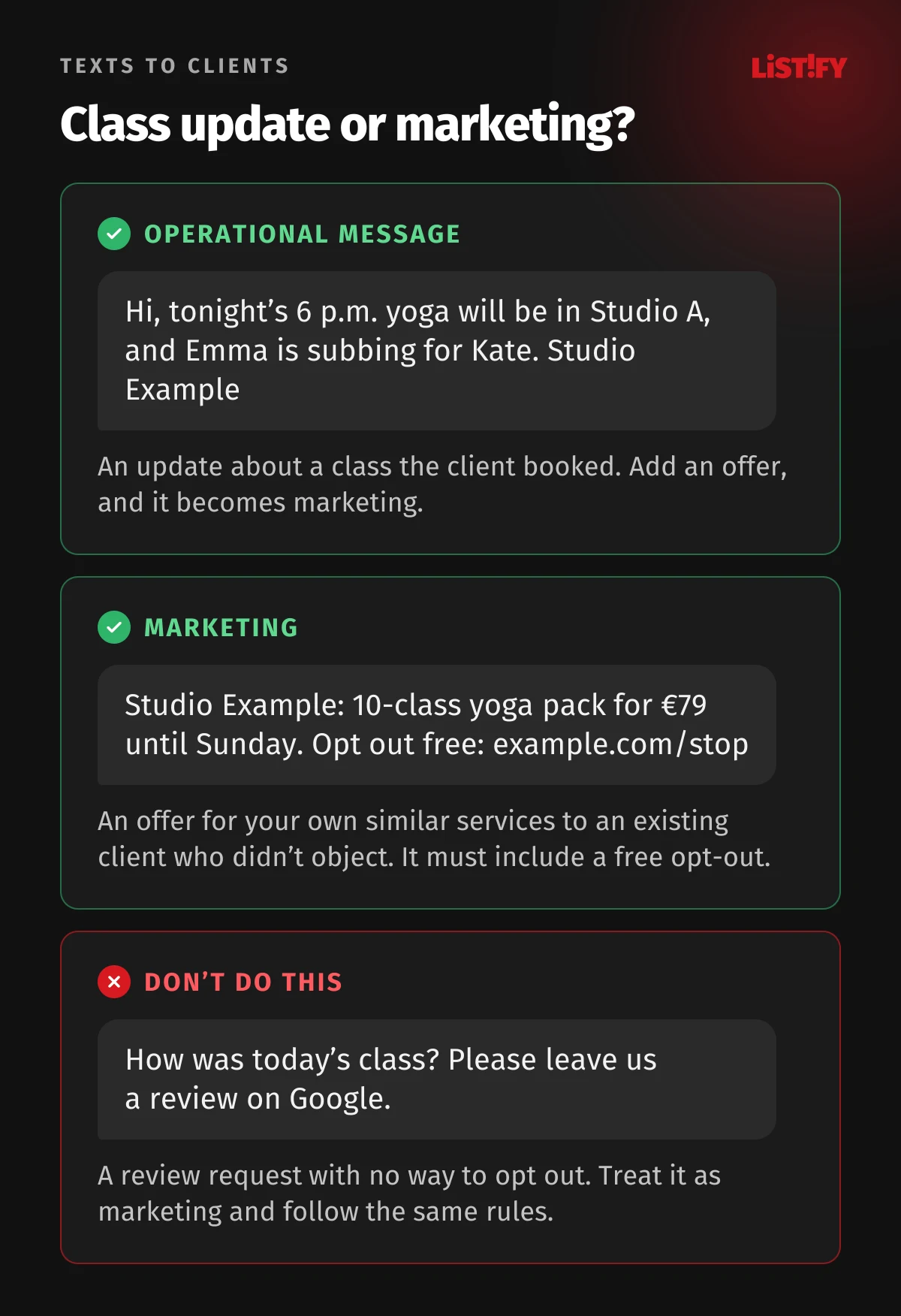
20. Review requests done right. Google reviews are often the first thing a new client checks. In Czechia, the data protection authority states in its 2025 annual report that review requests count as commercial communications, and it’s checking senders of such requests in 2026. Even where your regulator hasn’t said so, treating them as marketing is the safe choice: offer an opt-out at sign-up and in the message. Your system invites only people who attended a class.
21. Full client history, no caps. When they started, which classes they like, how often they didn’t show up and when they last paid. Some off-the-shelf tools even cap how much history you keep: SuperSaaS keeps 500 past reservations on its free plan. In your own system, the history is yours, and the data tells you who’s drifting away before they cancel.
22. Spotting members who stop coming. Members often keep paying for a while after they stop showing up. The same 2006 study of three US health clubs documents cancellation delays and found that monthly members were 17% more likely to stay enrolled beyond a year than members on annual contracts. A system that sees attendance drop can trigger a friendly check-in before the member cancels, which is fairer to the client and better for retention.
05Operations, data and law: reasons 23 to 30
23. QR code or key fob entry, biometrics only by choice. Members check in at the turnstile with a QR code from the app or a key fob, and the system checks the booking and the pass. Fingerprints and face recognition are biometric data under the GDPR, and processing them is prohibited unless an exception applies (Article 9), for a gym typically explicit consent. Off-the-shelf access control adds cost too: Gymdesk charges $100 a month for up to 3 doors, plus hardware. By default, members check in with a QR code or fob, and biometrics stay optional for those who want them.
24. The EU online withdrawal button. Since June 19, 2026, EU countries have had to apply the new rules: for distance contracts concluded through an online interface, consumers must be able to withdraw using a function labeled “withdraw from contract here” or similar, available throughout the withdrawal period, with a “confirm withdrawal” step and an acknowledgment that includes the date and time. This covers the 14-day withdrawal period, not canceling a membership months later. Booking a class on a specific date is usually exempt, because the Consumer Rights Directive excludes leisure services with a specific date of performance (Article 16(l)). National rules vary, and Czechia, for example, applies them from January 1, 2027. Product types are set up separately, so the button appears only where the law requires it.
25. US click to cancel: what actually applies. The FTC’s 2024 click to cancel rule isn’t in force: the Eighth Circuit vacated it on July 8, 2025, and the FTC has since only asked for comments on next steps. Federally, the Restore Online Shoppers’ Confidence Act still requires express consent and “simple mechanisms” to stop recurring charges for online sales. States go further. In California, a business that lets consumers sign up online must let them cancel online, with a prominent link or button, for contracts entered into, amended or extended on or after July 1, 2025. Annual plans need an annual reminder, and plans with an initial term of a year or more need a notice 15 to 45 days before renewal. Under New York’s law as published in July 2026, canceling must be as easy as signing up, and members who signed up in person must at least be able to cancel online or by phone. California also has a separate health studio law with a five-business-day cancellation right and refunds within 10 days. We build these rules into checkout, reminders and the member account.
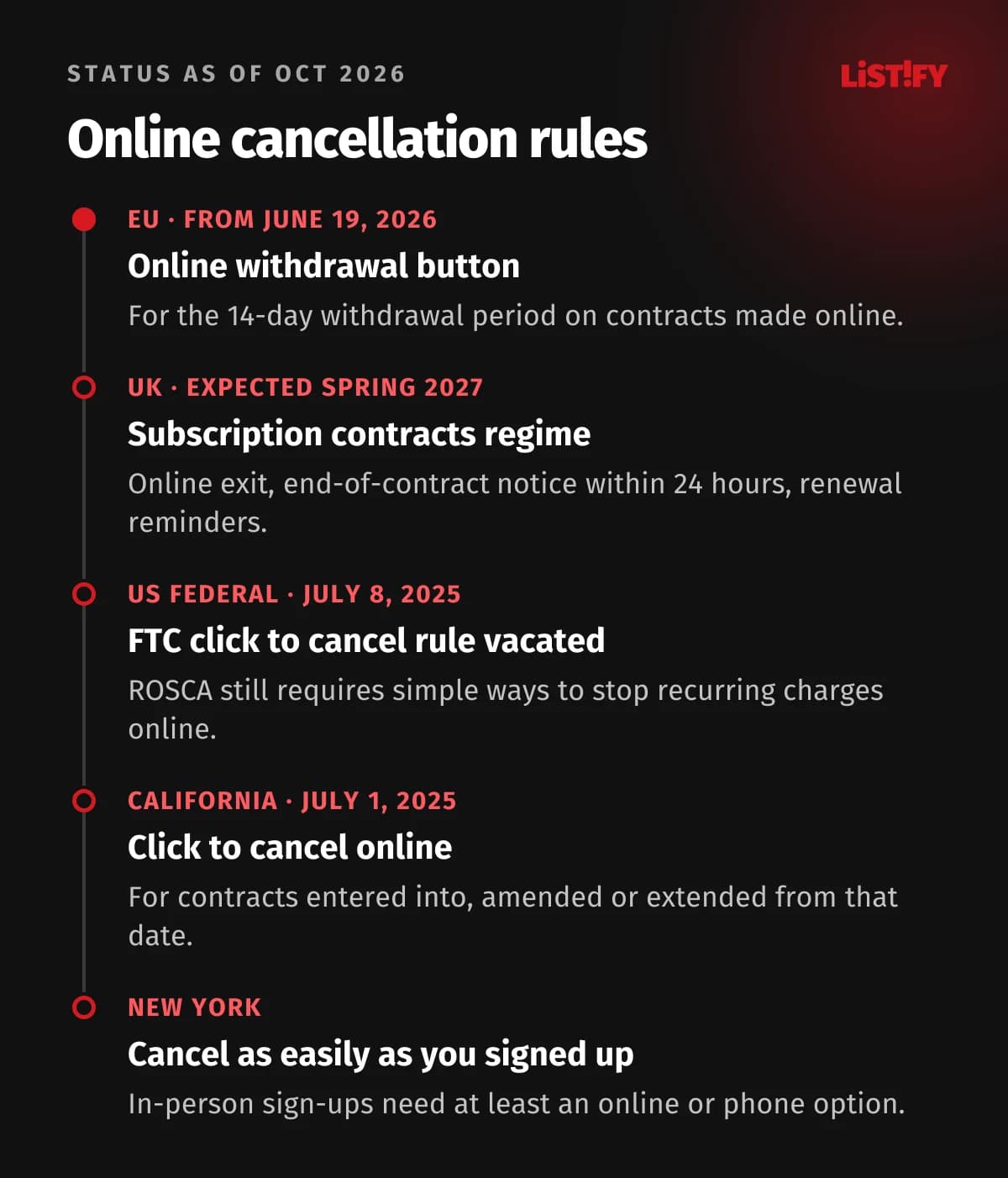
26. The UK subscription regime is on its way. The subscription rules in the UK’s Digital Markets, Competition and Consumers Act 2024 aren’t in force yet. The government said in April 2026 that it anticipates they’ll start in spring 2027. Once they do, members who signed up online must be able to cancel online, the business must confirm the end of the contract within 24 hours of an online request, and members must get reminder notices before renewal payments. The government’s response even mentions gyms: businesses worried that members would “go to the gym a lot” for a few days and then cancel for a nearly full refund, but the government kept the refund rules as they are. A system designed today should be ready for these rules and able to calculate a fair partial refund for the days used.
27. The right tax rate on every item. In many countries, VAT depends on the service. In Czechia, use of sports facilities and saunas has a 12% reduced rate, while hair and beauty services are taxed at 21%, and by our reading of the law so are non-therapeutic massage and tanning. In Slovakia, gym entry has been taxed at 5% since 2025; personal training and massage aren’t on the reduced-rate list, so by our reading they carry the standard 23%. A system that stores the rate per service splits package prices correctly and lets you change one setting when the law changes. Check the rules for your country with a tax adviser.
28. Instructor attendance and pay. Who taught how many classes, how many people came and who covered for whom. Payroll data comes from the schedule and attendance records, and if you pay instructors per head, the system calculates it automatically.
29. Reports on what each class and channel earns. Class occupancy by day and hour, new and lapsed members, and revenue after fees by payment channel. You’ll see that Tuesday 7 a.m. yoga is full while Thursday Pilates is half empty, and what an aggregator visit really earns you. We explain how to connect your system to accounting in API integration best practices.
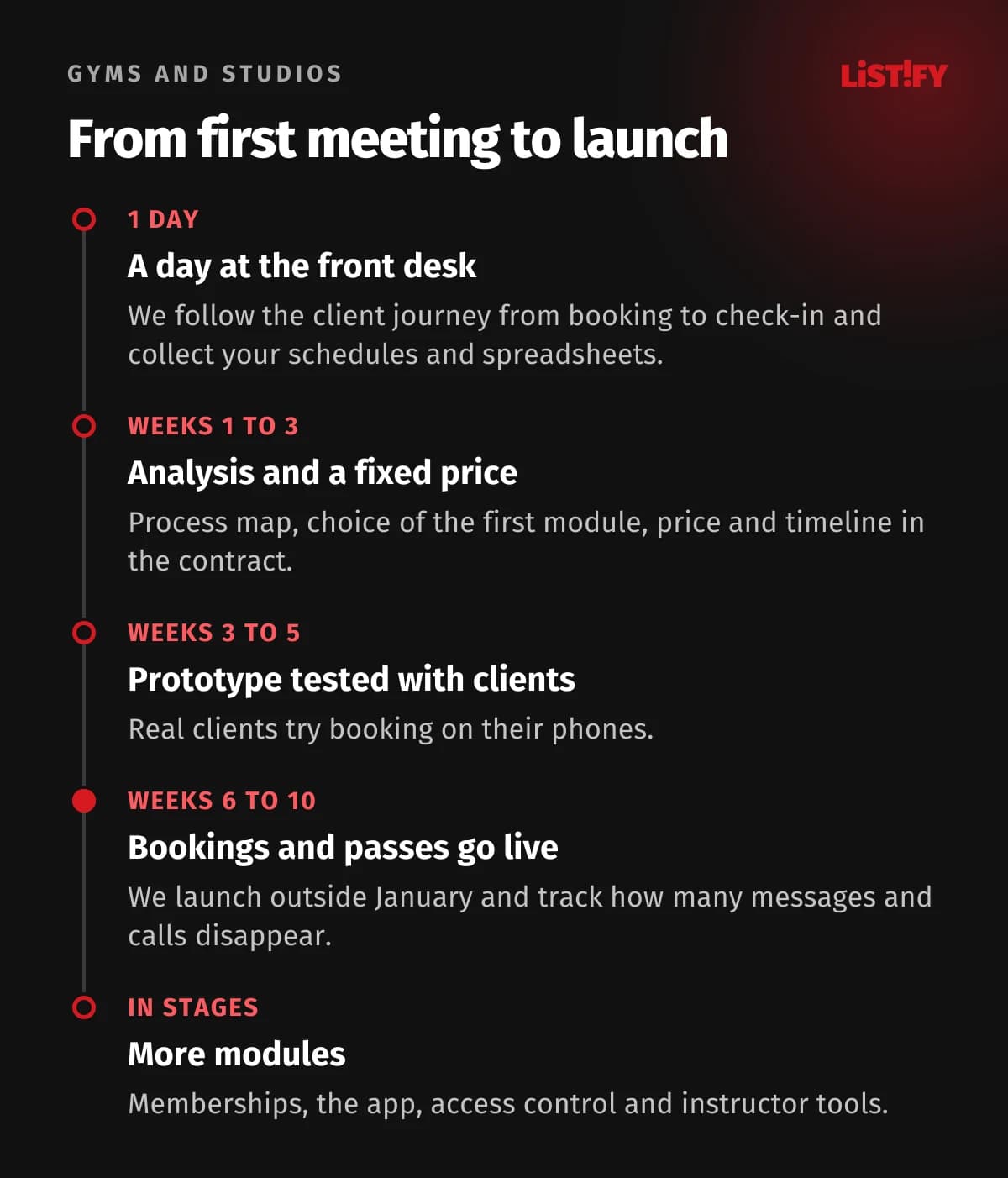
30. Secure data and modules added step by step. The system runs in an EU cloud, backs up automatically and gives each person only what they need: instructors see their classes, the front desk sees clients, the accountant sees invoices. More in Data security in custom software development. Most of our clients start with bookings and passes, because that frees up the front desk the most. Memberships, the app, access control and instructor tools follow, all on the same data.
06Five situations where custom software doesn’t pay off
- You work alone. In the EU, about three in four businesses in hair, beauty and other personal services have at most one person working in them, and so do 71% of sports businesses (Eurostat, our calculation). An off-the-shelf tool is cheaper for you: TeamUp has no setup fee or contract, and Arketa starts at $49 a month billed annually, plus 3% per payment.
- You’re just starting out. Early on, aggregators will bring you clients faster than your own app. ClassPass has no upfront cost to list, and Urban Sports Club says working with it is free of charge for partners. Prove your schedule and pricing first, then come back to custom software when an off-the-shelf tool starts holding you back.
- Your schedule is simple and you have a few dozen clients. If you don’t need memberships, aggregators, access control or instructor pay, an off-the-shelf tool with a waitlist will do. Mindbody handles waitlists and no-show fees, and its EU plans start at €99 a month per location.
- Your only goal is to meet one new rule. If you only need a withdrawal or cancel button, ask your current provider first. Many will add it, and a custom build is worth it only when several of the reasons above apply.
- You don’t have the budget for a first module. Bookings and passes start at €3,590 (CZK 90,000) before VAT with us. If that’s out of reach, start with an off-the-shelf tool and come back when your membership grows.
- 0 to 1 person150,385
- 2 to 9 people48,758
- 10 to 19 people6,500
- 20 to 49 people4,291
- 50 to 249 people1,627
- 250 or more240
Enterprises in NACE R93.1 “Sports activities”, EU27, 2024. Values for 10 to 19 and 250 or more are Eurostat estimates. Source: Eurostat, table sbs_sc_ovw.
A quick calculation helps you decide: how much you pay each month in platform fees, how many hours a week the front desk spends copying bookings and checking passes, and how many clients leave because they couldn’t get into a class. Our guide How to calculate software ROI walks you through it.
07What it costs and how to start
Bookings and passes with an online schedule, payments, a waitlist and reminders start at €3,590 (CZK 90,000) before VAT and usually take 6 to 10 weeks. A full system for gyms and studios with recurring memberships, an app, instructors and access control starts at €9,990 (CZK 250,000) and is built in stages over 10 to 18 weeks. Support and hosting start at €90 (CZK 3,000) a month, with no fees per member or per instructor. You get a fixed price and timeline after the analysis, written into the contract. See our pricing and how we work for details.
We start on site. We spend a day at your front desk and on the studio floor, follow the client journey from booking to check-in and collect the schedules and spreadsheets you use today. We launch outside the January rush, so your first live month isn’t your busiest one.
If your clients and passes live in Excel or an old system, read what to watch out for when migrating data before you start.
08FAQ
How much does custom gym booking software cost?
Bookings and passes with payments, a waitlist and reminders start at €3,590 (CZK 90,000) before VAT. A full system with recurring memberships, an app, instructors and access control starts at €9,990 (CZK 250,000). Support and hosting start at €90 (CZK 3,000) a month, with no fees per member or per instructor.
How long does development take?
Bookings and passes usually go live in 6 to 10 weeks. We add more modules in stages and launch them outside the January rush.
Do I have to leave ClassPass or other aggregators?
No. Aggregators can keep bringing you new clients. Your system matches their visits to your classes, can give your own members an earlier booking window and shows what each channel earns you.
Can it handle recurring billing and failed payments?
Yes. Memberships are charged automatically, and in the EU the client usually authenticates with their bank only for the first payment. Expiring cards and failed payments trigger a secure link to update the card, and in the UK you can collect by direct debit.
Do I need a cancel or withdrawal button?
It depends on where you sell. EU countries have applied the online withdrawal button since June 19, 2026, California requires online cancellation when members can sign up online (for contracts from July 1, 2025), and the UK expects its subscription rules in spring 2027. The FTC’s federal click to cancel rule was vacated in 2025. Your system shows the right button for each product and market.
Who owns the code and the data?
You do. Once paid, the source code and the data are yours, and the system runs on your own cloud account. If you ever switch providers, you keep your clients, passes and payment history.
What costs you the most money or stress today: bookings by message, tracking passes or fees on every payment? Tell us how clients book with you and what passes you sell, and we’ll suggest where to start.