Custom Booking System for Hotels and Guesthouses: 30 Reasons to Build One (and When Not To)
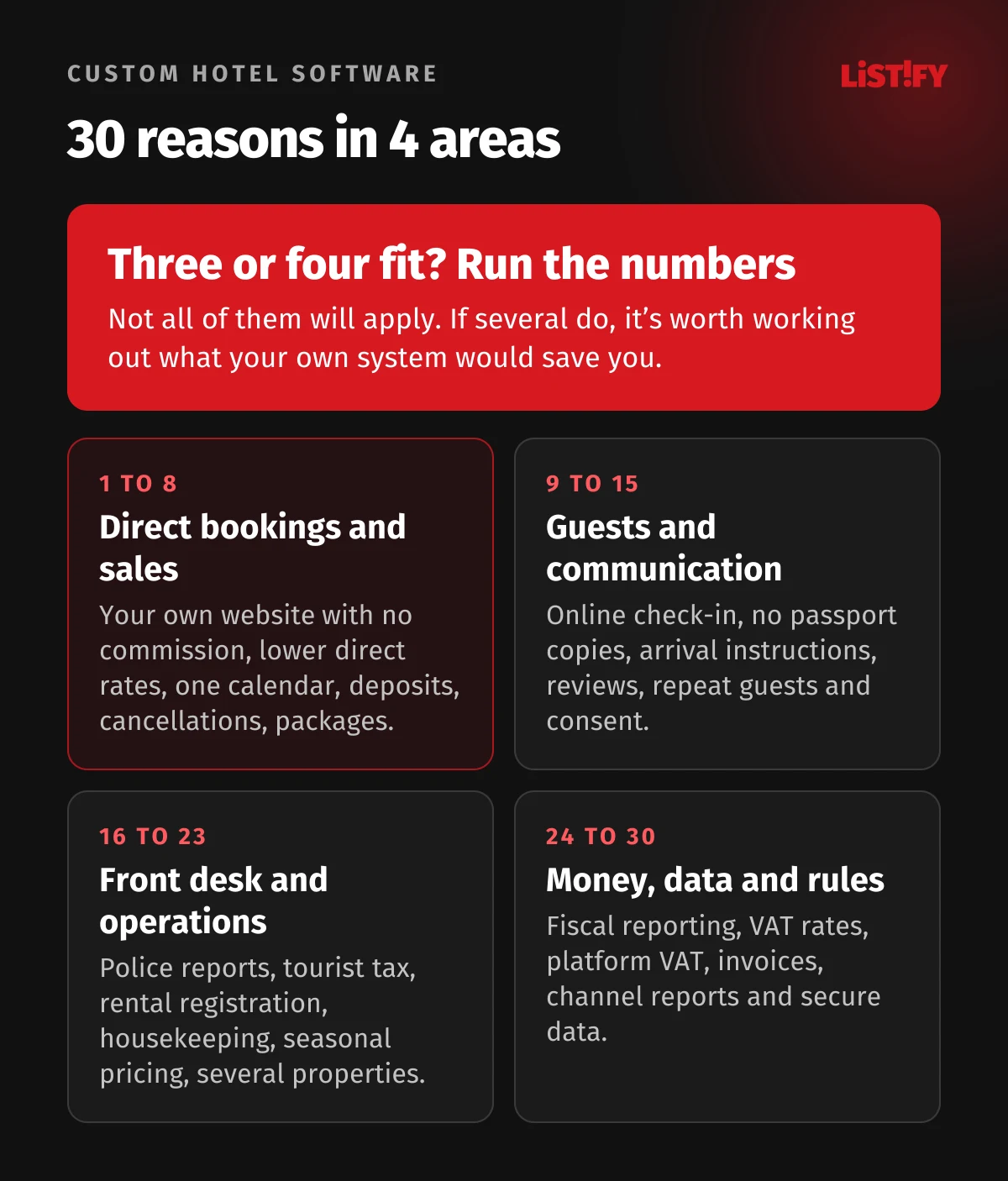
Saturday morning: a Booking.com guest wants a late checkout, the phone keeps ringing with people asking whether you have a room next weekend, and three foreign passports are waiting at the front desk to be entered into the guest register and reported to the police. Then there’s the tourist tax return for the town, new payment and fiscal rules in some countries, and new EU rules for platforms and short-term rentals. We’ve gathered 30 reasons hotels, guesthouses and vacation rentals invest in a booking system of their own, grouped them into four areas and backed most of them with laws, official statistics and published price lists. At the end, you’ll find five situations where you shouldn’t spend money on custom development.
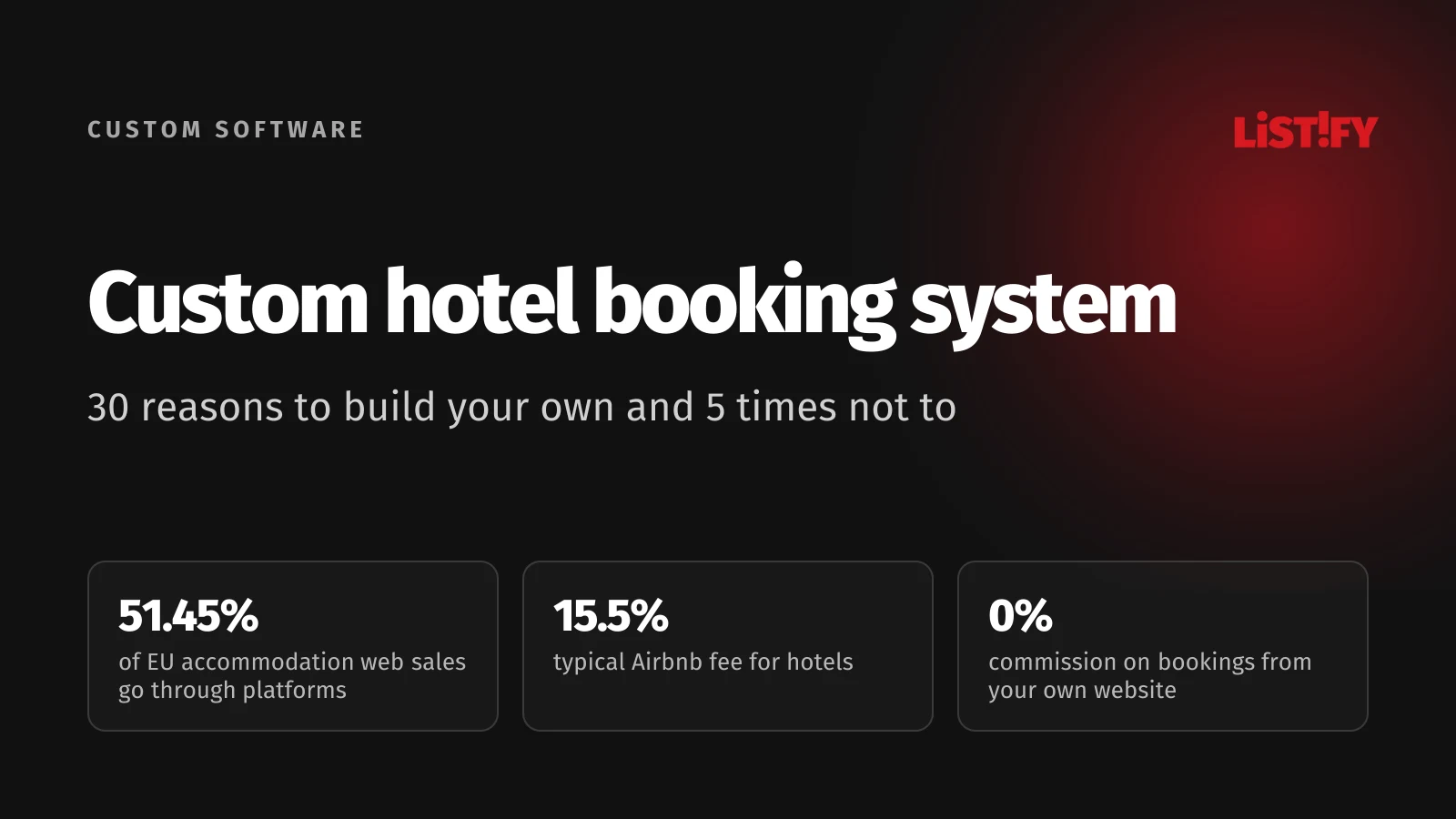
In accommodation, booking platforms carry far more of the business than in the economy as a whole. According to Eurostat, 51.45% of the money EU accommodation businesses with at least 10 employees made from online sales went through platforms such as Booking.com or Airbnb in the 2025 survey. Across the whole economy, the figure was just 15.54%. Platforms handled about a fifth (20.81%) of all accommodation revenue, and every one of those bookings carries a commission.
Over the past decade, direct bookings have lost ground. According to the European Hotel Distribution Study by HOTREC, based on 3,089 hotels, direct channels fell from 57.6% of overnight stays in 2013 to 50.9% in 2023, while online travel agencies grew from 19.7% to 29.6%. The 2026 edition, as covered by the trade site Tageskarte, puts direct bookings at 51.3% in 2025, so the lost share hasn’t come back. Small hotels are the most exposed: among those with fewer than 20 rooms, 27% get 30 to 49% of their bookings from online travel agencies and another 27% get more than half.
A custom booking system is software built around how your property actually runs: how many rooms and buildings you have, how you sell packages, how you invoice companies and who does the housekeeping. You own the code and the data, and you pay no percentage on bookings and no fee per room. We covered a similar topic for restaurants in Custom Restaurant Software. This time, we’re heading to the front desk and the rooms.
01The short answer: when your own system pays off
- Most bookings come through platforms. You pay commission even on repeat guests who would book with you directly, and you don’t have their contact details.
- You track availability in three calendars. Your website, Booking.com and Airbnb are synced by hand, and every so often the same room gets sold twice.
- The front desk re-keys guest details. Into the guest register, the police report and the tourist tax return, each time separately.
- You sell more than a room. Half board, spa packages, gift vouchers, corporate stays and groups are pieced together from emails and spreadsheets.
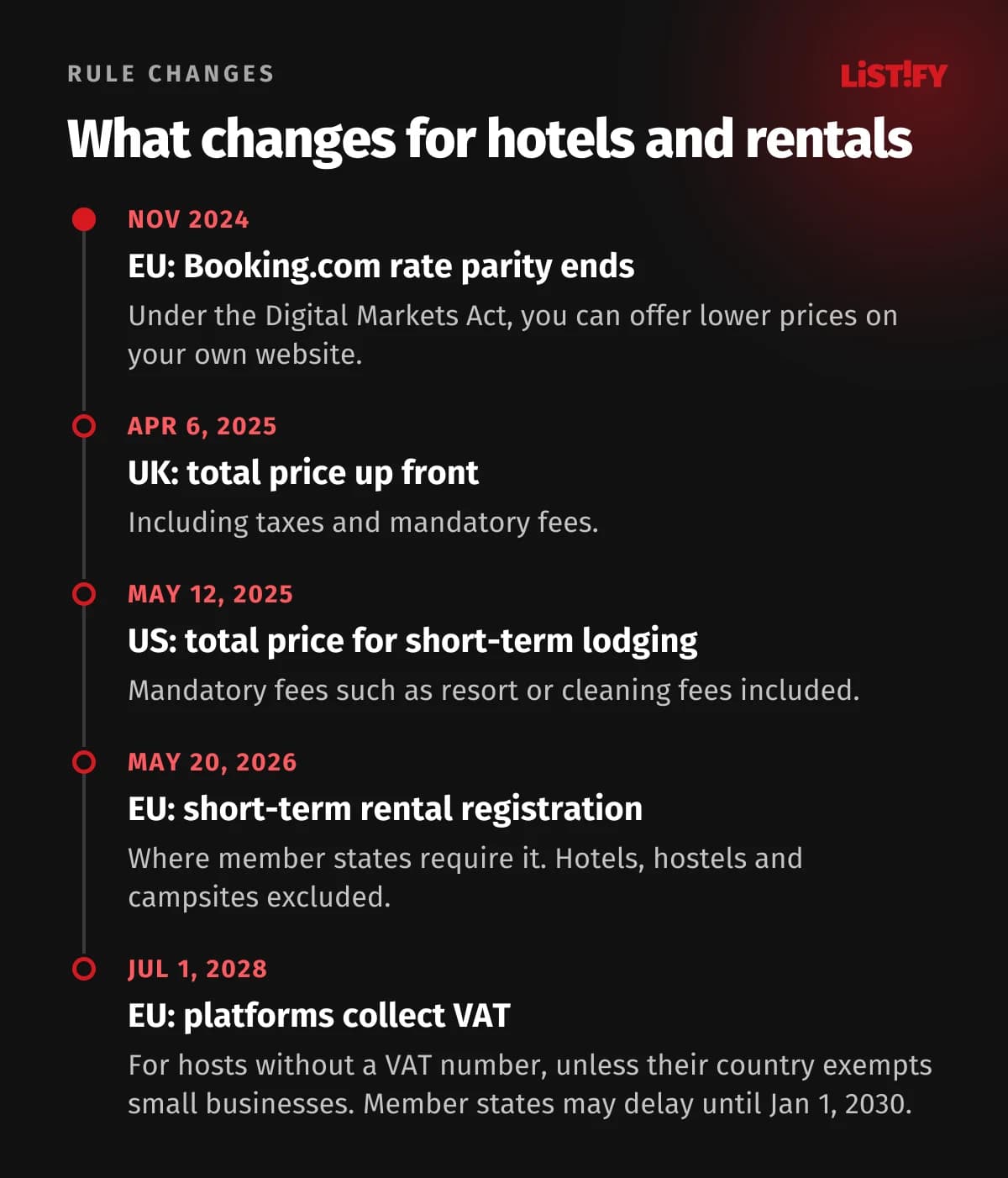
- Rules keep changing. Total-price rules in the US and UK, EU registration for short-term rentals and new VAT rules for platforms all land on your booking process.
02Direct bookings and sales: reasons 1 to 8
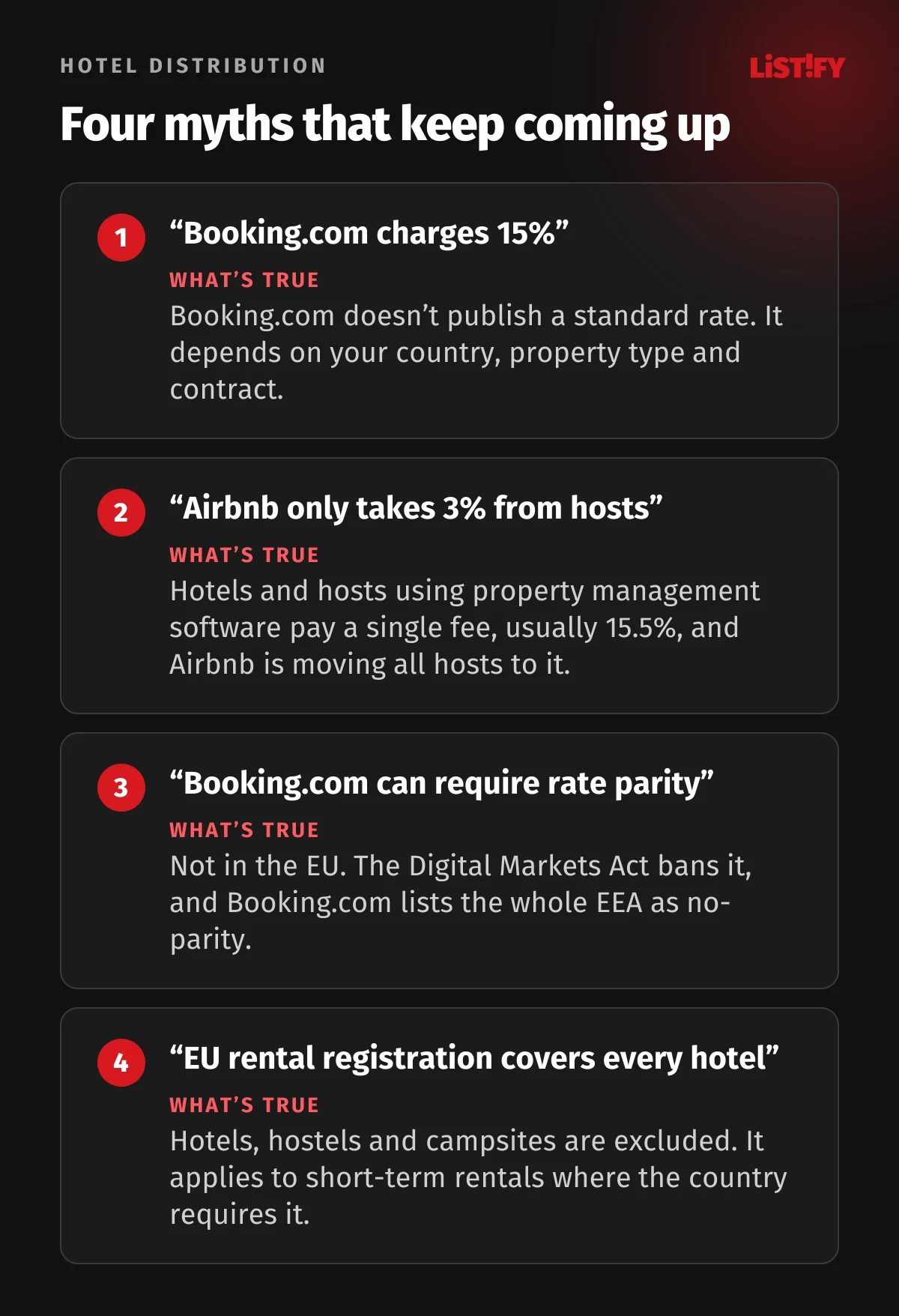
1. Direct bookings with no commission. Booking.com doesn’t publish its commission. Its partner help page only says that “the exact percentage depends on your country, property type and the accommodation agreement.” It also says commission is charged on the total booking amount, including cleaning fees, service fees and cancellation or no-show fees, and in most countries on VAT as well. Airbnb charges hotels, serviced apartments and hosts who use property management software a single fee, usually 15.5%, deducted from the host’s payout, and it’s moving all other hosts to the same model. On your own website, you pay only the payment gateway: Stripe charges 1.5% + €0.25 for standard European cards.
- Airbnb, single fee 15.5%62.00
- Booking.com at 15% commission60.00
- Off-the-shelf booking engine, 4%16.00
- Your own website, Stripe6.25
Illustrative calculation for a €400 stay. Booking.com doesn’t publish its commission, so 15% is an example rate (two 2019 contracts in the Czech public register show 13% and 15%), and its Preferred Partner or Visibility Booster programs increase it. Airbnb per its Help Center. Booking engine fee per Previo’s price list (4% of completed stays). Stripe per its pricing as of October 7, 2026.
To be fair, platforms bring you guests who would never have found you otherwise. Your own website doesn’t replace Booking.com. It takes over the guests who already know you or find you on Google. As an example, a guesthouse that moves 20 bookings a month from Booking.com to its own website, at €400 per stay and a 15% commission, saves about €1,075 a month after Stripe fees. After €90 a month for hosting and maintenance, a €3,590 first module pays for itself in under four months. With 10 bookings a month, it takes about eight months.
2. In the EU, Booking.com can’t stop you from pricing lower on your own website. On May 13, 2024, the European Commission designated Booking.com as a gatekeeper under the Digital Markets Act, and its obligations have applied since November 2024. Under Article 5(3) of the regulation, it can’t stop hotels from offering the same rooms on other platforms or “through their own direct online sales channel” at different prices or conditions. Recital 39 adds that this covers any measure with equivalent effect, such as higher commission rates or delisting. Booking.com itself says on its Preferred program page that its competitive pricing requirement doesn’t apply in “no-parity countries (including all countries in the European Economic Area).” Booking.com is the only travel platform designated so far, so this applies to Booking.com specifically. A custom system lets you set a lower rate or a perk for direct bookings, such as free breakfast, and keep it in place for every date.
3. One availability calendar for your website, Booking.com and Airbnb. If a room is sold twice, Booking.com asks you to cover the cost of relocating the guest, and from the fifth overbooking in 12 months, it also charges commission on the booking you couldn’t honor, because the room was available on its platform. Yet in the HOTREC study, 27% of hotels were still managing rates and availability manually in 2023. Your system keeps a single room calendar and syncs with platforms through a channel manager the moment a booking is made or canceled. The connection doesn’t have to be built from scratch: Channex, for example, offers developers a ready-made channel API from $130 a month plus a small fee per connected property.
4. Deposits and card guarantees done by the book. Jotting a card number down in a note won’t cut it in Europe. According to guidance from the European Commission published by the European Banking Authority, when a guest leaves card details as a guarantee for later charges such as a no-show fee, strong customer authentication has to be applied when the guest gives that mandate. A hold on the card won’t replace a deposit either: per Stripe’s documentation, online holds typically last only 7 days. Your system takes the deposit as a real payment with authentication, stores the guest’s acceptance of your cancellation policy and matches the deposit to the booking.
5. A cancellation policy the guest accepted up front. Guests should see your cancellation terms in the booking form and get them again in the confirmation, not discover them on the final bill. Your system records exactly what the guest agreed to and calculates any fee automatically. It also pays off because direct guests cancel less often. According to HOTREC’s 2026 European Hotel Distribution Study, as covered by the trade site Tageskarte, hotels put their average cancellation rate at 9.1% for bookings from their own website and 19.0% for Booking.com.
- Hotel’s own website9.1%
- Expedia11.7%
- Booking.com19.0%
Averages reported by hotels in HOTREC’s 2026 European Hotel Distribution Study (1,882 hotels in 28 countries plus data from 831 chain hotels). These are self-reported figures, taken from the trade site Tageskarte because the full study isn’t publicly available to us. A 2026 study of 33,263 hotel bookings also found higher cancellation and no-show rates for online travel agencies.
6. The total price from the very first screen. In the US, the FTC rule on unfair or deceptive fees has applied to short-term lodging since May 12, 2025. You must show the total price, including mandatory fees, more prominently than any other price. The FTC’s own examples include a mandatory resort fee and a vacation rental’s cleaning fee. Government taxes and fees may be left out of the total, but you still have to disclose them before the guest pays. In the UK, section 230 of the Digital Markets, Competition and Consumers Act 2024 has applied since April 6, 2025, and there the total price includes taxes too. Your system calculates the price for the whole stay with every mandatory charge, so guests never get a surprise when they pay.
7. Packages, vouchers and extras without commission. Half board (breakfast and dinner), a spa weekend, late checkout, parking or a gift certificate. Booked through a platform, they carry commission as well, because Booking.com charges it on the total booking amount, including the extra fees you charge. On your own website, upselling is commission-free. Your system also splits the package price across VAT rates. In Slovakia, for example, accommodation and breakfast included in the price are taxed at 5%, while with half board the food is taxed at 5%, soft drinks at 19% and alcohol at 23%, according to the Slovak Financial Administration.
8. Corporate clients and groups on invoice. A corporate client gets an agreed rate, its staff book on their own and the company receives one invoice a month. A training group gets a room block with a cutoff date. Invoices are becoming structured data across Europe: under the EU’s VAT in the Digital Age package, e-invoices become mandatory for cross-border business-to-business sales from July 1, 2030, and Slovakia, for example, requires them from VAT-registered businesses for domestic B2B sales from January 1, 2027, according to its Financial Administration. A system that creates invoices as data is ready for both.
03Guests and communication: reasons 9 to 15
9. Online check-in instead of paperwork at the desk. Guests fill in their details at home. Most European countries require a guest register. In Czechia, for example, the law on local fees lists exactly what it must contain, from arrival and departure dates to the guest’s ID number, allows it to be kept electronically and requires it to be kept for 6 years. Your system builds the register from online check-in and doesn’t let anyone quietly overwrite an entry.
10. No photocopied passports. Guest registration rules usually ask for data from the document, and a copy is rarely required. Under the GDPR, you may only store what you need. The Czech data protection authority, for example, warns that storing full copies of ID documents may breach the data minimization principle, and Czech law bans copying national ID cards without the holder’s consent. Your system stores only the fields the law requires.
11. Arrival instructions and door codes that send themselves. A booking confirmation, deposit details, arrival instructions the day before and a code for the door or key box. Operational messages like these aren’t marketing. Marketing by email or text, however, needs prior consent under Article 13 of the EU ePrivacy Directive, with one exception: you can market your own similar services to guests whose contact details you got when they booked, as long as they could object when you collected the details and can object in every message. Good software keeps these message types apart. For more, see App Notifications and Emails That Don’t Annoy.
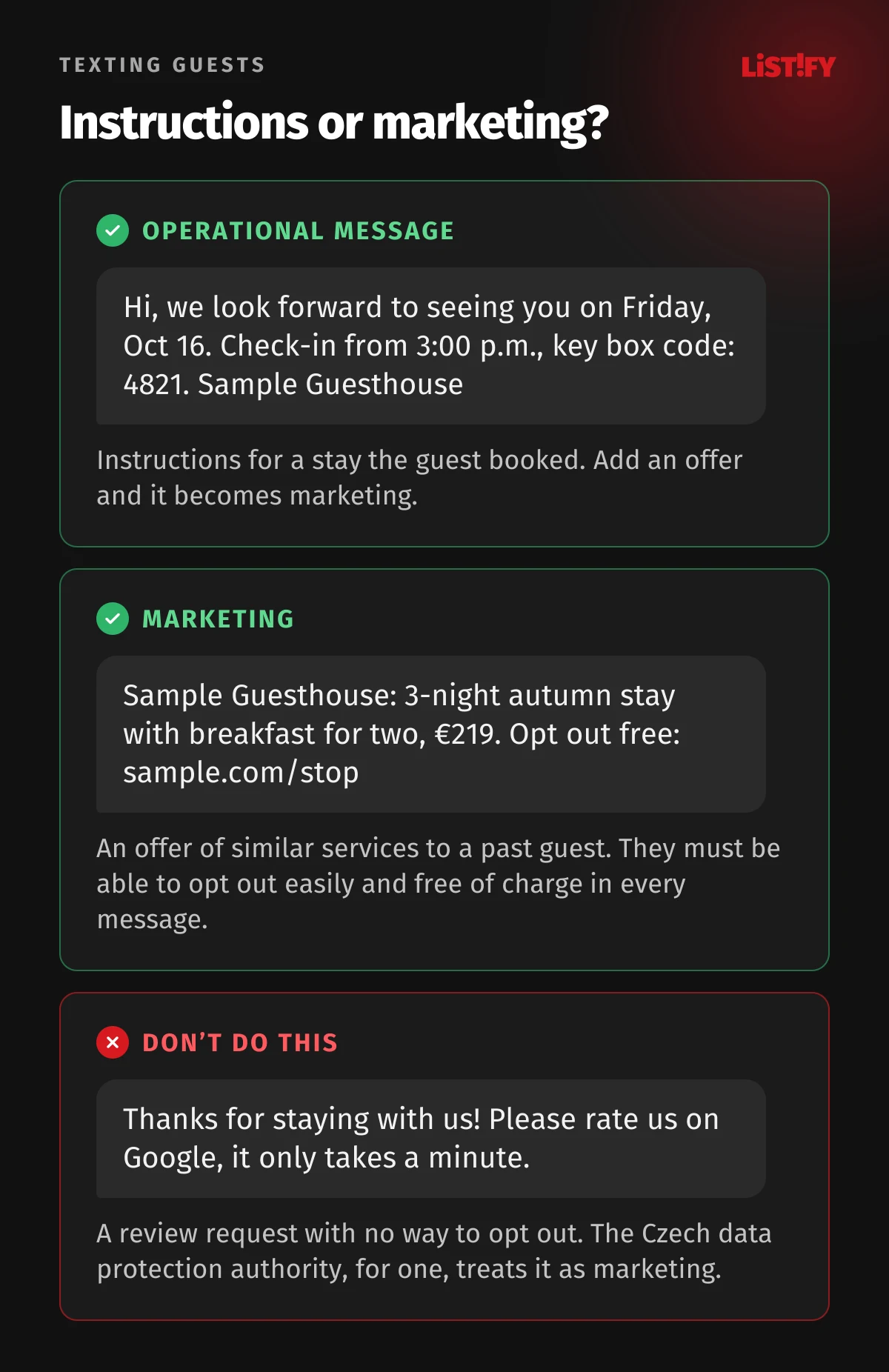
12. Review requests after checkout, done right. Reviews drive the next bookings, and an automatic “How was your stay?” email is tempting. But at least one EU regulator treats it as marketing: the Czech data protection authority states in its 2025 annual report that review requests are commercial communications, and it’s checking senders of review requests as part of its 2026 inspection plan. Send them only to guests who could opt out when they booked, and include an opt-out in every message.
13. Repeat guests who book with you directly. Platforms want your repeat guests too. In its 2025 annual report, Booking.com says that a “mid-fifties percentage” of its room nights were booked in its mobile app, most of them directly, and that it wants to keep growing its share of direct bookings. Direct to Booking.com, that is. And according to Booking.com, the standard 10% discount in its Genius loyalty program is “funded by you, the accommodation partner.” Only 18.24% of EU accommodation businesses with at least 10 employees personalize their website for returning visitors, according to Eurostat. Your system recognizes a repeat guest, offers their favorite room and gives them a perk for booking direct, which costs you less than the commission you’d pay on them.
- Sell through online platformsAccommodation: 65.9%All industries: 9.3%
- At least 20% of web sales via platformsAccommodation: 59.9%All industries: 7.6%
- Website with booking or orderingAccommodation: 81.0%All industries: 22.5%
- Website content for returning visitorsAccommodation: 18.2%All industries: 8.9%
EU businesses with 10 or more employees, 2025 survey. Accommodation is NACE I55, all industries excludes agriculture, mining and finance. Smaller guesthouses aren’t covered. Source: Eurostat, tables isoc_ec_eseln2 and isoc_ciwebn2.
14. You can contact platform guests directly. Under Article 5(4) of the Digital Markets Act, Booking.com must let hotels communicate with guests acquired through the platform, free of charge, promote offers to them on different terms and sign contracts with them outside the platform. You only get those guests’ personal data with their consent, though (Article 6(10)), and the GDPR still applies. Your system invites platform guests to sign up for your news at check-in and records their consent.
15. Guest consent you can prove. If you want to send news and offers, you need to be able to show that the guest agreed or didn’t object. Your system records when and where each guest gave or withdrew consent and stops sending anything to those who opted out.
04Front desk and operations: reasons 16 to 23
16. Foreign guest registration straight from the system. Nearly half of all nights spent in EU tourist accommodation are by guests from abroad: 48.9% in 2025, according to Eurostat. Many countries require hotels to report them to the police. In Czechia, it’s within 3 working days and businesses must file electronically through the police system Ubyport (Section 102 of the Czech Act on the Residence of Foreign Nationals), with fines of up to CZK 50,000. The Czech police recommend that hotels connect directly so data is sent “automatically straight from the booking or hotel system.” In Slovakia, it’s within 5 days and the fine is up to €3,300 (Act 404/2011). A custom system files these reports for you.
17. Tourist tax calculated for you. Tourist taxes are usually set by each town, with their own rates, exemptions and reporting deadlines. In Bratislava, for example, the rate is €3.50 per person per night in the Old Town and €3.00 elsewhere, with a monthly return due by the 15th. In Czechia, the law caps the fee at CZK 50 per night and exempts guests under 18. Your system calculates the tax from each guest’s age and length of stay, applies the rules of your town and prepares the return in one click.
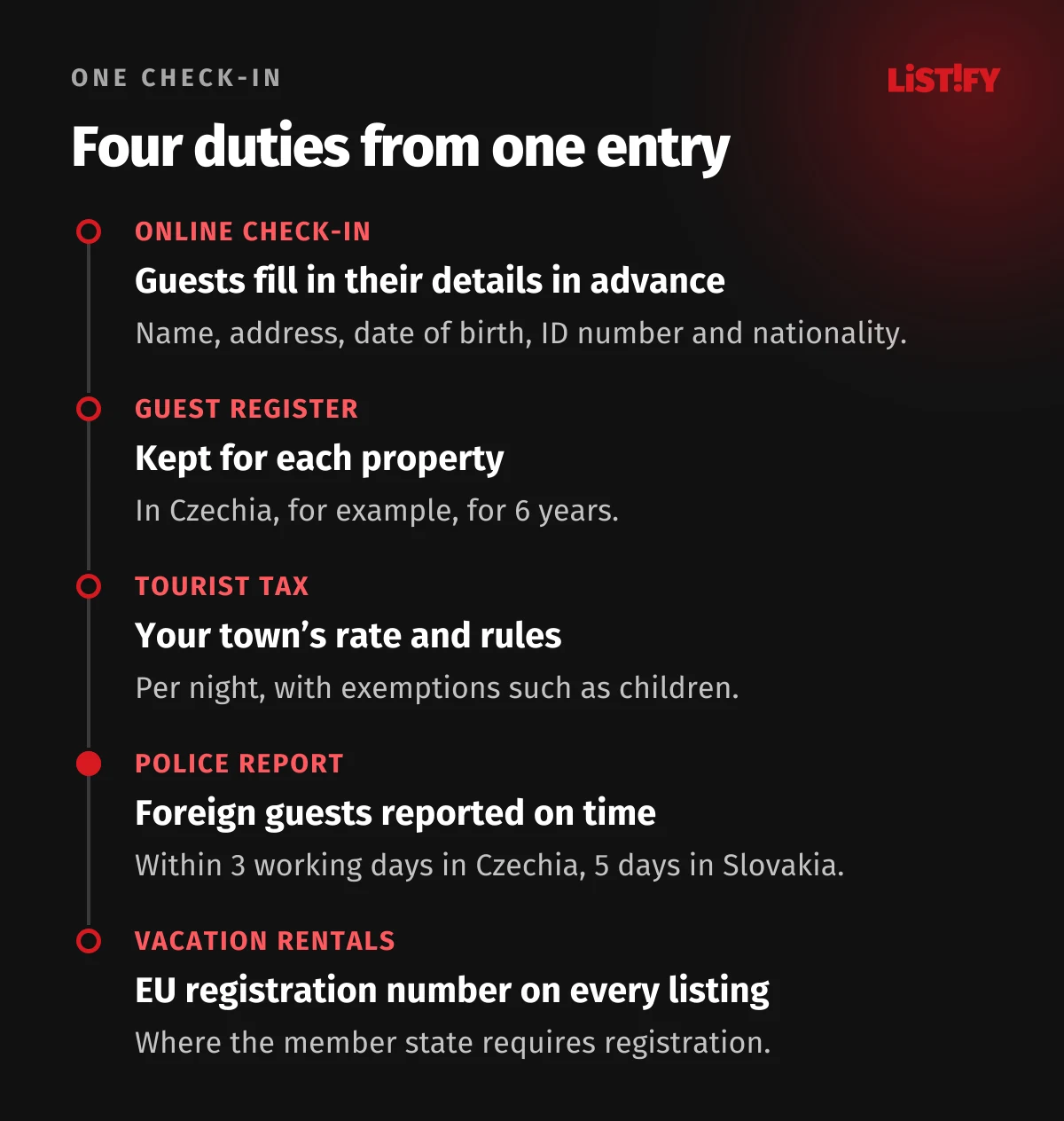
18. Ready for EU short-term rental registration. EU Regulation 2024/1028 on short-term rentals has applied since May 20, 2026. Where a member state introduces a registration procedure, platforms must make sure each listing shows a registration number and must send activity data to the authorities every month. Hotels, hostels and campsites are excluded, so it mainly affects vacation rentals. Your system stores the registration number for each unit and passes it to the channel manager. Czechia is also preparing a national guest register: under a draft bill published for comment in September 2026, it would take effect on January 1, 2028, with data sent straight from hotel systems through an API.
19. Housekeeping and maintenance on a phone. The average guest stays only about two and a half nights (2.51 in Czechia in 2025, according to the Czech Statistical Office), so rooms turn over often. Housekeepers see today’s departures and arrivals on their phones, mark rooms as clean and report a broken hair dryer with a photo. The front desk knows right away which room it can hand over early, and maintenance keeps every issue in a single list.
20. Prices that follow the season and occupancy. In Czech hotels and guesthouses, only 32.8% of rooms were occupied in January 2025, compared with 57.0% in August, according to the Czech Statistical Office. Your system can change prices by date and occupancy, offer packages for slow months and set minimum stays for weekends.
21. Cabins and apartments without a front desk. Guests get the door or key box code only after they’ve paid and completed online check-in, and the code works only during their stay. Where the law requires you to check foreign guests’ passports in person, as in Czechia and Slovakia, the system reminds you who to meet on arrival. You can see who has arrived on your phone and don’t have to drive across the country to hand over keys.
22. Several properties in one system. Each town has its own tourist tax rules, and each property may need its own register. Your system keeps properties separate for the authorities, while you see occupancy, prices and guests in one place. Adding another property just means configuring the same software.
23. A system built around your property. A guesthouse with a restaurant, a mountain hotel with a spa, a campsite with cabins and city apartments all run differently. The typical European hotel is small: the median hotel in the HOTREC study had 34 rooms, and 44% had fewer than 30. Off-the-shelf software is built for the average property, and your quirks end up as workarounds and notes. A custom system follows your exact steps: your packages, your cancellation rules, your corporate clients and your housekeeping.
05Money, data and rules: reasons 24 to 30
24. Fiscal reporting for front-desk payments. Some countries require every in-person payment to be reported to the tax authority in real time. Czechia brings this back on January 1, 2027: every in-person payment, cash or card, at the front desk has to be reported, while online prepayments through a payment gateway don’t. In Slovakia, every payment taken on site, including deposits and balances, goes through the eKasa system, and since May 1, 2026, businesses must accept cashless payment for any amount over €1 (Act 384/2025). A system that knows where each payment came from handles reporting automatically.
25. The right VAT rate on every line. Accommodation often has a reduced VAT rate, but not everything on the bill does. In Czechia, rooms are taxed at 12% under the VAT Act, and when a package includes services at different rates, the tax base has to be split proportionally. When every item in your system carries its own rate and packages split themselves, a rate change means updating one setting instead of reprinting your price list.
26. VAT on platform bookings is changing. From July 1, 2028 (member states may delay it until January 1, 2030 at the latest), platforms will have to charge VAT on short-term accommodation under the ViDA directive when the host doesn’t give them a VAT number and declare that they’ll account for the VAT themselves. This mainly affects small hosts who aren’t VAT-registered (member states may choose to exempt those in the small business scheme), and their prices on platforms are likely to rise. Bookings on your own website aren’t affected.
27. Invoices and accounting without re-keying. An invoice for a company, a deposit invoice for a group or a receipt for an employer are created from the booking and sent to your accounting software automatically. We explain how these connections work in API Integration Best Practices.
28. A clear view of what each channel really leaves you. How many nights came through your website, Booking.com or the phone, what the average rate was and how much was left after commission, discounts and cancellation fees. Watch the deadlines, too: according to Booking.com, if you don’t mark a no-show or cancellation within 48 hours of checkout, “you will be charged full commission on the original booking.” Your system reminds you.
29. Guest data kept safe. Guest registers contain ID numbers and must often be kept for years. Article 32 of the GDPR applies to keeping them secure. Your system runs in EU data centers, backs up automatically and shows each person only what they need: housekeeping sees departures, the front desk sees guests and the accountant sees invoices. More in Data Security in Custom Software Development.
30. Add modules as you grow. Start with direct booking on your website, because it saves commission from the first stay. Then add online check-in with guest registration, housekeeping, corporate clients and groups, vouchers and pricing, one at a time and all on the same guest data, so nothing has to be entered twice.
06Five situations where custom software isn’t worth it
- You rent out a cabin or a few apartments. Off-the-shelf software is cheaper. Beds24, for example, starts at €15.50 a month, regardless of how many bookings you get.
- All you need is tax compliance. If the only reason is a new fiscal reporting rule, use your existing POS system or a simple compliant app. Don’t build a custom system just for that.
- You’re new and nobody knows you yet. A new property gets its first guests mainly through platforms, and a website without a name or reviews fills slowly. Most hotels use both: according to Eurostat, 58.64% of EU accommodation businesses with at least 10 employees sell through their own website and through platforms at the same time.
- Your guests are mostly one-time international visitors. They find you mainly on platforms and won’t come back to book direct. Your own website will take over fewer bookings, and the savings will be smaller.
- You don’t have the budget for a first module. Direct booking on your website starts at €3,590 (CZK 90,000) before VAT with us. If that’s out of reach, start with an off-the-shelf booking engine and come back when commissions grow.
A simple calculation helps you decide: how much you pay each month in commission for guests who have stayed with you before, how many hours a week go into re-keying guest details and how many bookings and invoices are created by hand. Here’s how to calculate software ROI.
07What it costs and how to get started
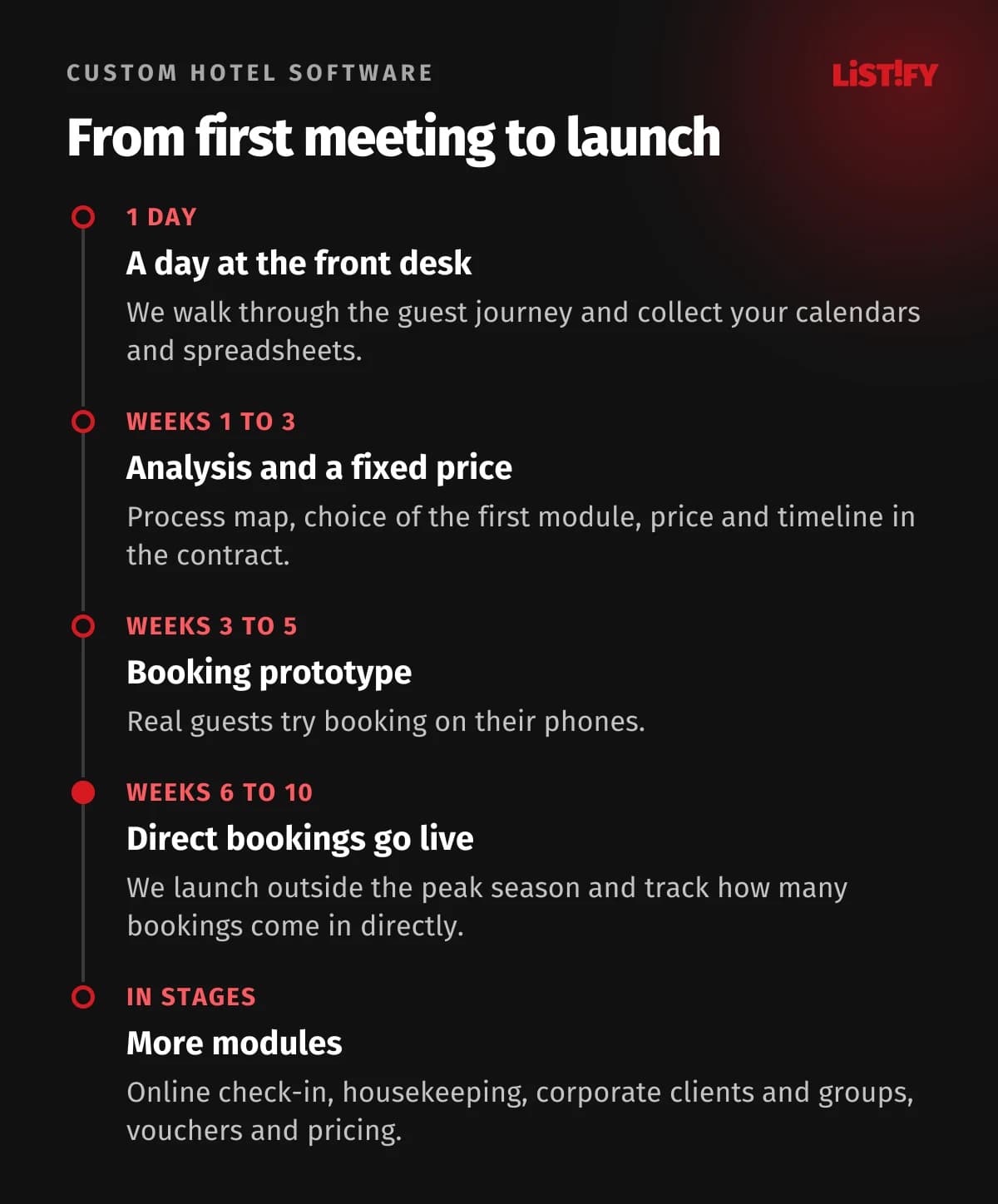
We build direct booking on your own website, with availability, rates, card payments and a channel manager connection, from €3,590 (CZK 90,000) before VAT, usually in 6 to 10 weeks. A full hotel operations system with front desk, housekeeping and maintenance, corporate clients and groups, vouchers and pricing starts at €9,990 (CZK 250,000) and is built in stages over 10 to 18 weeks. Hosting and maintenance start at €90 (CZK 3,000) a month, with no fees per room or per booking. You get an exact price and timeline after the analysis, and we put both in the contract. See our pricing and how we work for details.
We start at your property. We spend a day at your front desk, in person or on a video call, walk through the guest journey from booking to checkout and collect the calendars and spreadsheets you use today. We launch outside the peak season, and your platforms keep running.
If your guests or bookings live in spreadsheets or an old system, read up on what to watch out for during data migration before you start.
08Frequently asked questions
How much does a custom hotel booking system cost?
Direct booking on your website, with card payments and a channel manager connection, starts at €3,590 (CZK 90,000) before VAT with us. A system for the whole operation with front desk, housekeeping, corporate clients and vouchers starts at €9,990 (CZK 250,000). Hosting and maintenance from €90 (CZK 3,000) a month, with no fees per room or per booking.
How long does development take?
Direct booking on your website usually goes live in 6 to 10 weeks. We add further modules in stages and launch them outside the peak season, so your first weeks live never land in your busiest month.
Do I have to leave Booking.com and Airbnb?
No. Platforms can keep running and bringing in new guests. Your own website mainly takes over the guests who already know you, and you’re currently paying commission on them for no good reason. Availability syncs with platforms through a channel manager, so double bookings become a rare exception.
Can I offer a lower price on my website than on Booking.com?
In the EU, yes. Booking.com was designated a gatekeeper under the Digital Markets Act in May 2024, and since November 2024 it can’t stop you from offering different prices or conditions on your own website. It can’t punish you for it with higher commission or by delisting you either. Outside the EU, check your contract.
Can the system handle guest registration and tourist tax?
Yes. Details from online check-in go into the guest register, tourist tax is calculated from your town’s rules and each guest’s age, and foreign guests are reported to the police electronically wherever the country offers that. We build these connections for the country where your property is located.
Who owns the code and the data?
You do. Once paid, the source code and data are yours, and the system runs on your own cloud account. If you ever switch providers, you keep your guests and your booking history.
What’s costing you the most money or sanity right now: commissions, re-keying guest details or juggling three calendars? Tell us how bookings and check-in work at your property today, and we’ll suggest where to start.