Budgeting for 2027: What Does an Off-the-Shelf CRM Really Cost Over 5 Years?
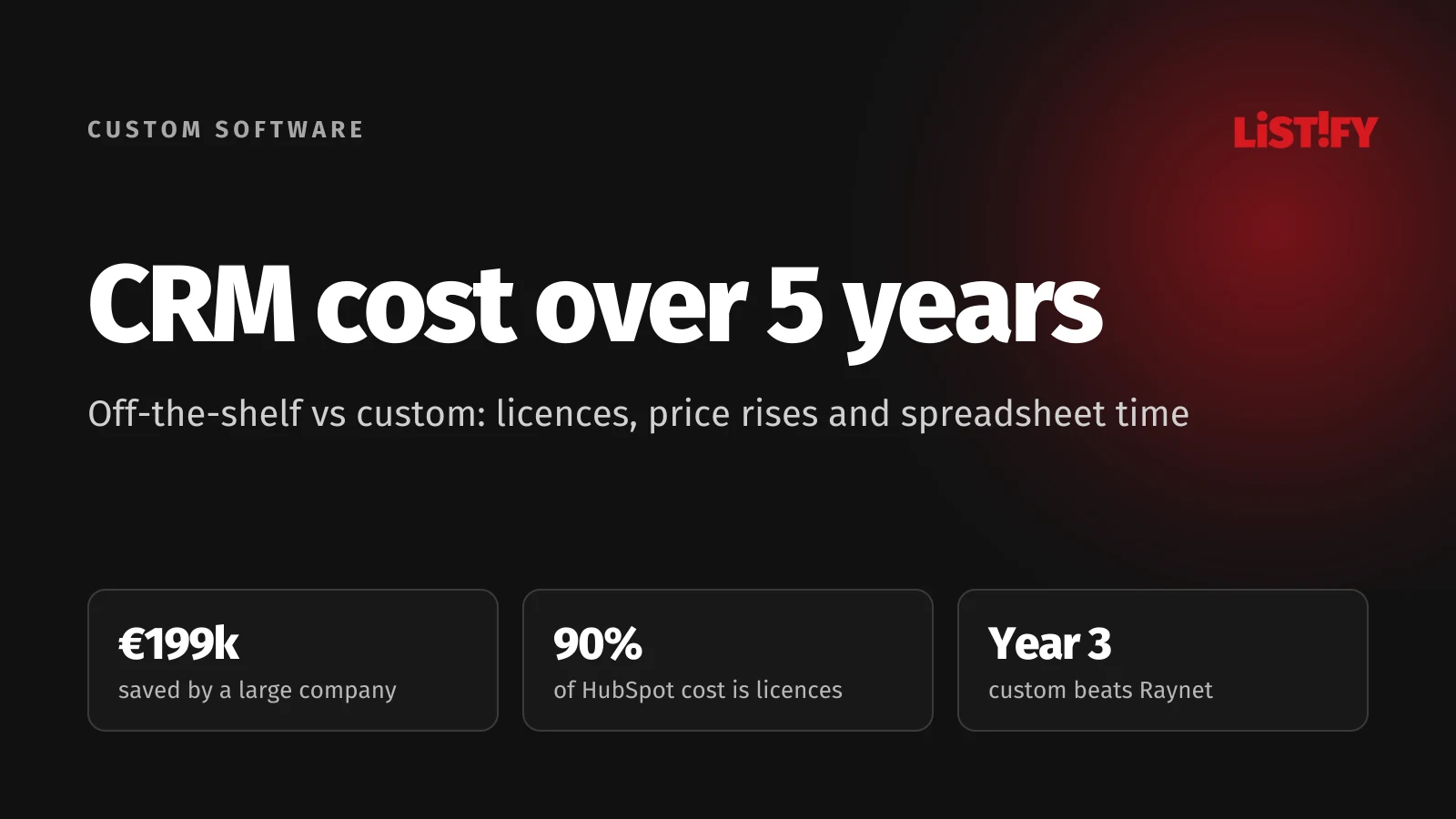
An off-the-shelf CRM is always a compromise. It does a bit of everything, but never everything you actually need. Over five years, it will also cost you more than a custom-built system. We ran the numbers for three companies: a small one with 5 people, a mid-sized one with 25 and a large one with 80 users. The custom system came out cheaper in all three cases, saving the large company nearly €200,000.
September and October are when business owners and managing directors put together next year's budget. When it comes to CRM, most people compare a single number: the monthly price per user. A few dozen euros per person looks harmless.
But a CRM isn't a one-off purchase. It's a commitment that lasts years. Licence fees multiply with every new hire, vendors raise their prices regularly, integrations cost extra, and whatever the system can't do ends up in a spreadsheet. If you're planning your 2027 budget right now, look at the full five years, not just the first month.
01What makes up the real cost of a CRM
The real cost of a system is its TCO (total cost of ownership), meaning everything you spend on it over its entire lifetime. For an off-the-shelf CRM, that breaks down into seven items, and only the first one appears on the pricing page.
- Per-user licences. You pay monthly or yearly for everyone who logs in. Hire a new salesperson and the bill goes up. Cheap plans are usually just bait, because the features that matter (automation, reporting, permissions) only come with the pricier ones.
- Price increases. Cloud software keeps getting more expensive. Vendors typically raise prices by 5 to 10% a year, sometimes in one big jump when they restructure their plans. Over five years, your annual bill can easily grow by a third.
- Paid add-ons and plan upgrades. Need advanced reporting, more automation or API access? You either buy an add-on or move the whole company to a more expensive plan. Storage and contact limits often cost extra too.
- Implementation and setup. Someone has to configure the fields, sales stages, roles and automations, whether that's a partner or one of your own people. For larger CRMs, this regularly runs into five figures.
- Integrations. A ready-made connection to your accounting software, online shop or bank often doesn't exist. You end up paying monthly for tools like Make or Zapier, or for custom development.
- Time lost to spreadsheets and manual work. Whatever the CRM can't do, your team does by hand: retyping orders, exporting data, matching payments, building reports for management. This is the biggest hidden cost, so we cover it separately below.
- Vendor lock-in. Your data and processes live in someone else's system. Leaving means migrating and retraining everyone, so in practice you have to accept every price increase.
A custom system has a different cost structure: a one-off investment in analysis and development, followed by annual running costs (hosting, backups, monitoring, support) and a budget for new features. There are no per-user licences, so 25 users cost the same as 60.
02How much popular CRMs cost in 2026
On the plan a company with automation and reporting actually needs, you'll pay roughly €33 to €195 per user per month. And you still get a product built for thousands of other companies, one that only covers what they all have in common. Whatever makes your business different, you won't find it on any plan.
| CRM | Plan companies actually use | Price per user per month (billed annually) | Watch out for |
|---|---|---|---|
| Raynet (popular Czech CRM) | Professional | approx. €33 (€39 billed monthly) | Automation only from Professional up, API calls and e-signatures above the monthly limit cost extra |
| Pipedrive | Growth / Premium | €39 / €59 | Lite has no email sync or automation, add-ons are billed separately |
| HubSpot Sales Hub | Professional | €90 | Mandatory onboarding fee of €1,470, sequences and custom reports only from Professional up |
| Salesforce Sales Cloud | Core (formerly Enterprise) | €195 | New pricing since September 2026, full API access only from this plan up |
Prices exclude VAT, come from the vendors' official European price lists and are valid as of publication. Raynet prices in Czech crowns, converted at €1 = CZK 24.3.
Two recent examples show why your budget should allow for price increases:
- Salesforce overhauled its pricing on 3 September 2026. The Enterprise plan at €175 per user per month was replaced by Core at €195, an 11% increase. (Salesforce Dictionary) And that came only a year after an increase of about 6% on its Enterprise and Unlimited plans in August 2025.
- Pipedrive charges €59 per user per month for its Premium plan, according to its official pricing page. Some comparison sites still list the old price of $49, so budgeting from them would leave you short.
03The numbers: small, mid-sized and large company over 5 years
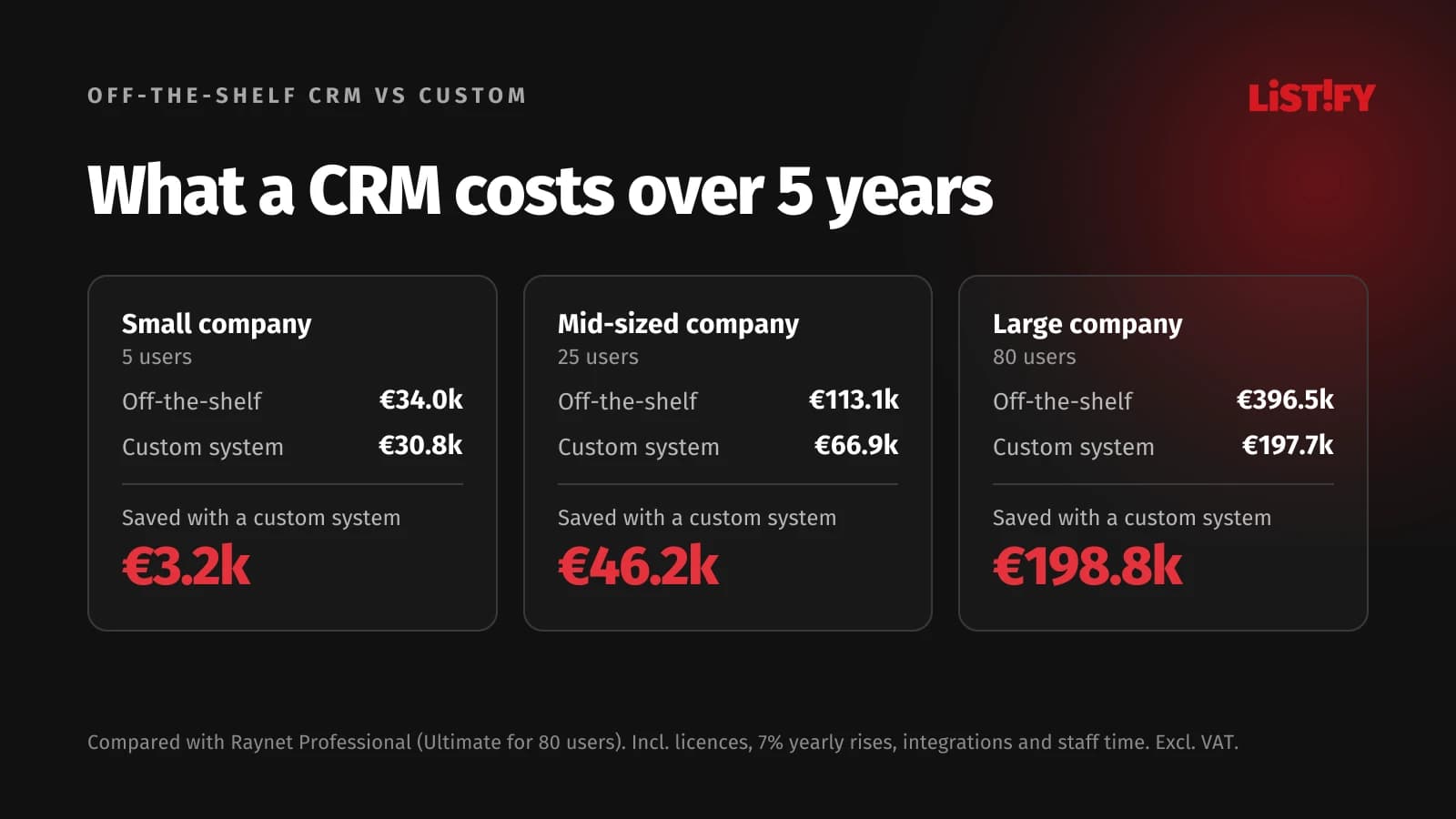
A custom system came out cheaper for every company size we looked at. The small company saves about €3,200, the mid-sized one over €46,000 and the large one nearly €200,000. And that's against the cheapest workable plan of Raynet, a popular Czech CRM. Compared with HubSpot, the savings are more than twice as high.
| Company | Off-the-shelf CRM compared | Off-the-shelf over 5 years | Custom over 5 years | Savings with custom |
|---|---|---|---|---|
| Small, 5 users | Raynet Professional | €33,979 | €30,782 | €3,197 |
| Mid-sized, 25 users | Raynet Professional | €113,105 | €66,872 | €46,233 |
| Mid-sized, 25 users | HubSpot Professional | €220,114 | €66,872 | €153,242 |
| Large, 80 users | Raynet Ultimate | €396,510 | €197,695 | €198,815 |
| Large, 80 users | HubSpot Professional | €683,457 | €197,695 | €485,762 |
- HubSpot Professional683.5
- Raynet Ultimate396.5
- Custom system197.7
Includes licences, 7% annual price rises, integrations and staff time, excluding VAT. LISTIFY calculation.
What the figures include:
- Off-the-shelf: licences with a 7% annual price increase, setup, integrations, add-ons, connector tools, plus the time people lose working around the system (an hour a week per person in the small company, 30 minutes in the mid-sized and large ones, at €16.50 an hour).
- Custom: development (€10,300 for the small company, €19,750 for the mid-sized one, €61,700 for the large one), running costs of €165 to €820 a month, a budget for new features from year two, and the 30% of manual work that remains even with the new system.
The large company shows best why per-user licences don't pay off. With 80 people, it spends €227,000 on Raynet Ultimate licences alone over five years, and nearly €497,000 on HubSpot. A custom system costs the same whether 60, 80 or 100 people use it.
04Detailed breakdown: a mid-sized company with 25 users
Leaving staff time out of it entirely, HubSpot comes to €173,000, Raynet to €66,000 and a custom system to €53,000. So even on invoices alone, custom is the cheapest option, and it overtakes Raynet in year three.
The model company
A manufacturing or wholesale business with 25 people using the system: sales, project managers, production, invoicing and management. It needs to track customers and deals, manage orders, connect to its accounting software, produce reports for management and send automatic notifications.
Assumptions
- The number of users stays at 25 for all five years. If the company grows, off-the-shelf costs grow with it, custom costs don't.
- Licence prices rise by 7% a year from year two.
- HubSpot Sales Hub Professional: €90 per user per month, mandatory onboarding €1,470, implementation partner €6,200, accounting integration via a connector tool €2,500 one-off plus €125 a month.
- Raynet Professional: approx. €33 per user per month, setup €2,500, integrations €1,650 one-off plus €80 a month for add-ons and a connector tool.
- Custom system: development €19,750 (CRM, order management, accounting integration, reporting, data import, notifications), running costs €330 a month (hosting, backups, monitoring, SLA support), new features €3,300 a year from year two.
- Staff time spent in spreadsheets is not included in this table. We cover it separately in the next section.
Five-year cost by item
| Item (EUR, excl. VAT) | HubSpot Professional | Raynet Professional | Custom system |
|---|---|---|---|
| Licences over 5 years | 155,270 | 56,726 | 0 |
| Implementation, onboarding, integrations, development | 10,112 | 4,115 | 19,753 |
| Connector tools, add-ons, running costs (5 years) | 7,407 | 4,938 | 19,753 |
| New features (years 2 to 5) | included in licence | included in licence | 13,169 |
| Total over 5 years | 172,789 | 65,779 | 52,675 |
| Average per year | 34,558 | 13,156 | 10,535 |
Look at the licence row. For HubSpot, it makes up 90% of the total cost, and there's nothing you can do about it. One of our clients, a metalworking company, was paying over €14,000 a year for its off-the-shelf system and per-user fees, which lands right between Raynet and HubSpot.
How the costs add up over time
| Year | HubSpot Professional | Raynet Professional | Custom system |
|---|---|---|---|
| Year 1 | 38,593 | 14,967 | 23,704 |
| Year 2 | 68,965 | 26,509 | 30,947 |
| Year 3 | 101,359 | 38,791 | 38,189 |
| Year 4 | 135,916 | 51,862 | 45,432 |
| Year 5 | 172,789 | 65,779 | 52,675 |
A custom system costs more up front, but after that the costs grow slowly. An off-the-shelf CRM starts cheap and gets more expensive every year, because the licences keep going up and you keep paying them again and again.
05The hidden cost: time your team spends working around the system
If 25 people each lose just 30 minutes a week working around their CRM, it costs the company around €9,500 a year, or more than €47,000 over five years. You won't see this on any invoice. You pay it in salaries.
Typical situations where the off-the-shelf system falls short and the spreadsheet takes over:
- a salesperson retypes an order from the CRM into the accounting software or production plan,
- someone in accounts matches payments to deals by hand,
- a manager spends every Monday piecing together a report from exports, because the CRM can't combine sales and production data,
- a project manager tracks orders in a spreadsheet, because the CRM only knows about “deals”, not how a job moves through production,
- someone is hunting for the latest version of the spreadsheet.
- Small company, 5 people, 1 hour a week19.0
- Mid-sized company, 25 people, 30 min a week47.4
- Large company, 80 people, 30 min a week151.8
46 working weeks a year at €16.50 an hour including employer contributions.
How to work it out for your business
Annual loss = people × hours per week × 46 weeks × hourly cost
For the model company: 25 people × 0.5 hours × 46 working weeks × €16.50 = around €9,500 a year. An hourly cost of €16.50 corresponds to a gross monthly salary of about €2,050 once you add employer contributions, which is typical in the Czech Republic. In Western Europe, the figure would be two to three times higher.
A custom system does most of this work automatically, whether that's retyping, matching payments or building reports. If 70% of the manual work goes away, the company saves around €6,600 a year. That's more than the entire annual running cost of the system in our model.
Then there are the costs that are harder to put a number on: mistakes made while retyping (a wrong price on a quote, a forgotten invoice), decisions delayed by out-of-date figures, and the frustration of people doing work the software should be doing.
06Small businesses: is custom worth it for a team of five?
Yes. By our calculation, even a company with five people saves around €3,200 over five years. More importantly, it gets a tool that fits the way it works from day one. Small companies actually lose the most time to workarounds relative to their size, because everyone wears several hats.
In a small company, five people typically handle sales, quotes, orders, invoicing and customer communication. An off-the-shelf CRM covers sales, and the rest ends up in spreadsheets, email and the owner's head. A custom system brings it all together in one place.
And a small company doesn't need to start with a big system:
- automating a single process (for example, turning an enquiry straight into a quote and an invoice) starts at €3,700 (CZK 90,000),
- a client portal for your customers starts at €6,200 (CZK 150,000),
- a custom CRM starts at €10,300 (CZK 250,000).
The system then grows with you. When you hire your sixth, tenth or twentieth person, you don't pay a cent more in licence fees. You'll find indicative prices for all our services on our pricing page.
07What an off-the-shelf CRM can't do and never will
An off-the-shelf CRM is designed for an “average company” that doesn't exist. The vendor has to keep thousands of customers happy at once, so your specific needs will never be their priority.
- Your processes. An off-the-shelf CRM has a fixed flow: lead, deal, closed. Made-to-order production, service intervals, three-step quote approvals or your own pricing logic can only be worked around.
- A connection to the whole business. An off-the-shelf CRM either can't connect to production, stock, accounting, your online shop or your bank at all, or you pay extra for another tool to do it. With a custom system, all your data is in one place.
- Exactly the screens your people need. A field technician doesn't need a salesperson's 40 fields. In an off-the-shelf CRM they see them anyway. In a custom system, they get one simple screen.
- New features when you need them. With an off-the-shelf CRM, you wait and hope the vendor adds it one day. With a custom system, we build it within weeks.
- Ownership. The code, the data and the access are yours. No price increases you're forced to accept, no dependence on a vendor, no licences.
An off-the-shelf CRM forces you to change your processes to fit the software. A custom system does the exact opposite.
08Is your off-the-shelf CRM holding you back?
If any of the points below sound familiar, your CRM is already costing you more than you think. That's true whether you have five people or a hundred.
Typical warning signs:
- you pay licences for people who only look things up in the CRM or enter one thing (production, warehouse, technicians),
- alongside the CRM, you have three or more spreadsheets the business can't run without,
- you enter the same data into two systems,
- your CRM vendor has been “considering” a feature you need for two years now,
- every year you pay more for licences and add-ons than the year before,
- the way you work is a competitive advantage, and you don't want to bend it to fit a template.
The hybrid path: you don't have to change everything at once
Between “stick with off-the-shelf” and “rebuild everything from scratch”, there are two steps in between:
- Off-the-shelf plus a custom extension. You keep the CRM for your sales team and build only what's missing: an order management module, a link to production or a client portal. The two systems talk to each other through an API. This works well as a first step if you're still tied into a contract with your current vendor.
- A gradual switch. The custom system starts with one area (orders, for example) and takes over the rest in stages. You cancel off-the-shelf licences as people move across. The risk is spread out, and you'll see the first savings within a few months.
Both paths start the same way, with an analysis of what's really happening in the business and what it's costing you today.
09A 7-question checklist for your 2027 budget
Before you renew your licence or order development work, go through these seven questions with your management team. The answers will tell you more than any comparison of pricing plans.
- How much did we pay for our CRM and all its add-ons this year? Add up the invoices for licences, add-ons, connector tools and outside consultants. Not the price list, the actual invoices.
- How many users will we have in three years? Multiply that by the price per user and add a 7% increase for each year.
- How many hours a week does the team spend in spreadsheets and retyping data? Ask the people doing the work, not their managers. Then plug the answer into the formula above.
- Which three features do we miss most in our current system? And how much would a higher plan or an add-on that provides them cost?
- What's our notice period, and does the contract renew automatically? Annual subscriptions often renew on their own, and you usually have to cancel 30 to 90 days before the end of the term.
- Can we export our data at any time in a usable format? Including history, attachments and the links between records.
- Is the way we work standard, or is it a competitive advantage? Every business has something that sets it apart from the competition. That's exactly what an off-the-shelf CRM can't do, and exactly what's worth building.
If questions 1 and 3 add up to more than €4,000 a year (which can easily happen even with five people), it's worth getting a no-obligation quote for a custom system.
10Frequently asked questions
How much does a custom CRM cost?
A simpler custom CRM starts at around €10,300 (CZK 250,000) excluding VAT. For a company with 20 to 30 users, order management and accounting integration, the price usually falls between €16,500 and €24,700 (CZK 400,000 to 600,000). On top of that, you pay running costs of a few hundred euros a month, but no per-user licences.
Is a custom CRM worth it for a small business?
Yes. In our calculation, a small company with five people saves around €3,200 over five years and gets a system that brings sales, orders and invoicing together in one place. You can also start smaller, for example by automating a single process from €3,700 (CZK 90,000).
How much does an off-the-shelf CRM cost per month?
Local CRMs such as Raynet start at around €16 per user per month (Raynet Start, for up to 3 users), and plans with automation and reporting cost €33 to €50. International tools like HubSpot or Salesforce cost €90 to €195 per user per month on plans you can actually work with.
What is TCO and why does it matter?
TCO (total cost of ownership) is the total cost of owning a system over its entire lifetime. Besides licences, it covers implementation, integrations, price increases, running costs and staff time. For a CRM, it's worth calculating over at least five years, because that's how long companies typically use one.
How long does it take to build a custom CRM?
You can start using the first part of the system within about eight weeks of starting the analysis. A complete system with integrations usually takes 10 to 16 weeks, delivered in stages, so you're not waiting for one big launch.
Can you migrate the data from our current CRM?
Yes. Contacts, companies, deals and communication history can all be imported from common CRMs and from spreadsheets. As part of the switch, we check and clean up the data so you don't carry duplicates over into the new system.
Who owns the custom system?
With us, you own the source code, the access and the data. You can host the system anywhere and develop it further with anyone. Ask every vendor about this, and insist on having it in the contract.
11Conclusion: off-the-shelf is a compromise, custom is an investment
Whether you have 5, 25 or 80 people, a custom system will cost you less over five years and do exactly what your business needs. An off-the-shelf CRM only ever covers part of it, and you pay for the rest in licences, add-ons and hours spent in spreadsheets.
If you're putting together your 2027 budget, try a quick test: add up last year's CRM invoices, estimate the time spent in spreadsheets and compare it with a one-off investment. Our calculator will give you a more precise picture.
Get an estimate for your custom system in 60 seconds
Pick what you need and you'll see the price and timeline straight away. We'll send you a detailed fixed-price quote within two business days. Would you rather talk it through? Call us on +420 771 166 199 and in 15 minutes you'll know how much a custom system could save you.
12Sources
Prices checked on 27 September 2026 on the vendors' price lists, excluding VAT. Prices change, so check with the vendor before making a decision.
- Raynet: price list (in Czech)
- Pipedrive: pricing
- HubSpot: Sales Hub pricing
- HubSpot: Sales Hub pricing guide
- Salesforce: Sales Cloud pricing (EU)
- Salesforce Dictionary: Salesforce Rebuilds Its Price List (3 September 2026)
- LeadHaste: Salesforce Pricing 2026 (August 2025 increase)
- SaaS Switcher: Pipedrive pricing in 2026
- Czech National Bank: exchange rates