Business website copywriting: How to write copy that sells
Business website copy should help people make a decision: identify a suitable service, understand the conditions, check your credibility and take the next step. One memorable slogan cannot do all of that. You need pages that work together to answer the reader’s questions. Here is how to plan, write, test and maintain them.
01What copy that sells actually does
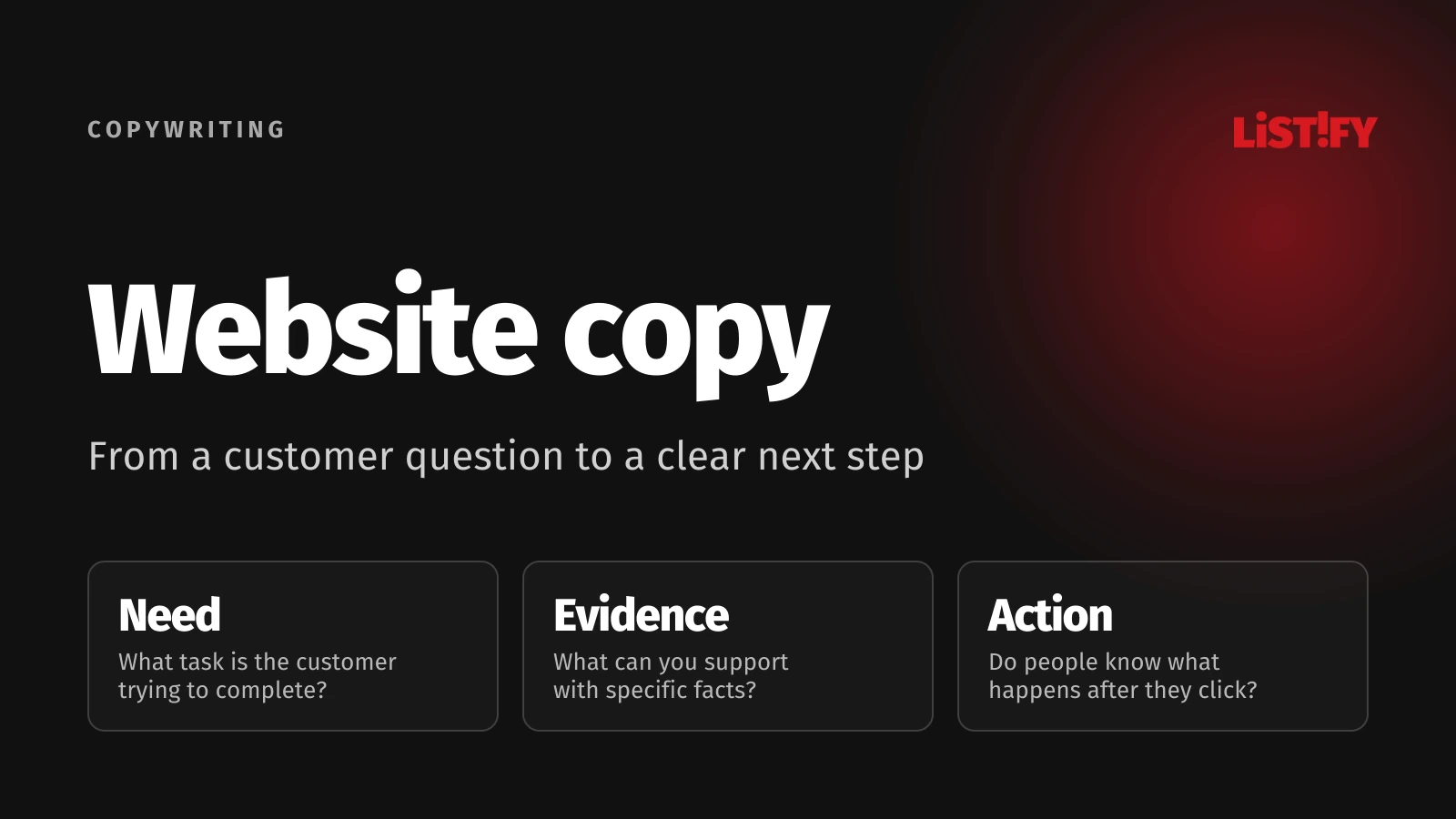
Useful business copy helps a suitable customer make an informed decision. Success need not mean an immediate purchase. For a specialist service, it might be a relevant enquiry, a meeting request or a clear understanding that the offer does not fit. Fewer, better prepared enquiries can be more useful than a flood of vague messages.
A whole website serves several situations. A new visitor needs to understand the offer, a colleague approving expenditure wants evidence, and an existing customer needs support. Each important page should also make sense to someone arriving directly from search, without reading your homepage first.
Our landing page copywriting guide covers a single campaign offer. This article concerns the whole business website. Copy supports what you sell, but cannot create missing capacity or fix a disappointing service. Check every promise against what your team can actually deliver.
02Start with a customer task, then write
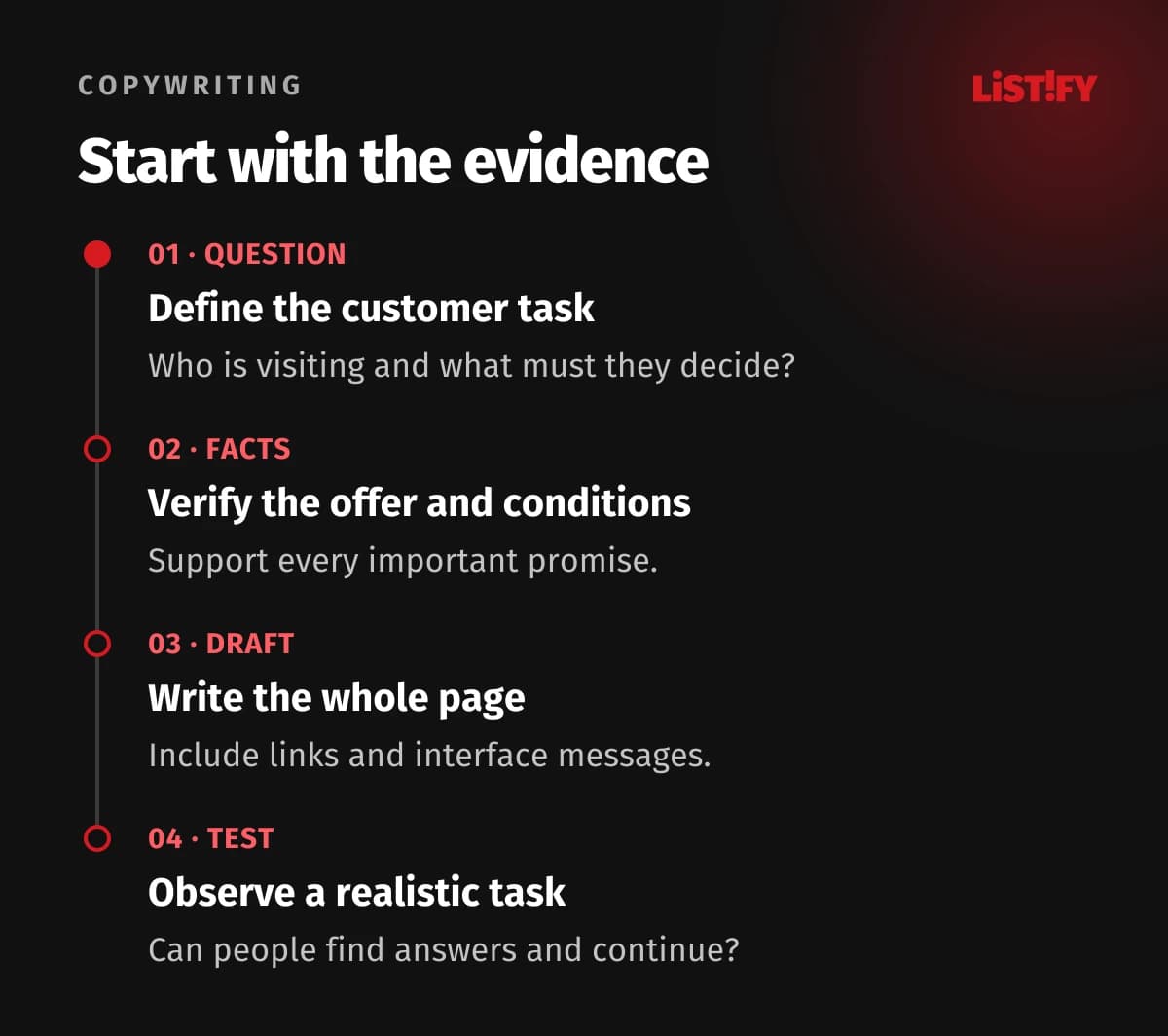
GOV.UK’s guidance on user needs starts with a person and a task. Record who is visiting, what they need to decide and why. Use customer conversations and evidence; label internal assumptions as assumptions.
A useful brief might say: An office manager needs to discover whether we repair their coffee machine and how to request service. That is more actionable than “make us sound professional”. Find out how customers describe the problem, what they have already tried and what prevents them from proceeding. Ask sales colleagues for recent examples, rather than only a generic list of objections.
Define the boundaries too: whom you help, which situations you exclude, where you work and what you need before quoting. Record the main question, the next step and available evidence in a short brief. A customer journey map helps connect the website with calls and sales conversations.
03Collect material and assign factual approval
A copywriter needs more than a logo and a service list. Collect proposals, process descriptions, photographs of real work, common questions and approved testimonials. Ask colleagues what they explain before almost every project. A missing condition or preparation requirement may be more useful to customers than another paragraph about company values.
Give each claim a source and an owner. A project count needs a defined period and meaning; a certification needs its current scope; a quotation needs permission. The person responsible for answering enquiries should approve a promised response time. If evidence is unavailable, change or remove the claim. Do not invent a number to fill a design block.
A shared claims register can track evidence, ownership and approval. Separate factual review from editing so specialists correct meaning without replacing every sentence with internal jargon. Our website content checklist provides a broader preparation guide. Resolve missing material before treating the page layout as final.
04Give every page a clear job
The homepage introduces the offer and routes people onwards. A service page helps assess suitability. About explains who does the work. Case studies demonstrate relevant experience, and Contact supports the transition to a conversation. Repeating the same general introduction on all of them makes readers search harder without learning anything new.
Write down each page’s main question and next step. Add supporting information when it helps that decision. You do not need every service and every proof point on every page: a useful summary can link to detail. Make the destination clear. “How servicing works” tells the reader more than another button labelled “More”.
Review alternative entry points. Open a service page, a case study and Contact independently. Can someone identify the business, understand the page and continue? This reveals explanations a visitor may never have seen.
| Page | Customer question | What the copy should provide |
|---|---|---|
| Home | Am I in the right place? | The offer, audience and routes based on needs. |
| Service | Can you address my situation? | Scope, conditions, process and next step. |
| About | Who would I work with? | Real people, roles and relevant experience. |
| Case study | Have you handled a similar brief? | Context, work, supported outcomes and limitations. |
| Contact | How do I start, and what happens next? | An appropriate route, required information and expectations. |
05Make the homepage explain the offer
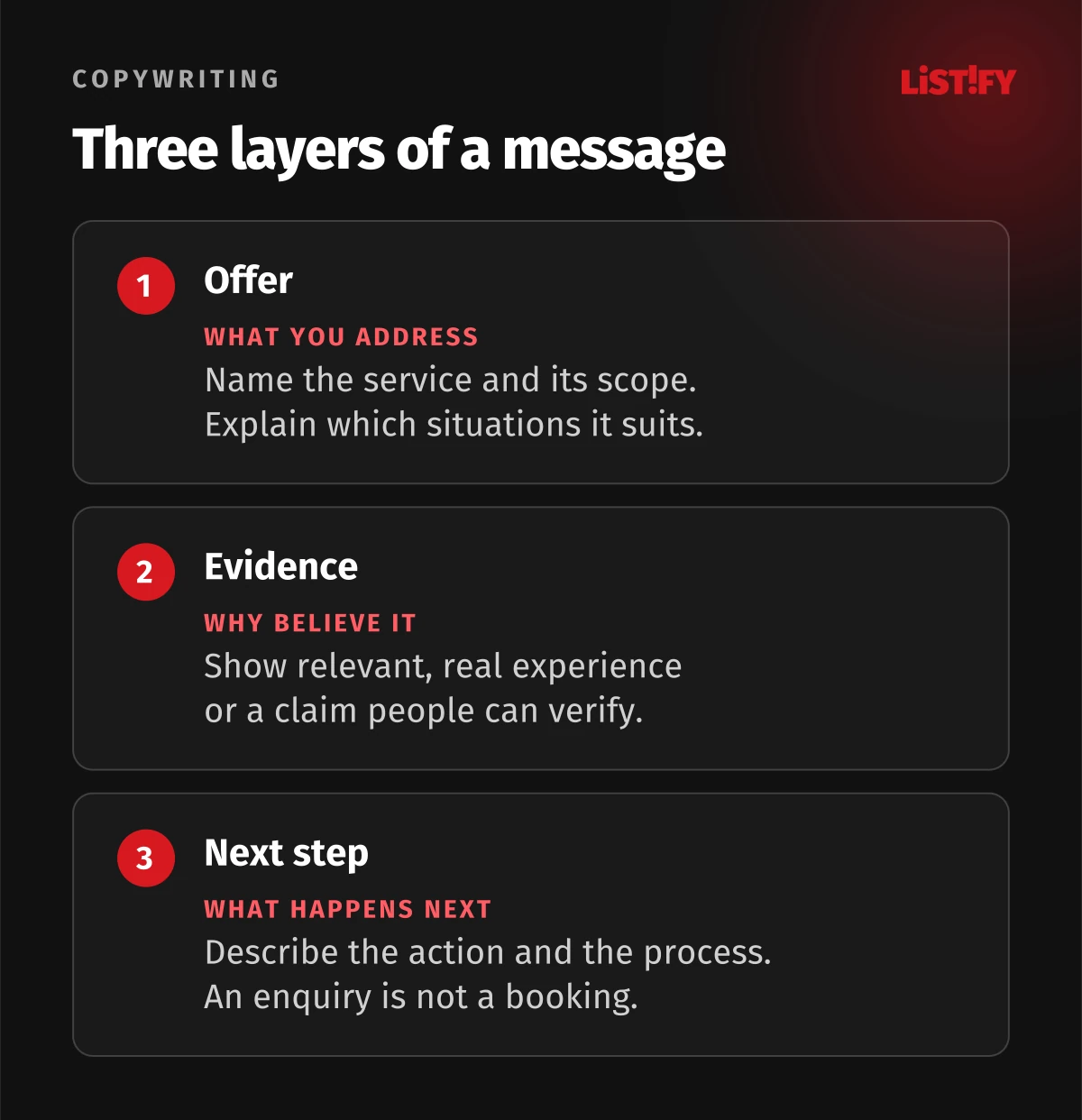
Use the opening headline to name your offer in language customers recognise. Explain whom it serves and the situation it addresses. Specificity can come from the audience, scope or location. It does not require a dramatic deadline. If delivery time depends on an assessment, do not promise immediate results simply to strengthen a headline.
Next, provide useful choices. A business with three distinct services can offer three clearly named routes. Existing customers should be able to find contact details easily. Explain the distinction between routes: “For businesses” and “For entrepreneurs” are not helpful categories if people cannot tell which one applies to them.
Read the headline, subheading, service names and buttons on their own. Then check the destinations. “Find out about servicing costs” should not lead to a general About page. Assess copy and navigation together in the actual design.
06Help people assess a service properly
A service page should explain what you do, for whom, what the customer provides, what they receive and how the work proceeds. Address the factors affecting cost and timing. Start with the most important answer, then add detail. “Everything is bespoke” is not an explanation: identify which parts vary and what determines them.
Connect features with practical benefits, while retaining necessary conditions. Online booking can let someone choose an available appointment without calling. It does not prove that repairs will be faster. An in-house team may simplify communication; it does not automatically eliminate delays. Ask how each claimed benefit follows from the feature.
If a price requires a brief, explain the information needed for an estimate and what happens next. Publish a range only when it has a meaningful scope and stated assumptions. Be equally clear about exclusions. These boundaries help customers and reduce the work of untangling unsuitable enquiries.
07Before and after: improve meaning, not just vocabulary
The following is an illustrative example created for this article, not a real company or a Listify client result. The fictional business repairs office coffee machines in Brno. It needs the model and fault description before confirming an appointment. It can discuss next steps after assessing those details, but has no basis for promising next-day repairs.
The original phrases sound polished without answering a useful question. The alternatives add specific information and a predictable action. They are proposals to test, with no claimed conversion uplift. Their clarity and suitability would need checking with people who actually arrange equipment servicing.
| Location | Original wording | More specific alternative |
|---|---|---|
| Home | Comprehensive solutions with a professional approach. | Office coffee machine repairs in Brno. |
| Service | An individual approach to every customer. | We recommend the next service step based on your machine and fault. |
| Contact | Do not hesitate to contact us. | Send the machine model and a fault description. We will discuss the next step. |
| Button | Solve the problem now | Send a service enquiry |
An improved version is not always shorter. The contact instruction grows because it resolves uncertainty; the headline loses empty praise. Usefulness is the criterion. If a real business supported only certain manufacturers, the copy would also need to state that scope. Adapt the example to verified facts, rather than copying its fictional conditions.
08Connect About and case studies with real work
About should help people understand who will be responsible for the relationship. Introduce actual people, their roles and relevant experience. A founding story is useful when it explains your specialism or working methods. A long chronology unrelated to the current offer is harder to use in a purchasing decision.
For a case study, describe the starting situation, scope and outcome, including limitations. Explain the period and method behind any metric. Do not automatically attribute an improvement to copy if a new campaign or offer launched simultaneously. Without reliable numbers, show the deliverable and the decisions behind it. A specific, truthful account of work is useful evidence.
Match proof to the question. A complex integration demonstrates different experience from praise for communication. Place a relevant summary near the offer and link to the detail. Our guide to testimonials, case studies and reviews explains evidence preparation. Never invent quotations or substitute fictional customers for real ones.
09Contact and interface copy complete the offer
Explain what each contact route is for and what happens next. A prospective customer and an existing client reporting a fault may need different contacts. Offer alternatives your team actually monitors. Any response commitment should reflect working days and exceptions. Replace vague promises such as “immediately” with an accurate process description.
Button text should describe the action without implying a completed outcome. Sending an enquiry is different from securing an appointment. “Send a service enquiry” therefore means something different from “Confirm appointment”. Explain unusual form fields, such as why you need an equipment model or approximate project scope. Put help beside the relevant decision.
Write error and confirmation messages too. Explain how to correct a problem without blaming the user. Distinguish receipt of a request from acceptance of an order. Review these states with the developer: persuasive main copy cannot resolve uncertainty when someone does not know whether their form was submitted.
10Write for the interface people will use
Nielsen Norman Group’s 1997 research supported concise, scannable and factual writing in its usability study. It does not predict sales on today’s websites. Check whether your readers can find answers in your own interface and context.
Give each paragraph a clear idea. Headings should describe what follows, lists should group related points, and emphasis should identify what matters. Bolding an entire paragraph removes that distinction. Explain unfamiliar specialist terms when first used, while retaining technical details that an informed buyer needs to compare.
Review the finished page on a phone and computer. A broken button label, clipped description or changed card order can disrupt the meaning. Do not put essential explanations only inside images. Links should make sense beyond their surrounding sentence. Readability is not a universal limit on paragraph lines: font size, available width and content all affect the result.
11Let SEO and brand voice serve the same reader
Google recommends useful, people-first content and explicitly has no preferred word count. Titles should describe the content. Answer a real need and support your claims rather than repeating a keyword throughout the page.
Name services in language customers recognise and use. A branded name can accompany an explanation instead of replacing it. Each service page should have a genuine reason to exist. Do not duplicate a generic description across dozens of locations with only the place name changed. Search titles, page headings and body copy should describe the same offer.
Create a short style guide covering terminology, tone and example phrases. In translation, preserve the meaning while checking local vocabulary, service availability and contact information. An English version need not follow Czech sentence structure. Consistency means the same offer and conditions, expressed naturally for each audience, rather than mechanically identical sentences.
12Test understanding and track enquiry quality
Give the draft to people similar to your customers. Ask them to establish whether the service fits their situation, what to prepare and how to proceed. Observe first, then ask questions. “Do you like the copy?” collects an opinion; a realistic task reveals whether someone understands the offer and can find the information.
Record specific difficulties and their likely causes. Information may be missing, a link misleading or two pages contradictory. A small qualitative study can identify problems without establishing their prevalence across your audience. Correct major obstacles and test the affected task again. Choose participants according to audience diversity and the risk of the decision.
After launch, track enquiry suitability and subsequent progress alongside form submissions. When comparing periods, consider traffic sources, seasonality and offer changes. An improvement after a rewrite does not prove causation. For an A/B test, plan the metric, duration and sample requirement beforehand. With limited traffic, focused research may be more useful than continually swapping headlines.
13Set a publishing check and a content owner
Start where an important customer question repeatedly goes unanswered or suitable enquiries are lost. Complete the whole page, including links and status messages, then check its connections. Factual approvers should review the final version, not only the first text document.
At handover, assign an owner to each key page and define review triggers: changes to services, prices, people, operations or forms. Add a regular review suited to how quickly the business changes. An outdated promise is an operational problem as well as a content problem. Record what changed and why to support later evaluation.
For a new website, develop copy alongside structure and design. Copywriting is part of Listify’s custom website service. The purpose is to align your message, interface and actual offer. Before publishing, use the checklist below with a sales colleague and someone who was not involved in creating the page.
- The offer, suitability and service boundaries are clear from a direct page entry.
- Every important claim has traceable evidence and an approver.
- Headings, links and buttons describe the actual content and action.
- Services, prices and contact details agree across pages and languages.
- Forms, errors and confirmations explain what happened and what follows.
- The copy has been checked on mobile and through a realistic customer task.
- The page has an owner, review triggers and a record of changes.
14Frequently asked questions
Should we write the homepage first?
Not necessarily. Completing the main service page first can clarify scope, customers, process and evidence. The homepage can then summarise that offer and route visitors to detail. Set priorities by business importance and available material.
How long should business website copy be?
Long enough to answer the important questions on that page without unnecessary repetition. A contact page and a specialist service require different detail. Add missing information, remove duplication and review readability in the design. Word count alone does not show whether the copy is useful.
Should we publish prices for bespoke work?
At least explain the factors affecting price and how to obtain an estimate. A meaningful range can help when its scope and assumptions are clear. Do not present the cheapest exceptional case as the normal price. Set accurate expectations for the next conversation.
Can AI prepare the copy?
It can help with outlines, variations and editing supplied material. Someone with relevant knowledge must verify offer details, evidence and commitments. Do not enter confidential client material without appropriate authorisation. Check the output against the brief, particularly whether possibilities have become promises.
What if we have no testimonials or metrics?
Show a concrete process, real people and work you are permitted to publish. Explain service boundaries and handover. An illustrative example is useful if clearly labelled and never presented as a client engagement. Do not invent ratings or percentages to fill a design block.
How will we know the new copy works?
Test understanding through realistic tasks first. After launch, consider relevant enquiries, their quality and progress while accounting for traffic changes. Clicks are only one signal. Establishing causation requires a suitable experiment or cautious interpretation of several sources.
Who should approve the final copy?
Assign one decision owner and specialists for particular facts. Sales checks the offer, operations checks deliverability, and the writer checks clarity. Review the finished mobile page, form and confirmation states. Without ownership, feedback can circulate indefinitely while conditions diverge across pages.