Why your PPC campaigns are not profitable and where the budget goes
Ads bring visitors, the report shows conversions, yet your business bank balance tells a different story. Before increasing spend, follow the entire journey from click to paid order. The problem may be targeting, faulty measurement, the website, a thin margin or what happens after someone submits an enquiry.
PPC should help acquire business that leaves a useful contribution after related costs. Cheap clicks alone do not establish that. A practical audit starts with the economics of your offer and follows the advertising account through to orders or CRM records. This guide helps distinguish genuine budget leakage from misleading reporting and identify the first useful repair.
01Start with what you can afford to pay for a customer
Take net revenue excluding VAT, after discounts and expected returns. Subtract the goods or direct delivery labour, payment fees, subsidised shipping and other variable costs. This leaves contribution before marketing. Customer acquisition, overhead and profit must be funded from that amount. The difference between your selling price and supplier invoice is not the full picture.
For an illustrative order with €80 of revenue and €24 of contribution before marketing, spending €24 on advertising to acquire it leaves nothing for campaign management or overhead. Allowing an €8 reserve and €4 of allocated management cost leaves at most €12 for media. This is a worked example, not a recommended limit for every store.
Include repeat purchases only when actual customer cohorts support the assumption. An expected lifetime value must not hide a business that cannot pay its bills today. Keep a first-order limit separate from your longer-term customer acquisition budget, and state when you expect the investment to pay back.
02Locate the point where performance breaks down
Avoid changing everything at once. Choose a completed reporting period, allow for the usual customer decision cycle and compare the same group of visits, enquiries and orders. Fresh enquiries should not be compared with deals that had three months to close. Keep the relevant advertising cost attached to that group.
| What you see | What to investigate first | Evidence for a decision |
|---|---|---|
| Clicks grow, relevant visits do not | Search intent, locations, the offer and landing pages | Search terms and visits to the right offer |
| Visits arrive, enquiries do not | Clarity, forms, mobile usability and payment | Task completion and error states |
| Leads are cheap, sales rejects them | Conversion definition, qualification and expectations | Recorded reasons for rejection |
| Orders rise, cash does not | Returns, discounts, margin and additional costs | Contribution after advertising and collections |
| The account looks healthy, the business stalls | Channel overlap, brand searches and repeat customers | New customers and a controlled test |
Record missing evidence as a gap in the audit. A zero in a report may mean no results, or it may mean a broken data connection. Those situations require different fixes. Do not turn an unavailable metric into a confident recommendation to stop a campaign.
03Make sure the campaign recognises a valuable outcome
A tap on a phone number is not an answered call. Opening a form is not an enquiry, and loading a confirmation page twice does not create two sales. List every conversion action, check when it fires and review the goals used by the specific campaign.
Google Ads uses primary actions within selected goals for bidding. Secondary actions normally serve observation, but including one in a custom goal is an exception. Review campaign goals as well as action settings. Google Ads conversion-action documentation.
Complete a controlled order and an enquiry. Check the value, currency, unique ID and submission time, and whether two tracking routes count the same outcome. For a fuller review, use our Google Ads measurement checklist. A seemingly improved conversion rate after a tracking change may simply mean the definition changed.
04Pay for the right intent, offer and location
A supplier of substantial business software needs different visitors from a website offering free templates. A search may contain the right word while coming from a student, a job seeker or someone trying to repair a competitor’s product. Assess what the person is trying to accomplish, not merely whether the wording matches.
The search terms report helps identify searches that triggered an ad. Irrelevant intent can be addressed with negative keywords where supported by the campaign type. Google Ads guidance on search terms.
Check service areas, availability and actual destination URLs separately. A local installation service should not promise nationwide coverage it cannot deliver. For an online store, confirm that campaign product data reflects stock and prices. A more precise offer can generate fewer clicks yet more valuable orders.
05Remove website obstacles before buying more traffic
Open the ad on a phone and complete the promised task. Does the visitor see the same service, timing and terms? Can they find a price or understand how it will be established? Do they know what happens after submission? Also test invalid input, returning from payment and a slower connection.
Describe issues precisely: selecting delivery hides the button, the form rejects a valid number, or the customer cannot tell whether the order succeeded. “The website needs a more modern design” does not identify a repair. Fix purchase-blocking errors first, unclear offers next and cosmetic details afterwards. Our landing page anatomy guide explains the page’s role in that journey.
You do not have to determine alone whether the problem is PPC, the website or lead delivery. Through our digital marketing and PPC service, we review these elements together. Send the website address, the offer being promoted and the business outcome you are missing.
06Check what happens after an enquiry is submitted
Confirm that the enquiry reaches the right person, has an owner and gets a next step. A lost email, a phone number nobody calls or an unanswered quotation can look like poor advertising. Conversely, a large volume of contacts does not prove good acquisition if almost none meet your requirements.
Agree simple outcome reasons with sales: relevant, outside the service, outside the territory, unreachable, lost on price and won. These should guide decisions about the offer or campaign, rather than merely justify the result. Consistent definitions across salespeople matter more than a long list of complicated labels.
For higher-value services, track cost per contact, qualified opportunity and acquired customer separately. Our guide to connecting ads, CRM and paid invoices explains the foundation. Use customer journey mapping to inspect handovers between advertising, the website and sales.
07A cheaper lead can produce a more expensive customer
The following model compares two campaigns over the same mature period. It assumes the same contribution per customer and correct linking of sales. These are illustrative figures, not client results or an industry conversion-rate benchmark.
| Metric | Campaign A | Campaign B |
|---|---|---|
| Advertising spend | €1,200 | €1,200 |
| Enquiries | 100 | 50 |
| Cost per enquiry | €12 | €24 |
| Customers acquired | 5 | 10 |
| Advertising cost per customer | €240 | €120 |
| Contribution before marketing per customer | €200 | €200 |
| Contribution after advertising | -€200 | €800 |
- Cost per enquiryCampaign A: 12Campaign B: 24
- Cost per customerCampaign A: 240Campaign B: 120
Illustrative model from the table. Advertising spend only; management and other acquisition costs are excluded.
A wins on cost per lead. B is better on contribution after advertising. But moving more budget to B does not mean results will double at the same acquisition cost. Additional customers may cost more to reach, and sales capacity may be limited. Increase spend in steps that can be evaluated.
08Separate capturing existing demand from further growth
Brand searches and returning customers can perform well, but describe a different situation from reaching a new business for the first time. Evaluate them separately when you have reliable data. The same applies to products with different margins, countries and customer types. For automated campaigns, continue with our guide to using and monitoring Google Performance Max.
Do not add the revenue reported by several ad platforms and call it company revenue. The same order may appear in more than one report. Platform attribution also does not establish that the customer would not have bought without advertising. For major decisions, a suitable experiment may help; with small volumes, acknowledge the uncertainty.
Allocate budget based on expected additional contribution and business capacity. Attractive-margin work that your team cannot deliver may create extra costs and damage customer relationships. Stock, appointment availability and sales workload therefore belong in a useful marketing audit.
09Fix problems in an economically sensible order
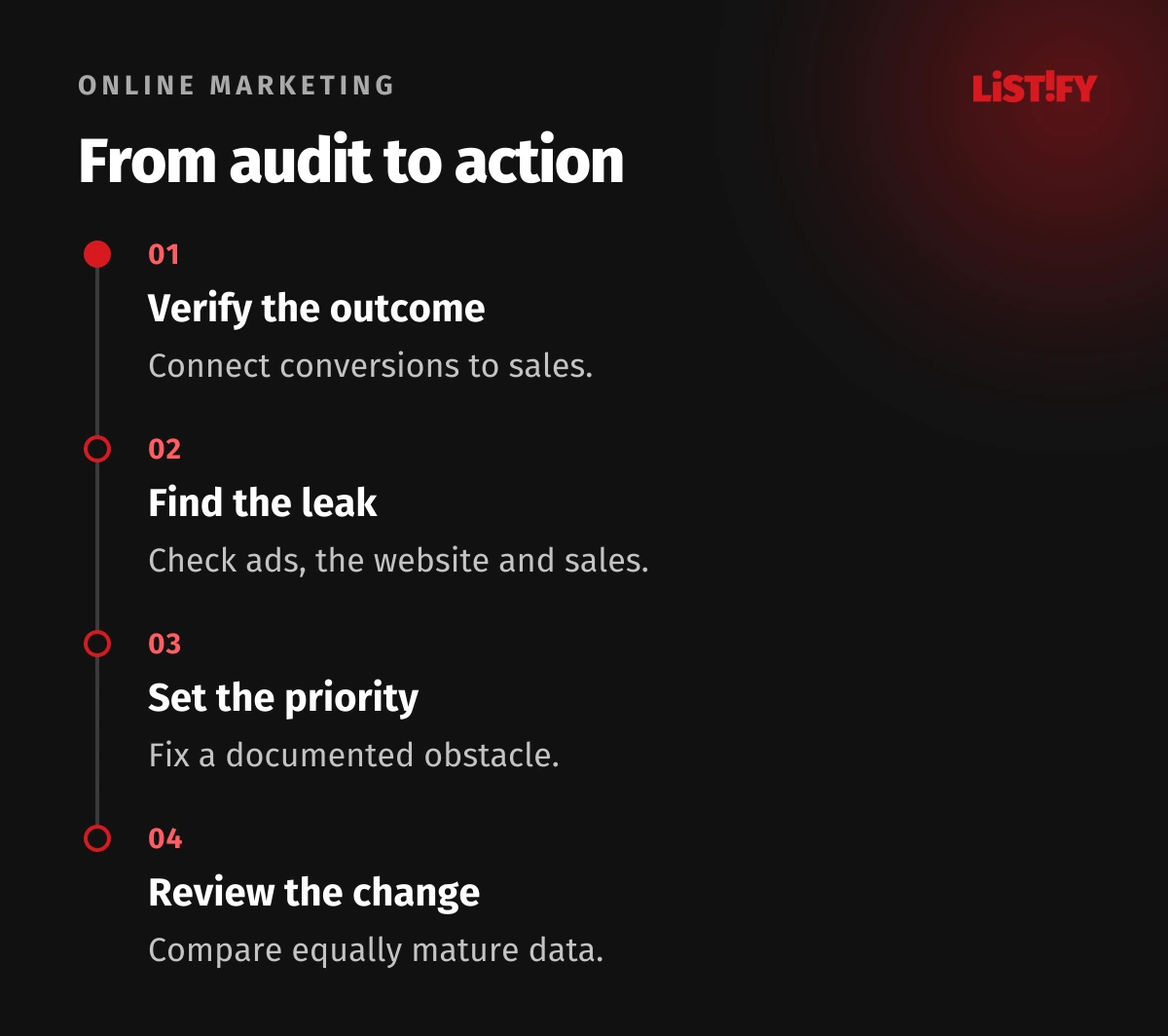
- Verify measurement and your economic limit first. Without them you cannot identify profitable performance.
- Stop obviously faulty promotion, such as an unavailable offer or a broken destination page.
- Fix the largest documented obstacle in the customer journey and handover to sales.
- Then test targeting, the offer or budget against a defined outcome.
For each item, record the evidence, estimated scale of the problem, effort required, owner and review date. Match the test period to sales volume and the buying cycle. There is no universal rule that one week provides the answer. Log material changes so later comparisons remain meaningful.
10What a joint audit with Listify should deliver
The output should make sense to the business owner and campaign manager alike: where value is lost, which evidence supports that conclusion, what will be repaired and how the result will be checked. If orders or sales outcomes are disconnected from the account, the proposal should include the data connection needed.
For an initial conversation, bring your website, main offer, approximate monthly spend and definition of an acquired customer. Where account access is needed, use an invitation to the relevant account. Before paying for more visitors, establish whether the existing journey can turn a visitor into worthwhile business.
11Frequently asked questions
Should I switch off unsuccessful PPC campaigns immediately?
Restrict obviously faulty promotion, such as ads leading to a broken page. For other campaigns, first verify tracking, the time needed to close a sale and customer contribution. Switching everything off based on an immature report can stop acquisition that works.
What is a good ROAS?
It depends on contribution before marketing, management costs, returns and the reserve you require. ROAS compares attributed value with advertising spend. When that value represents revenue, it is not a profit measure.
Why are leads cheap but sales scarce?
Possible causes include the wrong audience, an overly broad offer, an incorrect conversion or slow follow-up. Compare specific rejection reasons and the sales process. Cost per contact alone cannot identify the cause.
Will changing agencies help?
It helps if the underlying cause changes. Retain ownership of accounts, tracking history and the change log during a handover. The new manager needs to understand what the business actually sells and its related costs.
Can Listify work on both campaigns and the website?
Yes. We connect the campaign review with proposed website and measurement improvements. Depending on the problem, we can also propose CRM integration. The specific scope follows the audit and your priorities.