Google Performance Max: When to Use It and What to Monitor
Performance Max can extend your campaigns’ reach, but more reported conversions do not necessarily mean more new customers. What matters is the outcome the campaign optimizes for, where it sends visitors, and whether it adds business beyond your existing advertising. Here is how we assess its role and keep it accountable.
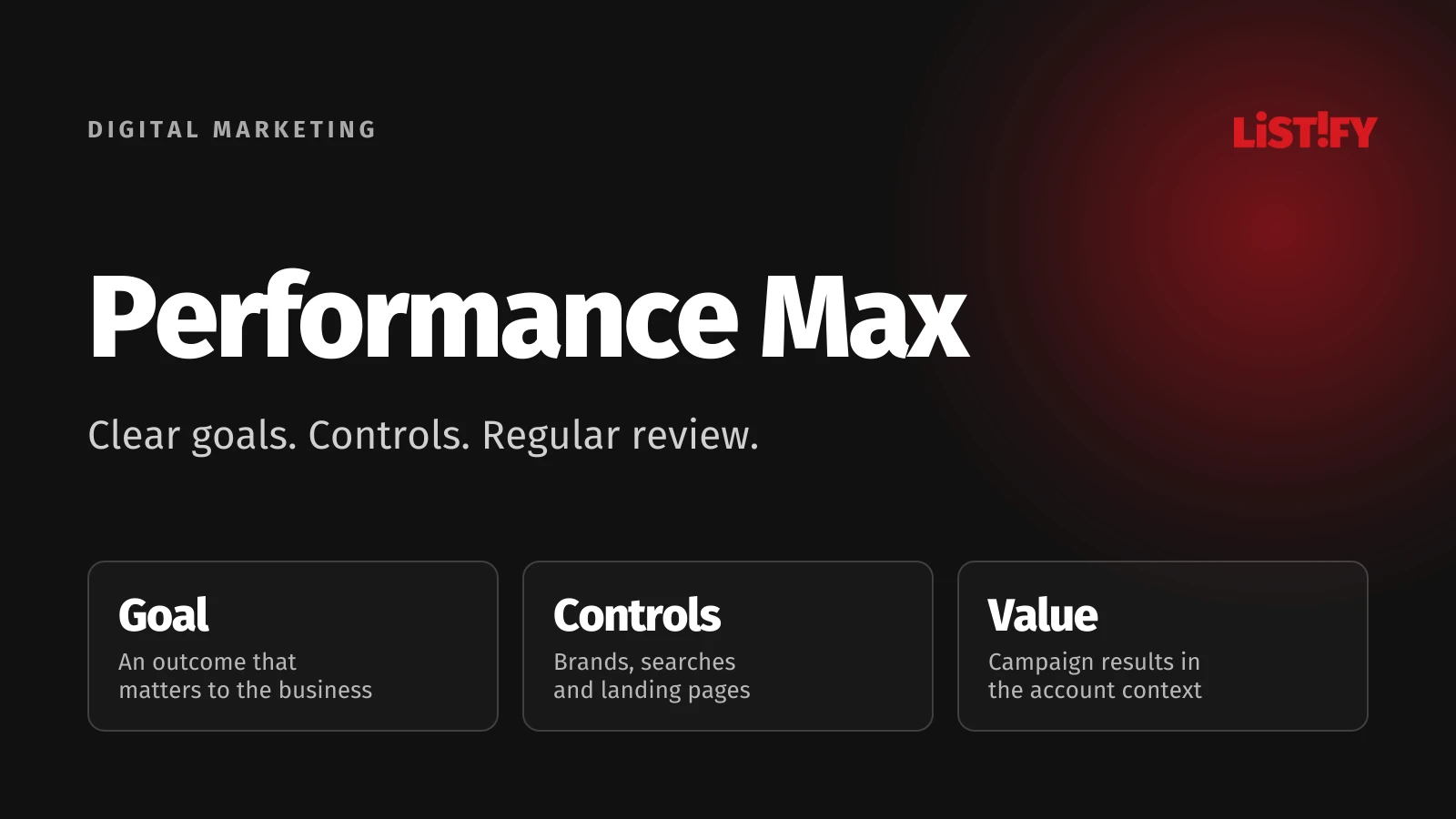
At Listify, we start by asking what Performance Max is supposed to do in the account. Should it expand sales for a product range, generate suitable enquiries, or replace a specific older campaign? Without that answer, a positive report cannot tell you whether it delivered the brief.
Our approach requires three things: a trustworthy conversion goal, a prepared offer with creative assets, and an agreed evaluation plan. If one is missing, we address it first. A recommendation in the interface to launch another campaign is not, on its own, a business case.
01What Performance Max does alongside Search
Performance Max is a Google Ads campaign type that uses automation across Google advertising channels to pursue a selected conversion goal. You supply assets, data, a budget and controls. It does not need to become the only campaign in your account.
Brand searches, a narrowly defined service and a broader offer may need different management. Before launch, record what existing campaigns will continue to handle and what PMax will test. Do not judge it solely by the results attributed to it after an account restructure.
For an online store, review product data, availability and the different economics of your ranges. For services, identifying a suitable enquiry is essential. A campaign producing many forms can meet its technical goal while the sales team deals with unsuitable contacts.
02When to launch PMax and when to fix the foundations
We do not promise a universal minimum budget or conversion count that guarantees success. We assess the value of the outcome, data availability and delay, the buying cycle and the scope of the offer. A test budget must support a useful evaluation without putting normal operations at risk.
| Business situation | Recommended first step |
|---|---|
| Sales tracking is reliable, and the offer and assets are ready | Define the role of PMax, its controls and the test plan. |
| Tracking records only a button click or page visit | Verify the actual business outcome first. |
| Enquiries arrive, but you cannot identify suitable ones | Agree qualification criteria and a feedback process with sales. |
| A small budget is spread across unrelated offers | Narrow the first test to an offer you can evaluate. |
| The website has obsolete services, incorrect prices or a broken form | Fix the landing pages and the path to purchase first. |
If the landing page is the obstacle, changing campaign types will not remove it. Our guide to a landing page that helps visitors complete an enquiry explains the next part of the journey. The promise in the ad must match the offer after the click.
03Choose the outcome the campaign should learn from
Review the goals selected for PMax itself, not just the account’s event list. Primary and secondary conversion actions have different bidding and reporting roles. A secondary action included in a custom goal can also be used for bidding, so check this exception. Avoid counting the same purchase through two primary tracking routes.
For services, choose a useful sales milestone that arrives in a workable time frame. If sales staff leave CRM records untouched, even a correctly configured import cannot provide timely feedback. Google’s lead quality guidance connects goal selection with data volume, freshness and conversion delay.
Our 50 tips for measuring Google Ads cover the technical checks. To return qualification or later sales outcomes to advertising, see connecting campaigns with your CRM. Here, the decision is which outcome should guide PMax specifically.
04Set controls for brands, searches and landing pages
Exclude your own brand according to the campaign’s role. To manage those searches separately, use brand exclusions and check their effect on Search and Shopping. Some configurations can retain branded Shopping traffic. Excluding a brand does not establish that every remaining conversion comes from a new customer.
PMax negative keywords apply to Search and Shopping, not to every channel universally. Distinguish campaign-level from account-level changes so you do not unintentionally restrict other advertising. Exclude genuinely unsuitable intent rather than every term without an immediate purchase.
Search themes supplement automation; they are not a closed list of permitted queries. Likewise, audience signals do not restrict the campaign to those people alone. Ads may reach other relevant users.
With Final URL expansion enabled, an ad can lead to a different relevant page on your website. A page feed alone does not restrict traffic to that list while expansion is enabled. Review exclusions for non-commercial sections and check the actual destinations.
For a website containing recruitment, support and several services, specify where paid visitors should land. Review the combinations of text, images and video too. Text customization can use website content, so correct an obsolete claim both in your campaign assets and on the page.
05What to monitor continuously and at a weekly review
Address operational failures immediately. Evaluate commercial performance over an interval that fits your data. If orders or qualifications arrive later, do not treat the newest days as equally complete as older periods during a weekly review.
| Check | Question to answer | Possible next action |
|---|---|---|
| Delivery and tracking | Is the campaign running, the website working and the right event arriving? | Repair the fault rather than automatically raising the budget. |
| Quality and value | Do outcomes match the selected business goal? | Verify the goal, qualification or values. |
| Brand and search terms | Has the composition of demand changed? | Adjust a specific exclusion or message. |
| Channels and assets | Does a performance shift coincide with a fault or a change we made? | Review diagnostics and missing assets. |
| Landing pages | Does the visitor reach the correct, available offer? | Correct the URL, feed or page. |
Use the channel performance report for costs, conversions and diagnostics, and the relevant search terms report for individual queries. A changing channel mix does not, on its own, show that automation failed. Compare it with the change history and the whole campaign’s results.
For campaigns using an average daily budget, do not expect identical spend every day. Google explains daily and monthly spending limits and the effect of budget changes. Alongside the Ads setting, record the approved total test cost and the rule for deciding whether to continue.
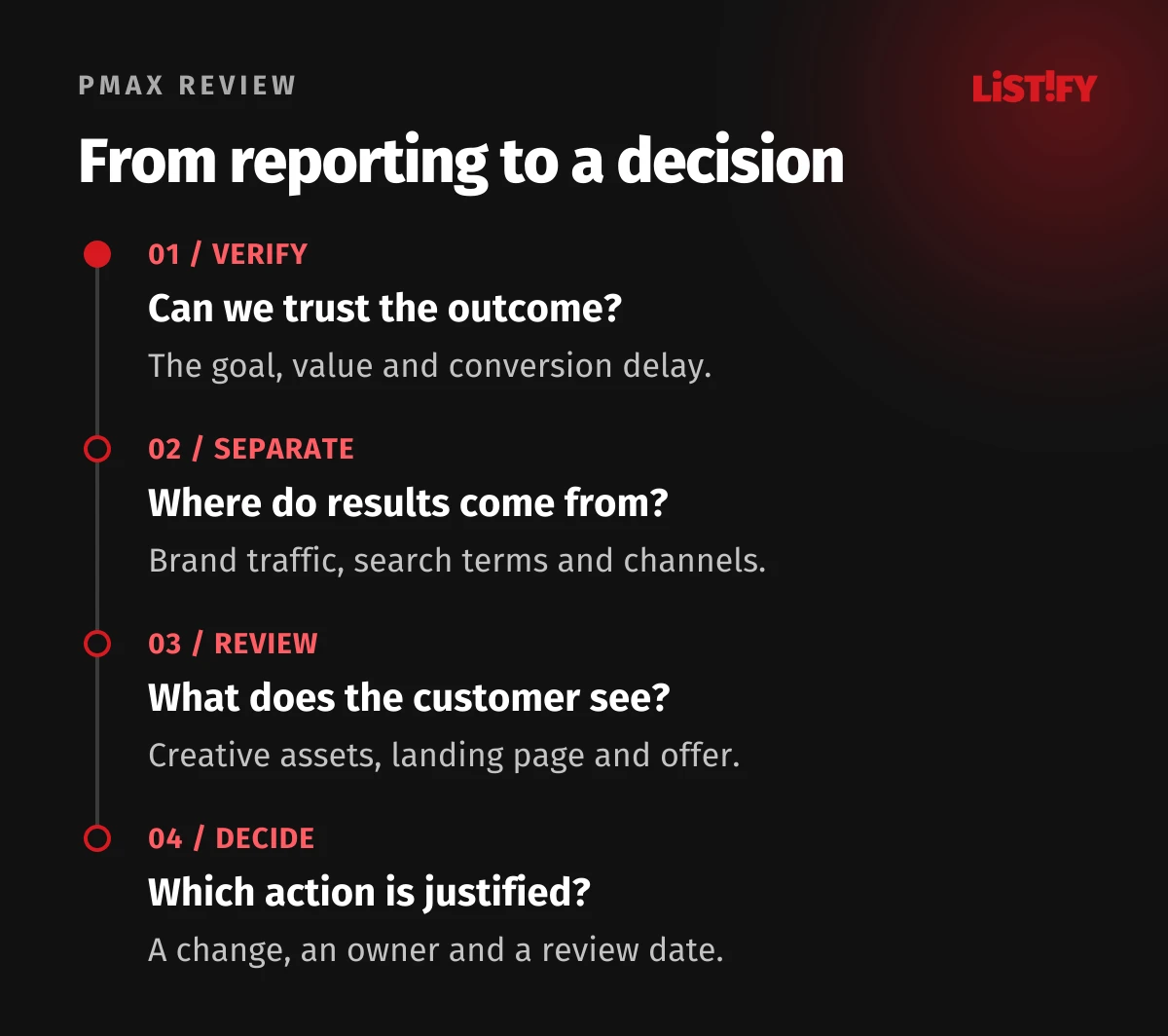
06Example: PMax reports 500% ROAS, but the account is flat
This is an illustrative example, not a client result. We compare two equal periods with complete conversions, the same definition of value, and no purchases counted twice. Value represents attributed revenue, not margin.
| View | Before adding PMax | After adding PMax |
|---|---|---|
| Existing campaigns: cost / value | €800 / €4,000 | €480 / €2,400 |
| PMax: cost / value | €0 / €0 | €320 / €1,600 |
| Whole account: cost / value | €800 / €4,000 | €800 / €4,000 |
| Whole-account ROAS | 500% | 500% |
PMax reports 1,600 / 320 × 100 = 500%. The new campaign can appear successful even though the account total has not changed. Traffic and attributed credit may have shifted between campaigns. Check brand searches, the history of other campaigns and actual orders.
This report proves neither incremental growth nor that PMax had no effect. Asking what would have happened without it requires a suitable comparison. Google offers different Performance Max experiments; we select the appropriate type and check eligibility against the account structure and test question.
07When to change the budget, fix the campaign or end the test
We consider increasing the budget when tracking is reliable, sufficiently mature outcomes meet the business economics, and the company can fulfil more work. Target CPA or ROAS should not be a wish. We base it on comparable results and a cost the business can sustain.
We address the cause first when we find an incorrect goal, an unsuitable destination, an obsolete product or a misleading message. A campaign may need an immediate restriction if it continues spending on a broken offer. An ordinary short-term fluctuation is a different situation from a fault.
We end or redesign a test when it reaches its agreed limit without answering the business brief. We record the change, the reason, the owner and the next review date. Changing the goal, budget, offer and every asset at once would make it harder to identify what helped.
08Performance Max questions
Is Performance Max only suitable for online stores?
No. It can also pursue lead generation goals. For services, you need to identify contacts that fit your offer and provide usable information about their quality. Form volume alone is insufficient.
Do we have to stop our existing Search campaigns?
Not automatically. We first define PMax’s role and its overlap with existing campaigns. Adding to an account and testing a replacement for a specific campaign are different briefs.
Does a good ROAS mean PMax brought new customers?
No. ROAS uses attributed value and cost. On its own, it does not distinguish a new customer or a sale that would not have happened without the campaign.
How soon will we know whether it works?
That depends on result volume and delay. We agree a review date and cost limit in advance. We fix technical faults immediately; a commercial conclusion needs more than one day or a universal number of weeks.
09What we review before launching or taking over PMax
Tell us what you sell, how you currently evaluate advertising and where you see a problem. Through our PPC and digital marketing service, we review campaign goals, assets, the website and the sales connection. We recommend launching PMax, changing its role or fixing measurement first.
The outcome should be a clear brief: the selected result, offer scope, test budget, controls and a decision-making report. You do not need a finished audit before contacting us. Start with what your current report fails to explain.
We checked Google’s features and documentation on 6 November 2026. The scope of individual settings can vary by campaign type and account availability. The tables and example are our proposed working framework, not a return guarantee. Euro figures are illustrative, not a currency conversion of actual results.