A social media strategy that builds a real community: a step-by-step guide
Thousands of followers and silence under every post. That is what a profile with an audience but no community looks like. Here is how to build a social media strategy that makes people come back, message you and recommend you to others. The guide is written for small and mid-sized businesses, with data from Eurostat and DataReportal and a plan for your first 90 days.
Short answer: a strategy that builds a community is not about how often you post. It is about conversation. Pick one or two platforms where your customers already are, find a topic that brings them together, post on a steady rhythm and, above all, reply. Then measure success in comments, shares, messages and returning people, not likes.
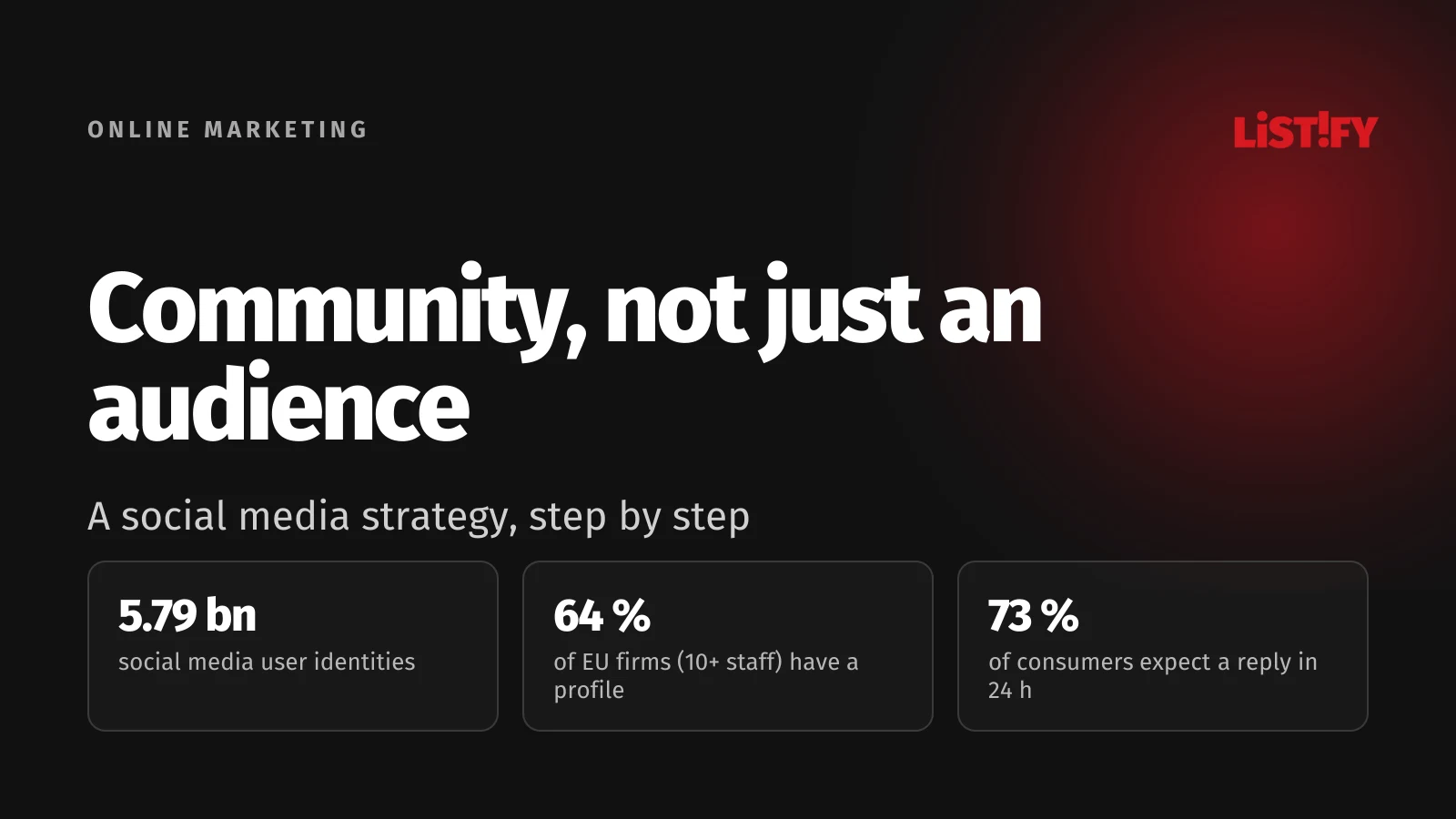
Why it matters: according to DataReportal, there were 5.79 billion social media user identities worldwide in April 2026, equal to 69.9 % of the world’s population. In the EU, 64 % of businesses with ten or more employees had a social media profile in 2025. You are competing for attention with friends, creators and competitors, and the profiles that win are the ones people actually have a reason to talk to. Figures were checked in September 2026. Sources are linked where they are used and listed at the end.
01Audience or community? The difference that matters
An audience follows you. A community talks with you, and its members talk to each other. You can buy an audience with ads in a few days. A community has to be built, but it stays with you when the ads stop.
| Aspect | Audience | Community |
|---|---|---|
| Direction | The brand talks, people listen | The brand and people talk, and people talk to each other |
| What you measure | Followers, reach, likes | Comments, shares, messages, return visits |
| Without ads | Reach drops quickly | People keep coming back because they enjoy it |
| Who creates content | Only the business | The business and its customers (reviews, photos, questions) |
| Value to the business | Visibility | Trust, referrals and repeat purchases |
A community does not have to be big. In a 2016 study, evolutionary psychologist Robin Dunbar found that people in two samples had an average of 155 and 183 Facebook friends. Yet those in the first sample considered only 28 % of their friends genuinely close. For a small business, a hundred people who truly care are worth more than ten thousand who once clicked an ad.
02Why platforms reward conversation, not follower counts
Platforms no longer show your posts to all your followers. The algorithm picks what each person is most likely to act on. Facebook (now Meta) said so openly in January 2018, when it started prioritising posts from friends and family and warned that Pages may see their reach, video watch time and referral traffic decrease.
The platforms describe what they look at themselves:
- Instagram: in Feed, the five interactions it looks at most closely are how likely you are to spend a few seconds on a post, comment on it, like it, share it and tap the profile photo. For Reels, the most important predictions include whether you will reshare it and watch it to the end (Instagram, May 2023).
- TikTok: looks at likes, shares, comments and whether you watch a video to the end. According to TikTok (2020), follower count is not a direct factor.
- LinkedIn: besides reactions, comments and shares, it also considers how constructive or professional the conversation under a post is.
That leads to a simple rule: a post people talk about gets more room than a post they just scroll past. Building a community is not a trade-off against performance. It is how you earn reach without paying for every impression.
03Where your people are: the numbers
According to Eurostat, 67 % of people in the EU aged 16 to 74 took part in social networks in 2025. Businesses lag behind: only 64 % of EU companies with ten or more employees had a social media profile, and the gap between countries is wide.
- Malta88.2%
- Finland87.6%
- Denmark86.0%
- Netherlands83.8%
- France69.8%
- EU average63.6%
- Germany63.0%
- Italy59.0%
- Czechia56.3%
- Poland47.5%
- Bulgaria41.5%
Share of businesses with 10 or more employees that have an account on at least one type of social media. Source: Eurostat, dataset isoc_cismt, 2025.
Size matters too. Across the EU, 89 % of large businesses (250+ employees) have a social media profile, compared with 76 % of mid-sized and 61 % of small ones. If you are a small business, many of your direct competitors are still not on social media at all.
Your customers’ age matters just as much. Almost every young adult is on social media, and the share drops fast with age:
- 16 to 2490.5%
- 25 to 3485.5%
- 35 to 4478.2%
- 45 to 5468.2%
- 55 to 6452.2%
- 65 to 7434.1%
Share of people in each age group who took part in social networks in the last 3 months, EU27. Source: Eurostat, dataset isoc_ci_ac_i (indicator I_IUSNET), 2025.
04Step 1: set a goal that likes cannot meet
“We want more visibility” is not a goal. A community goal describes what people should do, and it can be measured. Pick one main goal and at most two secondary ones:
- Loyalty: more repeat purchases from people who follow you (track it with a discount code only followers get).
- Customer care: questions answered on the platform, without a phone call or email.
- Referrals: more people tagging you, sharing your posts or telling friends “try this”.
- Ideas and feedback: customers help you choose new products, flavours or dates.
- Hiring: people who know you from social media apply for your open roles.
Give every goal a number and a deadline. For example: “By the end of the year, we want comments from 40 different people a month and 10 questions in DMs.” A goal like that forces you to write posts people can reply to.
05Step 2: find the topic that connects your people
People do not gather around a company. They gather around an interest, a problem or a way of life. A bakery does not build a community of “fans of our bakery” but of people who love proper sourdough bread. A bike shop brings together people who ride the same trails every weekend.
You will find your topic by answering three questions:
- Who is it for: who are your best customers? Not “women aged 25 to 45”, but something like “local parents of young kids looking for healthy snacks”.
- What do they talk about: what questions do customers ask you in the shop, on the phone or by email? Every repeated question is a post idea.
- What only you can offer: know-how, the story behind the scenes, the people on your team, local context. Neither competitors nor AI can copy that.
From your answers, write down your brand voice: how formal you are, how much humour you use and what you never post about. Voice matters as much as a logo, because it is how people recognise you in a crowded feed. We cover consistent branding in our guide to logo design rules.
06Step 3: choose one or two platforms, not all of them
A community needs attention every day. That is why it is better to go all in on one or two platforms than halfway on five. According to DataReportal, online adults use an average of 6.75 social platforms a month. Your customers are almost certainly on the one you choose, so you do not need to chase them everywhere.
| Platform | Best for | Format that builds community |
|---|---|---|
| Local services, older customers, events and groups | A group around your topic, events, questions and polls | |
| Products, food, fashion, travel, services for under-45s | Stories with polls, Reels, replies in DMs | |
| TikTok | Younger audiences, showing your work, behind the scenes | Short videos, video replies to comments |
| B2B, professional services, hiring | Personal profiles of your team, expert discussions | |
| YouTube | Tutorials and products that need explaining | Longer how-tos, comments under videos, Shorts |
Tip: for B2B businesses, the personal profiles of the founder and team members often reach more people than the company page. People want to talk to people, not to a logo.
07Step 4: content pillars and a rhythm people look forward to
Content pillars are 3 to 5 recurring themes you build your plan from. They save you from starting from scratch every week, and followers know what to expect. This mix works well for communities:
- Useful: how-tos, tips and answers to common questions. Content people save and send to friends.
- Behind the scenes: how the product is made, who works with you, what went wrong. It builds trust.
- Customers: their photos, stories, reviews and questions. Content where the community is the star.
- Participation: polls, questions, votes on what comes next. It gives people a reason to speak up.
- Offers: news and promotions. They belong here, but they should never dominate.
Consistency beats frequency. Two posts a week, every week, do more than ten posts in one week followed by a month of silence. A recurring format such as “Wednesday question” or “Friday in the workshop” becomes a small ritual people look forward to.
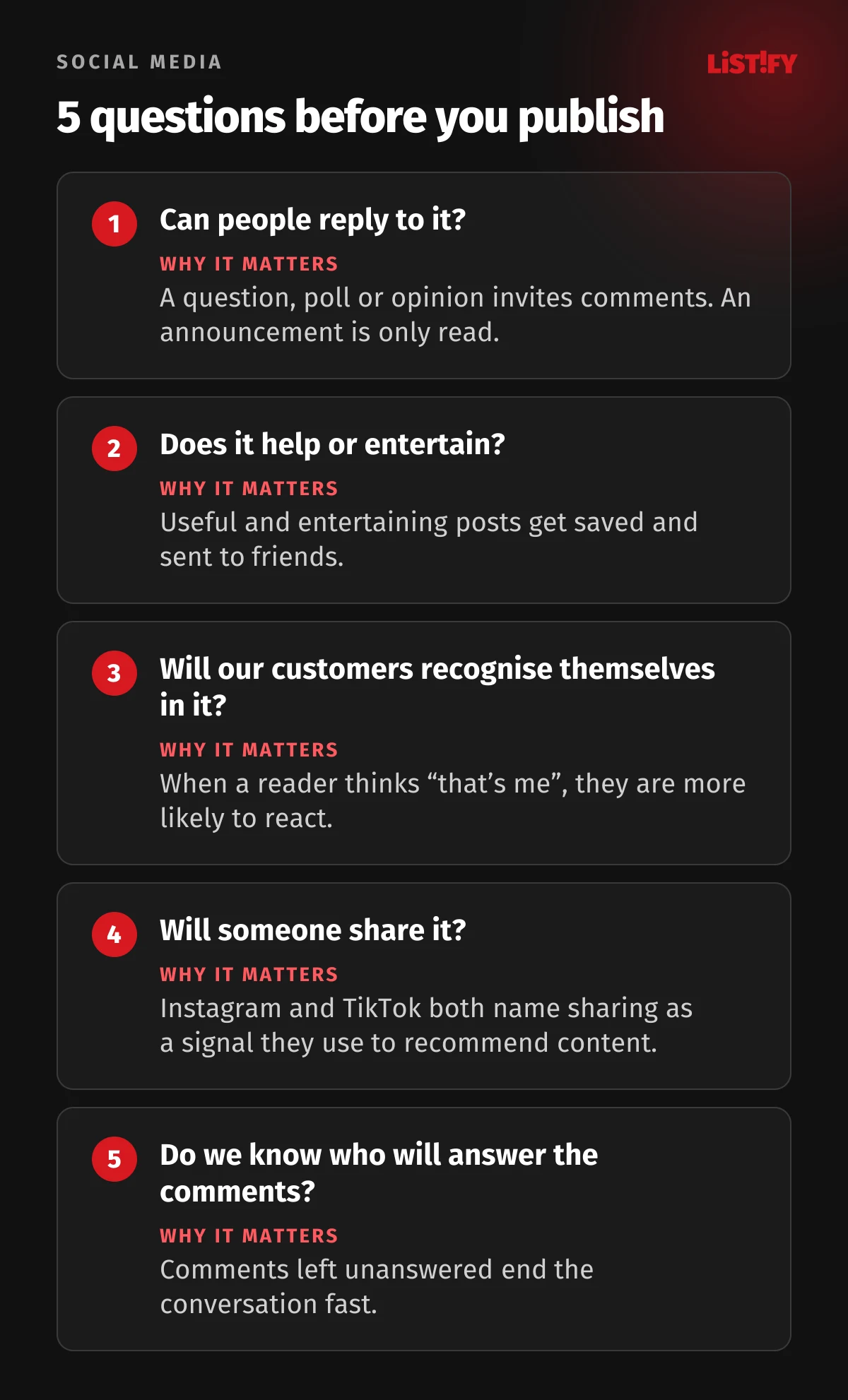
Before you publish, run through five questions. If the answer to most of them is “no”, rewrite the post:
08Step 5: reply fast and like a human
This is where a community is born or dies. According to the Sprout Social Index 2025, 73 % of consumers expect a brand to respond on social media within 24 hours or sooner. Also 73 % say they will buy from a competitor if a brand does not respond. Sprout Social sells social media software, and it surveyed 4,044 consumers in the US, the UK, Canada and Australia who follow at least five brands. Treat the numbers as an industry view, but replying within a day is a sensible standard anywhere.
A few rules that work:
- Reply to every comment, and do it soon. It gets the conversation going, and every new comment tells the platform that people care about the post.
- Ask something back. A reply that ends with a question hands the conversation back to the person.
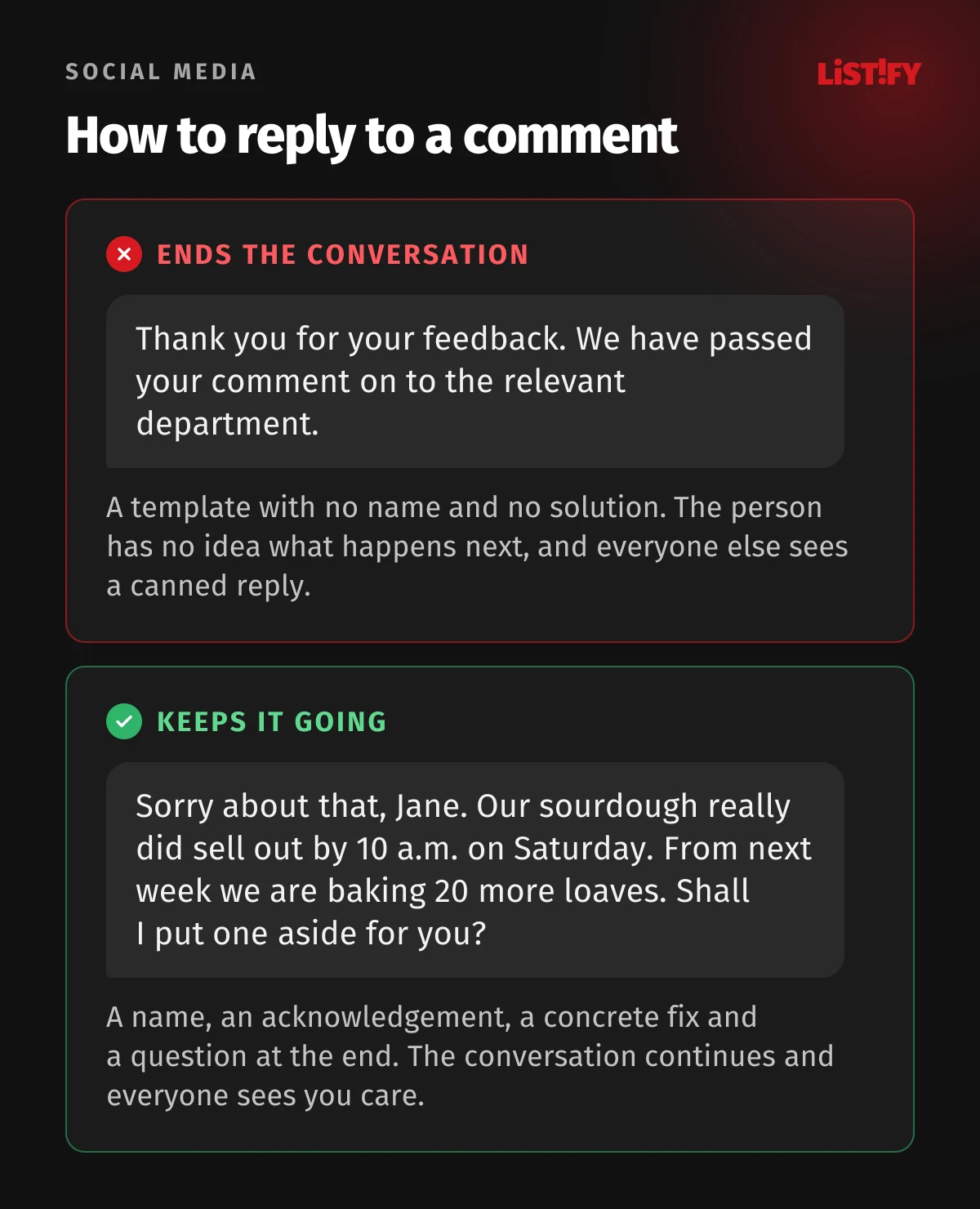
- Use names and your own words. People spot copy-pasted phrases instantly.
- Do not hide criticism. Say thank you, acknowledge the problem and move the solution to DMs. Everyone else sees that you care.
- Delete only spam, abuse and personal data. Write your moderation rules in advance and publish them, for example in your group description.
09Step 6: give your community space and a voice
Most people in online communities only read. Jakob Nielsen described this in 2006 as the 90-9-1 rule: roughly 90 % of users only read, 9 % contribute now and then and 1 % account for almost all the activity. You do not need to change that. Support the small active group and give it room.
- A group around your topic. According to the company, in 2019 more than 400 million people on Facebook belonged to a group they found meaningful. A group called “Baking sourdough at home” is likely to attract more people than a bakery’s page.
- Customer content. Share customers’ photos and reviews, always with their permission and credit. For everyone else, it is the best proof that you deliver.
- Your core members. Give the most active people something extra: early news, a behind-the-scenes invitation, a vote on your next product.
- Meeting in person. Relationships grow stronger when people meet face to face at least occasionally, as Dunbar’s study also notes. A workshop, a tasting or a group ride is enough.
10Step 7: measure what actually shows community
Follower count shows how big your audience is, not how strong your community is. Check these metrics once a month. You will find most of them in Meta Business Suite, TikTok and LinkedIn analytics. Unique and returning commenters need a manual count, and leads show up in your website analytics:
| Metric | What it tells you | How to calculate it |
|---|---|---|
| Engagement rate | Whether content interests people enough to react | Reactions, comments, shares and saves divided by reach |
| Comments from different people | How many people really take part | Number of unique commenters per month |
| Shares and sends | Whether people recommend you | Number of shares and sends in DMs |
| Saves | Whether content has lasting value | Number of times a post is saved |
| Response time | How fast you react | Average time to first reply to comments and messages |
| Returning people | Whether one-off visitors become regulars | How many commenters also took part last month |
| Business impact | Whether the community brings in money | Leads and sales from social media (UTM links, codes) |
To measure leads from social media, add UTM parameters to your links and make sure your website records conversions. We build sites like that; see our custom websites page.
11The rules people forget: giveaways, ads and personal data
A community runs on trust, and nothing destroys it faster than hidden advertising or a botched giveaway. Watch three things:
- Giveaways that follow platform rules. Facebook does not allow personal timelines or friend connections to be used to run a promotion, so “share on your timeline to enter” or “tag your friends to enter” are not permitted. A promotion needs official rules and a statement that it is not sponsored or administered by Facebook. And under EU consumer law, the prize you announce must actually be awarded.
- Disclosed partnerships. People must be able to recognise paid promotion clearly. In an EU check of 576 influencers in 2023, 97 % posted commercial content, but only 20 % consistently disclosed it. Use the platform’s “Paid partnership” label. The Commission’s Influencer Legal Hub explains the rules in plain language.
- Personal data. Publish winners’ names only with their consent and collect only the data you really need. Under Article 8 of the GDPR, children under 16 cannot consent on their own to online (information society) services unless their country sets a lower age, which can be no lower than 13.
12Your first 90 days
A community is not built in a week. You will usually see the first signs (more comments and messages) within a few weeks, and stronger relationships and referrals over months. Your first quarter could look like this:
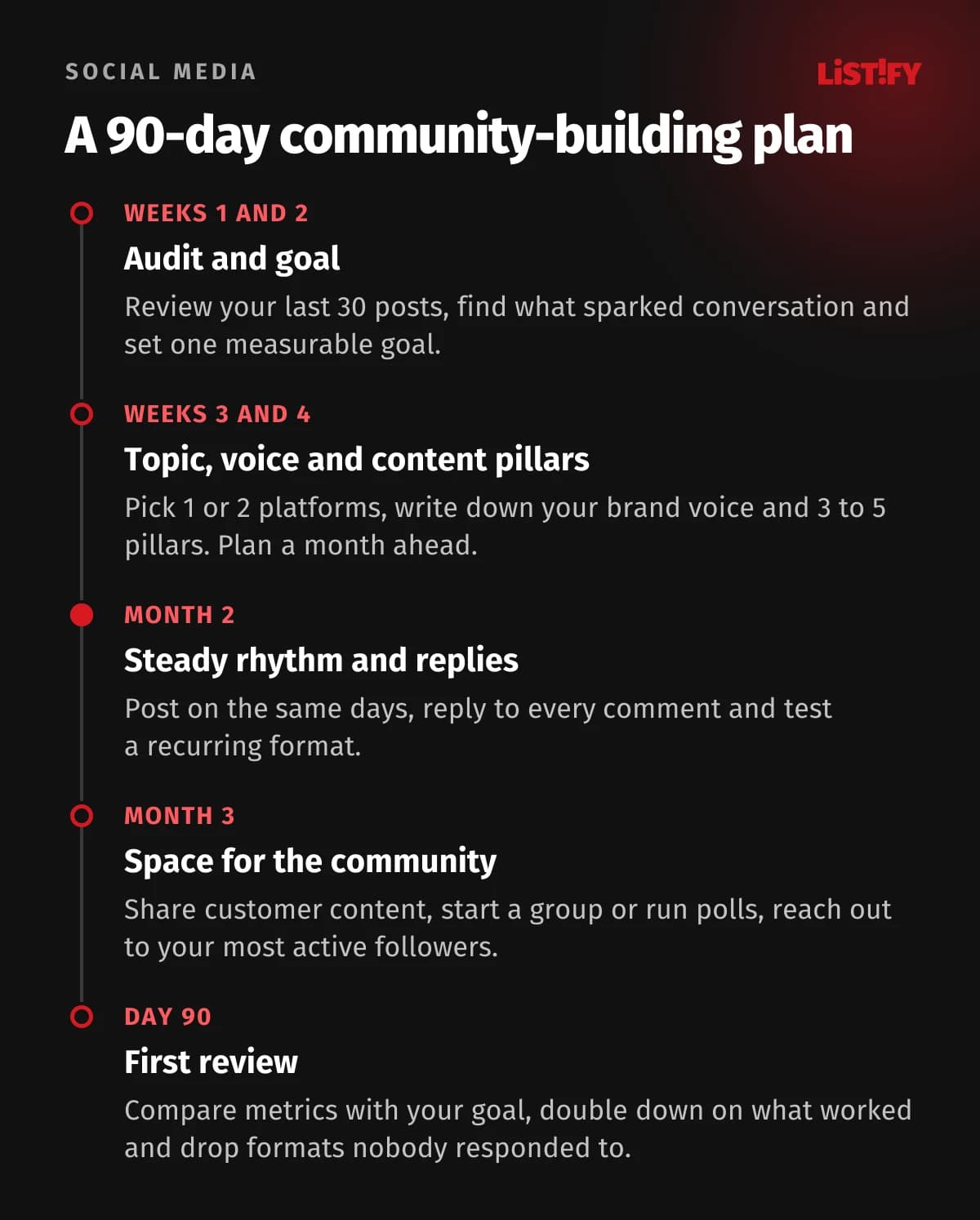
After three months, compare your metrics with the goal from step 1. Double down on what worked and drop formats nobody responded to. A strategy is not a document you write once and file away. It is a plan you adjust every quarter based on how people respond.
13The most common mistakes
- Being everywhere halfway. Five platforms without replies are worse than one where people feel heard.
- Only selling. When every post is a promotion, people stop reading and the platform stops showing your posts.
- Buying followers. Fake accounts do not comment or buy, and they ruin your stats and reach.
- Ignoring or deleting criticism. Everyone sees how you respond, and silence or deletion does more damage to trust than the complaint itself.
- Measuring only likes. A like takes no effort. Comments, shares and messages show real interest.
- Inconsistency. Daily posts for a month, then nothing for two. Algorithms and people forget quickly.
14Frequently asked questions
How long does it take to build a community on social media?
You will usually see the first signs, meaning more comments, messages and shares, within the first few weeks of consistent work. An active community that keeps coming back and recommends you takes months. Consistency and replying are what make the difference.
How often should we post?
As often as you can keep up with good quality while still having time to reply. For a small business, 2 to 3 posts a week on one platform is a good start. Consistency matters more than volume.
Which social media platform should we focus on?
The one where your customers are and where people already talk about your topic. Facebook is often strongest for local services and older customers, Instagram and TikTok for products and younger audiences, LinkedIn for B2B. One or two platforms are enough to start.
How do we know the community is working?
Look at comments from different people, shares, saves, messages and how many people take part repeatedly. A strong signal is when customers start answering questions in the comments before you do.
Can we build a community without paid ads?
Yes, but it takes longer. Ads help you find new people faster, and the community keeps them. The best results come from combining both: ads reach a new audience, while content and replies turn it into a community.
How much does social media management cost?
It depends on the number of platforms, formats and whether you need video and ad campaigns. With us, managing one platform starts at €490 (CZK 12,000) a month excluding VAT, and you pay your ad budget directly to the platform. See our pricing for details.
15Conclusion: a community is a conversation, not a broadcast
A social media strategy that builds a community rests on a few simple decisions: one clear goal, a topic that connects people, one or two platforms, a steady rhythm and a reply to every comment. The rest is patience and measurement.
Start this week: go through at least your last ten posts and count how many sparked a conversation. If you would rather hand strategy, content and community care to a team that does it every day, see how we work or go straight to our social media management.
16Sources
- Eurostat: Social media use by enterprises, dataset isoc_cismt
- Eurostat: Internet activities of individuals, dataset isoc_ci_ac_i
- DataReportal: Digital 2026 Global Overview Report
- DataReportal: Digital 2026 Mid-Year Global Update
- Sprout Social: Social media customer service (Sprout Social Index 2025)
- Sprout Social: The 2025 Sprout Social Index, methodology
- Instagram: Instagram Ranking Explained (2023)
- TikTok: How TikTok recommends videos #ForYou (2020)
- LinkedIn: LinkedIn relevance, Optimizing the member experience
- Meta: Bringing People Closer Together (2018)
- Meta: F8 2019 Day 1
- Nielsen Norman Group: The 90-9-1 Rule (2006)
- R. I. M. Dunbar: Do online social media cut through the constraints that limit the size of offline social networks? (2016)
- Meta: Pages, Groups and Events Policies
- European Commission: Sweeps, influencer sweep 2023
- European Commission: Influencer Legal Hub
- GDPR, Article 8: Conditions applicable to child’s consent