Is Influencer Marketing Worth It? When It Pays Off and How to Choose the Right Creator
A creator with a million followers looks like a safe bet. Yet follower count barely predicts sales. A meta-analysis of 251 studies found that how credible the creator is, and how much they interact with their followers, are far more closely linked to purchases. Brands keep spending anyway: US advertisers put $29.5 billion into creators in 2024, according to IAB, more than double the 2021 figure. And when the European Commission checked 576 influencers, only 20% consistently disclosed their ads. Here is when a partnership pays off, how to pick the right person, what to pay, how to measure it, and which rules you need to follow.
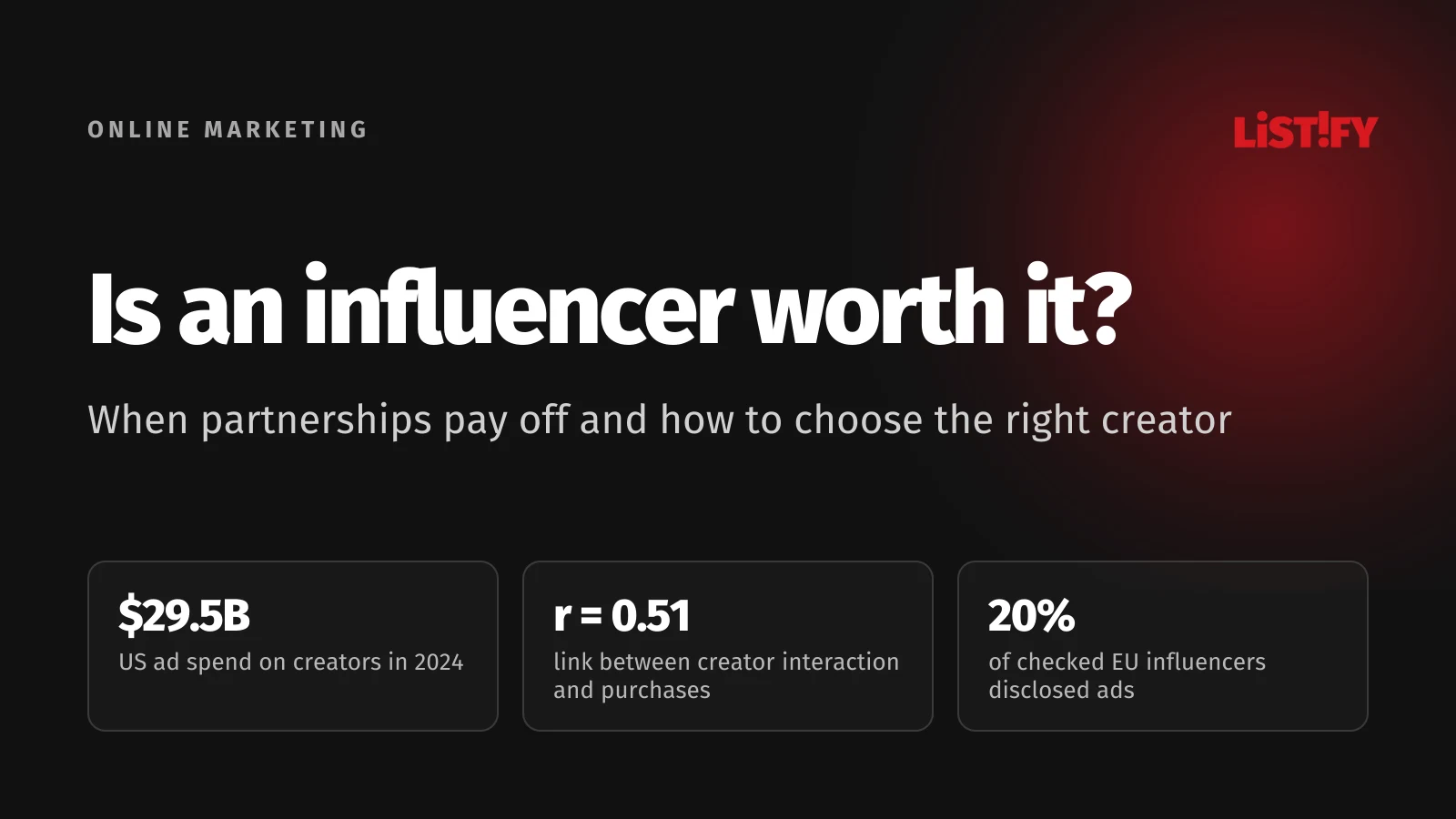
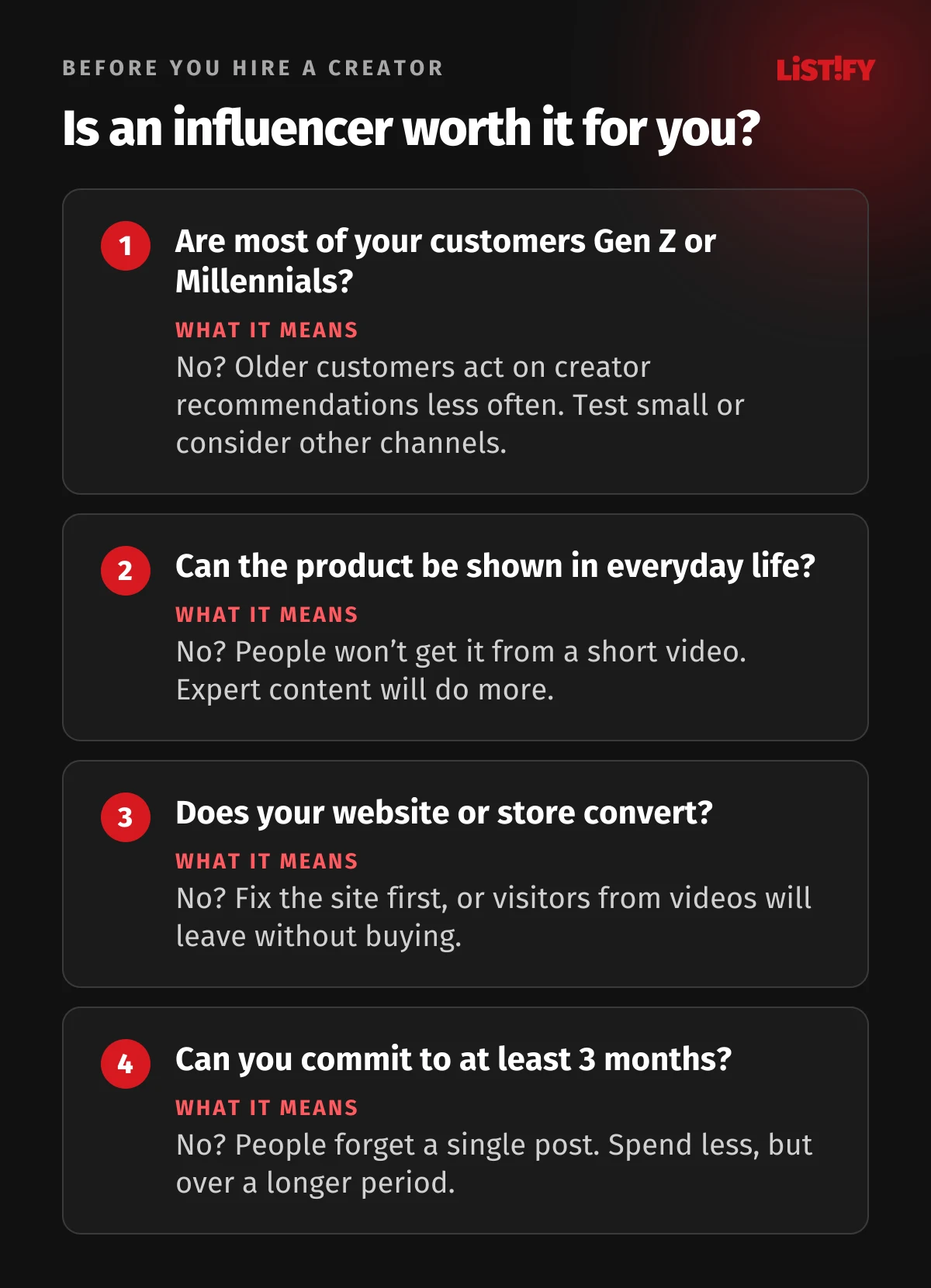
Short answer: influencer marketing is worth it when your customers are mostly Gen Z or Millennials, your product can be shown in everyday life, and you have somewhere to send people, meaning a website or online store that actually converts. It is rarely worth it as a one-off post with whoever has the biggest following. You usually get more from several smaller creators whose audience matches your customers, working with them over a longer period and tracking results with unique discount codes and links. Every paid partnership, including free products, has to be clearly labeled as an ad.
This guide is for owners, executives and marketing managers of small and mid-sized businesses. Figures are current as of September 2026, and sources are linked in the text and at the end.
01What influencer marketing is and how big it has become
Influencer marketing means a business working with someone who has an audience on social media and talks about the product in their own voice. The business pays in cash, free products or a commission on sales. The difference from a regular ad is that the message comes from a person people chose to follow.
Influencers are usually grouped by follower count. There is no official standard and every study draws the lines a little differently. The most common split looks like this:
| Tier | Followers | Best for |
|---|---|---|
| Nano | 1,000 to 10,000 | Local businesses, niche products, first tests |
| Micro | 10,000 to 100,000 | Most small and mid-sized businesses with a clear target group |
| Mid-tier | 100,000 to 500,000 | Brands that need nationwide reach |
| Macro | 500,000 to 1 million | Large campaigns and product launches |
| Mega and celebrities | Over 1 million | Awareness for big brands with big budgets |
Estimates of the market size vary widely because each source measures something different. Influencer Marketing Hub puts the global industry at $32.55 billion for 2025 without publishing a method. The most transparent series comes from IAB, which counts only what US brands deliberately spend on creators through sponsored content and related ads, excluding affiliate income, subscriptions and tips.
- 2021$13.9
- 2024$29.5
- 2025 (projection)$37.0
- 2026 (forecast)$44.0
Source: IAB, Creator Economy Ad Spend & Strategy Report 2025. US only. According to IAB, 48% of ad buyers now see creators as a “must buy.”
Who influencers actually reach
Age makes a big difference. In a May 2026 Sprout Social survey of 2,250 social media users in the US, UK and Australia, 67% said they had bought something in the past year directly because of an influencer’s recommendation. Among Millennials it was 73% and among Gen Z 81% (Sprout Social, PDF). In the EU, 67.3% of people aged 16 to 74 used social networks in 2025, according to Eurostat.
02When influencer marketing pays off, and when it doesn’t
An influencer won’t replace search ads or a good website. Creators work best as a way to reach people who don’t know you yet and give them a reason to trust you. That makes them most useful when a new customer needs to see the product first and hear about it from someone they believe.
| Situation | Worth it? | Why |
|---|---|---|
| Beauty, fashion, food, fitness, hobbies, consumer apps | Yes | The product fits naturally into everyday life, and the audience spends time on Instagram and TikTok |
| New product or new brand | Yes, with a longer partnership | People don’t know you yet and won’t remember a single post |
| Local business (café, gym, salon) | Yes, with local nano and micro creators | What counts is the audience in your city, not national reach |
| B2B and high-ticket business services | Only occasionally | Industry experts and the founder’s personal brand usually work better |
| Customers mostly over 55 | Less often | Fewer of them buy on a creator’s recommendation, so check your own audience data first |
| Alcohol, gambling, supplements, investments | Only with legal advice | Strict advertising rules and financial or health regulators |
| A website or store that doesn’t convert | Not yet | Paid traffic is wasted on a page that doesn’t persuade |
For B2B companies, a founder or in-house expert sharing real experience on LinkedIn often does more than a hired influencer. We cover how in Personal branding for CEOs and founders.
Trust is not automatic
People trust influencers less than you might think. In the BBB National Programs Influencer Trust Index, based on more than 3,700 US consumers, 74% said they trust or somewhat trust influencer content, compared with 87% for general advertising, and only 5% trust it completely. At the same time, 58% had bought something because of an influencer’s endorsement (BBB National Programs). So trust in influencers as a group is low, yet many people still buy on a specific creator’s word. Both figures are self-reported.
- Everyday users57%
- Subject matter experts26%
- Mega-influencers9%
- Brand employees8%
Source: Sprout Social, Pulse Survey Q2 2026, PDF, 2,250 social media users in the US, UK and Australia, May 2026.
03Nano, micro or celebrity: size matters less than you think
The most common mistake is choosing by follower count. Creators with smaller audiences usually get a higher engagement rate, meaning a larger share of people react to their posts. On Instagram the difference is large, on TikTok it barely exists. That is what a 2026 analysis by The Influencer Marketing Factory and HypeAuditor found after looking at more than 5 million Instagram accounts and almost 3 million TikTok accounts.
- 1,000 to 10,000TikTok: 8.1%Instagram Reels: 7.9%
- 10,000 to 50,000TikTok: 8.0%Instagram Reels: 6.2%
- 50,000 to 500,000TikTok: 7.4%Instagram Reels: 5.3%
- 500,000 to 1 millionTikTok: 7.4%Instagram Reels: 4.5%
- Over 1 millionTikTok: 7.6%Instagram Reels: 4.5%
Source: The Influencer Marketing Factory and HypeAuditor, Creator Economy Report 2026, p. 13. Engagement based on views, accounts with a mostly US audience, data from tool vendors.
More telling is what is actually linked to purchases. A 2024 meta-analysis in the Journal of the Academy of Marketing Science pooled 1,531 effect sizes from 251 studies. Follower count showed only a weak link with purchases and no statistically significant link with sales. The strongest links to buying were how much the influencer interacts with followers and how credible they seem.
- Interaction with followers0.51
- Influencer credibility0.49
- Influencer and brand fit0.40
- Follower count0.21
Source: Pan, Blut, Ghiassaleh and Lee, Journal of the Academy of Marketing Science 2024, table 4, link to purchase behavior. Correlation does not prove causation. The brand fit figure is based on only two studies and the follower count figure on three. Purchase behavior is mostly self-reported, and none of these traits showed a significant link with companies’ actual sales.
For a smaller business, that makes several micro-influencers whose audience matches your customers a safer bet than one big celebrity post: you spread the risk and can see which creator actually sells. A celebrity makes sense when you need nationwide reach fast and have the budget to repeat it.
04How to choose an influencer for your brand: seven checks before you sign
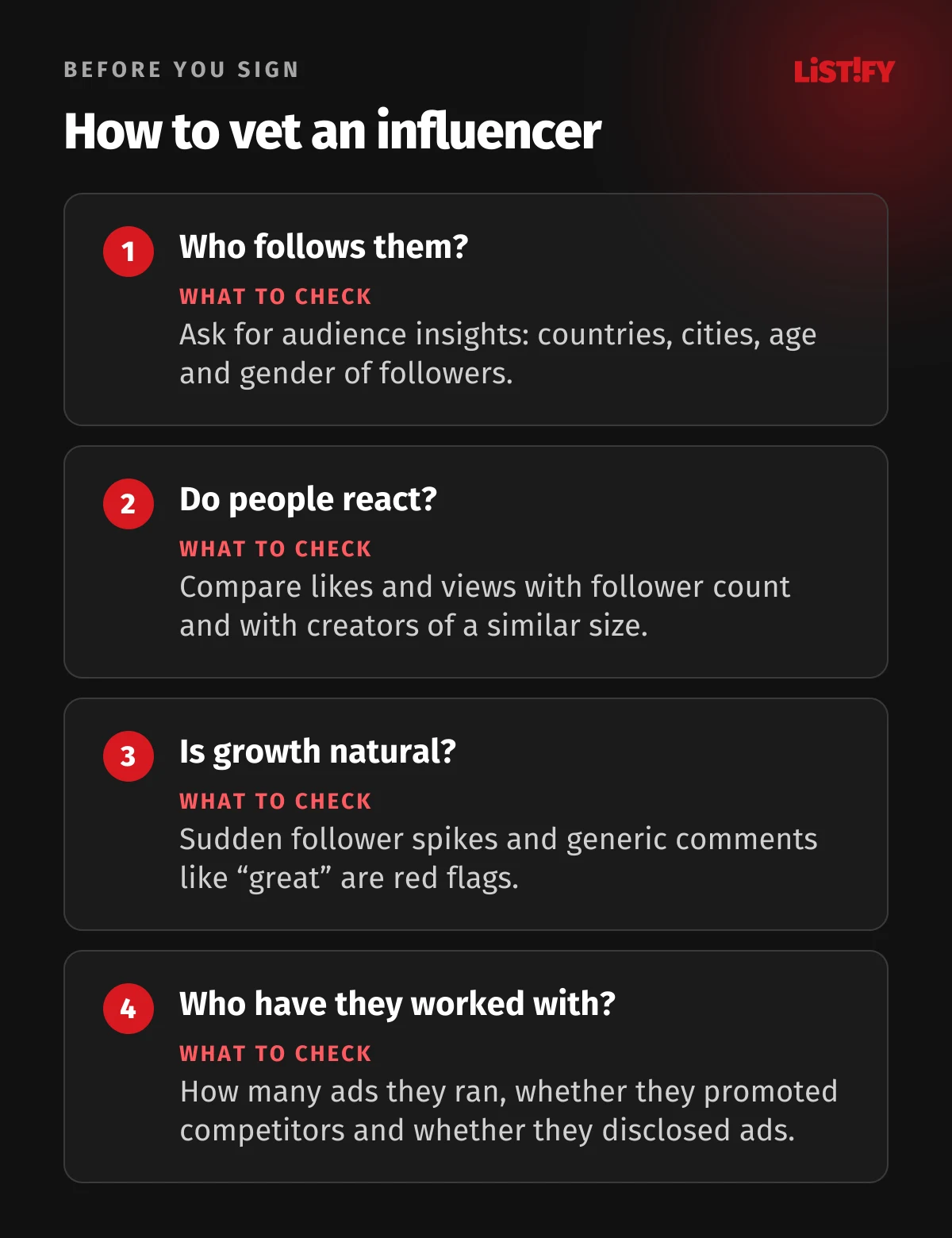
Before you start negotiating, run every candidate through these seven checks:
- Their audience matches your customers. Ask for screenshots of their account insights: countries, cities, age and gender of followers. A creator with a big audience in another country won’t bring you local orders.
- Engagement fits their size. Compare likes, comments and views with follower count and with creators of a similar size. Sudden jumps in followers and hundreds of generic comments like “great” are red flags.
- Their followers are real. In the Influencer Marketing Hub 2026 survey, fake or bot followers made up 56.5% of all reported fraud and quality issues. In the US, the FTC rule on fake reviews explicitly bans buying or selling fake indicators of social media influence such as followers or views (16 CFR 465.8). Check the account with an audience quality tool or ask the agency for data.
- Their content and tone fit your brand. Scroll back at least three months, not just last week. Look for a style your product would naturally fit into.
- Past partnerships. How many ads they ran recently, whether they promoted competitors and whether they disclosed them. If someone promotes three different face creams in a month, their followers stop listening.
- Values and risk. Look at past controversies, comments and how they behave outside social media. In 2023 Italy’s competition authority fined Chiara Ferragni’s companies €400,000 and €675,000 over a misleading charity campaign, and it also fined the brand, Balocco, €420,000 (AGCM).
- They actually use the product. Buyers care: 81% of respondents in the Sprout Social survey said it matters whether an influencer has used the product they promote.
One simple test helps too: ask the creator to write how they would describe the product to their followers. If they send back copy lifted from your own website, that is how the video will sound.
05How much influencers charge and how to pay them
There is no reliable public rate card for influencers. Most price lists online don’t say where their numbers come from. The better data comes from surveys and real payments. In the Influencer Marketing Hub 2026 survey of more than 600 marketers, about 55% of answers put nano-influencers under $500, and mid-tier creators most often in the $2,000 to $5,000 or $5,000 to $10,000 bands. These are marketers’ own estimates, and the survey doesn’t say whether they mean one post or a whole deal.
Actual payments tell a similar story. Across flat payments made through the CreatorIQ platform in 2025, creators earned $11,400 each over the year on average, but the median was only $3,000, and the top 10% of creators received 62% of all the money (CreatorIQ). Most of the money goes to a small group of top earners, while a typical creator earns far less.
| Payment model | How it works | Watch out for |
|---|---|---|
| Flat fee | You pay for an agreed number of posts, videos or stories | The business carries most of the risk, so insist on receiving stats |
| Gifting (free product or service) | The creator gets the product and talks about it in return | Gifted content is still an ad and must be disclosed |
| Affiliate commission | The creator earns a percentage of orders through their link or code | Big creators rarely agree to commission only |
| Hybrid | Lower flat fee plus commission | Motivates both sides and is easy to measure |
| Long-term ambassador | A six- or twelve-month contract with regular content | Highest credibility, but your brand is tied to one person |
How much to spend on marketing overall and how to split it between channels is covered in How much to spend on online marketing.
06How to measure whether it paid off
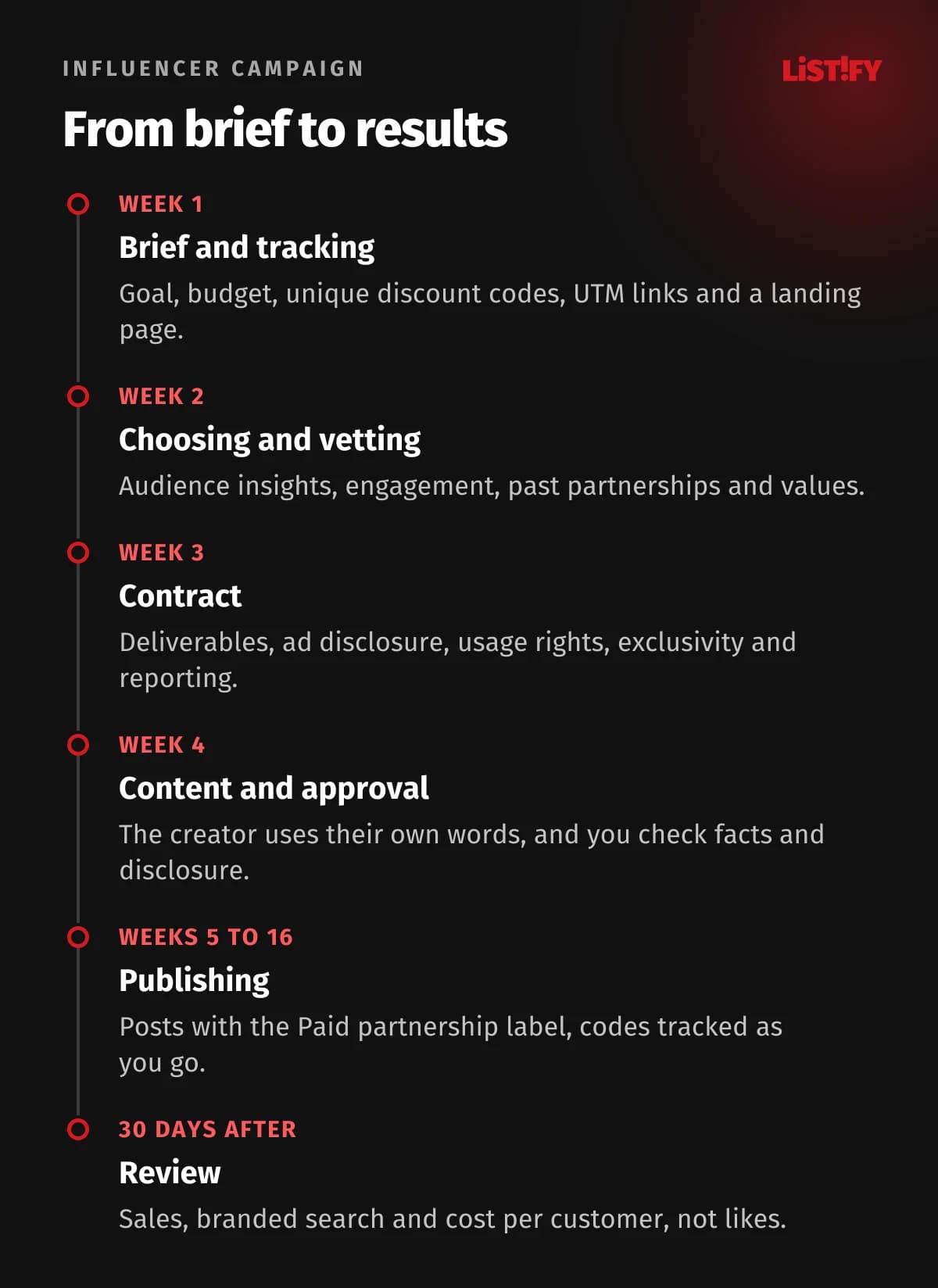
Likes and reach won’t tell you whether you sold anything. In a Linqia survey of more than 200 enterprise marketers, quoted by Influencer Marketing Hub, 79% said they struggle to measure influencer ROI. Set up tracking before the first post goes live. For social media measurement in general, see How to measure social media success. For creator partnerships, these work best:
- A unique discount code for each creator. The simplest way to tie an order to a person. In the Influencer Marketing Hub survey, 45.9% of marketers who answered use promo codes.
- Links with UTM parameters. Google Analytics will then show visits, leads and orders from each creator separately.
- A dedicated landing page. A page built for the creator’s audience converts better than your homepage and is easier to measure.
- Branded search. Watch Google Search Console and Google Trends to see whether more people search for your brand after the campaign. That catches buyers who never used the code.
- A comparison period or region. Sales in the same weeks last year, or in a region where the campaign didn’t run.
Be careful with earned media value
Agencies love to report earned media value. That is where the widely quoted claim that every dollar in influencer marketing returns $5.78 comes from. In the original 2020 Influencer Marketing Hub survey, though, it is not revenue, just an estimate of what the same attention would have cost as advertising. The “11 times higher ROI” claim is just as misleading. In 2015 Nielsen measured the sales lift for a single plant-based milk brand, and the 11× multiple was a projection that the vendor TapInfluence calculated for blog posts compared with display ads (TapInfluence and Nielsen Catalina study, PDF).
Nielsen’s actual measurement is useful in its own right: people who saw the influencer content bought $285 more per 1,000 views than a matched control group that didn’t see it. That is the kind of test worth copying on a smaller scale: compare people or regions that saw the campaign with those that didn’t.
07What the law says: disclosure, liability and fines
The core rule is the same in most markets: if a creator was paid, or received anything of value, the audience must be able to tell that the post is an ad. Hiding it is misleading advertising, and the brand that ordered the post can be held responsible as well as the creator.
- European Union. The Unfair Commercial Practices Directive blacklists paid promotion that isn’t made clear to consumers (Annex I, point 11) and treats hiding the commercial intent of a post as a misleading omission (Article 7(2)).
- EU platforms and traders. The Digital Services Act requires platforms to give users a way to declare commercial content (Article 26(2)), such as Instagram’s “Paid partnership” label. The European Commission treats influencers who regularly promote products as traders (Influencer Legal Hub).
- United States. Under the FTC Endorsement Guides, any material connection, including free or discounted products, must be disclosed clearly and conspicuously (16 CFR 255).
- United Kingdom. The CMA says it is not enough to tag a brand, use a discount code or add an affiliate link. The label #ad should appear clearly and upfront, and terms like #gifted, #collab or #spon should be avoided (CMA).
Enforcement is catching up. In a sweep by the European Commission and consumer authorities from 22 EU member states plus Norway and Iceland, 97% of 576 influencers posted commercial content, but only 20% consistently disclosed it as advertising. Only 36% were registered as traders, and 358 were flagged for further investigation (European Commission).
- Posted commercial content97%
- Ran a commercial activity78%
- Registered as a trader36%
- Consistently disclosed ads20%
Source: European Commission, press release of February 14, 2024.
Regulated products carry extra risk. In 2022 the US Securities and Exchange Commission charged Kim Kardashian for promoting the EthereumMax crypto token without disclosing that she was paid $250,000 for the post. She agreed to pay $1.26 million and not to promote crypto asset securities for three years (SEC, archived). Alcohol, gambling, supplements and financial products all have their own advertising rules, so get every post in these categories approved before it goes live.
If you plan to use AI with a creator, such as a digital twin or an AI-altered video, the EU AI Act has required whoever publishes a deepfake to disclose it since August 2, 2026. More in The AI Act: what businesses must do. The EU is also preparing a Digital Fairness Act. According to the European Parliament’s legislative tracker, the Commission plans to propose it in the fourth quarter of 2026, and it is expected to tackle misleading marketing by influencers.
08What to put in an influencer contract
A chat on Instagram is fine for gifting a small product. For a paid partnership, get a written contract that covers at least the following:
- Deliverables and dates. Number of posts, videos and stories, platforms, publishing dates and how long posts stay up.
- Ad disclosure. An obligation to use the platform’s paid partnership label and a specific disclosure in the caption.
- Content approval. Who approves the script and the final post, and by when. In regulated categories, always before publishing.
- Usage rights. Whether and for how long you can reuse the video in your own ads, on your website or run it as an ad from your brand’s account.
- Exclusivity. How many weeks before and after the campaign the creator may not promote direct competitors.
- Reporting. An obligation to send insights screenshots (reach, views, clicks, audience breakdown) within 7 to 14 days of publishing.
- Termination and reputation. What happens if the creator breaches the contract or gets caught up in a scandal that could hurt your brand.
- Fee and invoicing. Amount, payment terms, tax status and, for gifting, the value of the product.
09Common mistakes
- Choosing by follower count. Who follows the creator, and how much they trust them, matters more.
- One post and done. People need to see a brand more than once. Repeated work with one creator is more believable than three different faces in a month.
- A finished script from the marketing team. The creator knows their audience better than you do. Give them the key message and let them say it in their own words.
- No tracking. Without unique codes and links you won’t know whether the campaign sold anything.
- Undisclosed partnerships. Regulators can go after the brand too, and followers who spot a hidden ad stop trusting both of you.
- A weak website. Someone clicks through from a video, lands on a slow page with an unclear offer, and leaves.
10FAQ
Is influencer marketing worth it for small businesses?
Often yes, if your customers are mostly Gen Z or Millennials, the product can be shown in everyday life and your website or store converts visitors into customers. For B2B companies and older customers, other channels usually work better.
How much do influencers charge per post?
There is no reliable rate card. In the Influencer Marketing Hub 2026 survey, marketers most often put nano-influencers under $500 and mid-tier creators between $2,000 and $10,000, without saying whether that covers one post or a whole deal. Price depends on audience size and engagement, format, usage rights and exclusivity.
Are micro-influencers better than celebrities?
For most small businesses, yes. Smaller creators get higher engagement on Instagram, and research shows credibility and interaction with followers are more closely linked to purchases than follower count. A celebrity makes sense for fast nationwide reach with a larger budget.
How can I spot an influencer with fake followers?
Compare likes, comments and views with follower count, look for sudden growth spikes and comments unrelated to the post. Ask for audience insights by country and age, or check the account with an audience quality tool.
Does an influencer have to disclose a free product?
Yes. The FTC counts free or discounted products as a material connection that must be disclosed, and the UK CMA says posts about gifts must be labeled as ads even when there was no obligation to post. The safest option is the platform’s paid partnership label plus a clear #ad at the start.
Who is liable for an undisclosed influencer ad?
Usually both sides can be. Under the FTC Endorsement Guides, advertisers can be liable for failing to disclose a material connection with their endorsers, and an advertiser may be liable for a deceptive endorsement even when the creator is not. The Ferragni case in Italy also shows that regulators fine brands: Balocco was fined alongside the influencer’s companies over a misleading charity campaign.
How do you measure influencer marketing ROI?
Give each creator a unique discount code and a link with UTM parameters, track branded search and compare sales with a period or region without the campaign. Earned media value does not show revenue.
11Conclusion: choose trust, not reach
Influencer marketing pays off for businesses whose customers spend time on social media and need to see a product in the hands of someone they trust. Start with a small test: two or three micro-influencers whose audience matches your customers, each with their own code and link, running for at least three months. Then judge the results by sales and new customers.
Creator partnerships are only one part of your marketing. How to fit them into a wider social media plan is covered in A social media strategy that builds community, and how to split your budget between brand building and performance campaigns in Brand vs. performance marketing. If you’d like a team that does this every day to handle creator selection, contracts and tracking, take a look at our social media management, pricing and how we work.
12Sources
- Pan, Blut, Ghiassaleh and Lee: Influencer marketing effectiveness, Journal of the Academy of Marketing Science 2024 (PDF)
- The Influencer Marketing Factory and HypeAuditor: Creator Economy Report 2026 (PDF)
- IAB: 2025 Creator Economy Ad Spend & Strategy Report
- Sprout Social: Pulse Survey Q2 2026 (PDF)
- BBB National Programs: Influencer Trust Index
- Influencer Marketing Hub: Benchmark Report 2026
- CreatorIQ: Creator Compensation Report
- TapInfluence and Nielsen Catalina Solutions: sales lift study (PDF)
- European Commission: results of the influencer sweep, February 14, 2024
- European Commission: Influencer Legal Hub
- European Parliament: Digital Fairness Act, Legislative Train
- FTC Endorsement Guides, 16 CFR 255
- FTC rule on fake reviews and testimonials, 16 CFR 465
- CMA: Social media endorsements guide for influencers
- AGCM: Ferragni and Balocco fines
- SEC: Kim Kardashian charged for touting crypto security (archived)