AI customer support: set clear boundaries and a useful handoff
A customer asks why an order has not arrived. AI can explain the published delivery policy, retrieve an authorized order status or draft a case summary. Deciding whether to refund an unusual order is a different responsibility. Useful support automation makes these boundaries clear before the conversation reaches an exception.
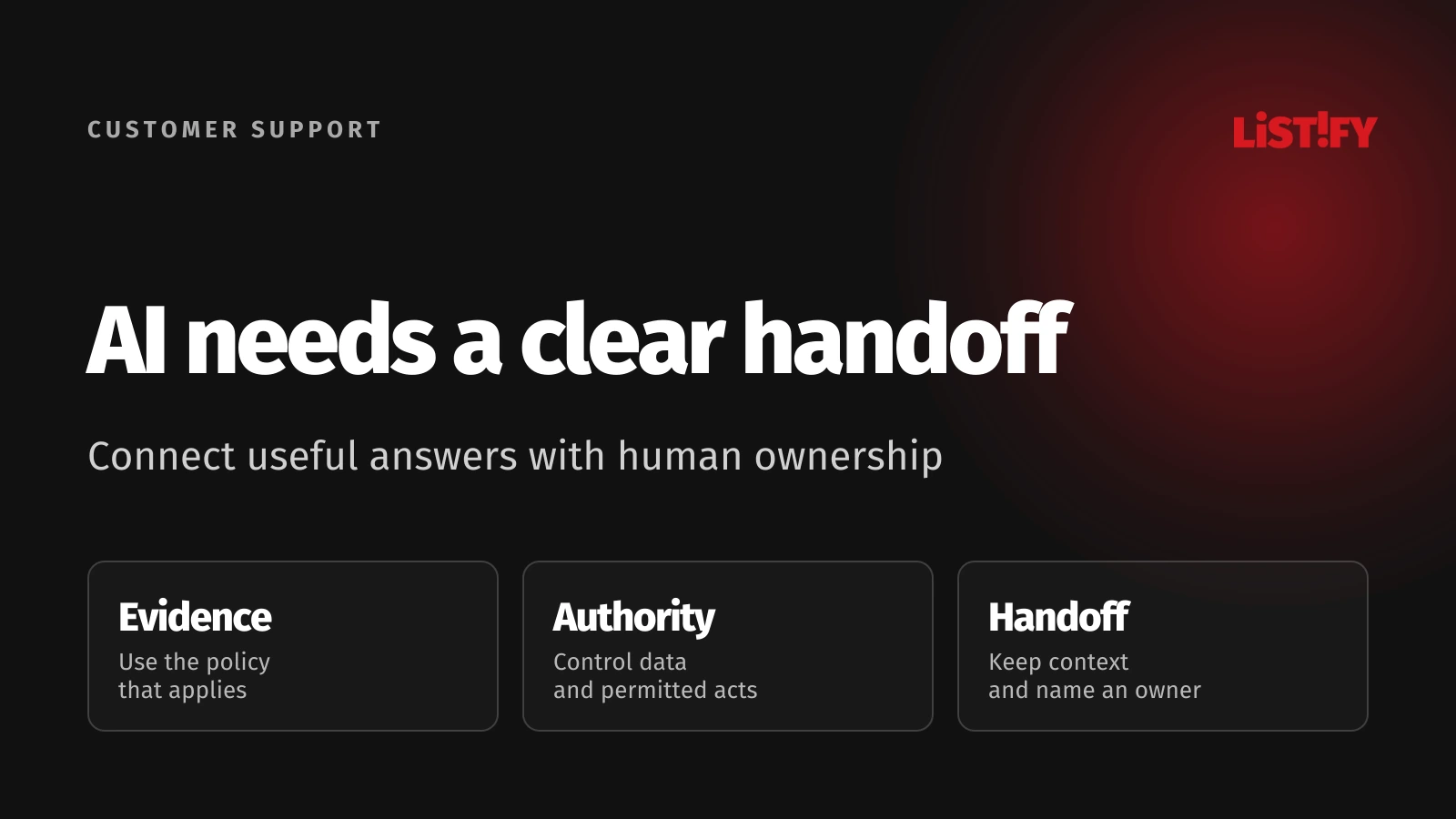
AI can help with repeated questions, routing and preparation for a representative. Its role should depend on the task, available evidence and consequence of an error. A fluent reply does not establish that the information is correct or that the system is permitted to perform the requested action.
Begin with one support queue and a defined set of cases. Decide which responses can be sent directly, which need review and when the customer moves to a human. Build the handoff alongside the automated experience so the team can finish the cases the system cannot resolve.
01Define support tasks and decision boundaries
Separate explaining a policy, reading customer-specific information and changing a record. These tasks have different evidence and permission requirements. An assistant that can answer a public returns question does not automatically need access to private order histories or authority to issue refunds.
Inventory the cases in the chosen queue. Include their ordinary resolution, exceptions and required context. For a delivery question, note whether the answer depends on a carrier event, a missing address, a disputed receipt or a special contractual arrangement.
| Support task | Possible AI role | Boundary to define |
|---|---|---|
| Public policy question | Explain current approved information | Use the applicable version and identify missing detail |
| Order-status question | Retrieve authorized status and explain it | Verify customer access to the specific order |
| Troubleshooting | Guide an approved diagnostic sequence | Stop when the required evidence or safe next step is missing |
| Account or financial change | Prepare a request or call a controlled operation | Require authorization and the applicable approval rules |
| Complaint or unusual exception | Summarize and route the case | Give a human ownership of the decision |
| Internal agent assistance | Find information and draft a response | Keep review and final responsibility explicit |
Name the decisions that remain with a person, such as a policy exception, a disputed transaction or a consequential account restriction. Explain how the system recognizes that the normal path no longer applies and who receives the case.
Let customers request human help through a clear route. Do not require them to prove that the assistant has failed several times. A person may need an exception, a clarification or a different communication style that the automated path is poorly suited to provide.
The business automation guide provides related workflow context. Start by removing avoidable handling work around the support task, such as classification and duplicate data entry, before assigning the assistant a broad decision-making role.
02Ground answers in information the team can maintain
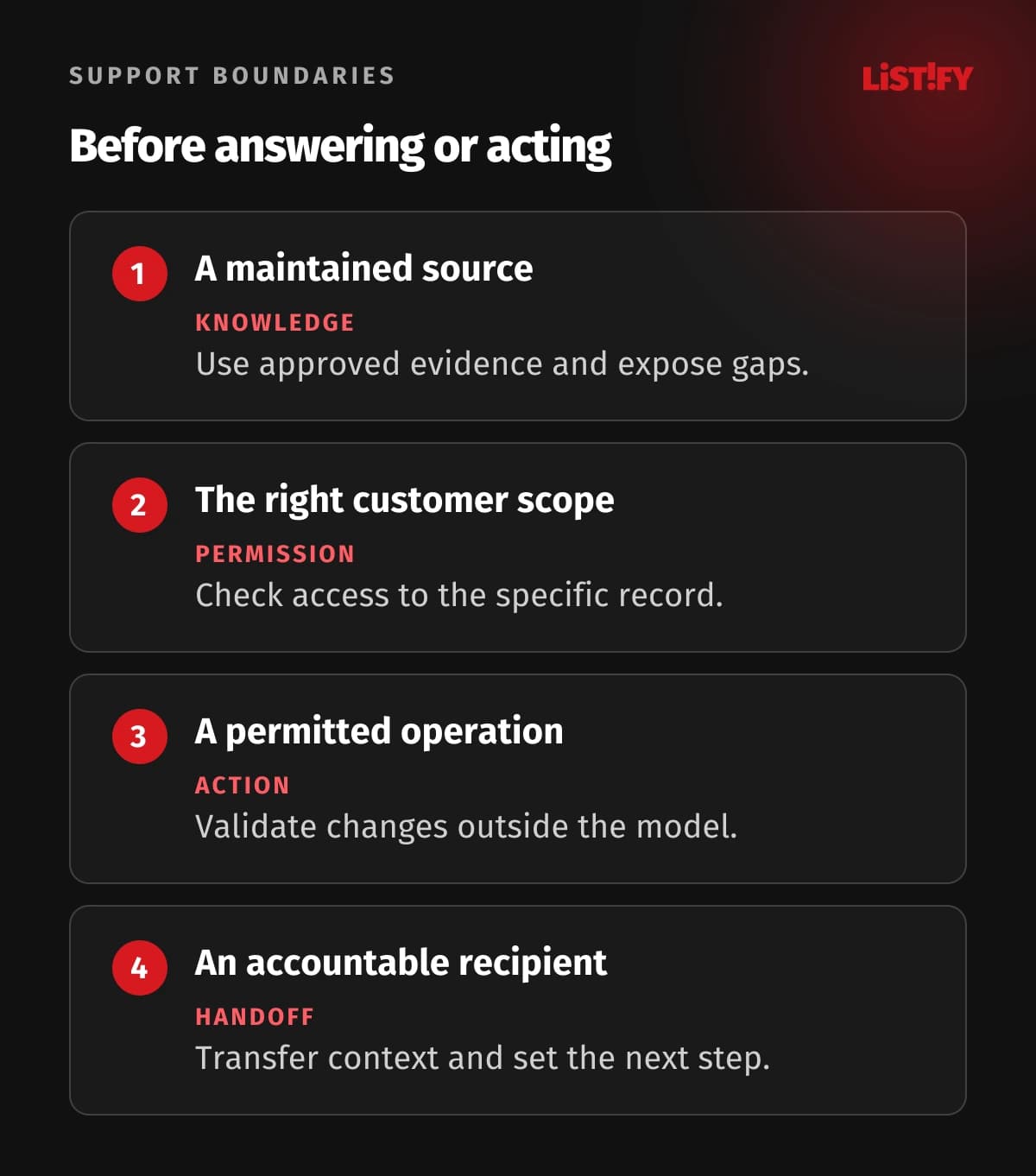
Choose approved knowledge sources with owners, version context and an update process. A returns rule can differ by product, geography or contract. The assistant needs to identify the relevant rule rather than combine fragments from policies that apply to different situations.
NIST’s Generative AI Profile describes confidently presented false content and misleading generated justifications. For support, evaluate the substance of the answer and its evidence. A confident tone or a plausible-looking citation is insufficient.
Make missing or conflicting evidence a normal outcome. If the current knowledge base cannot establish the answer, the assistant can ask a useful clarifying question or create a handoff. It should not fill a gap by inventing a deadline, entitlement or completed action.
Give the support team a way to correct a knowledge item and understand where it is used. Removing a stale document from one folder is not enough if an old indexed copy continues to answer questions. Include retrieval updates in the content change procedure.
Test similar questions with different applicable rules. A request about a new order and a legacy contract may sound almost identical. Use these cases to check whether the assistant selects the right source, preserves qualifications and asks for the information it actually needs.
Keep source links usable for the customer’s permissions. An internal document citation may help a representative review the reply but be inappropriate for a public response. Provide the corresponding customer explanation or route to a person rather than revealing internal material.
03Control data access and actions outside the model
Authenticate access to customer-specific records through the application’s normal security controls. Authorize the particular order or account on the server. A convincing claim inside a message does not establish that the sender may view another person’s information.
OWASP’s excessive-agency guidance identifies excessive functionality, permissions and autonomy as problems. Limit available operations and enforce downstream authorization. A tool intended to read shipment status should not also provide unrelated administrative powers.
Use specific operations with validated inputs and clear outcomes. A request to check an order should call the appropriate status operation, not provide unrestricted database or command access. Keep the permitted scope tied to the authenticated customer and the task.
OWASP’s prompt-injection guidance covers instructions arriving through both direct messages and external content. Treat retrieved documents and customer attachments as untrusted inputs. Knowledge retrieval does not remove the need for security boundaries.
For an approved change, show what will happen and require the applicable confirmation or human approval. Validate the business rules in the service performing the action. Do not ask the language model to decide whether a refund falls within authority based only on a persuasive conversation.
Distinguish requested, accepted, completed and failed operations. If a carrier integration times out, the assistant must not say the address was changed. Use safe retries and reconcile uncertain outcomes so repeated conversation turns do not duplicate a financial or account action.
04Make human handoff a complete workflow
Define handoff triggers before launch: an explicit customer request, missing evidence, an unsupported exception, failed identity checks, repeated misunderstanding or an operation that requires human judgment. Use task-specific rules and evidence instead of relying only on the model to report how confident it feels.
Google’s Dialogflow CX handoff documentation describes a transition to a human agent and the relevant integration setup. Whatever technology is chosen, connect the transition to the actual support queue and receiving team.
Create a case with a concise summary, the customer’s request, relevant verified context, attempted steps, tool outcomes and the reason for escalation. Preserve a link to the original conversation. Mark unverified claims so a generated summary does not quietly turn a customer statement into an established fact.
Tell the customer what happens next in terms the service can deliver. Explain whether a representative is joining, a ticket is awaiting review or the team is currently unavailable. Avoid a reassuring message that promises immediate human help when no one is assigned.
Give the receiving representative visible ownership and a way to acknowledge the case. Prevent the assistant and the human from independently issuing conflicting replies after the handoff. Decide who controls the conversation and how it returns to automation, if that is appropriate.
Test the route outside staffed hours and when the queue is overloaded. Preserve the customer’s progress and provide the approved alternative contact path. Do not repeatedly send the person back into the same automated loop because the preferred representative is unavailable.
05Measure resolution, quality and effort together
Choose resolution evidence appropriate to the task. For a status question, a correct authorized answer may finish the interaction. For a missing delivery, a created ticket is a next step. It does not establish that the underlying problem has been resolved.
Track repeat contact, reopened cases, incorrect answers, unnecessary transfers and time to a useful next action. Include customer feedback and representative review. A conversation ending without another message can mean success, abandonment or a person trying another channel.
Report automation or containment with its definition. A case handled without a human is useful only if it was within scope and handled correctly. Optimizing solely for avoiding human contact can discourage necessary escalation and make the customer’s work harder.
Evaluate by task, language and relevant scenario. Include unclear requests, outdated information, similar account identifiers, permission failures and provider outages. An average result across easy policy questions can hide a serious problem in a less frequent but consequential workflow.
For answer quality, check factual support, applicability, completeness and whether the response promises something the system did not do. For actions, inspect authorization, inputs, confirmations and the resulting record. Text quality and operational correctness require different checks.
Count the human work created by the system: reviewing drafts, correcting knowledge, investigating failures and handling transferred cases. Reduced typing can be valuable even when a representative remains responsible. Evaluate the whole support operation before claiming a cost reduction.
06Pilot a narrow queue with an operating owner
Begin with historical or representative cases whose expected handling the team can explain. Use appropriately protected examples and exclude unnecessary personal data. Check answers and routes before allowing the system to communicate directly with customers.
A draft-assistance stage can reveal knowledge gaps while a representative reviews the response. Follow with a limited direct-answer scope where the evidence and permissions are ready. Keep the expansion criteria tied to quality and task boundaries rather than the number of conversations processed.
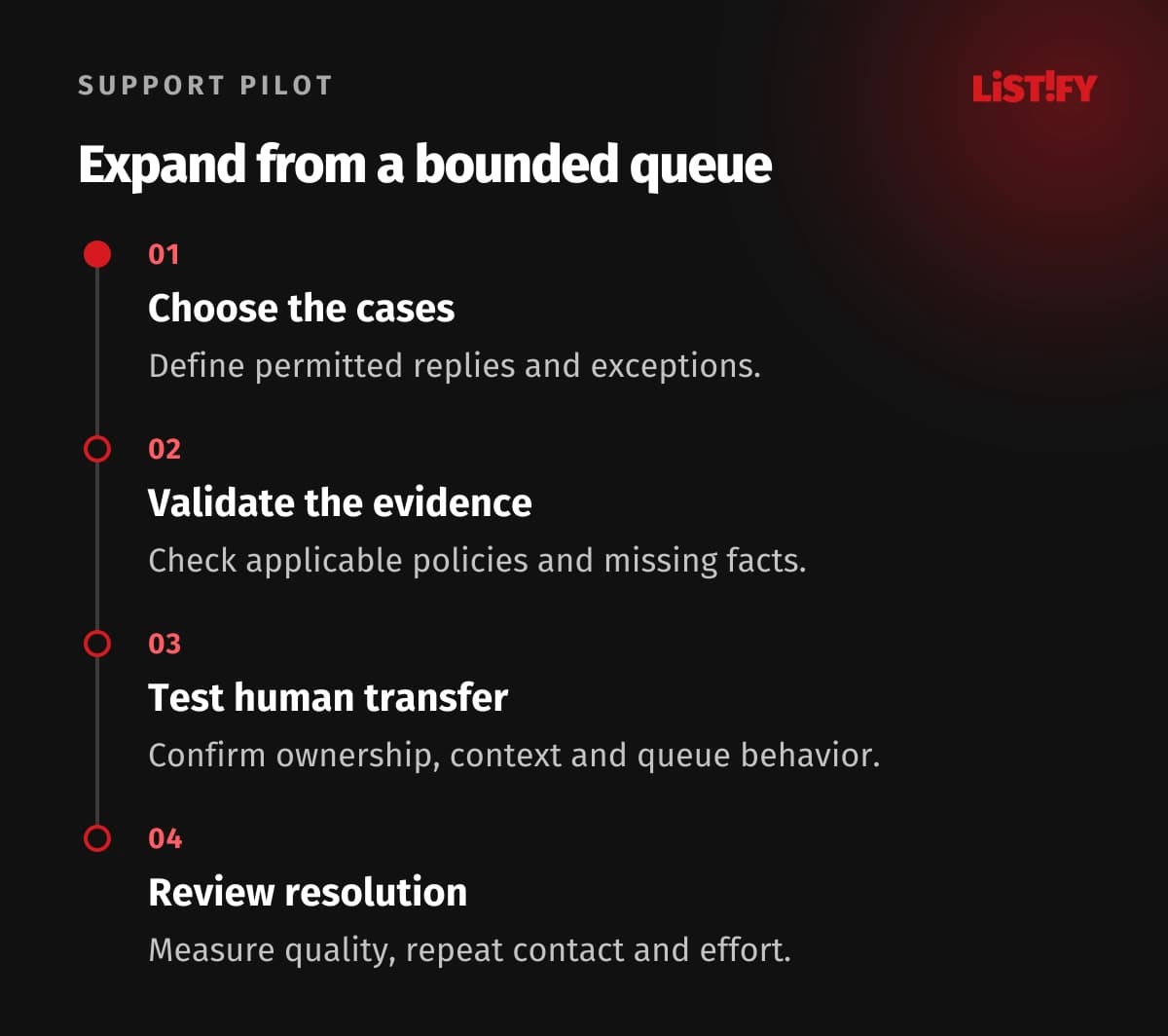
Give knowledge, integrations and escalation rules identifiable owners. Document the model and configuration versions used for an evaluation. Recheck relevant cases after a model change, policy update or new tool, because a previously acceptable result may no longer describe the current system.
Set a practical stop procedure for an incorrect policy answer, unauthorized data exposure or a repeated operational failure. The team should be able to disable an affected capability and route cases to the approved support path while investigating the problem.
The data-security guide provides related access questions. Apply suitable rules to transcripts, ticket summaries, provider processing and diagnostic records. Keep the information needed to support and assess the service without making every conversation permanently available to everyone.
07Questions about AI and human customer support
Which support tasks should be automated first?
Start with a bounded queue, approved information and clear expected handling. Repeated policy questions or internal drafting can be suitable candidates. Validate the actual cases and build escalation before expanding direct answers or actions.
Does a knowledge base stop incorrect answers?
It can provide relevant evidence, but retrieval and generation still need evaluation. Check applicability, stale documents, unsupported conclusions and missing information. A citation or confident tone does not prove that the answer is correct.
Should the assistant decide access permissions?
No. The application must authenticate the customer and authorize the specific record or action through server controls. The model’s interpretation of a message is not a substitute for permission checks.
When should a conversation move to a human?
When the customer requests it or the case crosses an agreed boundary, such as missing evidence, an unsupported exception or required judgment. Use task-specific handling rules and preserve context for the receiving representative.
What should a handoff include?
The request, concise summary, verified context, attempted steps, tool outcomes and escalation reason, with access to the original conversation. Distinguish customer claims from established facts and give the case a receiving owner.
Can no further messages be counted as resolution?
Not reliably by itself. The customer may have succeeded, abandoned the conversation or moved channels. Use task-appropriate evidence, repeat-contact signals and feedback to assess whether the problem was actually handled.
Does successful AI support require removing human agents?
No. Faster knowledge lookup, draft preparation and routing can improve a service while people keep responsibility for decisions. Evaluate customer outcomes and total operating work, including review, corrections and transferred cases.