AI training is over. How to assess its value in 30 days
Your team left training with new techniques and some promising examples. A month later, you need to know what changed in everyday work. Here is how to choose tasks, include checking and corrections in your measurements, and decide where AI earns its place.
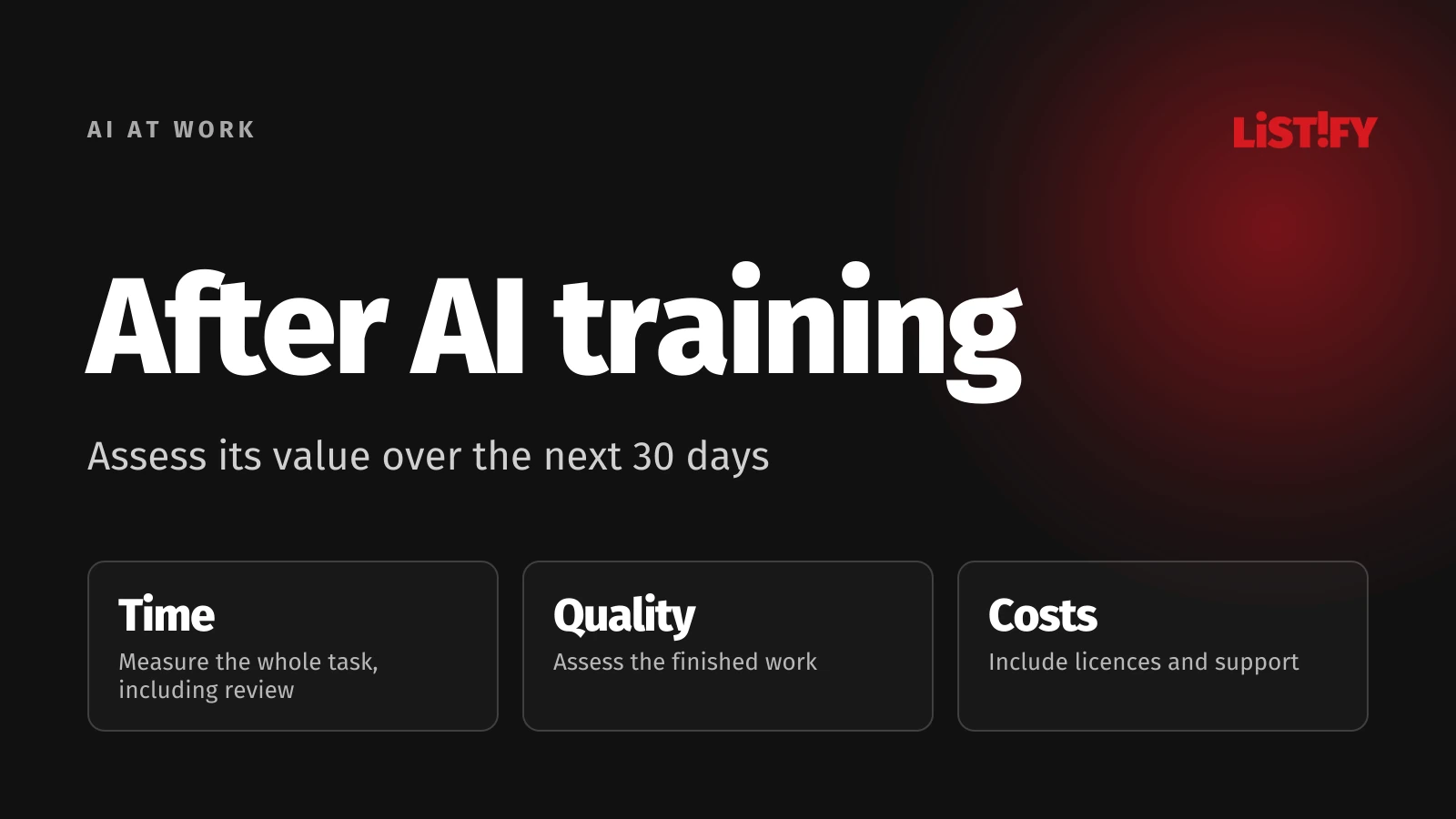
The short answer: choose two recurring tasks, measure the complete process with and without AI, and compare the finished work. Include corrections, costs and occasions when people abandon the tool. The 30 days below are our proposed evaluation schedule, not a legal deadline or a promise that a month will establish a return on investment.
01Separate usage from useful results
Logins tell you whether people opened a tool. They do not tell you whether a customer received an accurate quote sooner. For example, Microsoft's Copilot adoption report measures usage across teams, applications and features. Your business still needs to measure the work that gets done.
A sales manager might want shorter quote preparation. An assistant might need reliable meeting notes. These tasks involve different inputs and different consequences when something goes wrong. Do not combine them into a single average or turn prompt counts into an employee competition. That encourages visible activity rather than useful work.
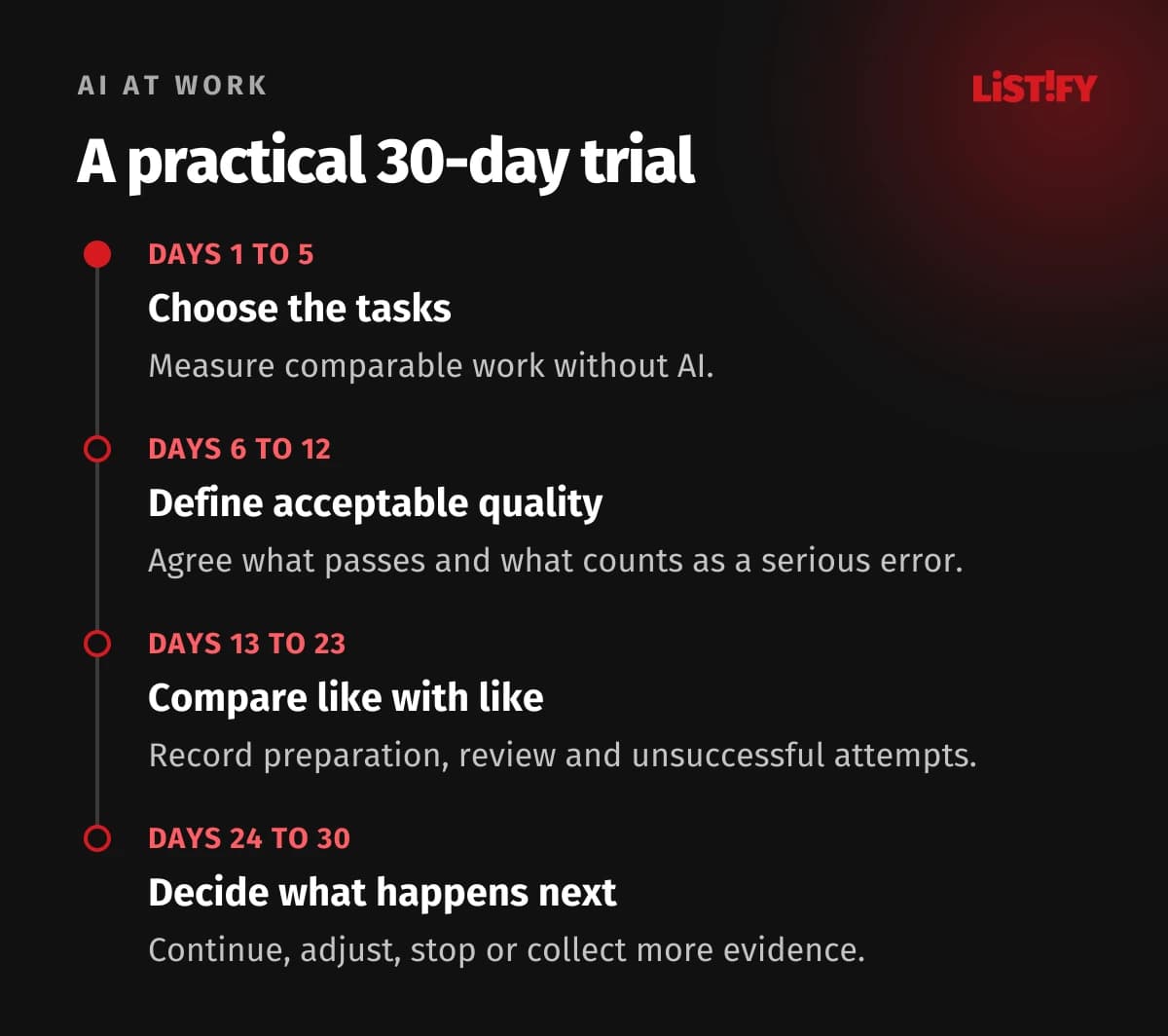
02Days 1 to 5: Choose the tasks and establish a baseline
Pick two activities that will actually recur during the month: drafting replies to routine enquiries and preparing meeting briefings, for instance. Define where each task starts and what counts as finished. The endpoint is work that the responsible person can accept, not the first generated draft.
Keep a simple record. A shared spreadsheet with restricted access will usually do for a pilot. Do not put entire customer documents in it when a task reference is enough for measurement.
| Record | Purpose |
|---|---|
| Task type and difficulty | Separates routine requests from complex exceptions. |
| Preparation, production and review time | Shows whether effort moved to another stage. |
| Accepted, corrected or rejected | Distinguishes usable work from a quick draft. |
| Reason for corrections or not using AI | Helps improve the process or choose a different task. |
If training has already finished and you have no earlier measurements, say so. Measure the current process without AI using fresh, comparable tasks. Recollections such as “that used to take an hour” can inform a conversation, but they are not equivalent to a measured baseline.
03Days 6 to 12: Define an acceptable result
For a sales reply, acceptance might mean using the price in the source material, inventing no delivery date, answering the questions and sounding natural. Classify errors by consequence. A typo and an unauthorised promise to a customer are different problems. A serious error must not pass because the draft appeared quickly.
NIST's generative AI profile describes confidently presented false outputs and recommends checking results against known correct information. Assign someone who understands the subject well enough to spot an error.
Score several examples together. If two colleagues disagree on whether a quote is acceptable, clarify the rules before collecting more results. Where practical, do not tell reviewers whether AI helped produce the text. Use approved tools and only the material your organisation permits you to process in them.
04Days 13 to 23: Compare like with like
Compare routine enquiries with routine enquiries, and complex cases with complex cases. Include people with different experience levels in both groups. Someone completing the same document twice will already know the answer. You cannot attribute all that improvement to AI. Different tasks of the same type and similar difficulty are more useful.
Record unsuccessful attempts too. Preparing material, writing instructions, follow-up prompts, checking facts, editing the tone and transferring the result to your CRM, the system used to manage customer records, all belong in the total. Separate time waiting for the tool from time a person actively spends on the task. Both can matter, but they answer different questions.
Illustrative example: a routine reply takes 18 minutes without AI. With AI, preparation takes 3 minutes, drafting 2, checking and corrections 8, and entering the result into the system 1. The total is 14 minutes: a difference of 4 minutes. Across 60 comparable replies a month, that would release 4 hours of capacity. These figures demonstrate the calculation; they are not a LISTIFY client result or a savings promise.
- Without AI18
- With AI, including review14
Illustrative calculation from the article. These are not measured savings or results from a LISTIFY client.
Four available hours do not automatically reduce payroll costs. Explain how the team will use them: clearing a queue sooner, preparing more quotes or reducing overtime. Record licences, training, template preparation and support separately so the time saving does not obscure their cost.
05Days 24 to 30: Decide what happens next
For each task, summarise the number of cases, typical completion time, variation and corrections. With a small sample, include concrete examples and state what remains unknown. A before-and-after comparison cannot, on its own, separate the effects of training, the tool, growing experience and changes in the work coming in.
The UK Government's AI Playbook recommends ongoing evaluation of system quality and fitness for purpose. Applied to a business pilot, that means revisiting the decision when tools, source material or working practices change.
- Continue: results meet the agreed standard and the complete process works for the team.
- Adjust: missing inputs, review work or copying between applications limits the benefit.
- Stop or extend measurement: errors are serious, no benefit has emerged, or there are too few cases to judge.
Give the owner of each task one specific next action and a review date. If copying between applications is the bottleneck, connecting the systems may help. Another general training session will not fix that handover by itself.
06Frequently asked questions
Is a post-training survey enough?
It reveals satisfaction and obstacles. To assess business value, add samples of completed work, timing and quality checks.
Do we need to assess every employee individually?
For an initial decision, assessing the task and team is usually more useful. Keep experience differences in view without turning the exercise into a league table.
What if thirty days is not enough?
Extend the evaluation for infrequent or lengthy tasks. A valid conclusion after a month is that you do not yet have enough evidence.
07Turn training into a practical trial
Send us two activities you want to improve and an example of the current process. Through our AI services for businesses, we can help define a pilot, review rules and an evaluation that supports a clear next decision.