Marketing and sales: agree on lead quality and the next action
Marketing reports a successful campaign because inquiries increased. Sales reports that the inquiries are unsuitable or still waiting for a reply. The disagreement cannot be resolved by changing the dashboard label. Both teams need the same definition of a useful lead and a visible agreement about what happens after it arrives.
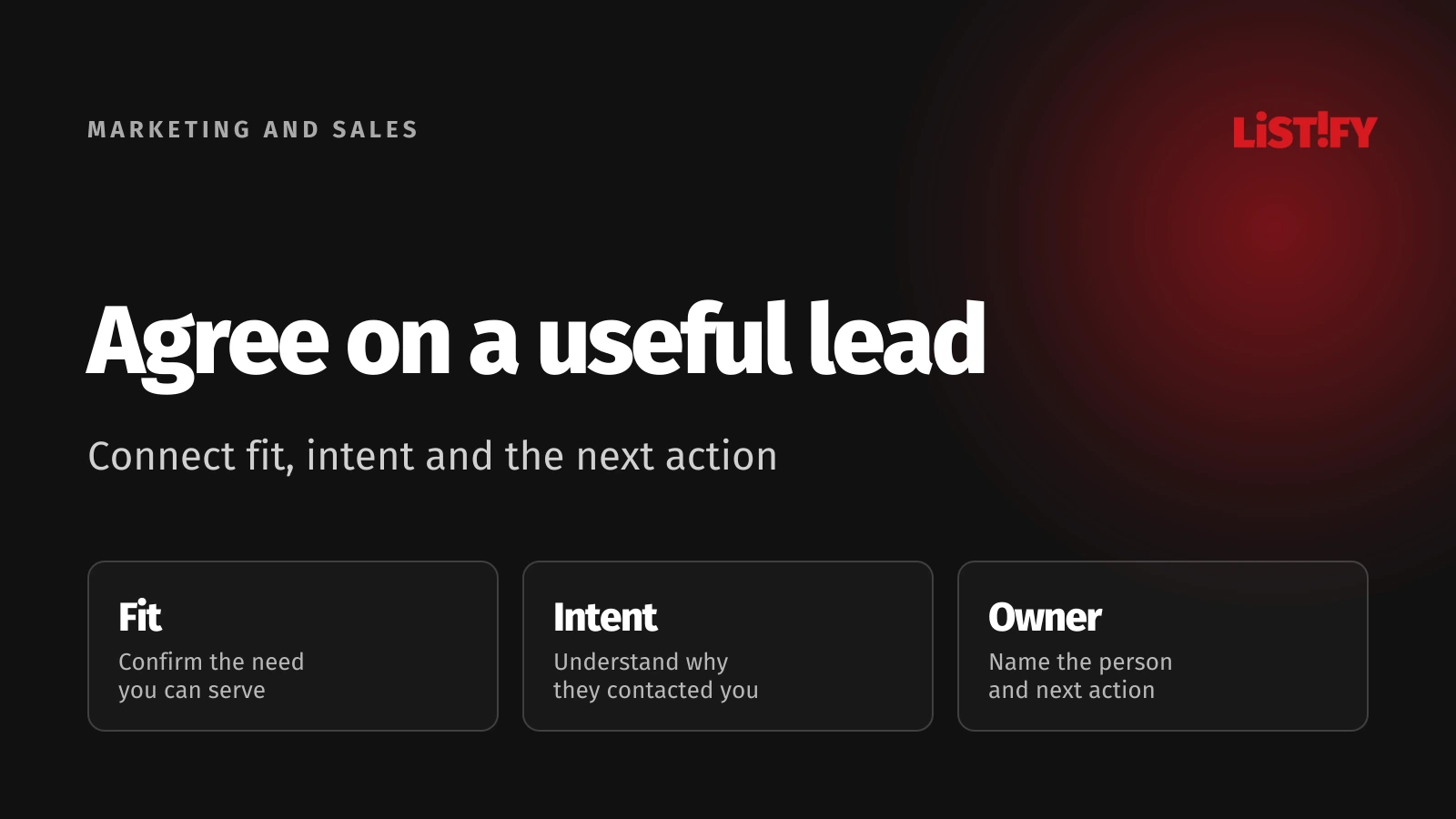
A lead process connects acquisition with human decisions. Marketing needs to know which promises attract suitable buyers. Sales needs enough context to respond well and enough capacity to work the queue. Leadership needs evidence that separates a poor audience match from slow follow-up or an immature buying cycle.
Begin with one offer and a sample of recent inquiries. Agree on qualification, ownership, response expectations and return reasons. Put those decisions into the CRM and review real records together before introducing an elaborate score or another report.
01Choose a shared business outcome
Define the result both teams are trying to support, such as suitable opportunities for a particular service. Lead volume remains useful for planning, but it cannot describe suitability, intent or the work required to convert an inquiry into an opportunity.
Connect the result to the offer and the customer profile. A company selling a specialized integration service needs a relevant problem, a compatible environment and a realistic delivery path. An interested person outside the service scope may still be a useful contact, but not an immediate sales opportunity.
Agree on which constraints matter: service geography, organization type, required capabilities, commercial viability and available delivery capacity. Keep the list short enough to use. Avoid inventing a precise ideal profile that excludes promising buyers simply because a field is unknown.
Separate team contribution from attribution. A campaign may introduce the organization, useful content may support evaluation and a representative may clarify the requirement. A single credited source does not describe every influence on the eventual decision.
Review incentives alongside the report. If marketing is rewarded only for submissions and sales only for immediate closes, each team has a reason to avoid uncertain but potentially suitable inquiries. Choose measures that encourage useful progression and accurate records.
The B2B lead-generation guide covers acquisition choices. This operating agreement begins when an inquiry reaches the business and follows it through the decisions that reveal whether the acquisition was useful.
02Define qualification through fit and intent
Use two separate questions: can the organization serve this prospect, and is there evidence of a relevant buying conversation? Fit describes the first. Intent and readiness help answer the second. Combining them into one opaque score makes it difficult to explain why a lead was passed to sales.
Salesforce’s qualification training distinguishes engagement scores from fit grades and notes that assignment criteria vary by sales cycle and strategy. Use that distinction to make the team’s decision explicit, rather than adopting an arbitrary universal threshold.
A request to discuss an integration has different meaning from a general resource download. Several downloads can indicate curiosity, existing customer research or a student’s interest. Ask what the behavior demonstrates before treating frequency as a purchasing signal.
Unknown information should remain unknown. A missing budget field is not proof that the prospect cannot buy, and a senior title is not proof of signing authority. Record the questions that the first conversation needs to resolve without presenting assumptions as verified facts.
Use scoring where it helps sort a substantial queue, and explain the factors that contributed. Set clear handling for explicit requests that deserve a response even if the score is low. A model should support a decision, not become an excuse to ignore a customer asking for help.
Review suitability and timing independently. A well-matched organization planning a project later may belong in an agreed follow-up process. An unsuitable request needs a different reason and action. Putting both into rejected hides information that marketing could use.
03Make the handoff an operating agreement
| Process state | Entry evidence | Responsible next action |
|---|---|---|
| New inquiry | A recorded request with usable contact context | Assign an owner and confirm receipt |
| Ready for sales review | Agreed fit and intent evidence is present | Accept, clarify or return with a reason |
| Working inquiry | An owner has accepted responsibility | Record contact attempts and next step |
| Qualified opportunity | A relevant buying conversation meets agreed criteria | Create or update the opportunity |
| Later timing | Fit exists, but a sales conversation is premature | Set a suitable follow-up owner and review date |
| Unsuitable or invalid | A specific exclusion or data-quality issue is recorded | Close or correct the record and return feedback |
HubSpot’s lifecycle documentation distinguishes marketing-qualified, sales-qualified and opportunity stages, with a separate lead-status property. Vendor defaults can provide a starting vocabulary. The team still needs its own entry evidence and responsibilities for each stage.
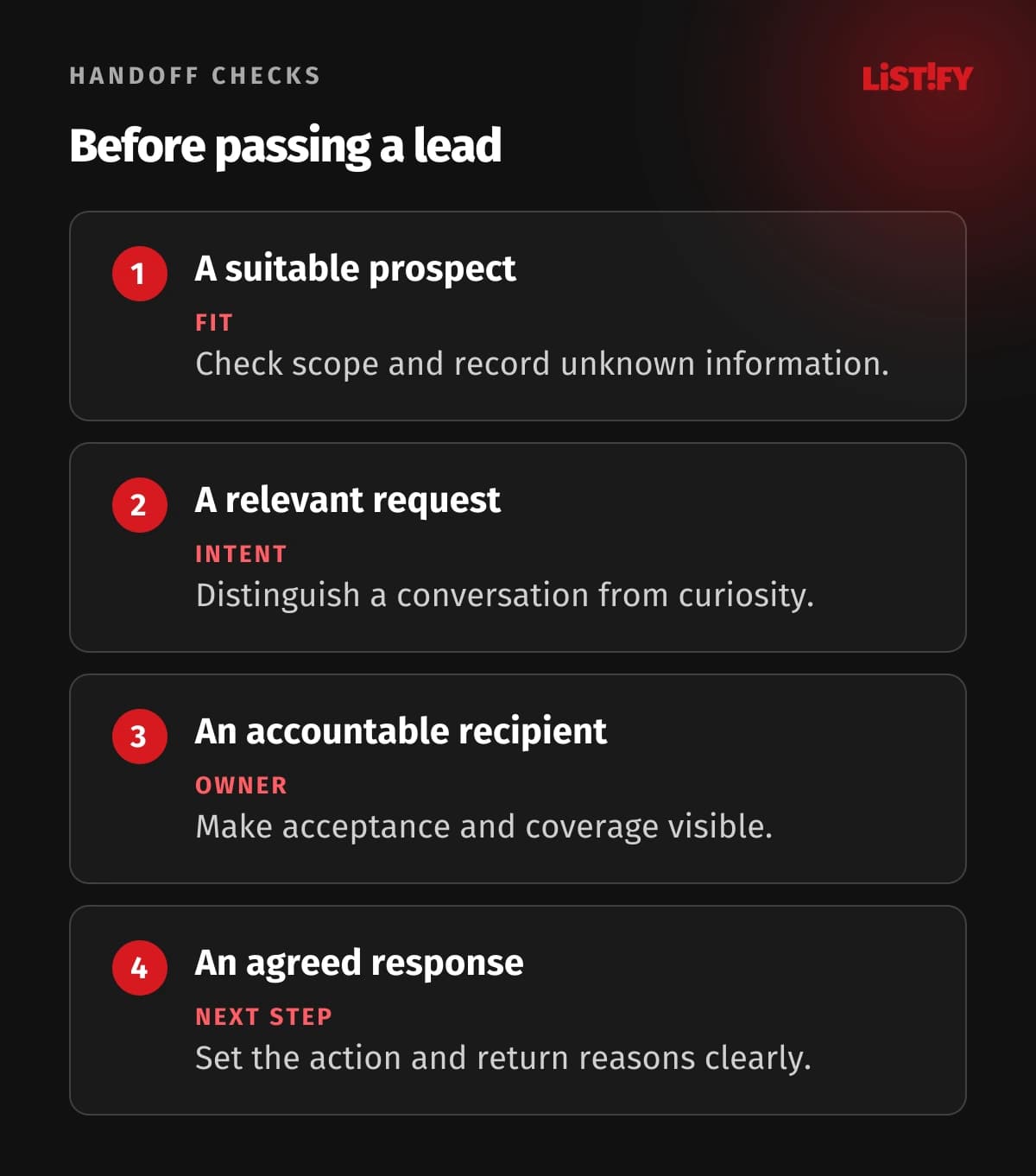
Write response expectations that match the request and staffed hours. A direct sales inquiry may need a different queue from a low-intent content registration. Define what acknowledgment means, when a human response is expected and how missed expectations are escalated.
Make acceptance visible. Assigning a name automatically does not confirm that the representative has seen the record or can work it. Define a review state, an overflow route and coverage for leave or an unavailable specialist.
Send the context needed for the first conversation: the offer, submitted requirement, relevant source, known fit information and unresolved questions. Keep unnecessary browsing history and sensitive material out of the handoff. The representative needs a usable summary, not every event ever collected.
Give sales a short set of return reasons such as outside service scope, insufficient context, later timing, duplicate or invalid contact details. Require a concise explanation where needed. A generic poor quality label cannot show the team which change to make.
04Keep CRM records and automation trustworthy
Keep the contact, organization and opportunity distinct. Several contacts can belong to one buying process, and one contact can make more than one inquiry over time. Reporting every form submission as a new independent buyer inflates the apparent pipeline.
Define duplicate handling without losing the new request. Match cautiously, preserve the inquiry’s date and context, and notify the existing owner where appropriate. Merging records should not silently replace an active conversation with a fresh campaign assignment.
Record important transitions with timestamps, reasons and ownership. A current status alone cannot explain whether the lead waited for routing, a representative’s response or the prospect’s decision. Preserve enough history to review the process without reconstructing it from email.
Protect routing against conflicting automations. A campaign workflow, a territory rule and a company-owner rule may each try to assign the same record. Establish precedence and test an existing customer, an open opportunity and a new organization separately.
A failed integration should create a visible exception with an owner. Do not assume that a successful website submission means the CRM record and assignment were created. Reconcile the capture and CRM systems so requests cannot disappear between them.
The custom CRM guide discusses when workflow requirements exceed spreadsheet management. Choose software around the agreed process. Changing the tool will not resolve competing qualification definitions unless the team makes those decisions first.
05Review quality with cohorts and honest denominators
Build a small shared report with submitted inquiries, valid inquiries, accepted sales reviews, qualified opportunities and relevant later outcomes. Show the definitions and time window. A rate is difficult to interpret when people do not know which records were eligible for the denominator.
Compare cohorts with enough time to mature. Leads arriving late in a reporting period have had less time to become opportunities than older leads. A recent campaign can look poor simply because its buying cycle is still underway.
Segment where it informs an action: offer, audience, source or request type. Avoid slicing a small dataset into so many categories that individual records dominate every percentage. Inspect the underlying cases and treat early patterns as hypotheses.
Measure response and process delays alongside acceptance and progression. If a good inquiry waits unnoticed, its later failure cannot be attributed confidently to the campaign. Review unsuccessful contact, unsuitable fit and no response as distinct situations.
Google Ads documents qualified and converted lead goals using offline conversion data. Such feedback can connect campaign measurement with later stages. First agree on the event definition and validate the data; uploading an inaccurate label only spreads the disagreement into another system.
Keep attributed pipeline separate from incremental impact and actual revenue. A CRM relationship can show an association without proving that a campaign caused the sale. Do not combine opportunity estimates, won contracts and recognized revenue into one unlabeled return figure.
06Close the feedback loop with a small pilot
Choose one offer, one inbound route and a manageable group of representatives. Review a mix of accepted, returned and unresolved leads together. Ask whether the recorded evidence supports each decision and whether the next action was clear.
Turn repeated return reasons into a specific change. If inquiries repeatedly request an unsupported service, improve the offer explanation or targeting. If a useful requirement is missing, improve the relevant question. If routing is slow, fix ownership before buying more traffic.
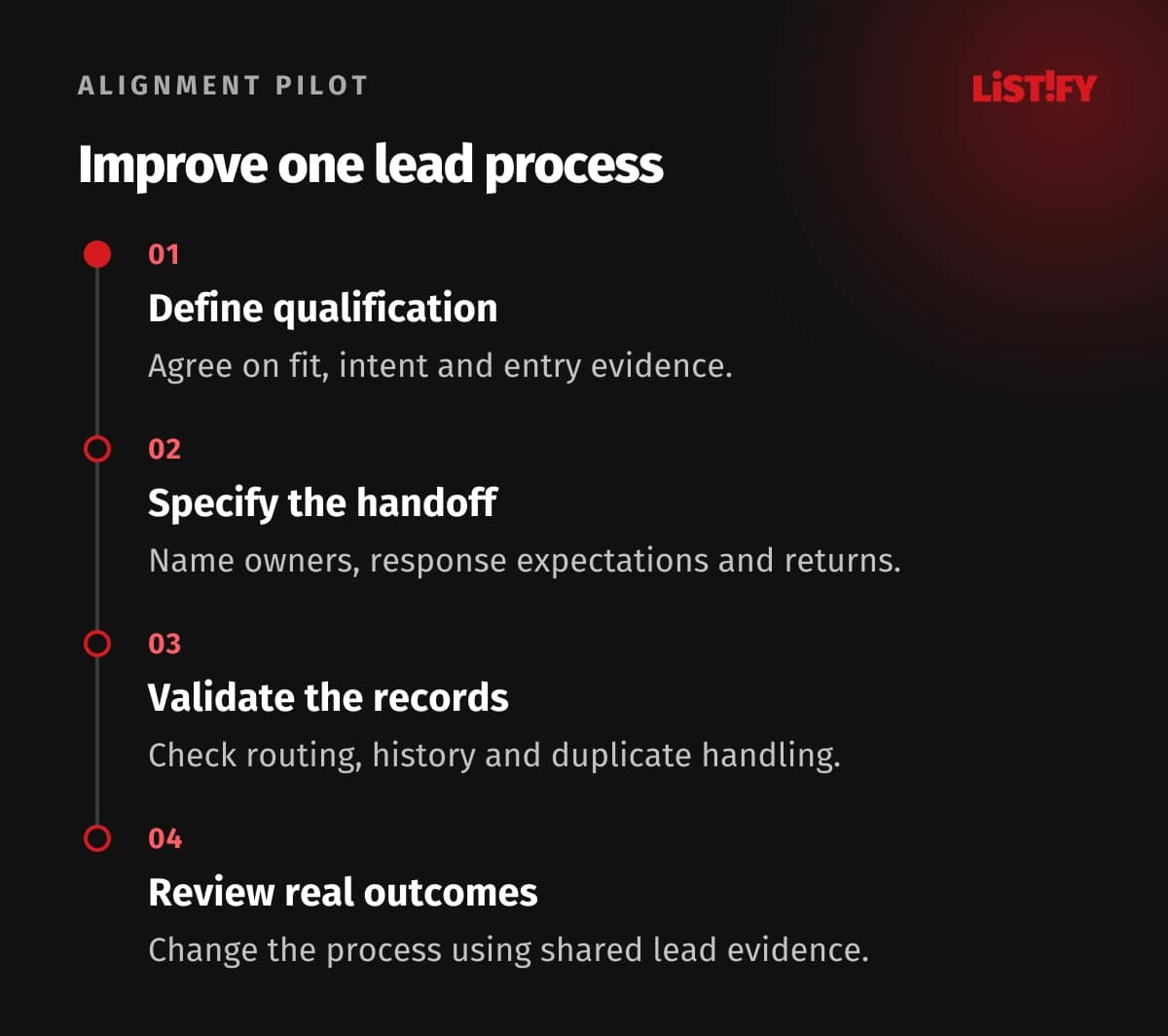
Assign the review a cadence suitable for the volume and sales cycle. Bring records, reason codes and open decisions. End with an owner for each change and a date to assess its effect. A recurring meeting without changed actions does little to improve the process.
The executive marketing reporting guide helps present these outcomes to leadership. Include the unresolved limitation, such as immature cohorts or missing CRM transitions, so the report does not imply certainty that the underlying records cannot support.
Version the qualification and handoff rules. When the offer, audience or delivery capacity changes, both teams need to know which rules now apply. Keep historical reports interpretable instead of retroactively treating every old record as if it had passed the new criteria.
07Questions about marketing and sales alignment
Is a marketing-qualified lead ready to buy?
It indicates that marketing has applied agreed readiness criteria for sales review. It does not prove purchasing intent, authority or an eventual sale. Record the evidence and let sales complete the relevant conversation.
Should every lead go straight to sales?
Not every interaction needs the same route. Explicit requests need a suitable response, while early research may belong in an agreed follow-up process. Define handling by the request and evidence rather than a single rule for all forms.
What is the difference between fit and intent?
Fit concerns whether the business can serve the prospect well. Intent concerns evidence of a relevant buying conversation or interest. A prospect can show one without the other, so keep both visible.
How fast should sales respond?
Set expectations for the request type, staffed hours and available capacity. Define acknowledgment, human response and escalation separately. Avoid copying a universal response target that the team cannot operate.
What should happen when sales returns a lead?
Record a specific reason and the appropriate next owner or action. Later timing, unsuitable scope and invalid details require different responses. Review repeated reasons jointly so marketing and operations can improve the process.
Can offline conversion imports solve lead-quality problems?
They can carry later-stage events into campaign measurement, but only if those events are accurately defined and recorded. Validate transitions, duplicates and privacy requirements before using the feedback to guide optimization.
Which metric should both teams share?
Use an outcome tied to the offer, supported by stage progression and process guardrails. Suitable opportunities, response delays and later results are more informative together than a single submission count or unexplained quality score.