Cross-sell and upsell: increase order value with useful offers
A customer buying a coffee grinder may need suitable cleaning tools or a model designed for a different brewing method. A useful recommendation explains that relationship. Adding unrelated products or blocking checkout with repeated offers can raise friction even when a few customers spend more.
Cross-selling adds a complementary purchase; upselling offers a more suitable higher-value version of the intended purchase. Design both around the customer’s task and evaluate the full economics, including whether the offer reduces completed orders.
Average order value is a useful indicator, but it only describes orders that happened. If an aggressive offer discourages other visitors from buying, a higher average can accompany a worse business result. Protect the main purchase while testing the additional offer.
01Distinguish a complement from an upgrade
Cross-selling helps complete the original use case. A compatible cleaning brush can complement a grinder. Upselling changes the main choice, perhaps to a model with a adjustment mechanism suited to the customer’s brewing needs. The reason should be understandable without a sales slogan.
Shopify’s upselling guide explains the distinction between higher-priced versions and complementary additions. Use the definitions to organize your offers, while choosing the actual products from your own catalog and customer needs.
| Offer | Customer question | Useful explanation | Main risk |
|---|---|---|---|
| Cross-sell | What else helps me use this? | Compatibility and the practical role of the extra | An unnecessary or incompatible addition |
| Upsell | Would another version suit me better? | Meaningful feature difference and total cost | Paying more for features the customer does not need |
| Bundle | Can I buy the complete set? | Included items, conditions and actual value | Hidden overlap or discount that erodes margin |
| Service add-on | Would help with setup be useful? | Scope, availability and the optional price | Unclear terms or an assumed purchase |
Make the existing choice remain credible. An upsell comparison that suggests the basic product cannot do the job can undermine confidence in the whole range. Explain which needs the upgrade addresses and for whom the original product remains appropriate.
Distinguish a necessary component from an optional extra. If a customer needs an adapter to use the product as advertised, that requirement should be visible before the final checkout stage. Do not disguise incomplete product information as a clever cross-sell.
02Choose products from compatibility and customer need
Start with a small manually reviewed map of product relationships. For each main product, identify complements that are compatible, available and useful. Merchandising expertise can be more reliable than a recommendation model trained on a small or messy order history.
Use structured attributes for important compatibility rules. Device models, sizes, connector types, material care and regional variants can determine whether an accessory works. A broad category match is insufficient when an apparently similar product can fail in use.
Shopify Search & Discovery documentation distinguishes complementary products from related alternatives and documents availability requirements. Check the behavior of your actual storefront and theme rather than assuming every recommendation engine applies the same rules.
Suppress items already in the cart and products the customer has clearly declined in the current journey where your design supports that behavior. Repeating an offer without new context adds pressure, not useful information. Limit the displayed set so the main choice remains clear.
Review bundle contents for duplication. A starter kit can be convenient for a new customer, while a returning buyer may already own half of it. Offer individual items when appropriate and explain the bundle as a complete choice, not an obligation.
Maintain the relationships as the catalog changes. A replacement model, discontinued accessory or changed supplier specification can invalidate yesterday’s recommendation. Assign a merchandising owner and provide a way to disable an incorrect relationship quickly.
03Put the offer where it helps the decision
Use the product page for a comparison that changes the main product choice. A customer should understand an upgrade before committing to the original item. A short table with relevant differences is often clearer than a pop-up announcing a premium option.
Use the cart for a simple complementary addition when compatibility is already established. Show the item, price and reason, then let the customer proceed. Do not interrupt address entry or payment with an unrelated mini shopping journey.
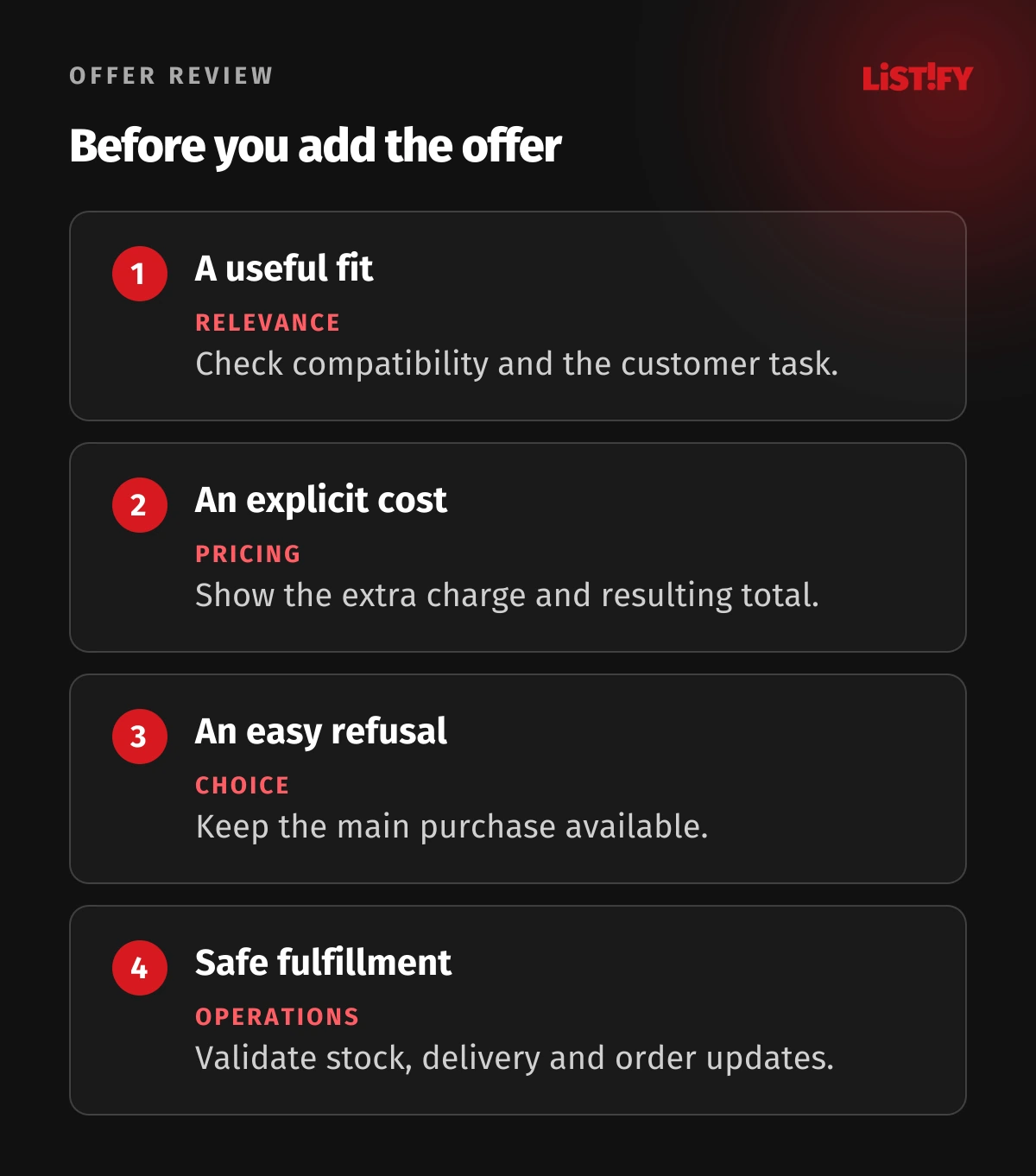
After purchase, make the existing order status clear before showing another offer. If an addition changes fulfillment, payment or shipping, explain that consequence. A customer should not have to guess whether they placed another order or amended the first one.
For service or subscription upgrades, tie the suggestion to a real need. A team reaching a plan limit may benefit from a comparison of capacity and terms. Offering the same upgrade repeatedly to an account that does not use the relevant feature is weaker targeting.
Test mobile and accessible interaction. Recommendations should have clear labels, usable controls and predictable layout. A small add-on is not helpful if its overlay hides the total or makes the checkout button difficult to reach.
04Make pricing, optionality and terms clear
Show the additional cost and the resulting total at the moment of choice. Explain recurring charges, quantities or service conditions where they apply. A vague upgrade button should not leave customers uncertain about what they are committing to buy.
Use explicit selection for optional additions and an ordinary refusal path. Keep the main purchase available. Do not rely on confusing defaults, hidden fees or language that shames a customer into accepting an extra.
The FTC’s dark patterns report discusses practices including unwanted cart additions, misleading urgency and obscured terms. It provides a US consumer-protection reference. Review the rules applicable to the markets where you sell, alongside a clear choice design.
A time-limited offer should have a real deadline and a defined treatment when it expires. A countdown that resets whenever the page reloads is not useful product information. Likewise, scarcity statements should reflect actual availability rather than an invented prompt.
Shopify’s bundle documentation describes bundles as related products sold together, commonly at a discount. A bundle need not be discounted to be convenient, but any claimed saving needs an accurate comparison and clear conditions.
Ensure taxes, delivery charges and discounts appear consistently through the journey. A promotion that looks worthwhile on the product page can become confusing if its discount disappears when another code is applied. Test the rules, then explain material limitations where the customer chooses.
05Evaluate contribution as well as the larger basket
Agree on the average-order-value definition: eligible sales value divided by eligible order count, using consistent treatment of tax, shipping, cancellations and refunds. Keep the definition stable across a test. A change in reporting can create an apparent improvement without changing customer behavior.
Track the additional offer’s acceptance rate with a clear denominator. You might divide accepted offers by eligible sessions that actually saw the recommendation. Do not compare that with a rate calculated from all store visitors and treat the numbers as equivalent.
Review completed purchases and contribution per eligible visitor or account. Include the variable costs relevant to the decision, such as product cost, discount, fulfillment and returns. An add-on with weak margin or expensive delivery can increase revenue without improving contribution.
Inspect the product mix. Customers may move to a premium version that carries a different margin, or buy a discounted bundle instead of the full-price items they would otherwise have selected. Some accepted offers shift revenue rather than create additional value.
Include delayed effects such as cancellations, incompatible-item returns and support contacts. A campaign that looks healthy at checkout may create problems after delivery. Choose an observation period that allows the important outcomes to become visible.
Use business records to reconcile the measurement. A click on an offer is not an order, and an added cart line is not a paid purchase. The marketing reporting guide provides related context for tracing activity to financial outcomes.
06Test one useful relationship and protect fulfillment
Choose a narrow hypothesis: a compatible cleaning accessory shown beside the selected grinder will improve useful completed baskets without harming checkout completion or increasing unsuitable-item returns. Define the audience and success criteria before launching.
Use a comparable control group where feasible and keep key conditions stable. Record offer exposure, acceptance, checkout completion and final order contents. Avoid selecting only people who accepted the offer when estimating its overall effect.
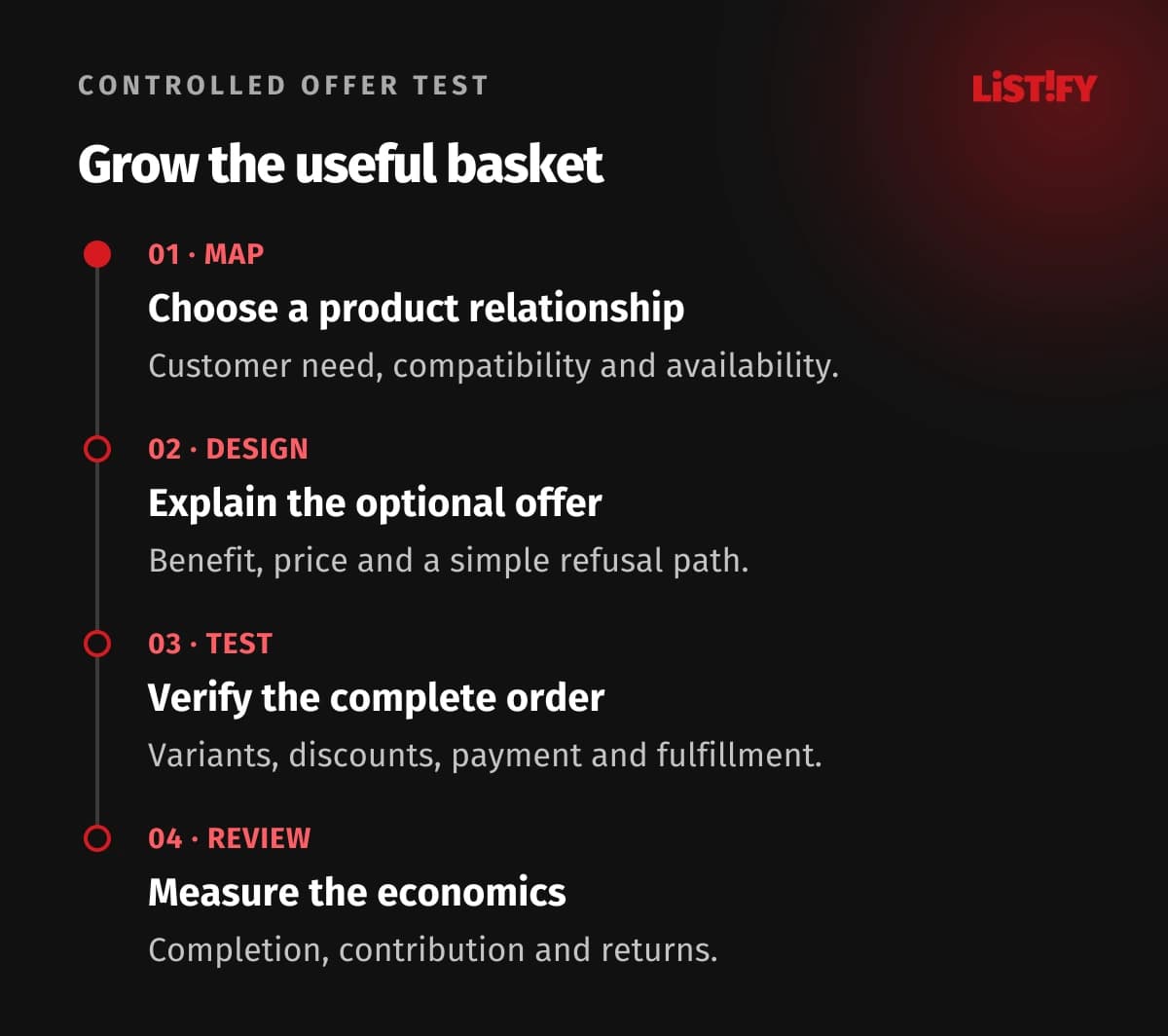
Validate inventory and variant behavior. A recommendation should not offer a size that is unavailable or allow a bundle whose required component cannot be shipped. Check whether adding the extra changes the delivery promise or warehouse routing.
Exercise payment retries, discounts, returns and order edits. Post-purchase additions may require different implementation than a cart recommendation. Preserve clear authorization and prevent duplicate charges when an operation is retried.
The ecommerce platform guide connects these features to operating workflows. Choose a suitable built-in feature or extension before assuming a custom recommendation engine is necessary.
Expand only after the first relationship has reliable evidence. Keep a record of the offer rule, owner, compatibility data and experiment outcome. Regularly remove offers that create confusion or no longer match the catalog.
07Questions about cross-selling and upselling
What is the difference between cross-sell and upsell?
Cross-selling adds a complementary item to the intended purchase. Upselling offers a higher-value version or level of that purchase. Explain the customer benefit and keep optional extras distinct from necessary components.
Where should the recommendation appear?
Put a meaningful product comparison before the main choice is final, often on the product page. A simple compatible extra may fit the cart. After-purchase offers need clear order status and disclosure of changes to payment or fulfillment.
Do bundles need a discount?
Convenient curation can be useful without one. If you claim a saving, the comparison and conditions must be accurate. Evaluate the margin and whether the bundle replaces purchases customers would otherwise have made at full price.
Is higher average order value proof of success?
No. Check completion and contribution across eligible visitors as well. A larger average among fewer completed orders can produce worse total economics. Include returns, support costs and product mix in the review.
Do we need AI recommendations?
Start with reviewed product relationships when the catalog and use case are manageable. A model needs appropriate data and controls for compatibility and availability. Automation should improve a useful rule, not conceal an unreliable catalog.
How many products should we recommend?
Use a small set that helps the current task, then test its effect. There is no universal ideal count. Too many choices can distract from the original purchase, especially on a small screen.
What should we check before launch?
Compatibility, available variants, explicit prices, refusal, discounts, delivery changes and payment behavior. Confirm that the measurement reaches real orders and that the team can pause an incorrect offer quickly.