Facebook Ads: structure campaigns around the result your business needs
A service company celebrates cheap enquiries, then discovers that most people cannot use its service. An online store reports strong ad revenue while returns erase the margin. Facebook Ads need a clear business outcome, reliable measurement, and a campaign structure that supports learning about that outcome.
Facebook advertising is managed within Meta's advertising environment, where campaigns can use different placements and capabilities. Decide what you intend to run and inspect the current options in your account. Features, defaults, eligibility, and interfaces change; a copied setup from an older tutorial may describe a different process.
The durable questions are simpler: which action matters, who can genuinely use the offer, what evidence will guide delivery, and how will the team decide whether to continue? Answer them before building a large collection of campaigns and audiences.
01Choose a business outcome before a platform metric
For a B2B service, an enquiry is useful when the person has a relevant need and the team can follow up. For retail, the purchase needs to be assessed alongside margin, fulfillment, cancellations, and returns. For an app, an install may matter less than an eligible user completing the intended activity.
Choose the available campaign objective and performance goal that align with that action. Optimizing for visits is a different request from optimizing for purchases or leads. If the desired signal is unavailable or unreliable, fix the measurement and process rather than assuming the objective name resolves the gap.
Meta's introduction to campaign objectives starts with defining business goals and choosing a relevant ad objective. Review the objective, performance goal, and conversion path together in your actual account; an option that optimizes for clicks does not automatically optimize for completed purchases.
Set a decision rule before launch. Agree the acceptable commercial result, testing budget, follow-up capacity, and circumstances that require a pause. The rule should acknowledge the sales cycle and limited evidence, rather than demand an immediate winner from a handful of events.
02Give each campaign level a clear job
Think of the campaign as the broad goal and operating arrangement, the ad set as a delivery configuration, and the ad as the actual message and creative. Some automated arrangements consolidate settings or place budget controls differently. Inspect the current setup rather than assuming every option always appears at one level.
| Level | Purpose to clarify | Useful review question |
|---|---|---|
| Campaign | Business objective and overall arrangement | Are these activities pursuing a coherent result? |
| Ad set | Delivery, optimization, audience and placement settings as available | What meaningful difference justifies a separate configuration? |
| Ad | Creative, message, destination and call to action | Does the final experience communicate the actual offer accurately? |
| Measurement and follow-up | Event definitions and the real business result | Can we distinguish useful outcomes from duplicates or unsuitable enquiries? |
Avoid splitting a modest budget into many nearly identical configurations. Each new division should answer a useful question or reflect a real business constraint, such as a different market, offer, or conversion path. Excess fragmentation can make the evidence difficult to interpret.
Use names that describe the market, offer, purpose, and creative version. Preserve enough change history to understand when a result changed. An account that only its creator can navigate is hard to review, maintain, or hand over.
Keep testing and ordinary delivery distinct in your plan. If you need a fair comparison, choose the appropriate experiment arrangement and review its limits. Ordinary delivery may allocate impressions unevenly and does not automatically provide a controlled comparison of every ad.
03Set necessary audience boundaries and inspect automation
Define who can receive the offer: service locations, relevant language, eligibility, and any applicable restrictions. Separate those boundaries from a hypothesis about who might respond. The business should know which settings are firm controls and which are suggestions within the selected automation.
A saved audience or a customer list does not prove the campaign will reach only that group under every setup. Inspect expansion behavior and available exclusions. For a strict remarketing task, verify the actual arrangement rather than relying on the label attached to an audience.
Automation can influence delivery, placements, and creative behavior. Meta's 2026 advertising update describes its continuing investment in AI-driven advertising capabilities. That establishes the direction of the platform, not a performance guarantee for your offer or a substitute for reviewing account controls.
Avoid narrowing the audience simply to make the configuration feel more precise. Equally, do not remove a real eligibility or legal boundary merely because broad delivery is recommended. Test the choices that fit your actual market, offer, budget, and available evidence.
Check relevant rules for sensitive or specially regulated categories in the current account and official policy material. Requirements can differ by ad type and market. Do not use inferred personal characteristics or misleading creative to work around a restriction.
04Make creative and the destination tell the same story
Test meaningful creative ideas: the customer's problem, a useful demonstration, a product detail, or a clear reason to consider the offer. Changing a minor color or punctuation mark may answer less than comparing different explanations of the same truthful proposition.
Adapt the material to the placements you actually use. Check crops, text visibility, captions, sound-independent understanding, and the destination on a mobile device. Automated adaptations still need review; they can change the way an offer or product is represented.
The landing page should confirm the promise quickly and explain the next step. A lead form needs enough information to help people qualify themselves, with an appropriate notice and follow-up. More friction is not always bad if it prevents a request the business cannot fulfill.
Check claims and rights before release. In the US, the FTC's advertising guidance requires truthful, nondeceptive, evidence-backed claims. Other markets have their own requirements. Platform approval does not establish compliance with every applicable rule or permission to use someone else's material.
Our landing page guide can help review the destination alongside the ad. Changing audience settings will not fix a confusing offer, a broken form, or a mobile checkout that hides important information.
05Verify measurement without treating server events as a bypass
Define the event that represents the action. A button click, submitted form, qualified enquiry, and completed sale are different signals. Check where each event fires, whether failed or repeated actions create duplicates, and whether values and currencies match the actual record.
When using browser and server integrations together, test the same real action across both paths. Confirm that the implementation handles duplication appropriately and that diagnostics reflect the intended event. Do not increase reported results by counting a page refresh or repeated notification as another purchase.
Meta's April 2026 update on Pixel and Conversions API describes simplified setup options and advertiser responsibility for business-tool terms, including sensitive information. Availability and the appropriate integration need review in the actual account.
A server-side integration is not a general exemption from consent, privacy, or platform requirements. Review what data leave your systems, the applicable basis and permissions, retention, and relevant market rules. Hashing information does not automatically make the transfer anonymous or unrestricted.
Meta's June 2026 notice about information from other businesses also shows why teams should keep data-use arrangements under review. Understand the current service terms and configuration instead of assuming a familiar tracking label fully describes the processing.
06Manage spend and interpret results in context
Set the budget and review the selected budget type, schedule, billing, and available spending controls. Read how the current arrangement handles delivery over time. Do not assume a field described as a daily budget is a strict cash ceiling for every individual day.
Keep cost controls distinct from desired performance. A target cost or bidding choice does not guarantee that result or ensure sufficient delivery. Use current account documentation and review the practical consequences of a change instead of applying a universal scaling percentage.
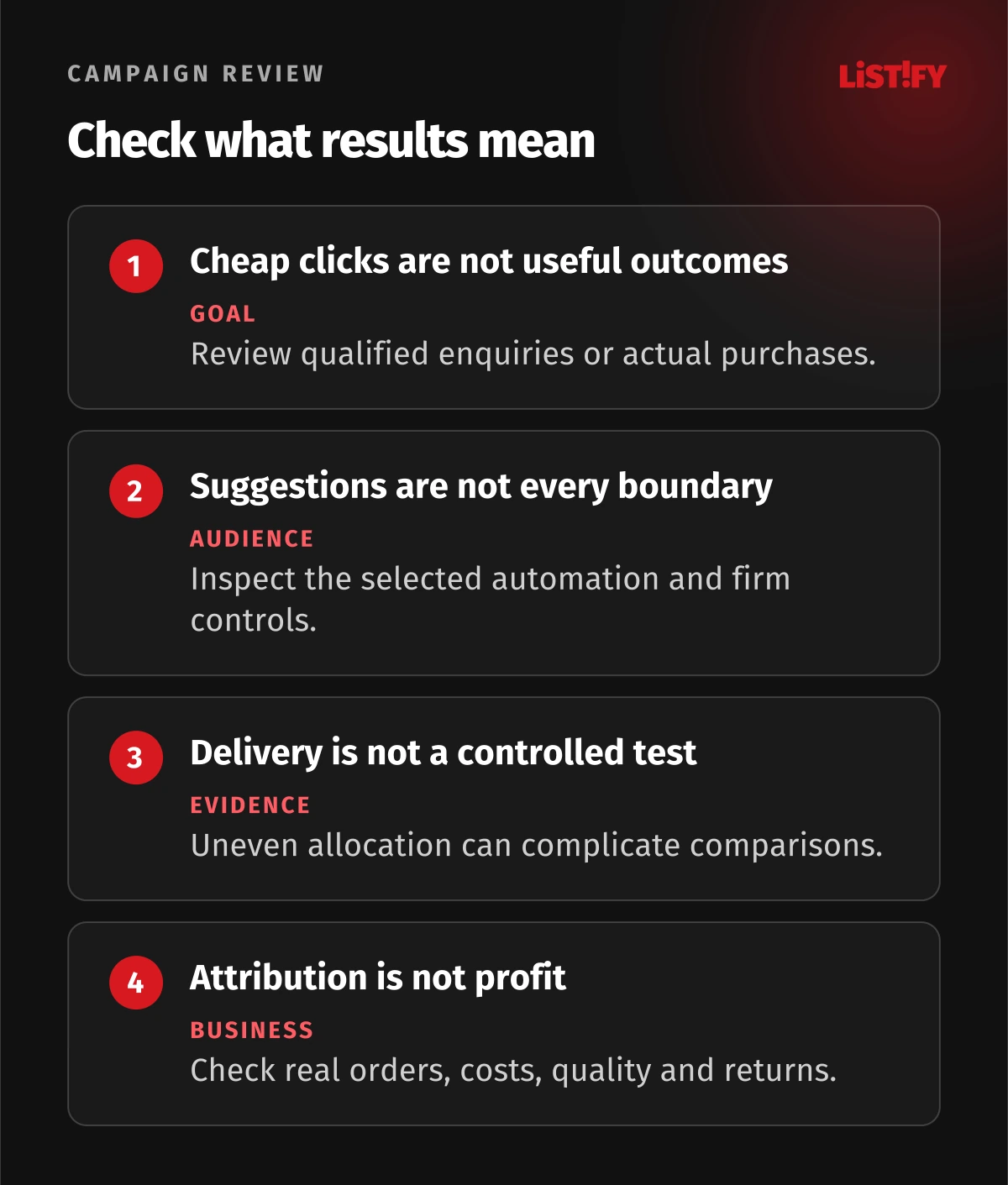
Compare Ads Manager with the relevant business records. Attribution depends on the selected settings, event definitions, time windows, and reporting systems. Several platforms may claim credit for the same order. A reported return on ad spend is not automatically incremental revenue or profit.
Review the advertising report alongside your order records or CRM. Track which event was counted, the attribution settings, and whether canceled orders or unsuitable leads remain in the number. Keep a clear distinction between an attributed result and a result caused by the campaign.
For leads, review qualification, response time, meetings, and completed business. For retail, include cancellations, returns, and contribution. Read results over a period appropriate to the sales cycle, and record other changes such as price, season, stock, or website updates that could affect the interpretation.
07Run a reviewable pilot and change one useful thing at a time
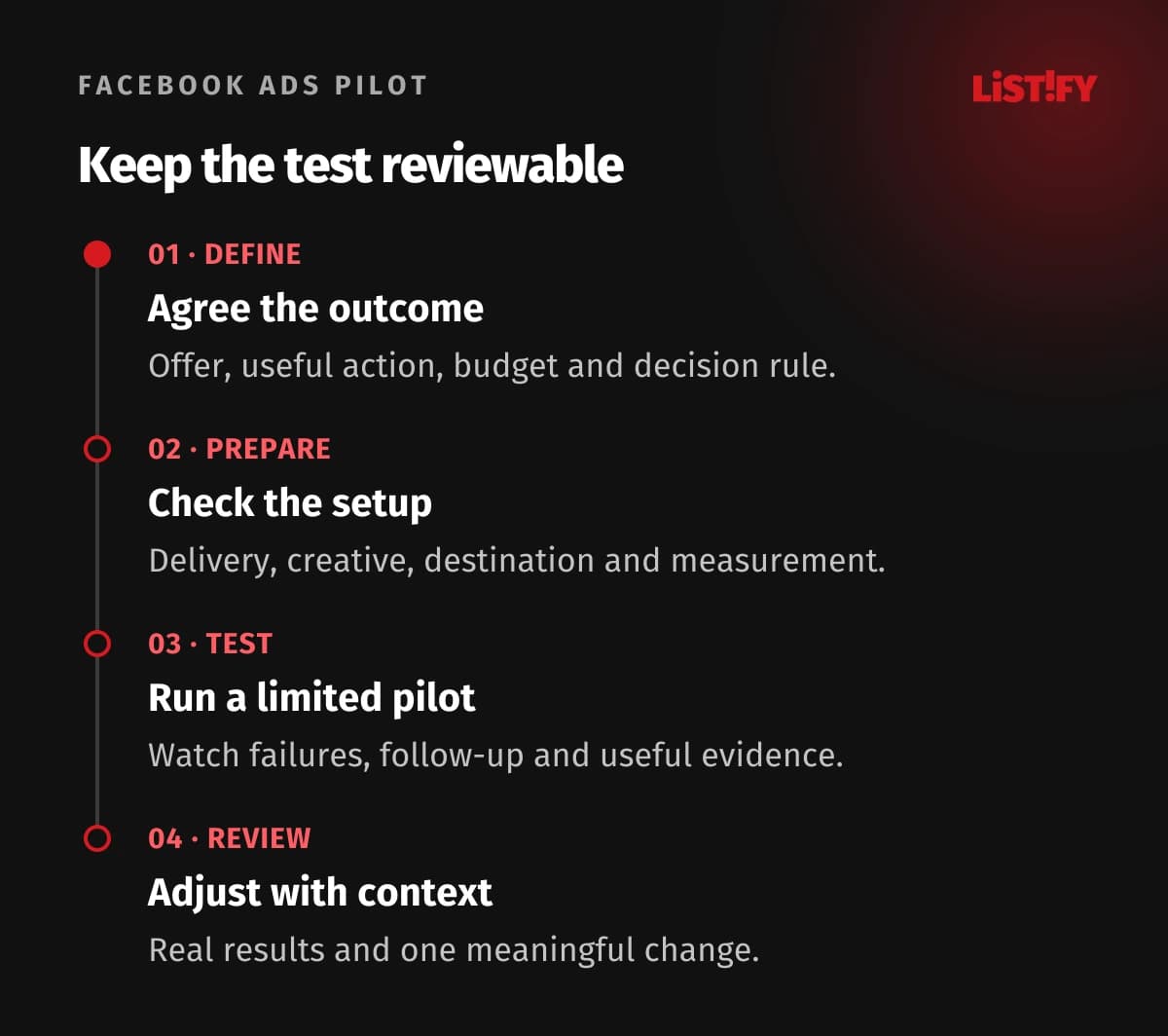
- Define the outcome. Agree the offer, useful action, budget and decision rule.
- Prepare the setup. Check objective, delivery controls, creative, destination and measurement.
- Run a limited test. Watch technical failures and follow-up while gathering relevant evidence.
- Review and adjust. Compare real outcomes and change a meaningful factor before expanding.
Use a small set of creative concepts and a manageable structure. Give the team enough time to observe the intended conversion path without leaving broken measurement or an unsuitable offer running for the sake of a schedule. Write down what changed and why.
Review the whole chain before deciding which control to adjust. Weak response can come from the offer, creative, destination, audience boundaries, signal quality, or follow-up. A repeated audience edit is not a diagnosis. Preserve the findings so the next campaign starts with better evidence.
08Questions about Facebook Ads
Should we optimize for traffic when we want sales?
Choose the available objective and performance goal that align with the desired action and reliable measurement. Visits and purchases are different outcomes. Fix a missing or unreliable conversion signal before expecting the setup to solve it.
How many campaigns and ad sets should we create?
Use a meaningful structure for the markets, offers, constraints and questions you need to assess. Avoid unnecessary divisions that fragment a limited budget and make evidence harder to interpret.
Will an audience setting always restrict delivery to that group?
Not under every automated arrangement. Inspect firm controls, suggestions, expansion and available exclusions in the actual campaign. Verify strict remarketing or eligibility boundaries directly.
Does Conversions API remove consent requirements?
No. Server-side delivery still needs review of the data, applicable privacy and consent requirements, platform terms, and configuration. It is not a universal tracking bypass.
Is a daily budget always a strict daily ceiling?
Review the current budget arrangement, schedule and available spending limits. Do not assume that the label alone describes a hard limit for every day or that a performance target guarantees spend or results.
Does high reported ROAS prove profitable growth?
No. Review attribution, actual orders, margin, cancellations, returns and other costs. Platform credit is not automatically incremental business or profit.
What should we inspect before scaling?
Confirm the useful outcome, reliable signals, accurate offer, audience boundaries, follow-up and spend controls. Review enough evidence for the sales cycle and record changes so the next result remains interpretable.