Ecommerce Email Marketing: Why 2% of Your Emails Can Drive Nearly a Third of Email Revenue
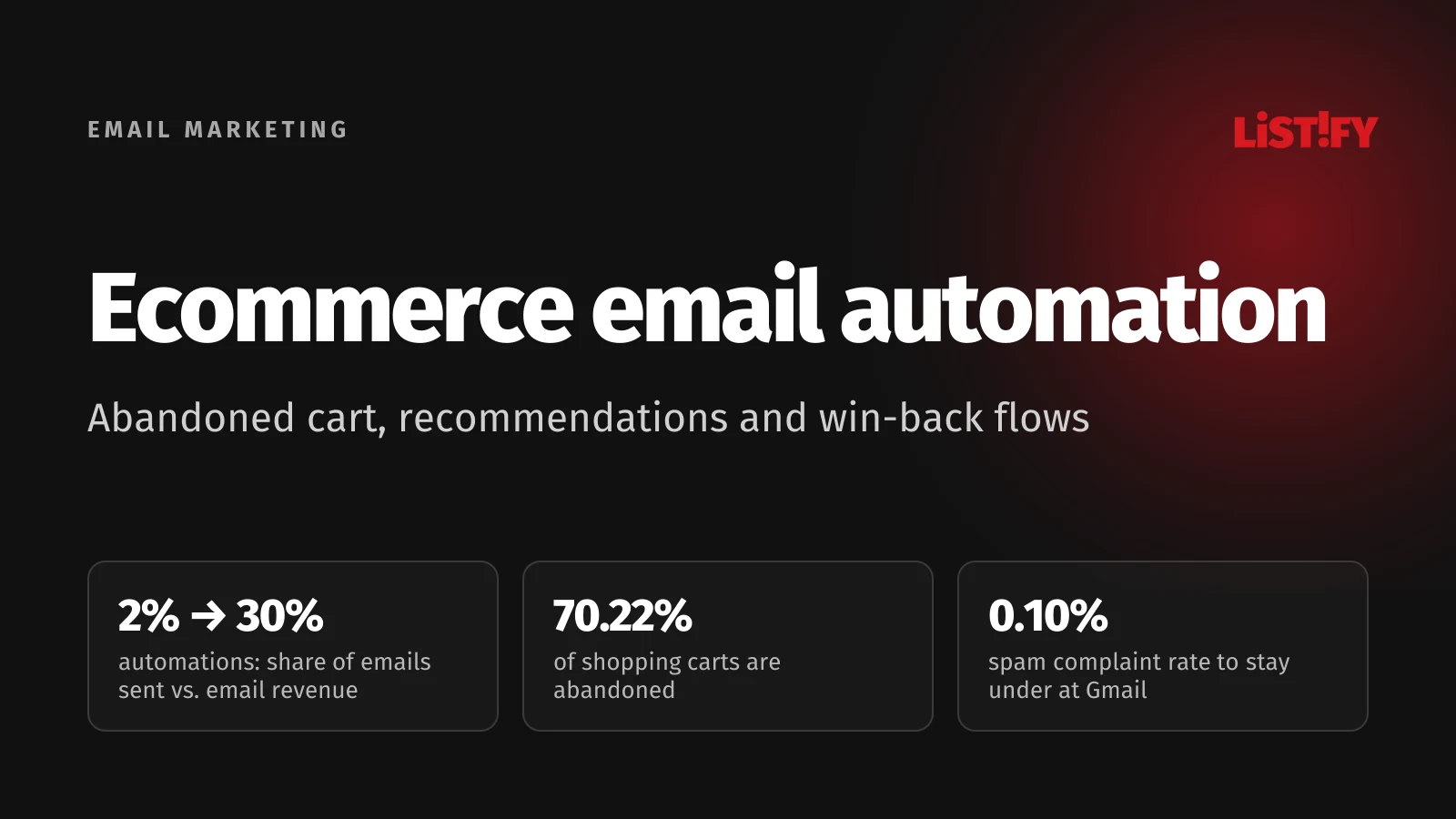
A weekly newsletter goes out to your whole list and earns, on average, about 18 cents per email sent. An automated email that reaches one person at the right moment earns more than fifteen times as much per send. Among stores sending through Omnisend in 2025, automations made up just 2% of emails sent but 30% of email revenue. We went through the data from Klaviyo, Omnisend and the Baymard Institute, the EU rules on email marketing and the sender requirements of Gmail, Yahoo and Outlook. The result is a practical guide to abandoned cart, recommendation and win-back emails that make money without landing you in the spam folder or in front of a regulator.
According to Eurostat, 73.56% of people aged 16 to 74 in the EU had bought something online in the 12 months before the 2025 survey. Your customers shop online and they read email. The real question is whether your store writes to them when it actually helps them, or only when the marketing team has a free Wednesday.
Klaviyo and Omnisend are two of the largest email platforms for online stores, and both publish aggregated data from their customers. They measure things slightly differently, but they reach the same conclusion: a small share of emails, the ones triggered automatically by what a customer does, brings in a large share of the money.
- Klaviyo, 2026 benchmarksShare of emails sent: 5.3%Share of email revenue: 41.0%
- Omnisend, 2025 dataShare of emails sent: 2.0%Share of email revenue: 30.0%
Klaviyo: automated flows in its 2026 benchmarks; the data period is not stated. Omnisend: automations across 150,000 brands and 27 billion emails sent in 2025. The platforms have different customers and attribute revenue differently, so the figures shouldn’t be combined. Klaviyo says “nearly 41%”. Sources: Klaviyo, Omnisend.
This guide is written for owners and marketers of small and mid-sized stores on Shopify, WooCommerce or a custom platform. We start with the difference between newsletters and automations, then cover who you are allowed to email, and only then get into the individual flows, deliverability, measurement and tool pricing for a list of 5,000 contacts.
01The short answer: what to set up first
- A welcome series and an abandoned cart flow. At Omnisend, these two automations drove 76% of all orders from automated emails. Start there.
- Without consent, recommend only what fits the purchase. Accessories for something a customer just bought are fair game. Offers from partners are not.
- Win-back with an exit. Contacts who stay silent get a few re-engagement emails and are then removed from regular sends. It saves money and protects deliverability.
- Check the law before the creative. Without consent, EU rules let you email existing customers only about your own similar products, and only if they did not object when you collected their address.
- Authentication decides delivery. Gmail requires SPF or DKIM from every sender. Bulk senders need both, plus DMARC and one-click unsubscribe.
- Don’t judge success by opens. Apple generates a large share of “opens” automatically. Track clicks, orders and revenue against a holdout group.
02Newsletters vs. automations: what’s the difference?
A newsletter, or campaign, goes out at once to your whole list or to a segment: new arrivals, promotions, sales, content. You decide when it is sent and everyone gets the same message. An automation, often called a flow, runs on its own when a customer does or does not do something: signs up, leaves items in the cart, places an order, goes quiet for a while. Each person gets it at a different time, and only when it is relevant to them.
That is why automations perform much better per email. In its 2026 benchmarks, Klaviyo reports an average click rate of 5.58% for automated flows versus 1.69% for campaigns. The gap in orders is even wider: 0.16% of campaign recipients place an order on average, compared with 2.11% for flows. At Omnisend, an automated email earned $2.87 per send on average in 2025, while a scheduled campaign earned $0.18.
- Campaign (newsletter)0.16%
- Automated flow, average2.11%
- Abandoned cart flow2.68%
Klaviyo, average across all industries. Campaigns and flows from the 2026 benchmarks; abandoned cart from a Klaviyo article published in November 2025. Sources: Klaviyo benchmarks, abandoned cart.
That doesn’t make newsletters pointless. According to Klaviyo, campaigns account for 94.7% of email volume and still bring in most email revenue. Newsletters keep your brand top of mind and grow the list that later triggers your automations. They just shouldn’t be the only thing your store sends.
| Comparison | Newsletter (campaign) | Automation (flow) |
|---|---|---|
| When it goes out | When you schedule it | When a customer does or does not do something |
| Who gets it | The whole list or a segment | One person, based on their behavior |
| Effort | Every week, from scratch | Set up once, then refine |
| Click rate (Klaviyo 2026) | 1.69% | 5.58% |
| Placed order rate (Klaviyo 2026) | 0.16% | 2.11% |
| Revenue per email sent (Omnisend 2025) | $0.18 | $2.87 |
03Who you can email: the EU rules
Marketing email in the EU is governed by Article 13 of the ePrivacy Directive 2002/58/EC, which each member state has written into its own law, together with the GDPR. The proposed ePrivacy Regulation that was meant to replace the directive has been formally withdrawn (notice of October 6, 2025), so the directive and the national laws based on it still apply. Outside the EU the rules are different; this section covers the EU.
Consent, or the existing customer exception
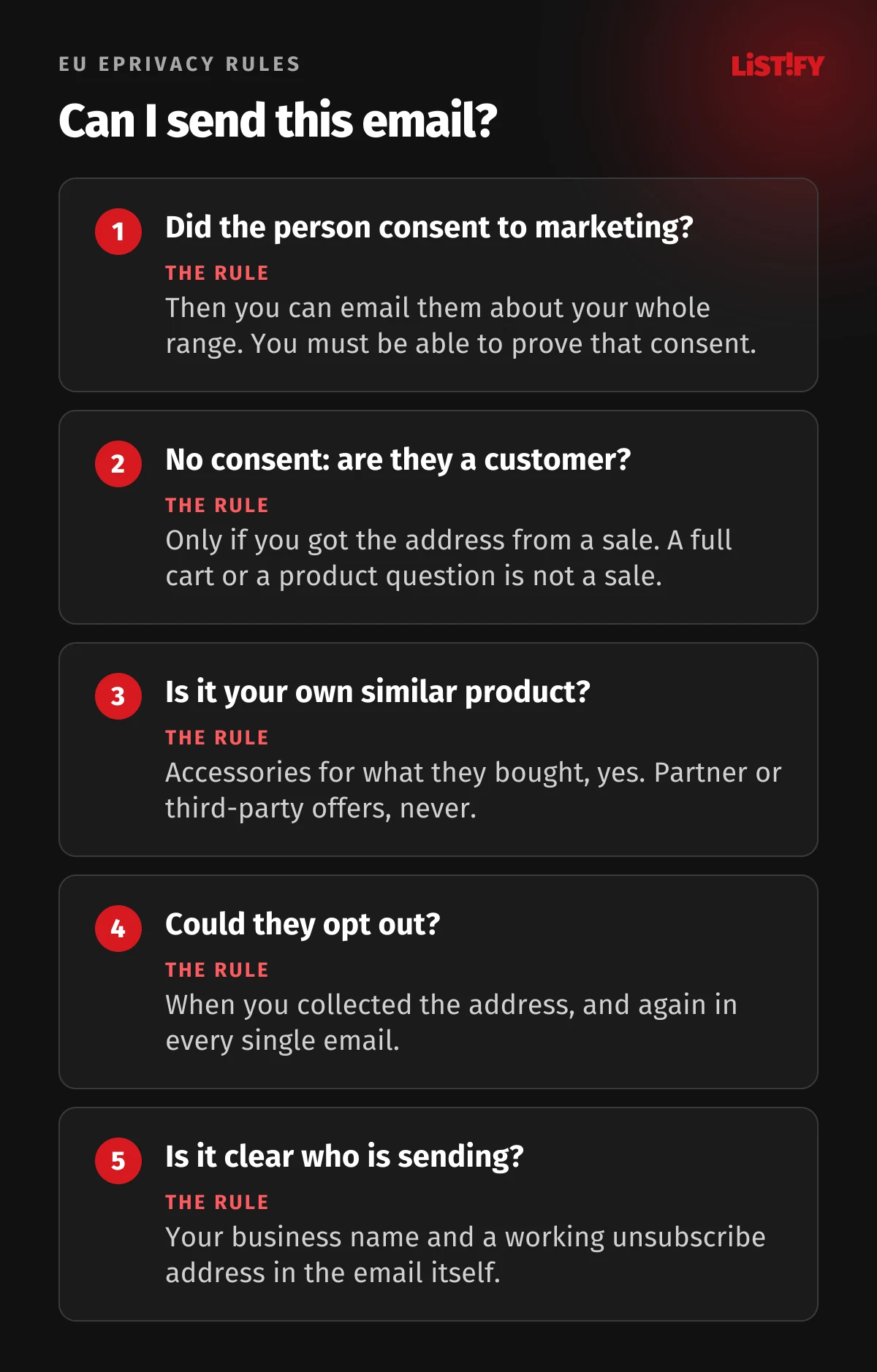
Under Article 13(1), you may send direct marketing by email only to people who have given prior consent. Article 13(2) creates an exception, often called soft opt-in, for your existing customers. It applies only when all of the following are true:
- you obtained the email address in the context of the sale of a product or service,
- you are marketing your own similar products or services,
- the customer was clearly given the chance to object free of charge when you collected the address, and did not,
- they can object again in every message you send.
In November 2025, the Court of Justice of the EU clarified two points in case C-654/23 (Inteligo Media). An email address collected when a user created a free account that also gave access to paid content was obtained “in the context of the sale” of a service. And when a business relies on the Article 13(2) exception, the GDPR conditions for lawful processing in Article 6(1) do not apply on top of it. The ruling concerned a specific publishing model, so do not read it as “every sign-up counts as a sale”.
Member states add their own details, and they matter. Slovakia, for example, has since November 2025 limited the customer exception to one year after the contract ends. The Czech data protection authority says the exception weakens over time and that a person who only asked about a product is not a customer. Check the law in each country you sell to.
What about abandoned cart emails?
EU law has no specific rule on abandoned cart reminders, and we found no EU-level guidance on them. In our reading, a reminder that shows products and links back to your store counts as direct marketing, and someone who never completed an order is not yet a customer. The safe approach is to send cart reminders only to contacts who have consented to marketing, or to existing customers covered by the exception who did not opt out.
Consent and every email
- Consent must be a clear affirmative action. Under the GDPR, silence, pre-ticked boxes or inactivity are not consent.
- You must be able to prove it. The burden is on you, so keep a record of when and how each person signed up.
- Withdrawing must be as easy as giving it. One click in the email, not a login and a settings page.
- Never hide who you are. Article 13(4) prohibits marketing email that disguises the sender or has no valid address for opting out.
- An objection is final. Under Article 21 of the GDPR, once someone objects to direct marketing, you must stop using their data for it.
Double opt-in, where people confirm their sign-up by clicking a link, is not required by EU law. It is still the simplest way to prove consent, and regulators such as the Czech data protection authority recommend it.
04Abandoned cart: the highest-earning automation
Based on 50 studies from 2006 to 2025, the Baymard Institute puts the average cart abandonment rate at 70.22%. Out of every seven people who add something to their cart, roughly five leave without ordering. Some of them were just browsing, but others left for reasons you can fix.
- Just browsing, not ready to buy42%
- Extra costs too high (shipping, tax, fees)40%
- Delivery too slow20%
- Did not trust the site with card details19%
- Site required creating an account18%
- Long or complicated checkout17%
- Website errors or crashes17%
- Returns policy was not satisfactory13%
- Could not see the total cost up front12%
Baymard Institute 2026 survey of 1,083 US adults who shopped online in the past three months. Multiple answers were allowed, so the total exceeds 100%. Source: Baymard Institute.
The chart points to the first rule: email will not fix your checkout. If people leave because of shipping costs that appear at the last step, or because you force them to register, fixing the store will do more than any reminder. Email does work well for people who got distracted, wanted to think it over or were comparing prices.
According to Klaviyo, abandoned cart flows bring in more revenue than any other type of flow: $3.07 per recipient on average, with 2.68% of recipients placing an order.
How to build the sequence
- First reminder the same day, while the purchase is still on their mind. Product image and name, price and a button back to the cart. No discount.
- Second email on day two or three answers common doubts: shipping, returns, warranty, reviews and how to reach support.
- A third email with a discount only where it pays. If everyone who abandons a cart gets a coupon, customers learn to wait for it. Discounts make sense for higher-priced items or first-time buyers.
- Stop the flow the moment someone buys, and leave out items that have since gone out of stock.
Two related automations are also worth setting up. Abandoned checkout catches people who entered their address but did not pay. Browse abandonment reminds people of products they looked at but never added to the cart. Both require your store to know who the visitor is.
Who your store can actually reach
This is where many smaller stores hit a wall. Your platform can only send a reminder if it knows the shopper’s email address, typically because they are logged in, entered it at checkout or clicked through from an earlier email with tracking consent. A visitor who hasn’t given you an email address and consent won’t get a reminder, and under EU rules shouldn’t.
05After the purchase: recommendations, reviews and replenishment
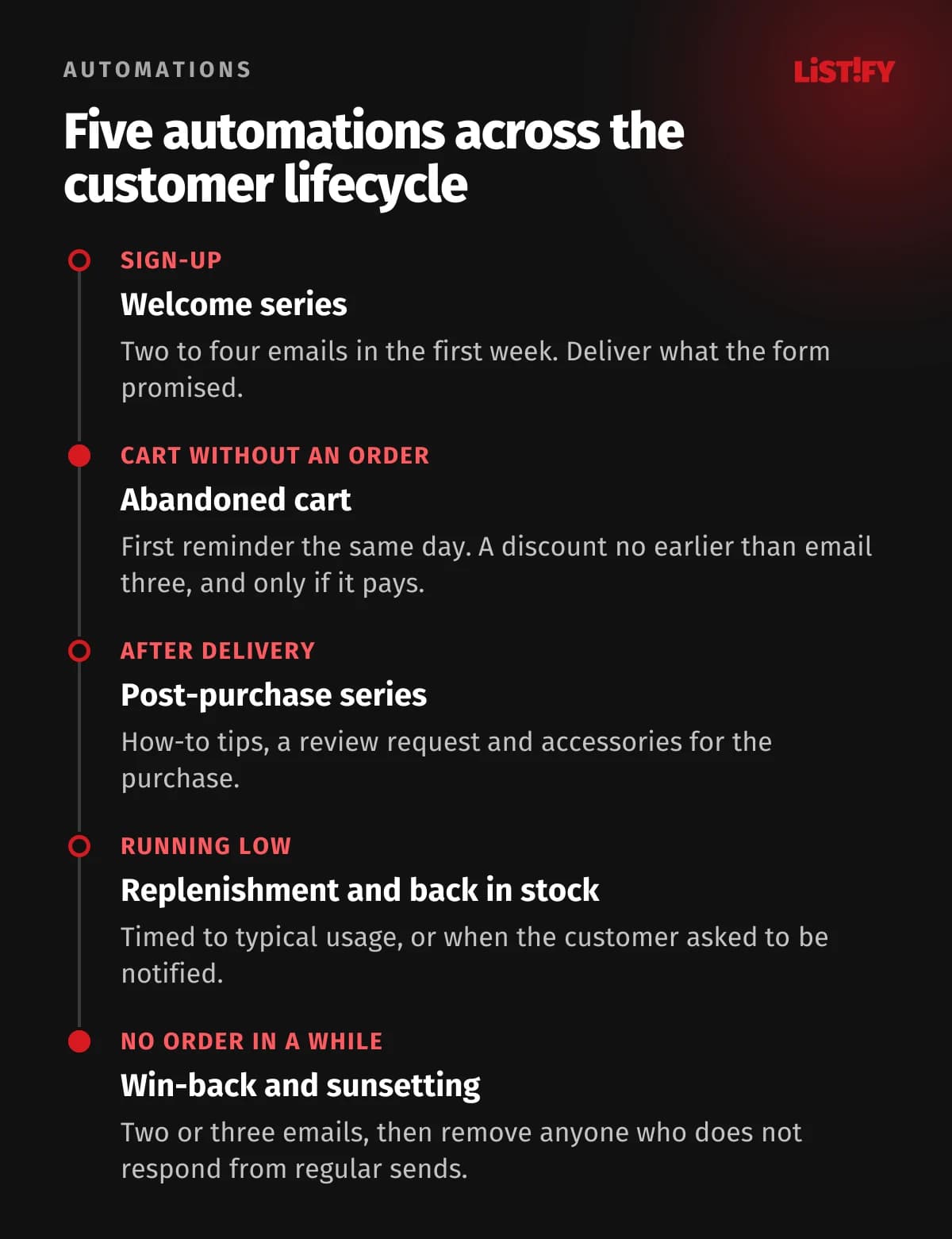
A customer who has just bought from you is the best audience you have. They know you, they have paid, and the existing customer exception lets you tell them about similar products even without consent, as long as they did not object. A typical post-purchase series includes:
- Order confirmation and delivery updates. Purely transactional messages are not marketing. Once you add a promotion to them, they are.
- How-to tips for the product a few days after delivery. They can cut avoidable returns and support requests.
- A review request once they have had time to use the product. Treat it as marketing and include an unsubscribe link.
- Related product recommendations. Accessories, refills, add-ons. Klaviyo says emails with AI product recommendations have an average click rate of 3.75%. Keep in mind that this is a vendor figure without a holdout comparison.
- Replenishment reminders for consumables such as pet food, cosmetics, coffee capsules or filters, timed to when the customer is likely to run out.
- Back in stock and price drop alerts. Omnisend reports that back-in-stock emails have the highest conversion rate of any automation, 6.46%. The customer asked for them.
Recommendations are only as good as your data. The tool needs a product feed with current prices, availability and categories, plus order history. Without that, it will recommend products the customer already owns or items that are sold out.
06Welcome series: first impressions and the first order
People who have just subscribed or created an account are expecting a welcome email, so it usually gets more attention than anything else you send them. Together with abandoned cart, it drove 76% of all automation orders at Omnisend. Across all flows, Klaviyo reports that nearly 48% of flow revenue comes from new buyers, compared with just 16% of campaign revenue.
A good welcome series has two to four emails over the first week. The first one arrives right after sign-up and delivers whatever your form promised: a discount, a guide or a catalog. The rest introduce the store: why buy from you, shipping and returns, bestsellers and reviews. Anyone who places an order along the way moves straight into the post-purchase series.
The copy does a lot of the work here, and the same principles apply as for a landing page; we cover them in Landing Page Copywriting That Sells. If you also send emails from your own app or customer account, see App Notifications and Emails That Don’t Annoy.
07Win-back flows and list hygiene
Every list goes stale. People change addresses, stop buying or delete your emails unread. A win-back flow targets customers who have not purchased for a while. When someone counts as inactive depends on what you sell: weeks for coffee, years for furniture. Start from the typical time between two orders in your store.
- A reminder without a discount: what is new, bestsellers, or what they bought last time.
- An offer if the first email did not work: a discount, free shipping or a gift.
- A final email with a clear way to stay or leave. Remove anyone who does not respond from regular sends.
Removing inactive contacts hurts because the list gets smaller, but there are two good reasons to do it. Mailbox providers judge senders partly by how recipients react, so a large group of people who never read your emails drags down delivery to those who would. And most tools charge by contact count, so you are paying for addresses that do nothing.
For former customers, also keep the legal side in mind. The customer exception is tied to an actual relationship, and some countries put a time limit on it. Win-back emails to people who stopped buying long ago should go only to those who gave consent.
08Deliverability: what Gmail, Yahoo and Outlook require in 2026
The best automation earns nothing if it lands in spam or the receiving server rejects it. The major mailbox providers have tightened their rules considerably since 2024.
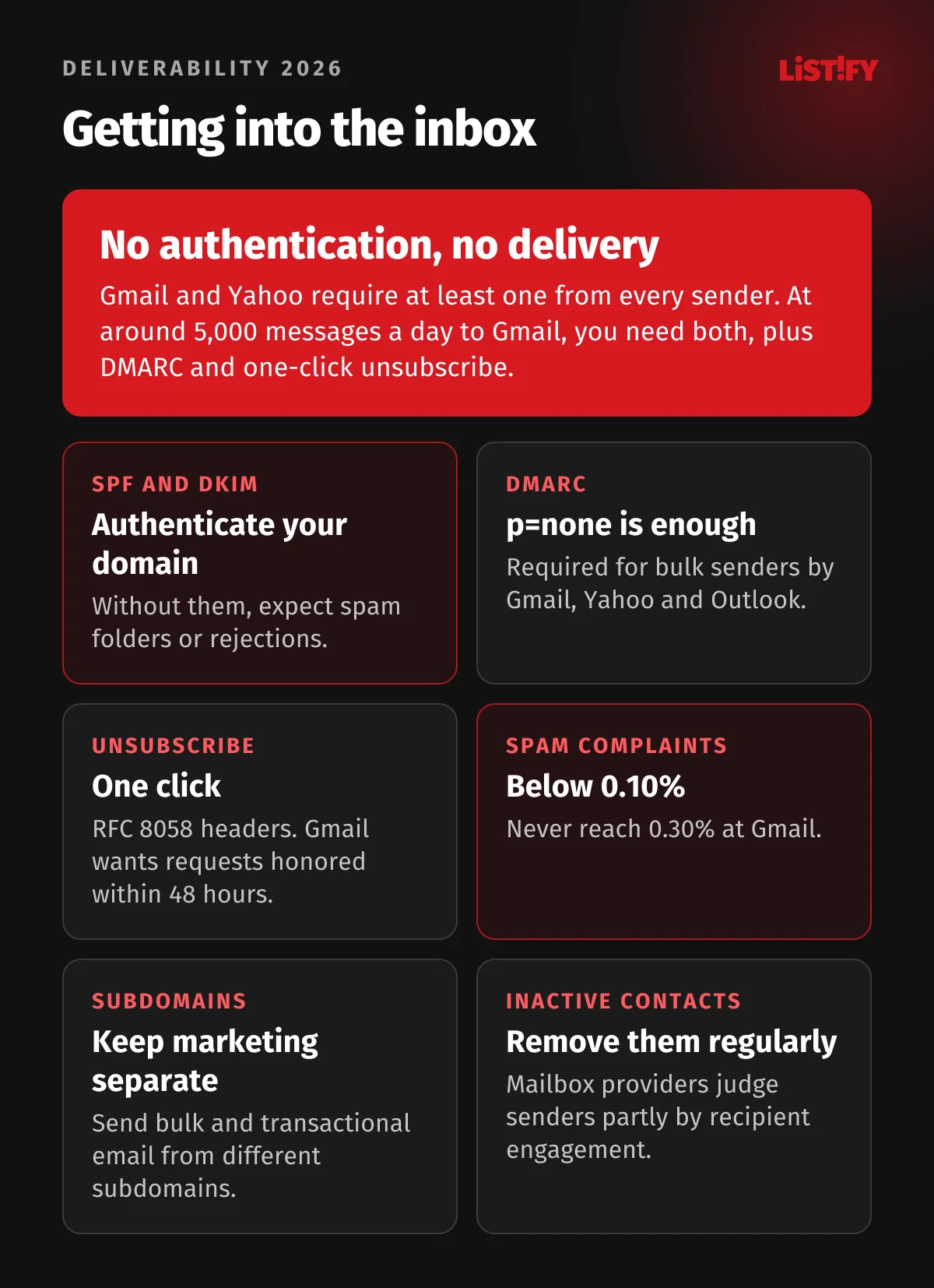
| Requirement | Gmail | Yahoo | Outlook.com |
|---|---|---|---|
| Who it applies to | Bulk senders: close to 5,000 or more messages a day to personal Gmail accounts | Bulk senders, no volume threshold given | Domains sending more than 5,000 messages a day |
| SPF and DKIM | Both required | Both required | Both required |
| DMARC | Required, p=none is enough | Required, p=none is enough | Required, p=none is enough |
| One-click unsubscribe | Required for marketing, honored within 48 hours | Required, honored within 2 days | A working unsubscribe link recommended |
| Spam complaint rate | Below 0.10%, never 0.30% or higher | Below 0.3% | Not specified |
| Consequences | Temporary and permanent rejections since November 2025 | Enforced since February 2024 | Rejection since May 5, 2025 (550 5.7.515) |
One-click unsubscribe relies on the List-Unsubscribe and List-Unsubscribe-Post headers defined in RFC 8058; a plain mailto link does not meet Gmail’s requirement. Gmail counts the 5,000 threshold across your whole domain, and once you cross it, you are treated as a bulk sender permanently. It is also worth sending marketing and transactional email from separate subdomains, so a problem with your newsletter is less likely to hold up order confirmations.
Your email platform will handle most of this, but you or your web team still need to add the DNS records for your domain. Check it now rather than later. Google Postmaster Tools shows your spam complaint rate for Gmail addresses.
09How to measure without fooling yourself
Open rates are no longer reliable. Apple Mail Privacy Protection downloads remote content, including tracking pixels, in the background whether or not the person engages with the email, so the message is counted as opened. According to Litmus, Apple accounted for 62.26% of tracked opens in July 2026, and Litmus does not treat opens from Mail Privacy Protection users as reliable. Omnisend’s data fits the same pattern: average open rates rose for the fifth year in a row, from 26.6% in 2024 to 30.7% in 2025, while click rates fell.
What to rely on instead:
- Clicks and orders per recipient rather than opens, and revenue per recipient for automations.
- Attribution window. Email platforms credit orders placed within a set window after an open or click. A long window that also counts opens will claim sales that would have happened anyway. Use the same window in your email tool and in your analytics.
- A holdout group. Leave a small share of people, say one in ten, out of an automation and compare how many of them buy. The difference is what the automation really adds.
- UTM parameters on links, so Google Analytics or your analytics tool records email as the traffic source.
- Unsubscribes and spam complaints for every send. A rising unsubscribe rate is a warning sign before delivery problems start.
For how to present email results so leadership understands them, see Marketing Reporting for Executives.
10Tools and pricing for a list of 5,000 contacts
For a store with 5,000 contacts, prices vary more than you might expect. A lot depends on whether the plan includes store integration, abandoned cart flows and product recommendations. All prices exclude VAT and were checked on October 2, 2026.
| Tool | Monthly price (5,000 contacts) | What you get |
|---|---|---|
| Klaviyo | Based on active profiles; paid plans from $20 | Free for up to 250 active profiles and 500 emails a month |
| Mailchimp Standard | $100 (Essentials $75) | Essentials limits flows to 4 steps |
| Omnisend Standard | $81 | Ecommerce automations, billed in USD |
| MailerLite Comfort | $49 or €44 | Automations, 50,000 emails a month |
| Brevo Standard | From €15 | Priced by email volume, not contacts |
Klaviyo and Omnisend are built for ecommerce and integrate closely with Shopify, which makes them a natural fit for Shopify stores and brands selling in several countries. Mailchimp and MailerLite are more general and cheaper for simple newsletters, but check how well they connect to your platform before you commit.
A custom store can connect to any of these tools through an API and send exactly the events you need, including stock levels, margins or loyalty data. We look at when a custom build pays off in Shopify vs. custom ecommerce.
11Your first-month plan
- Audit your consents. Where each address came from, who consented and who is a customer that did not object at checkout. Customers must be able to opt out at checkout, for example with an unticked box.
- Set up your domain. SPF, DKIM, DMARC and one-click unsubscribe, ideally with a separate subdomain for marketing email.
- Connect your store to the email tool, including the product feed, orders and on-site events.
- Launch the welcome series and abandoned cart flow, the two automations with the biggest impact.
- Add a post-purchase series: how-to tips, a review request and related products.
- Set up measurement: UTM parameters, an attribution window and a holdout group.
- Review after a month, then add win-back, replenishment and back-in-stock flows.
If you would rather have someone set this up for you, take a look at our online marketing service, where email marketing is one of the areas we cover. You will find indicative prices on our pricing page, and how we work explains the process. If you are still planning a new store, start with custom ecommerce and include email in the brief from day one.
12Email myths that keep getting repeated
- “Email returns $42 for every $1.” The figure comes from a Litmus survey of marketers run in late 2018 and early 2019, so it reflects their estimates rather than measured revenue. Litmus now reports a spread instead: 35% of marketers report a return of $10 to $36 per dollar spent, 30% put it at $36 to $50, and 21% don’t measure it at all.
- “Email ROI is 4,400%.” This comes from Campaign Monitor’s 2016 annual report, with no published methodology.
- “The average ecommerce open rate is X%.” Mailchimp’s benchmarks are often quoted as current, but they were last updated in December 2023, and Apple inflates open rates anyway.
- “Double opt-in is required by law.” EU law does not require it. It requires that you can prove consent.
- “Customers can be emailed about anything.” Without consent, only about your own similar products, and never with partner offers.
- “Gmail requires DMARC p=reject.” A policy of p=none is enough for Gmail, Yahoo and Outlook. Stricter policies are a good idea, not a requirement.
13Frequently asked questions
What is the difference between a newsletter and an email automation?
A newsletter, or campaign, goes out to your whole list or a segment at a time you choose. An automation, or flow, is triggered by what a customer does, such as abandoning a cart or placing an order. In Klaviyo’s 2026 benchmarks, 0.16% of campaign recipients place an order on average, compared with 2.11% for automated flows.
Can I send abandoned cart emails without consent in the EU?
EU law has no specific rule on them. In our view, a cart reminder that shows products counts as marketing, and someone who never completed an order is not yet a customer. The safe approach is to send reminders only to contacts who consented to marketing, or to existing customers covered by the soft opt-in exception who did not object.
Is double opt-in mandatory?
No, EU law does not require it. You do have to be able to prove consent, and double opt-in is the simplest way to do that. Some regulators, including the Czech one, recommend it.
How many emails should an abandoned cart flow have?
Usually two or three. The first goes out the same day without a discount, the second on day two or three to answer common objections, and the third, with or without an offer, depends on your margins and the type of customer. The flow should stop as soon as the person buys.
What do I need so my emails don’t land in spam?
Gmail and Yahoo require at least SPF or DKIM from every sender. If you send close to 5,000 or more messages a day to Gmail, you also need both SPF and DKIM, DMARC, one-click unsubscribe and a spam complaint rate below 0.30%, ideally below 0.10%. Removing inactive contacts helps too.
How much does an email marketing tool cost for an online store?
For 5,000 contacts, expect roughly $50 to $100 a month before VAT for the main international tools with ecommerce automations, such as MailerLite, Omnisend or Mailchimp. Klaviyo prices by active profiles and offers a free plan for up to 250 of them and 500 emails a month.
14Sources
- Directive 2002/58/EC on privacy and electronic communications
- General Data Protection Regulation (EU) 2016/679
- Court of Justice of the EU: case C-654/23, Inteligo Media
- Withdrawal of the ePrivacy Regulation proposal, C/2025/5423
- Eurostat: internet purchases by individuals
- Baymard Institute: Cart Abandonment Rate
- Klaviyo: email marketing benchmarks 2026
- Klaviyo: email marketing benchmarks by flow and campaign
- Klaviyo: how to reduce cart abandonment
- Omnisend: Ecommerce Marketing Report 2026
- Mailchimp: email marketing benchmarks
- Google: email sender guidelines
- Google: email sender guidelines FAQ
- Yahoo: sender best practices
- Microsoft: Outlook requirements for high-volume senders
- RFC 8058: one-click unsubscribe
- Apple: Mail Privacy Protection
- Litmus: email client market share
- Litmus: the ROI of email marketing