Shopify vs. custom ecommerce: when does building your own store pay off?
For most online stores, a SaaS platform like Shopify is the right call. Custom code only starts paying off once the platform’s limits cost you more than building and running your own would. In our model of a mid-size store, the custom build didn’t break even until year five. If your team isn’t losing hours to manual work around the platform, SaaS stays cheaper the whole way through.
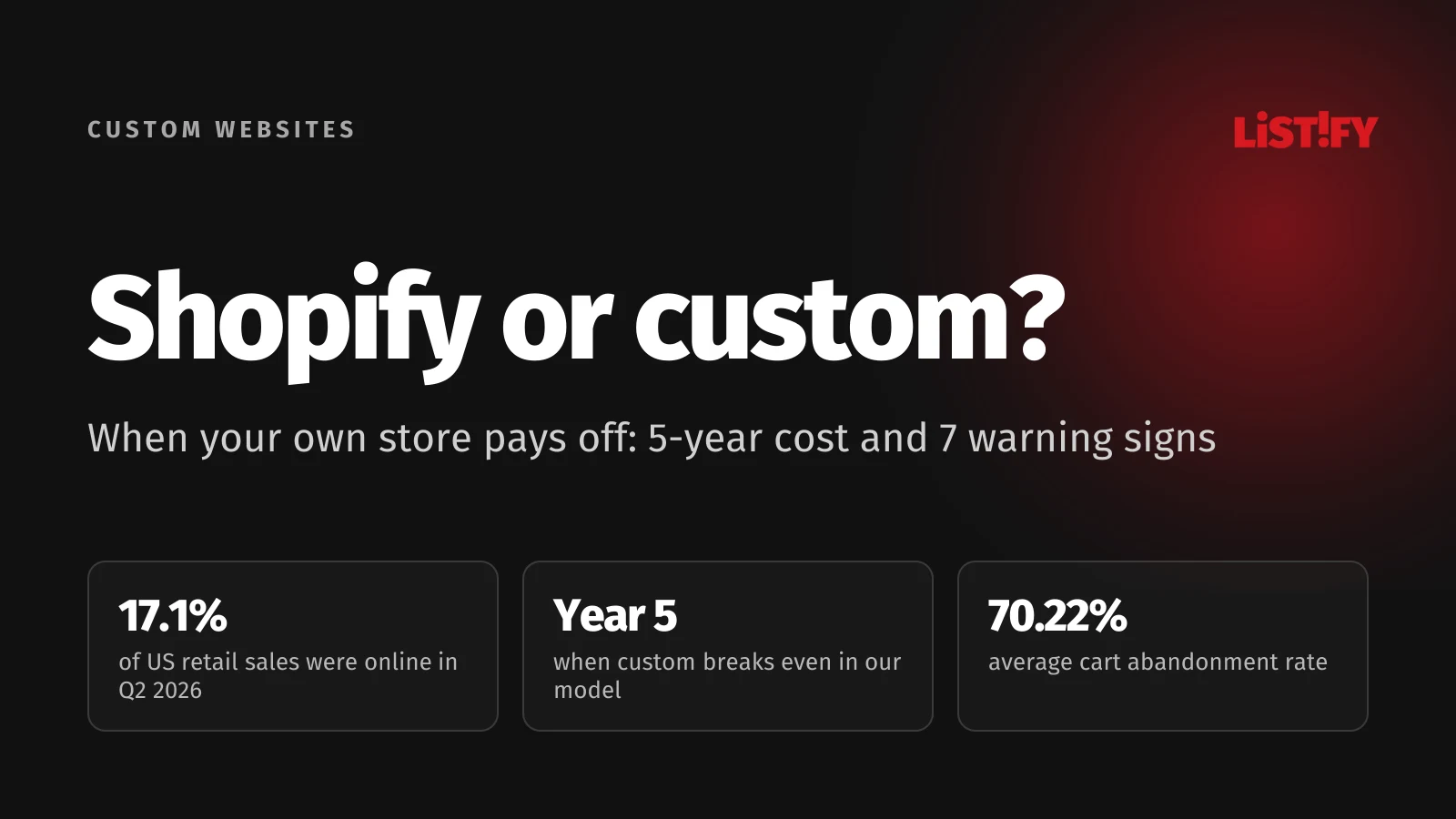
Online sales are growing faster than retail as a whole. In the second quarter of 2026, ecommerce made up 17.1% of US retail sales and grew 12.2% year over year, compared with 6.7% for total retail (US Census Bureau). The more orders you process, the more every manual step, every paid app and every extra tenth of a second of load time costs you.
The costs that tip the scale rarely show up on a pricing page. They’re the hours your team spends copying orders between systems, the pile of apps that don’t talk to each other, and the sales you lose to a slow site or a checkout you can’t change. Below is a five-year cost comparison, seven signs you’ve outgrown your platform, and a migration plan that protects your search rankings.
01SaaS or custom code: what you’re actually choosing between
With a SaaS platform, you rent your store. The provider handles hosting, security, updates, and the connections to payment gateways and shipping carriers. You pay a monthly subscription, plus apps and, in some cases, transaction fees. A custom build is software you own: you pay to build it, then to host and maintain it, but it can do whatever you need it to.
Most businesses end up somewhere between those two extremes. Prices below are in US dollars, billed monthly, unless noted otherwise.
| Option | Examples | Typical cost | Best for |
|---|---|---|---|
| SaaS platform | Shopify, BigCommerce, Wix | Shopify $39 to $399 a month, plus apps and payment fees | New and mid-size stores with standard products |
| Enterprise SaaS | Shopify Plus, BigCommerce Performance | Shopify Plus from $2,300 a month on a 3-year term ($2,500 on a 1-year term); BigCommerce Performance from $1,499 a month, billed annually | Brands with custom design, several markets, or ERP integration |
| Open source with an agency | WooCommerce, Magento Open Source, PrestaShop | Free license; you pay for development and hosting | Teams with in-house or contract developers |
| Custom build | Your own backend and storefront | A basic small store from CZK 180,000 (about $8,400), excl. VAT; larger builds with integrations cost far more | Unusual business models, complex operations, high volume |
One line on the Shopify Plus pricing page is easy to miss. If you use a third-party payment processor instead of Shopify Payments, you pay your processor’s fees plus 0.20% per transaction to Shopify (Shopify Plus). On $10 million in annual sales, that adds up to $20,000 a year before you’ve paid for a single app. On the standard plans, the fee for a third-party gateway is higher: 2% on Basic, 1% on Grow and 0.6% on Advanced (Shopify). If you need to connect the store to your own systems, our guide to API integration covers what to plan for.
02What each option costs over five years
We modeled a mid-size store that runs on Shopify Advanced, pays for a stack of apps, and needs inventory and ERP integration. That is why the model assumes a $150,000 build; a basic small custom store would cost far less. The custom build costs far more in year one: you pay for development, and the old store keeps running until the new one launches. From year two on, the savings come entirely from less manual work: in the model, hosting plus maintenance for the custom store costs more than the Shopify plan and apps.
- Year 1SaaS: 71.9Custom: 195.1
- Year 2SaaS: 143.8Custom: 235.8
- Year 3SaaS: 215.7Custom: 276.5
- Year 4SaaS: 287.6Custom: 317.2
- Year 5SaaS: 359.4Custom: 357.9
Editorial cost model, September 2026. Assumptions are in the table below the chart.
By the end of year five, the two options are roughly even: the custom store comes out only about $1,500 ahead. Here are the assumptions:
| Cost item | SaaS store | Custom store |
|---|---|---|
| Platform or hosting | $399 a month (Shopify Advanced) | $500 a month after launch |
| Paid apps | $500 a month | Part of the build |
| Development | $0 | $150,000 in year one |
| Overlap during the build | Not applicable | The SaaS store keeps running, at full cost, for the first 6 months |
| Maintenance and updates | $0 | 15% of the build cost per year, from year two |
| Extra manual work | 25 hours a week | 5 hours a week |
| Loaded labor cost | $47 an hour | $47 an hour |
The model is deliberately simple. It leaves out payment fees, which depend on your processor either way, and any conversion lift if the new site turns out faster. Plug in your own numbers. The biggest lever is manual work: if your team barely works around the platform today, a custom build won’t pay for itself within five years. In the same model with no manual work, SaaS costs about $54,000 over five years and the custom store more than $270,000. For a similar five-year view of another system, see what a CRM really costs over five years.
037 signs you’ve outgrown your platform
One sign on its own doesn’t mean you should build. If three or more sound familiar, it’s time to run the numbers.
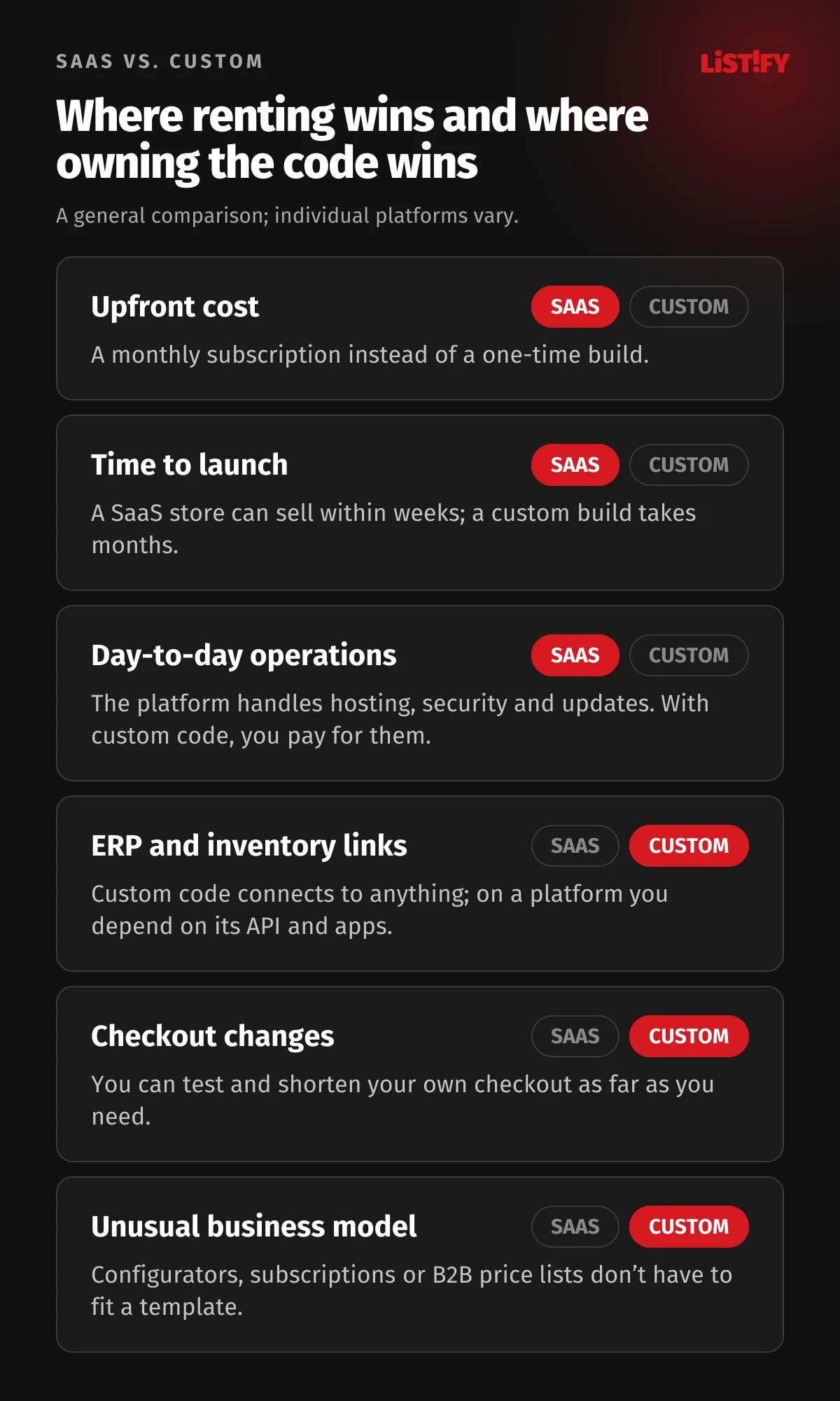
- Your team re-enters data by hand. Orders get copied into accounting, inventory lives in a spreadsheet, and support checks three systems to find a tracking number. Our piece on outgrowing Excel looks at the same problem from the CRM side.
- You pay for a dozen apps that don’t work together. Each one fixes a single problem, and platform updates keep breaking something.
- Your business model doesn’t fit the template. Product configurators, subscriptions, customer-specific B2B pricing, or made-to-order products.
- You need a direct connection to your ERP, WMS, or PIM, and no off-the-shelf app can handle it.
- Your site is slow and there’s nothing you can do about it. A Deloitte study commissioned by Google found that a 0.1-second improvement in mobile site speed was associated with 8.4% more retail conversions and a 9.2% higher average order value (Deloitte, Milliseconds Make Millions).
- You can’t change your checkout the way you want. Baymard Institute puts the average cart abandonment rate at 70.22%. And 17% of US online shoppers have abandoned an order because the checkout was too long or complicated (Baymard Institute). On Shopify, deeper checkout customization is reserved for Plus. If you control the checkout, you can test it and cut the fields nobody needs.
- You’re expanding into several countries at once, and each market wants different payment methods, carriers, and rules.
- Retail: conversions8.4%
- Retail: average order value9.2%
- Travel: conversions10.1%
- Travel: average order value1.9%
Source: Deloitte, Milliseconds Make Millions, 2020. Data from 37 brands, mainly in Europe and the US, over 4 weeks. The study measured an association between speed and results, not direct cause.
- Extra costs too high40%
- Delivery too slow20%
- Didn’t trust the site with card details19%
- Site wanted me to create an account18%
- Checkout too long or complicated17%
- Site had errors or crashed17%
- Unsatisfactory returns policy13%
Source: Baymard Institute, share of US online shoppers citing each reason, excluding those who were just browsing. Shoppers could name more than one reason.
When to stay on SaaS
- You’re still finding out whether your product sells.
- You sell standard products and existing apps cover every integration you need.
- You have no budget for ongoing maintenance. Without it, custom code goes stale and becomes a security risk.
- Nobody on your side can own the project and sign off on the work.
04The third option: let the platform sell, and build the rest yourself
You don’t have to pick one side. Plenty of growing stores keep orders, checkout, and payments on a proven platform and build only what the platform can’t do: an internal system for fulfillment, a link to accounting, or reporting for management. The systems then exchange data through an API.
A variant of this is headless commerce. The platform runs in the background and handles the catalog and orders, while the storefront your customers see is your own front end, and its speed is in your hands. Shopify offers its free Hydrogen framework, with Oxygen hosting at no extra charge on its standard paid plans from Starter to Plus (Shopify). For more on what a site built from scratch can do, see the benefits of a custom website.
05How to move to a custom build without losing customers
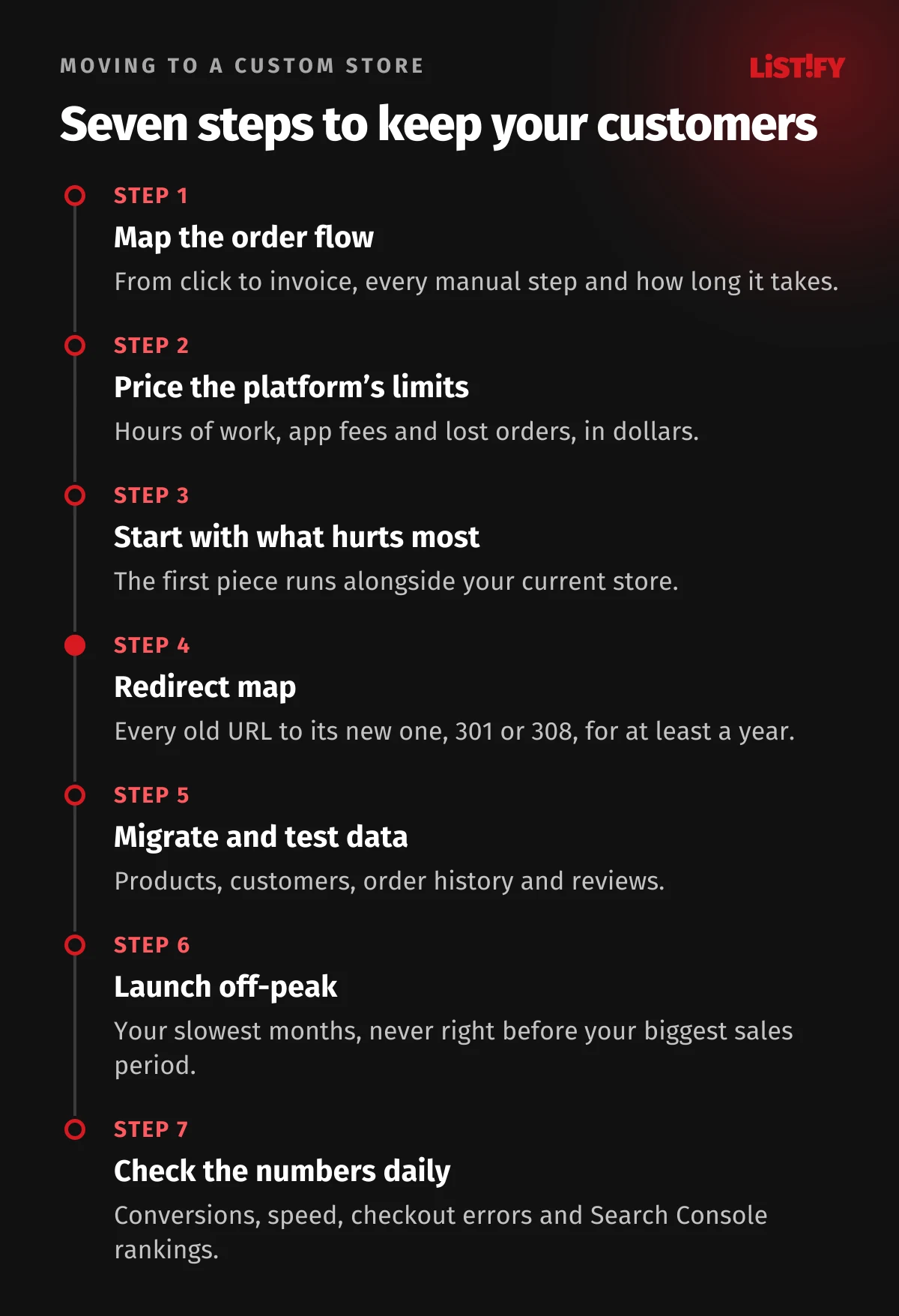
- Map how an order really flows today. From the customer’s click to the final invoice. Write down every manual step and how long it takes.
- Put a price on the platform’s limits. Hours of manual work, app fees, lost orders. Without that number, you have nothing to compare a vendor’s quote against.
- Start with what hurts most. The first piece can run alongside your current store and pay for itself before you take on the rest.
- Build a redirect map. Every old product and category URL needs a permanent redirect (301 or 308) to its new address. Keep the redirects as long as you can, at least a year. Skip this and your search rankings will drop.
- Migrate your data and test it. Products, customers, order history, and reviews.
- Launch outside your peak season. Pick your slowest months, and never launch right before your biggest sales period.
- Check the numbers daily for the first month. Conversion rate, page speed, checkout errors, and rankings for your key pages in Google Search Console.
For site moves with URL changes, Google recommends permanent server-side redirects without chains, kept for at least a year. It also warns that rankings fluctuate temporarily during a move, and that for a medium-sized site it can take a few weeks or more before Google gradually starts showing the new URLs instead of the old ones (Google Search Central). What else decides rankings today is covered in SEO in 2026.
06FAQ
How much does a custom ecommerce site cost?
It depends on scope. A basic small custom store without inventory or ERP integration runs CZK 180,000 to 320,000 (about $8,400 to $14,900), excl. VAT, according to our calculator. Plan for ongoing hosting, maintenance, and updates on top of the build. Our model assumes a $150,000 build for a mid-size store with integrations and 15% of that cost every year for maintenance. That percentage is our assumption, not an industry rule.
When does a custom store pay for itself?
When it saves or earns more than it costs to build and run. In our model the custom build broke even in year five. In a version of the model with no extra manual work, it didn’t pay for itself within five years.
Isn’t upgrading to a higher plan enough?
Often, yes. Before you talk to developers, check whether a higher tier, an enterprise plan, or a single custom-built integration solves the problem.
Will I lose my Google rankings if I migrate?
Not permanently, if you do it right, but expect some temporary fluctuation. What matters is a complete redirect map, keeping your page content, and watching Google Search Console closely after launch.
Who owns the code of a custom store?
That depends on your contract. Insist on getting the source code, documentation, and all access credentials so you can switch vendors if you ever need to. Our guide on taking over a website from an unresponsive developer explains what to secure up front.
Can I move from SaaS to custom step by step?
Yes, and it’s often the safest route. Build the piece that hurts most first, such as an inventory or ERP integration, while the platform keeps selling. Move the whole store only once that first piece has proven itself.
07Sources
- US Census Bureau: Quarterly Retail E-Commerce Sales
- Shopify pricing
- Shopify Plus pricing
- BigCommerce pricing
- BigCommerce: 2026 plan and pricing updates
- Shopify: Hydrogen and Oxygen fundamentals
- Deloitte: Milliseconds Make Millions
- Baymard Institute: Cart Abandonment Rate
- BLS: Employer Costs for Employee Compensation, June 2026
- Google Search Central: site moves with URL changes
Prices and figures are current as of September 29, 2026.