How to involve customers in creating useful UGC
A customer has found a useful way to use your product. Your next marketing asset may begin with one good question and an easy way to share the answer. A customer content program works when participation is voluntary, the request is clear, and people understand what will happen to their photo, video, or review.
UGC means user-generated content. For a brand, it can include customer photos, practical videos, and reviews describing a real experience. Customers can show situations your studio never thought to film and explain details that matter to other buyers. That value depends on preserving their actual experience rather than turning every contribution into a scripted endorsement.
Paid creator videos and sponsored posts are additional options, with different production and distribution arrangements. Start with the customer participation process: whom you invite, what you ask, how they contribute, how you obtain permission, and how you respond. A public hashtag alone does not resolve those questions.
01Choose a customer question worth answering
| Content type | What it can contribute | What to clarify |
|---|---|---|
| Invited customer photo or video | A useful demonstration from someone who has used the product | A voluntary request, simple submission, and permission for the proposed use |
| Customer review | Feedback and evidence of an actual experience | Authenticity, incentives, disclosures, and fair moderation |
| Commissioned creator video | A demonstration or explanation for your channels | Deliverables, truthful claims, usage rights, and revisions |
| Sponsored creator post | Content plus access to the creator's audience | Audience fit, disclosure, publication commitment, and reporting |
| Creator content used in paid ads | A creative asset for a controlled distribution test | Ad rights, account permissions, music, edits, and expiry |
Choose one question that another customer genuinely needs answered. For a kitchen product, ask how the customer uses it during a normal weekday meal. For software, ask which task became easier and what still takes effort. Avoid a request to tell everyone why the product is amazing. A specific question produces more useful detail and leaves room for an honest answer.
Invite people after they have had a reasonable opportunity to use the product, rather than immediately after payment. A follow-up message, community discussion, or packaging insert can point to the same submission page. Match the invitation to the experience: setup advice from a new user and long-term care advice from an established customer answer different questions.
02Make participation simple and voluntary
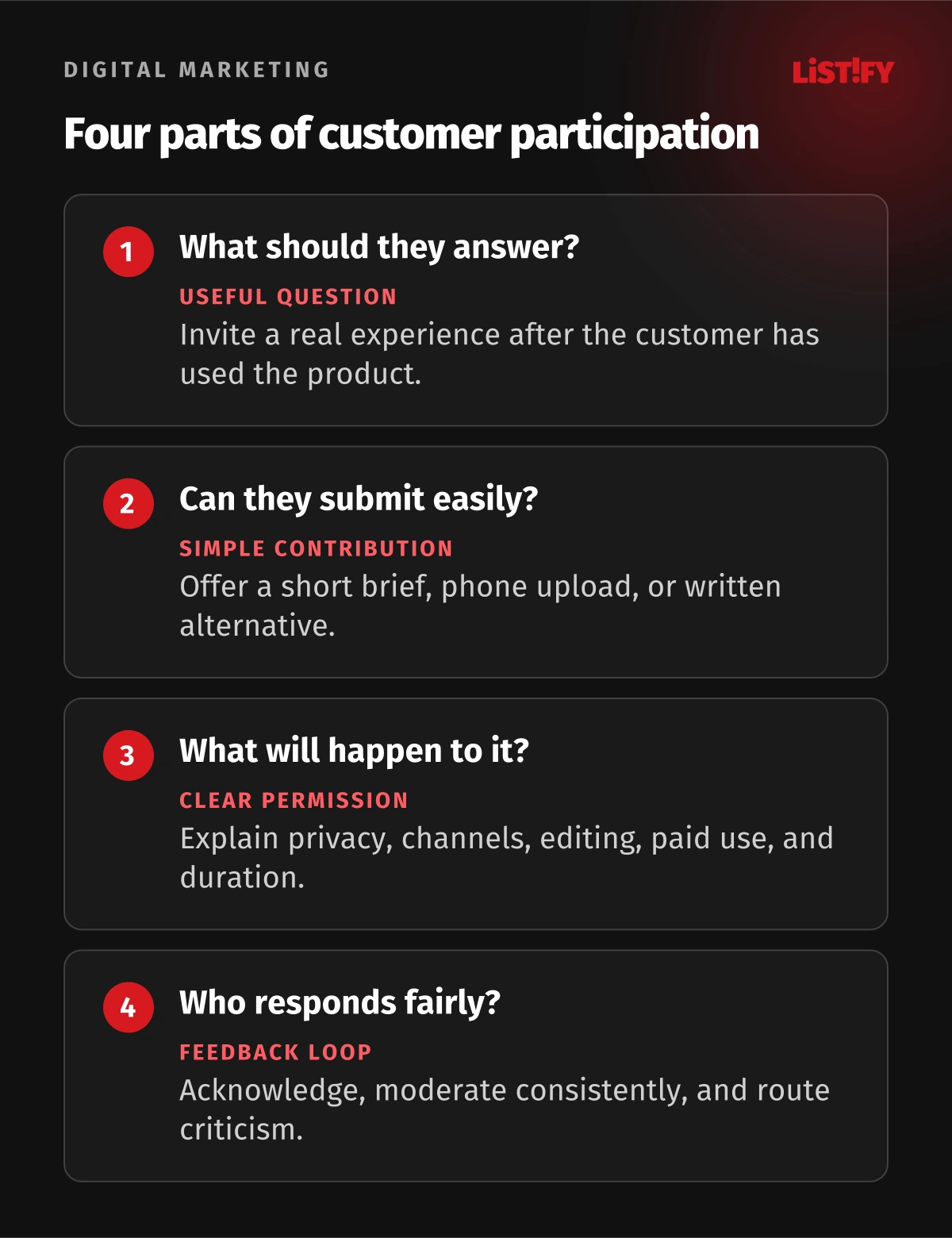
Give the customer a small task they can complete with an ordinary phone. For example: show the product in use, describe the problem it helps with, and mention one detail you wish you had known earlier. Offer a photo plus a short answer as an alternative to video. Do not require public posting, a polished edit, or a long application to contribute.
Put the brief beside the upload form. Explain accepted formats, practical file limits, and whether a short written review is welcome. Ask only for information needed to handle the submission and contact the participant. Separate any marketing subscription from the contribution process; a customer should understand each choice they make.
Reduce avoidable friction. Let people preview what they are sending and correct a mistake. Show a useful progress and failure message for an upload, and preserve their written answer when a file fails. Provide an alternative contact route when uploading is inaccessible or difficult. Test the form on the phones your customers actually use.
Include a short privacy reminder before recording: avoid addresses, account details, private screens, and identifiable bystanders unless the appropriate permissions cover them. A software customer can demonstrate a task with sample data. Explain who receives the file, the intended use, how long you retain submissions, and how to ask a question or raise a concern.
03Review contributions and close the feedback loop
Tell participants what happens next and give a realistic response window. Acknowledge receipt, then check the file, the experience described, personal information, and the proposed use. Keep an internal status such as received, clarification needed, approved for a specified use, or not selected. A submission should not disappear into an inbox that nobody owns.
Use written moderation rules for abuse, irrelevant content, exposed personal data, and unsupported claims. Apply them consistently to positive and critical contributions. Selecting a useful photo for a campaign is different from running a review service: explain your selection criteria and do not present a curated promotional set as a complete picture of all customer feedback.
When something is unclear, ask a focused follow-up. For example, ask which product version appears in the video or whether a reported result required another tool. Do not coach customers to remove meaningful qualifications or describe an experience they did not have. Edit for length and clarity only when the approved use allows it and the meaning remains intact.
If you offer a reward, explain the terms before participation and check the relevant rules and platform policy. Avoid rewarding only praise or requiring a particular review score. Record whether a gift, discount, or other benefit needs disclosure where the contribution appears. A transparent incentive still does not justify misleading feedback.
Let the customer see the finished use when practical, credit them as agreed, and thank them whether or not the contribution becomes a campaign asset. Route product criticism to support or the product team and explain what you can address. The program should help customers understand one another and improve the product, not simply extract files from them.
04Explain permission before reusing customer content
WIPO's copyright guidance explains that creators' works can carry rights over reproduction, adaptation, and other uses, with national differences. A file in your shared folder is not a complete rights record. Do not assume that payment or a public post grants every reuse your campaign may need.
Describe the proposed use in language a customer can understand: the product page or social channels, organic and paid use, territory, duration, editing, translation, and any agency involvement. Avoid hiding a broad advertising license behind a vague upload button. Obtain the appropriate agreement before reuse and have it reviewed for the markets and uses involved.
Clear third-party elements too: music, stock material, identifiable people, locations, logos, and work shown in the background. TikTok's Commercial Music Library guidance describes music intended for commercial TikTok activity. That is not a blanket license to export the same track into every platform, website, or offline campaign.
Do not assume a hashtag or tagging your brand grants an unrestricted license. Ask for permission that matches the planned reuse, including whether the customer wants a name or account credit. If a commissioned creator also grants advertising-account access, use supported permissions rather than requesting a password. That platform permission and the content license remain separate controls.
Maintain an asset register with the approved version, source, rights, disclosures, and expiry. Link it to active campaigns. When a license ends, the team should know which ads, product pages, and local variants need action. A folder called final is insufficient once many versions exist.
05Keep reviews and commercial relationships honest
Rules vary by market, but a brand should make a commercial relationship clear. In the US, the FTC's Endorsement Guides FAQ explains material-connection disclosures and truthful experiences. For video, a hidden description alone may be inadequate. It also warns that a platform's built-in label is not automatically sufficient.
YouTube's branded-content guidance provides platform controls and points creators toward local legal requirements. Check the platform settings and the actual disclosure together. A viewer should understand the relationship in the version they encounter, including a short cutdown viewed without the original caption.
Do not turn commissioned creative into a fake independent review. The FTC's Consumer Reviews and Testimonials Rule FAQ discusses fake or false reviews and prohibits compensation conditioned on a particular review sentiment. An incentive disclosed by the reviewer does not make buying five-star reviews permissible under that US rule.
Write moderation rules that remove abuse, irrelevant material, and exposed personal data consistently. Route criticism to the team that can fix the issue. Do not make the program's success depend on hiding inconvenient genuine experiences or pressuring customers to change their opinions.
These US rules and platform examples are useful checks, not a worldwide legal template. Assess local advertising, consumer, privacy, and personality rights for your distribution. Keep the claims and permissions review close to the people making and approving the content.
06Measure participation and the contribution’s usefulness
Define the outcome before collecting a library of files. Track invitations, willing participants, successful submissions, and contributions usable for the intended purpose. Ask why people abandon the process and how much staff time clarification takes. A tutorial may help people complete setup; a review may answer an uncertainty; an ad may support a purchasing decision. Views alone do not evaluate those jobs.
When testing paid assets, keep the audience, offer, landing page, and measurement method as comparable as practical. Change one meaningful creative idea at a time: the question addressed, demonstration, opening, or explanation. Different audiences and budgets can explain a result that appears to come from the video.
Inspect what happens after the click. A persuasive demonstration cannot repair a slow product page, missing information, or broken checkout. Our guide to landing-page structure covers the destination, while social media measurement helps choose useful campaign evidence.
Include production, revisions, shipping, usage extensions, media spend, and internal review time in the cost. Reconcile sales with refunds and the offer's margin. Discount codes and platform attribution have limits, and a small test may not support a strong causal conclusion.
Record what customers taught you as well as what performed in a campaign. A repeated setup problem may deserve a product change or clearer instructions. A distinctive use case may become the next invitation. Keep any paid creator experiment separate enough to understand its costs and arrangement; it should complement customer participation rather than masquerade as unsolicited praise.
07Pilot one invitation and improve the customer loop
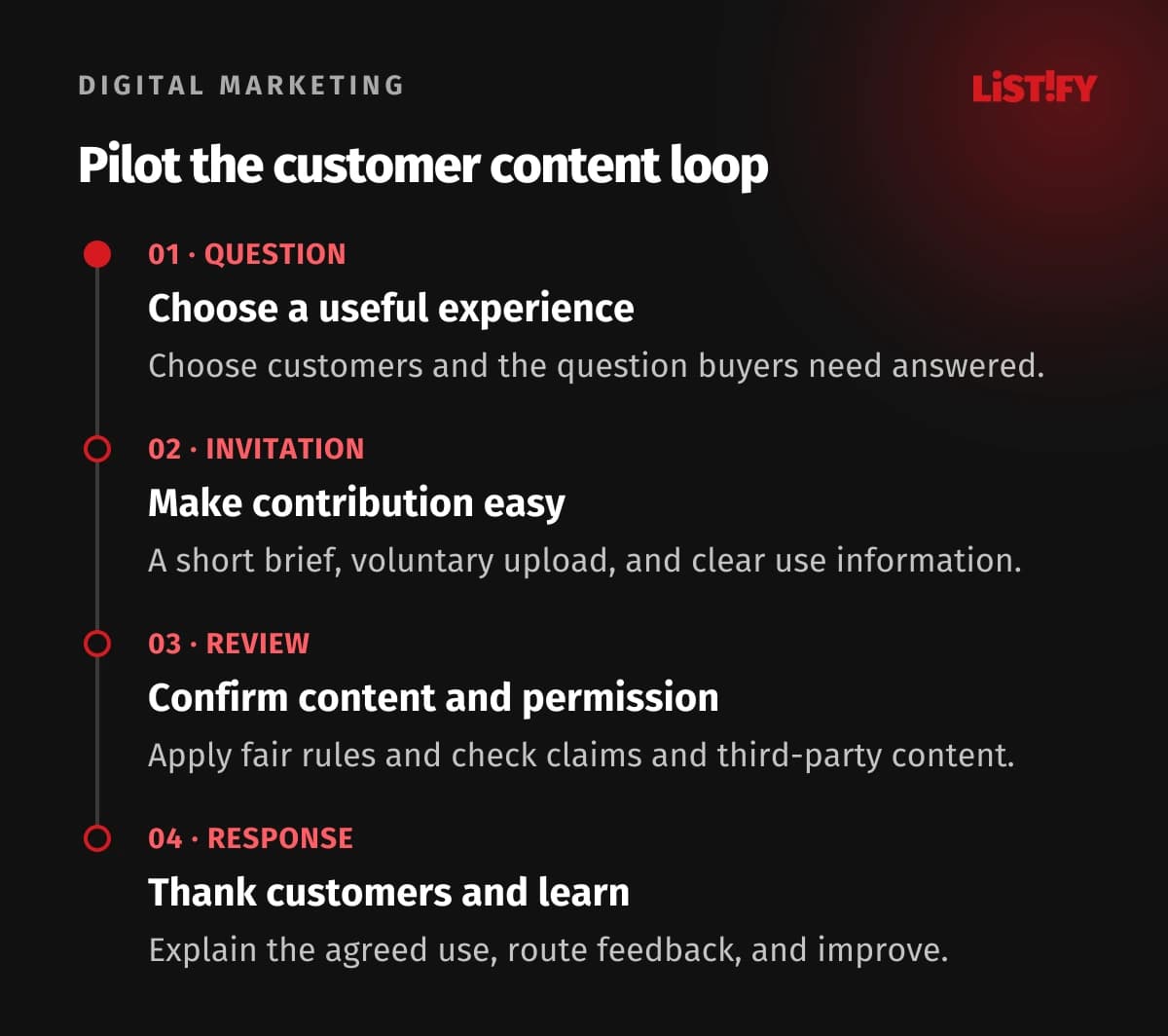
- Choose the question. Name the real experience, customer group, product version, and information another buyer would find useful.
- Make contribution easy. Offer a short brief, a simple upload or written answer, voluntary participation, and clear privacy and use information.
- Review fairly. Confirm the experience, permission, disclosure, and third-party elements. Apply moderation rules consistently and clarify uncertainties.
- Respond and learn. Thank participants, share the agreed use, route criticism, and improve the invitation and submission process from the evidence.
Name an owner for replies, permission records, publication, and removal when a term expires or a concern needs attention. Start with a volume that person can handle. Expand when customers can participate easily and your team can respond reliably. Paid creators may later fill a specific production gap; they do not replace the customer feedback loop.
08Questions about involving customers in UGC
When should we invite a customer to contribute?
After they have had a reasonable chance to use the product. Ask a specific question suited to that stage, such as setup advice or an everyday use case. Keep participation voluntary and offer a straightforward contribution route.
What should the customer brief contain?
One useful question, a small recording or writing task, practical submission instructions, and clear information about privacy and intended use. A phone photo and a short answer may be more accessible than a polished video.
Can we reuse a customer’s public video in ads?
Do not assume public availability, a brand tag, or a hashtag grants the rights you need. Confirm the proposed use, permission, third-party elements, and relevant local requirements before distribution.
Can we offer a reward for participation?
Check the applicable rules and platform policy, explain the terms, and keep participation separate from required praise. The US FTC rule prohibits compensation conditioned on a particular review sentiment; disclosure does not permit buying five-star reviews.
Should we remove negative customer feedback?
Apply consistent rules for abuse, irrelevant material, and personal data, and route genuine criticism to the responsible team. Explain promotional selection and do not present a curated campaign as an unfiltered collection of all customer reviews.
Where do paid creators fit?
They can provide a specific demonstration or production skill when you need one. Define the commission, truthful claims, disclosure, and paid or organic usage rights. Keep that arrangement distinct from unsolicited customer feedback.
How do we know the program is useful?
Review participation, upload failures, usable contributions, response time, and the job the content should support. Include staff and production costs. Learn from product feedback as well as campaign results; attention and incremental sales are different measures.