Managing risks and dependencies in product teams
Development is progressing, but launch depends on API access, a commercial decision or data from a supplier. Faster coding rarely resolves that surprise. Risk and dependency management should reveal what might threaten the outcome, who will investigate it and when the plan needs to change. Here is an approach that works for smaller product teams too.
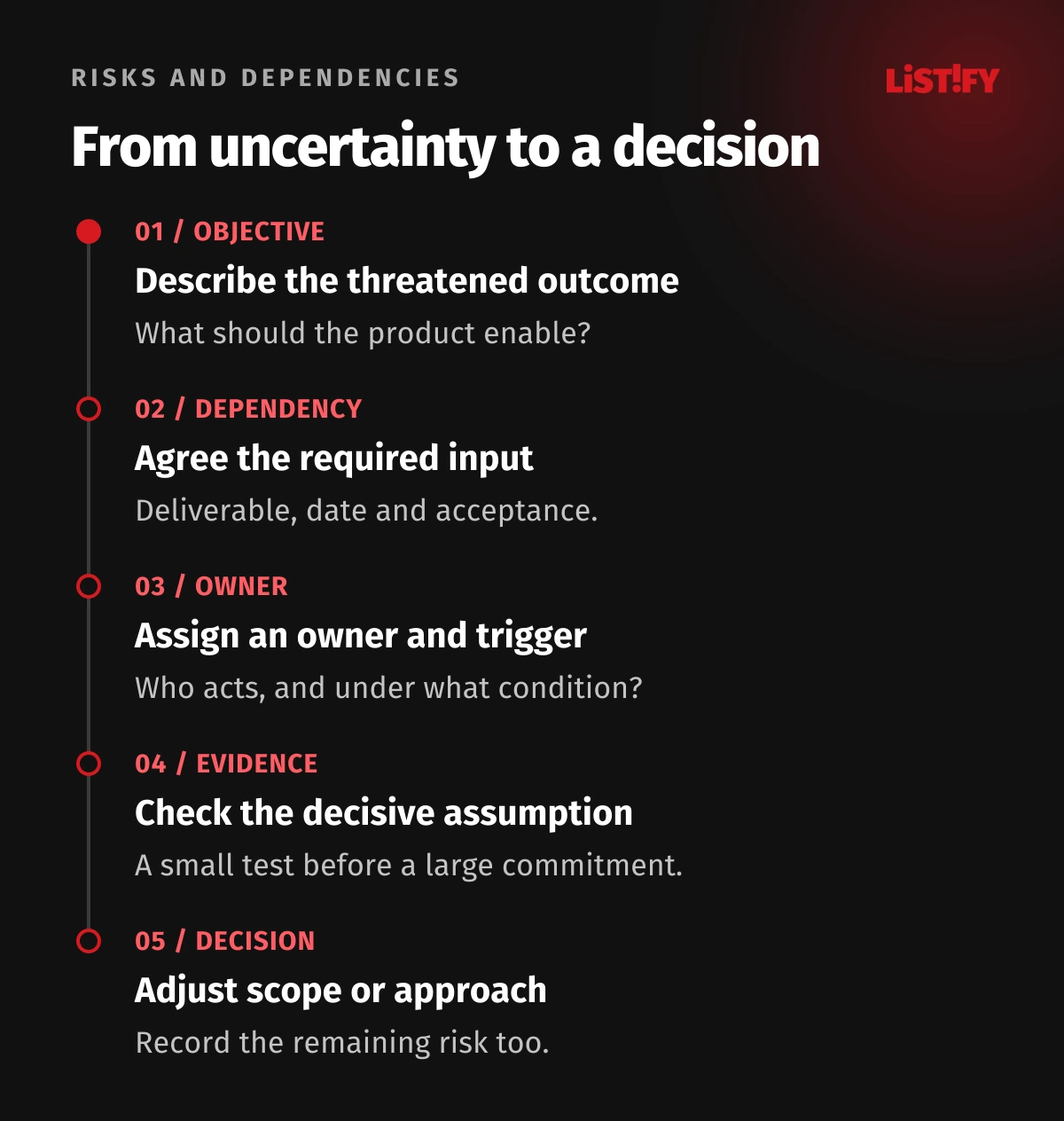
A presentation full of red indicators does not protect a project. Useful risk management produces concrete work: checking an uncertain assumption, securing an input, preparing a fallback or reducing scope. The team should know who can make a decision before a crisis meeting becomes necessary.
01Separate risks, dependencies and problems that already exist
A risk is uncertainty that may affect an objective. A dependency means the outcome requires something from elsewhere. An issue has already happened and needs resolution. “The supplier may not deliver test access” is a risk; needing that access is a dependency; a rejected request on testing day is an issue. Mixing them obscures what to investigate and what to fix immediately.
The UK Treasury’s Orange Book describes risks through causes, events and consequences. A product example is: without a confirmed export format, customer migration may fail and the pilot cannot begin at the intended scope. That statement already suggests useful next steps.
First define the objective using the product vision and strategy. Without it, the team cannot judge whether timing, feature completeness, safety or demand validation matters most in a particular decision.
02Look for uncertainty across the complete product journey
Technical teams often recognise a difficult integration. They may have less visibility into unapproved pricing, a customer unavailable for the pilot or support staff unfamiliar with the process. Investigate risks with the people commissioning, using and operating the product. Reviewing development tasks alone is insufficient.
For each important step, ask what must be true for it to work, who can confirm it and what remains an assumption. Distinguish demand, usability, technical feasibility, commercial rules and operational readiness. Missing evidence is not automatically a defect, but it should be visible.
Prioritise uncertainties whose late discovery would change a major decision. If the required data may be unavailable, investigate before designing a detailed report. A small discovery task can be worth more than another completed screen because it changes what the team should build next.
03Describe a dependency as an agreed deliverable
| Dependency | Unhelpful description | Usable agreement |
|---|---|---|
| External API | Waiting for integration. | Supplier provides a test account and agreed scenarios. |
| Company data | The client will send the database. | Data owner supplies a sample, field meanings and correction rules. |
| Product decision | Sales will comment. | Named owner approves pricing and first-release exceptions. |
| Operations | IT will arrange launch. | Operator accepts the environment, access and verified recovery procedure. |
Separate “needed by” from “promised for”. If the promised date is later, the plan already contains a conflict. Leaving two incompatible dates in a schedule does not resolve it. Agree a change to scope, sequence or timing and tell the dependent team.
Acceptance must be testable. API access is not ready if it cannot perform the required operation. Data is not ready merely because a file arrived when nobody understands its identifiers. An input is complete when the next team can genuinely proceed with the intended work.
04Prioritise impact, timing and evidence
Assess severity against the objective. Data loss, an unavailable service, an unusable pilot and avoidable spending are different consequences. Include the time remaining before corrective options disappear. A smaller risk requiring a decision today may need action before a larger risk in a distant phase.
Do not attach precise probabilities without evidence. State what is known, what is estimated and what would change the assessment. A colour matrix can support discussion, but multiplying arbitrary scores should not conceal an unacceptable consequence. The explanation is more useful than false numerical precision.
Distinguish the priority of a feature from the priority of validating its assumptions. A prerequisite for a small feature may block the whole release. Connect that work to backlog prioritisation. A risk with no next action is often merely a note.
05Give important risks an owner and an action trigger
The owner tracks the situation, arranges the next step and escalates decisions beyond their authority. They do not have to perform every repair personally. “The whole team” can mean nobody acts when an input slips. Identify who may accept residual risk or change a commitment to a customer.
A trigger defines when observation becomes action. For example, if a data sample fails the agreed checks before migration begins, the pilot will use only the verified segment. Decide that condition in advance. During a crisis, it is harder to separate an acceptable compromise from a desire to preserve the launch date.
Prepare options with consequences. A leader needs more than “we may be late”: provide a limited release, further validation or a schedule change. For each option, describe what is gained, what is sacrificed and what remains uncertain. Make the required decision date visible.
Does your product repeatedly wait for external inputs or unclear decisions? Tell Listify the objective, next milestone and main dependencies. We can help establish a feasible scope and sequence of validation work.
06Reduce risk with the smallest useful evidence
Check an uncertain API with a focused technical exercise using a real type of request. Walk through an unclear workflow with a future user using an interactive prototype. Investigate unknown data quality with a representative sample. The aim is evidence for a decision, rather than creating a separate miniature project.
Define the output and boundaries: what counts as success, failure or insufficient information? “A developer looked at it” does not show whether the integration handles permissions and errors. Record the conditions of the exercise so its conclusion is not automatically generalised to the entire product.
If a dependency cannot be removed in time, consider an independent first phase or a temporary manual step with limited volume and a clear owner. The fallback needs error controls and an exit plan. Otherwise, temporary work becomes an invisible permanent operating cost.
07Illustrative example: a client portal depends on accounting data
A company wants clients to see invoice status in a portal. The team can build the interface but has not confirmed how the accounting system represents partial payments and corrective documents. The risk is not simply “bad integration”. The concrete consequence is that a customer sees an incorrect debt and support must resolve conflicting information.
First collect representative cases and agree their meaning with the accounting-process owner. Then check reading, updating and failure states. If some cases cannot be distinguished reliably, the first release can explicitly mark them for review or omit them under an agreed rule. It should not present invented certainty.
This is an authored example, not a client case study. It shows why ownership often crosses team boundaries. The interface, accounting rule and exception workflow must work together. Subsequent development should follow what was learned, rather than the original optimistic assumption.
08Integrate reviews into work instead of parallel reporting
| Point in the process | What to review | Required decision |
|---|---|---|
| Before planning a phase | Unverified assumptions and available inputs | What to validate before dependent work starts. |
| After a change or new evidence | Impact on the objective and other teams | A change in sequence, scope or response. |
| Before release | Open risks and operational readiness | Accept, limit or stop the release. |
| After an incident or completion | Cause, response and recurring dependencies | Improve the process and remove repeated causes. |
The Scrum Guide connects transparency, inspection and adaptation. In practice, new information should change the plan when it changes the conditions. Repeating the same red status every week without action is not risk management.
Link the risk register to tasks and decisions in the existing work tool. A clear table can be enough for a small team. Your delivery method, including the choice between agile and waterfall, does not replace specific ownership.
09Reduce avoidable dependencies as the team grows
If every release waits for the same person or shared component, reconsider how work is divided. Clear interfaces, shared documentation, backup ownership and smaller independently verifiable changes can help. The objective is not to pretend systems are independent when they operate on shared data.
When scaling a product team, track waiting, recurring blockers and decisions returned because inputs were incomplete. Adding people cannot resolve a missing agreement by itself. Removing one repeated dependency may free more capacity than adding another planning layer.
At the end of a phase, preserve what was confirmed, what changed and what remains open. Completing an investigation task does not automatically close its risk. You need evidence that a change removed the consequence or that an authorised owner consciously accepted the remaining exposure.
10Frequently asked questions
Does a small team need a formal risk register?
It needs visible important uncertainties, owners and next actions. A simple table connected to tasks may be sufficient. The record should support decisions rather than create administration for its own sake.
Is every dependency a risk?
Not automatically. A confirmed, reliable input may be a normal part of work. Risk comes from uncertainty about availability, quality or the consequences of failure.
Should only the project manager manage risks?
They can coordinate the overview, but specialist assessment and decisions belong to the relevant owners. One person cannot validate commercial rules and technical feasibility for everyone.
Is scoring likelihood and impact from one to five enough?
A scale can help discussion, but it is not a precise calculation. Preserve causes, evidence, response time and particularly severe consequences. A score alone does not identify the required action.
When should we escalate to leadership?
When the next action exceeds the owner’s authority or threatens an agreed objective the team cannot compromise independently. Bring options, consequences and the date a decision is needed.