How to scale a product team without slowing delivery
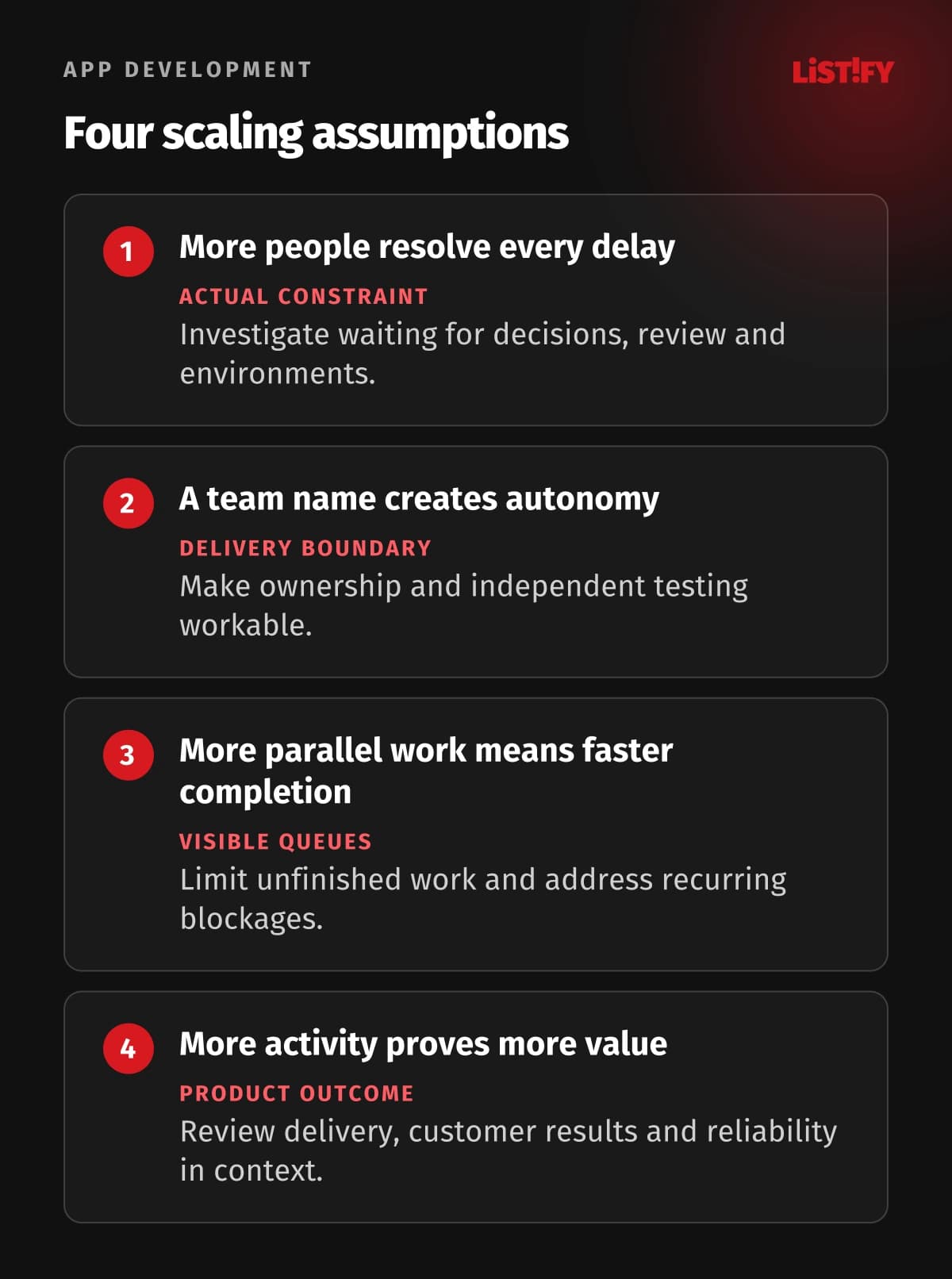
You add developers to clear the roadmap, but features spend longer waiting for decisions, reviews, and shared environments. Everyone is busy while completed work barely moves. Growing a product team requires more than dividing the backlog: the way people decide, build, release, and support the product must grow with them.
Headcount adds capacity and coordination needs at the same time. The result depends on where the work is constrained. A new engineer cannot resolve an unclear product decision or make a central review queue disappear simply by writing more code.
Begin with one product area and trace a recent change from customer need to a working release. Identify decisions, handoffs, waiting, rework, and operational responsibility. That map helps you decide whether the next investment should be hiring, a boundary change, a technical improvement, or a clearer priority.
01Find the constraint before adding another team
Choose representative changes, including one routine improvement and one difficult feature. Record active work separately from waiting for product clarification, design, review, testing, approval, or deployment. Include the work after release: support, incident handling, and correction. A ticket marked development complete may still be far from usable.
| Observed delay | Question to investigate | Possible first change |
|---|---|---|
| Repeated product clarification | Are priorities and decision authority clear? | Define the outcome, owner, and decision route before starting |
| Long review queue | Does one specialist review every change? | Share knowledge and make smaller changes with clear review responsibility |
| Cross-team dependency | Does one customer feature need several synchronized teams? | Review ownership, interface contracts, and the order of work |
| Waiting for an environment | Can teams safely test representative changes themselves? | Provide a usable test path and clear environment ownership |
| Frequent release repair | Are defects found late or recovery steps unclear? | Improve feedback, release checks, monitoring, and rollback |
Ask staff where they need permission, information, or help from someone outside their normal working group. Look for a recurring dependency rather than blaming the person who answers it. A senior engineer reviewing everything may be compensating for missing tests, undocumented boundaries, or an unclear risk policy.
Keep the investigation manageable. You do not need perfect measurement for every ticket before improving an obvious queue. Agree on the evidence that would show the suspected constraint has changed. Hiring may still be the right decision, but specify which capability and work the person will add.
02Align ownership with a meaningful product area
Give a team an understandable part of the customer experience and the ability to improve it. For a SaaS product, that might be onboarding, billing, or a core operational workflow. Draw boundaries around decisions and changes people can own together, rather than placing every frontend, backend, and test task in separate permanent queues.
DORA's loosely coupled teams guidance connects organizational and technical structure with independent delivery. Independence requires the ability to test and change safely, not merely a team name. Document interfaces, shared data, permissions, and what requires coordination.
Do not turn a modest application into dozens of services to match an organization chart. A modular application can offer useful ownership boundaries. Conversely, many deployed services can remain tightly coupled if each feature needs simultaneous changes, a shared database edit, and a coordinated release.
Decide who owns cross-product choices such as identity, navigation, shared data definitions, and security requirements. Teams need a route for resolving conflicts and revising boundaries. Local autonomy works better when the common constraints and decision authority are visible.
If you use Scrum, follow its actual product accountabilities. The 2020 Scrum Guide says multiple Scrum Teams working on the same product should share the Product Goal, Product Backlog, and Product Owner. It is a framework-specific arrangement, not a universal staffing rule for every product organization.
03Keep fewer things in progress and make changes smaller
A growing team can start more initiatives than the surrounding organization can finish. Set a visible order of work and limit simultaneous items at the stages that create queues. Include urgent requests and defects in the same capacity conversation. A limit that ignores support work describes an imaginary team.
DORA's work-in-process guidance recommends focusing on completing a smaller number of priorities and using the constraint to improve flow. If work is blocked, helping clear the blockage can be more useful than starting another feature. Choose an initial limit from the actual workflow and adjust it from evidence.
Split features into useful, testable steps with a clear result. An onboarding improvement could begin with one validated step and its error handling, rather than replacing every screen and backend rule in one release. Avoid dividing work so finely that no increment can answer a product question or support a user task.
DORA's small-batch guidance explains how smaller changes shorten feedback and reduce coordination complexity. The aim is a manageable unit of learning and delivery, not an arbitrary requirement that every feature fit the same number of hours.
Review work that has aged without moving. Clarify whether it needs another decision, a smaller scope, a missing dependency, or cancellation. A busy board with many half-completed items can hide a prioritization problem that another hire will make larger.
04Make delivery and operation repeatable
A release process that depends on one person's memory becomes fragile as teams grow. Document the deployment route, environment configuration, monitoring, recovery, and support ownership. Automate routine checks where they provide useful feedback, and keep the result understandable to the team making the change.
DORA's continuous-delivery guidance emphasizes technical capabilities and collaboration across the lifecycle. Build and test feedback should arrive while the team can still act on the change. A large testing phase after all development creates a different queue rather than a dependable release path.
Create a common minimum for useful release evidence: relevant checks, operational visibility, a safe rollout, and a recovery route. Adapt it to risk. A cosmetic copy change and a financial migration need different depth of review, even if both follow the same principle of knowing what changed and how to respond.
Treat internal platforms as services for product teams. Team Topologies' key concepts distinguish product-focused, enabling, platform, and specialist arrangements, with attention to cognitive load. A platform should remove repeated difficulty; a new central approval queue can do the opposite.
Start with a thin useful capability, such as self-service environments or a supported deployment template. Observe whether teams can use it without constant assistance. Keep documentation, support, and ownership visible. An elaborate platform roadmap is unnecessary if the immediate problem is an unreliable test environment.
05Onboard people into decisions as well as code
Give a new colleague a product map, a working local environment, access suited to the role, and a small supported contribution. Explain who makes product and technical decisions, where designs and constraints live, and how the team handles an incident. A repository tour alone does not show how work gets completed.
Pair on the first changes and document the questions that repeat. Choose an experienced contact with time allocated to help, rather than expecting the newcomer to interrupt several busy specialists. Account for that mentoring work in capacity planning; onboarding is an investment before it becomes additional delivery capacity.
Spread important knowledge through reviews, pairing, short explanations, and maintained operational instructions. Look for work only one person can approve, deploy, or recover. Sharing that capability reduces a bottleneck and makes holidays, role changes, and incidents easier to handle.
Give senior engineers a clear role in helping others make sound decisions. If they become the compulsory approver for everything, adding junior staff may expand their queue. Identify where guidance, tests, or a delegated decision can safely replace repeated personal approval.
Keep remote and distributed teams able to find decisions asynchronously. Record the reason, owner, and consequence in a place tied to the work. Use live discussion when ambiguity needs it, then preserve the result. Repeated meetings to recover lost context are a sign the operating model needs attention.
06Measure useful flow and product outcomes
Track whether customers can complete the task you are improving, with relevant operational and business evidence. Then examine delivery: waiting, rework, reliability, and the ability to restore service. A team can deploy frequently while spending its capacity on changes that nobody needs.
DORA's current metrics guide uses five delivery measures: change lead time, deployment frequency, failed deployment recovery time, change fail rate, and deployment rework rate. Apply them in the context of one application or service, and use them to investigate improvement rather than rank individuals.
Do not compare teams by raw story points, commits, or lines of code. Those measures depend on local conventions and can reward activity that does not help the product. A change in scope, architecture, or incident load can also alter delivery measures. Explain the context before concluding that a reorganization caused a result.
Use a small set of measures alongside conversations and examples. Record the constraint you intended to change and whether it improved without unacceptable effects on reliability, staff load, or customer outcomes. Keep the measurement effort proportionate to the decision it supports.
07Test one scaling change before restructuring everything
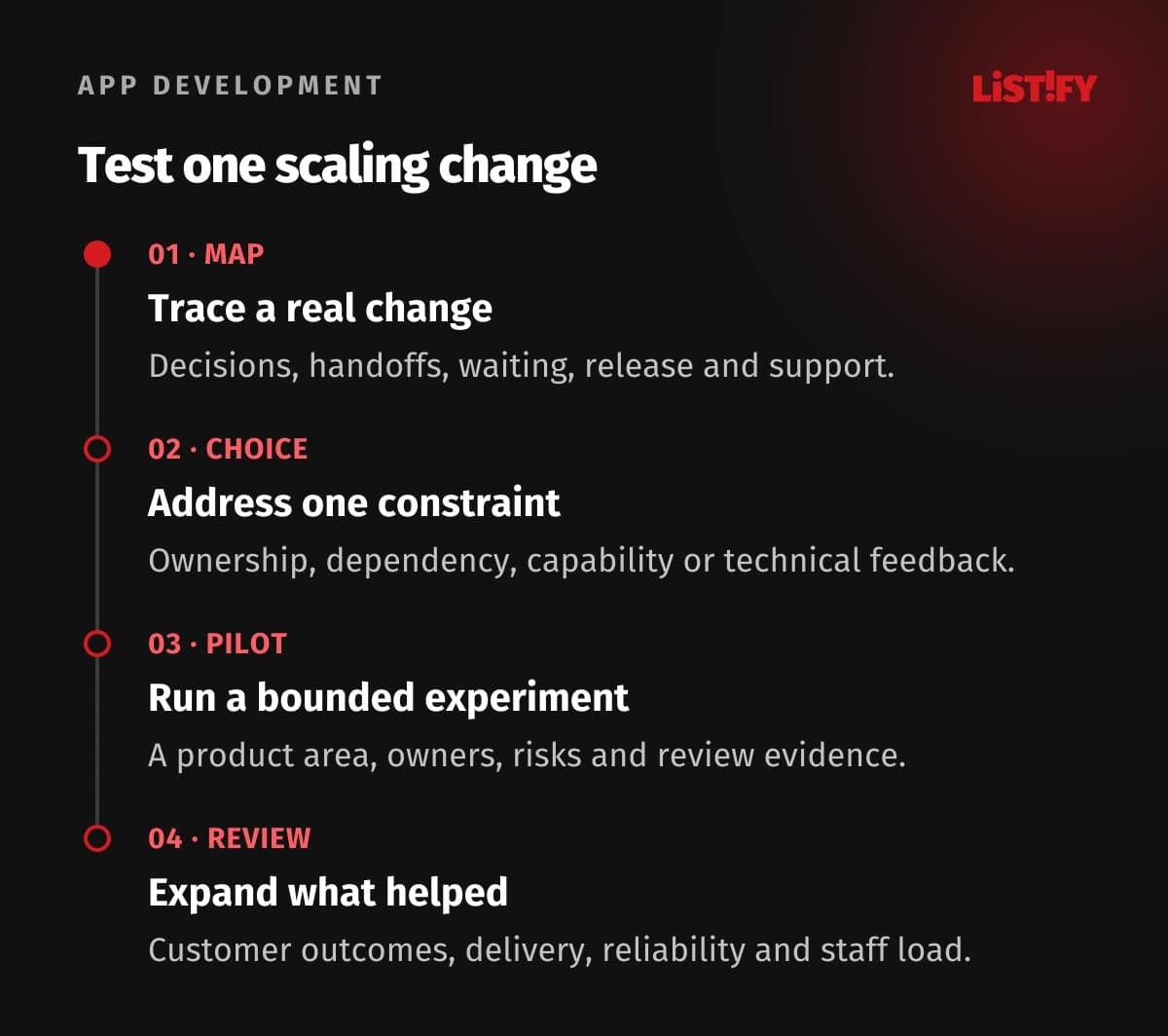
- Map a real change. Include decisions, handoffs, waiting, release, support, and recovery. Agree on the main constraint.
- Choose one intervention. Clarify ownership, reduce a dependency, improve a test path, or hire for a demonstrated capability.
- Run a bounded pilot. Name the affected product area, owners, expected evidence, risks, and review point.
- Review and expand carefully. Compare delivery, customer outcomes, reliability, and staff load. Keep what helped and revise what did not.
Keep the product's direction visible while you change its delivery structure. Our SaaS development planning guide covers the wider product plan. Team growth should make that plan easier to execute and adapt, with responsibilities people can understand.
08Questions about scaling product teams
Should slower delivery always mean hiring?
No. Investigate whether work waits for decisions, reviews, environments, or dependencies. Hire when you can explain the capability and work the person will add, and account for onboarding support.
What is the ideal team size?
There is no universal number for every product. Consider ownership, required skills, coordination, and cognitive load. If you use a named framework, distinguish its guidance from a general staffing rule.
Do independent teams require microservices?
Not automatically. Independence depends on boundaries and the ability to test and change safely. A modular application can support useful ownership; many services can still require tightly coordinated releases.
How do we reduce a senior-engineer bottleneck?
Find why every change needs that person's approval. Share knowledge, clarify review ownership, improve feedback, and delegate appropriate decisions. Keep specialist review for cases that need it.
Should every team have its own backlog?
Choose a structure that preserves product priorities and makes ownership clear. Multiple Scrum Teams on one product have specific shared-accountability guidance. Avoid fragmented lists that hide cross-team conflicts.
Can we compare teams by story points?
Raw points use local conventions and do not reliably compare value or productivity. Examine outcomes and delivery in context, including waiting, reliability, rework, and the work the team actually owns.
What should the first scaling experiment be?
A bounded change addressing the clearest observed constraint in one product area. Set owners and review evidence, then assess customer results, delivery, reliability, and staff load before expanding.