Prioritize the backlog: use methods that explain the decision
The backlog contains a customer’s requested export, an onboarding improvement and a change that makes future integrations easier. Each has a different kind of value, and each stakeholder calls their item urgent. A useful prioritization method makes the tradeoff understandable and identifies what the team should do next.
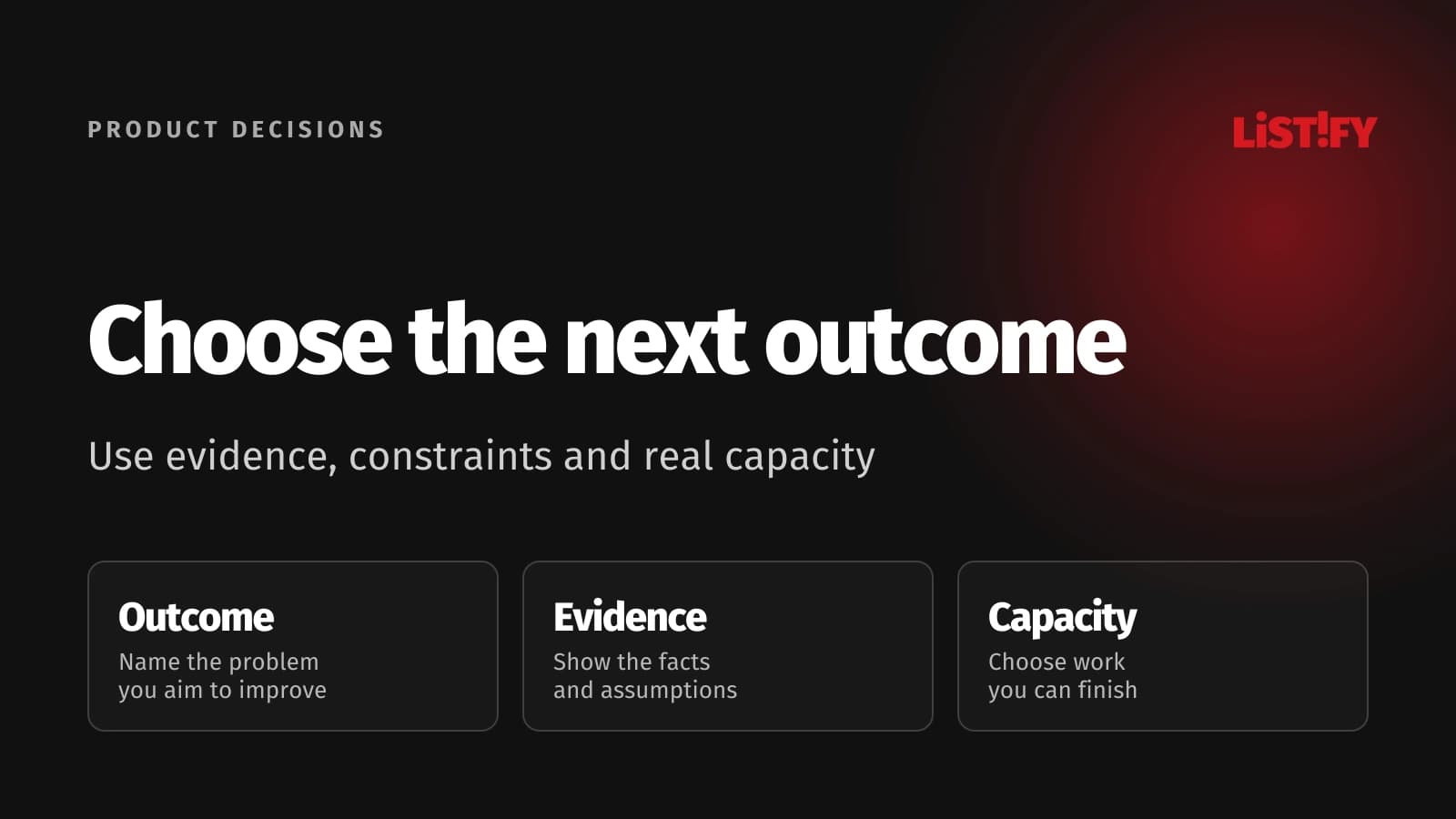
Prioritization is a decision about outcomes under limited capacity. A score can organize evidence, but it cannot determine which promise matters, remove a dependency or make an estimate certain. Begin with the current product goal and the constraints that the team must respect.
Then compare a manageable set of candidates at a similar level of detail. Record the reason for the order, the main uncertainty and when it should be reviewed. The result should be a usable next-work decision, not a permanently sorted spreadsheet that everyone is afraid to change.
01State the goal before ranking requests
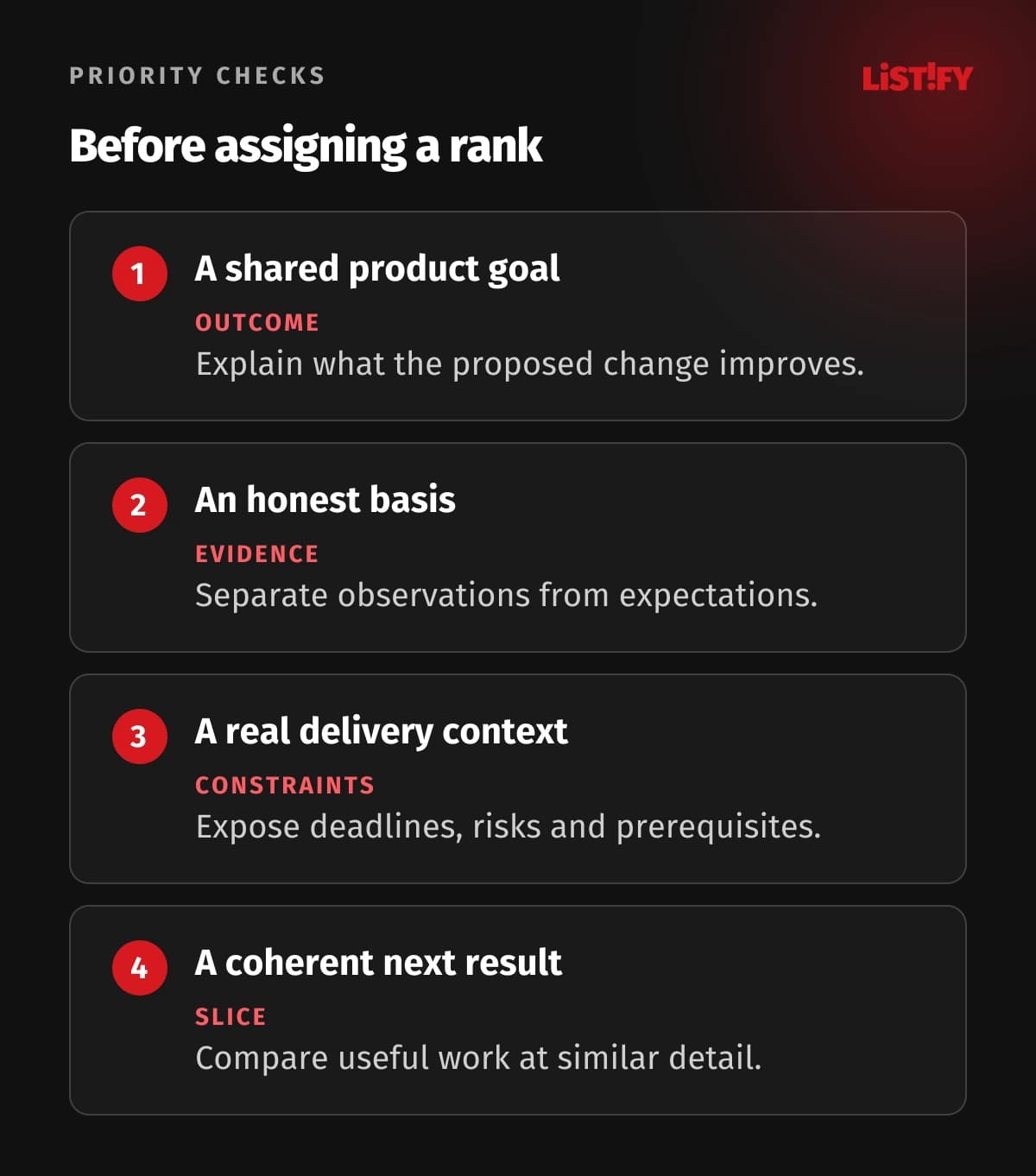
Choose the outcome the current investment is intended to support. A customer portal might aim to help customers resolve ordinary order questions without contacting the service team. That goal gives an onboarding improvement and an export request something concrete to be evaluated against.
Describe the problem separately from the proposed solution. A request for a downloadable report may reflect a need to share an order summary with a colleague. A different, smaller feature could solve the same problem. Scoring a feature name before understanding the task narrows the options too early.
Name the affected users and the evidence of the problem. Use support cases, observed task failures, product events or a documented requirement as appropriate. A loud request is useful evidence of one person’s need, but it does not establish how broadly the problem occurs.
Keep the decision horizon explicit. Work that matters to the next release may differ from work that matters to the product over a longer period. Do not compare an immediate correction and an exploratory strategic idea as if they were both ready for the same delivery slot.
The idea-to-MVP guide provides related demand-validation questions. Apply the same discipline after launch: ask what the change is expected to improve and what evidence would tell the team that the assumption was wrong.
Maintain a small candidate set for the next decision. The rest of the backlog can hold opportunities and context without pretending that every entry has a precise current rank. Detailed scoring of stale ideas adds maintenance work before it adds useful information.
02Identify constraints and prerequisites first
Separate work required to address an active failure or an established obligation from discretionary improvements. Determine its actual scope, consequence and deadline. Labeling something compliance or security does not resolve those questions, but a legitimate constraint should not compete blindly with a convenience feature.
Ask which dependencies make the proposed value possible. An integration improvement may require an identity change or a data contract before the visible feature can work. Compare a realistic delivery slice rather than assigning the visible feature a high score with its prerequisite omitted.
For the portal example, authorization must protect the customer record before a sharing feature can expose it appropriately. The team should define this dependency and the intended access behavior. A high-impact sharing estimate does not permit skipping the necessary control.
Record externally constrained dates with their source and consequence. A stakeholder’s preferred date, a supplier transition and a confirmed contractual commitment are different inputs. Establish what changes if the date is missed before placing every dated item at the front of the queue.
Acknowledge maintenance and operational work in capacity planning. If every available slot is promised to visible features, necessary reliability work will arrive as an unexplained interruption. Define how the team evaluates and funds it alongside customer-facing outcomes.
When new urgent work arrives, show the tradeoff. Name the planned item that moves and the reason. A priority change that quietly adds another commitment conceals the limited capacity that made prioritization necessary in the first place.
03Choose a method for the decision you face
| Approach | Useful decision | Important limitation |
|---|---|---|
| RICE | Compare candidate improvements with reach, impact, confidence and effort | Inputs are estimates and dependencies still matter |
| MoSCoW | Agree scope for a defined delivery period | Categories alone do not order every item within them |
| Impact and effort comparison | Discuss a small set with limited quantitative evidence | Simple labels can hide uncertainty and assumptions |
| Pairwise tradeoff | Explain why one of two competing items should come first | Repeated comparisons need a consistent goal |
| Delay consequence review | Identify why waiting changes the result | Urgency needs evidence and a defined consequence |
Intercom’s original RICE explanation combines reach, impact and confidence, divided by effort. Use a common reach period and comparable effort units. Its author explicitly allows dependencies and other reasons to change the score-based order.
Keep a score as a comparison tool, not a forecast of exact return or delivery success. A confidence factor can make uncertainty visible, but it does not transform an opinion into a measured probability. Explain the evidence behind the inputs.
The Agile Business Consortium’s MoSCoW guidance defines Must, Should, Could and Won’t Have this time. Its categories relate to a stated timeframe. Use the consequence of leaving something out to distinguish essential scope from a desirable improvement.
When every request becomes a Must, ask whether a viable release exists without it and what alternative is available. If the required scope exceeds capacity, negotiate scope, timing or resources explicitly. Renaming a full backlog does not create room to deliver it.
For a small team choosing among a few improvements, a clear impact-and-effort conversation may be enough. Record what each label means and the reason for the choice. Add a more formal method when it resolves a real inconsistency, rather than because it looks sophisticated.
04Make uncertainty visible and compare similar slices
Separate measured facts from assumptions in the candidate record. The number of affected accounts may come from product events, while the expected change in behavior remains a hypothesis. Showing both helps the team identify which question could change the decision most.
Use estimates appropriate to the available evidence. A broad effort range can be more honest than a precise decimal for work whose integration is still unknown. Discuss whether the candidates remain in the same order across plausible assumptions.
Investigate the decision-sensitive unknown. If a requested integration appears valuable but might require a complete supplier migration, a focused technical check can be the next priority. The purpose of the check is to resolve the choice, not to complete implementation by another name.
Slice large proposals into coherent outcomes. A full reporting module may contain a basic order summary, filtering and scheduled distribution. Compare the smallest useful version with another similarly sized candidate, while keeping the later work and dependencies visible.
Do not make a feature appear cheap by excluding design, testing, migration or operational support. Include the work required to reach a usable result. A quickly built interface with an unresolved data dependency is not the same candidate as a complete supported workflow.
For the portal, a clear answer to the most common order-status question could be a useful slice. Test whether it reduces confusion before assuming the team needs a broad self-service center. A small result can improve the evidence for the next backlog decision.
05Connect order with capacity and accountability
Name the person accountable for the final order and how stakeholder input reaches that decision. Engineering contributes feasibility and effort, support contributes recurring problems and business owners contribute constraints. The method should make these inputs usable without requiring every stakeholder to approve every position.
The Scrum Guide assigns accountability for Product Backlog ordering to the Product Owner. Teams using Scrum should respect that responsibility. Other operating models still need a clear decision owner rather than a scoring spreadsheet that supposedly makes the choice by itself.
Keep readiness distinct from importance. An important item may need clarification, evidence or a prerequisite before delivery can start. State the next preparation action while preserving its significance. A less important ready item should not silently become the strategy simply because it is easier to begin.
The Kanban Guide describes explicit workflow policies, control of work in progress and selecting new work when capacity is available. Ordering candidates is useful only if the team can finish work through its actual process.
Inspect current work before adding more. A blocked integration or aging review may deserve attention before another high-scoring feature starts. Make the bottleneck and owner visible. Opening a new task can feel productive while postponing the result the customer is already waiting for.
Use capacity and observed delivery information to support a forecast, and communicate its uncertainty. A priority score is not a promised release date. Keep the decision to pursue an outcome separate from a commitment that depends on scope, dependencies and available people.
06Review the result and update the order deliberately
Record a concise decision: chosen item, expected outcome, evidence, main uncertainty, relevant dependency and the reason another candidate waits. This is enough context to explain a later change without recreating the entire discussion.
Review the outcome after delivery, using the original success condition. A feature being released does not establish that the problem improved. Check whether the targeted users can complete the task and whether the change creates errors or additional support work.
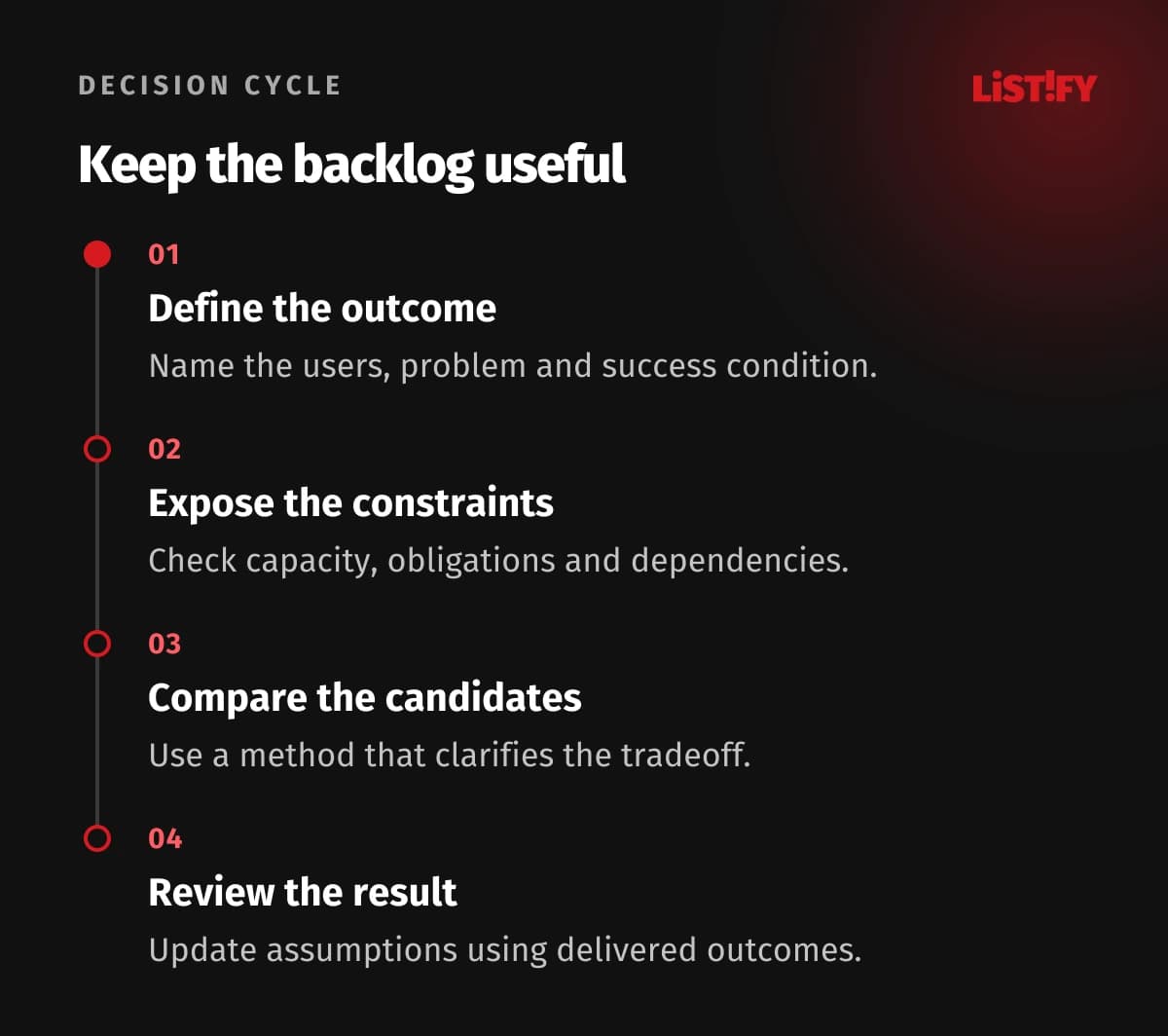
Use new evidence to revise assumptions and estimates. An integration proving harder than expected can alter the next slice; a delivered improvement producing little benefit can reduce the value of similar proposals. Keep the update connected to a fact or decision rather than an unexplained change of mood.
Review at an appropriate cadence and when a material event occurs. Avoid rescoring everything whenever a new request arrives, but do not preserve an obsolete order simply because it was approved last month. Explain the effect on work already underway.
The agile and waterfall comparison discusses broader delivery choices. Whichever approach the team uses, keep priorities, scope and commitments distinguishable. A useful backlog helps people understand the next decision and the tradeoff behind it.
07Questions about backlog prioritization
Which prioritization method is best?
Choose according to the decision and available evidence. RICE can support comparable candidates, MoSCoW can clarify timeframe scope and a simple tradeoff can work for a small set. No method removes the need for a goal, constraints and judgment.
Does the highest score have to be delivered first?
No. Dependencies, established obligations and operational constraints can change the sequence. Record the reason so the exception is understandable rather than adjusting inputs to make a preferred item appear mathematically inevitable.
What if every stakeholder calls an item a Must?
Define the delivery period and the consequence of leaving each item out. Identify a viable minimum scope and real workarounds. If required work exceeds capacity, negotiate the plan explicitly instead of labeling everything essential.
How should uncertain effort be handled?
Show a suitable range and the unknown that drives it. Investigate when resolving that unknown could change the choice. Avoid precise numbers that imply knowledge the team does not yet have.
Should technical maintenance compete with features?
It needs visible evaluation and capacity, with its operational consequence explained. Some work addresses a constraint or enables another outcome. Do not hide it or assume a customer-feature score describes its entire value.
How often should priorities change?
Review at a cadence suited to the work and when material evidence or constraints change. Explain displaced work and preserve the context of current commitments. A new request alone need not trigger a complete rescore.
Can a score guarantee return on investment?
No. It organizes estimates and tradeoffs. Validate the outcome after delivery and use the result to improve future decisions. A ranking, a delivery forecast and actual business value are separate forms of information.