Native vs. cross-platform app development: what actually pays off for your project in 2026
For most business apps, cross-platform development is the better deal today: one codebase for iPhone and Android, one team, and roughly half the work on every new feature. Native development earns its cost when the app depends on raw performance, phone hardware or the very latest iOS and Android features. Here is how to tell which group your app belongs to.
Sooner or later, every company planning a mobile app hits the same question: build it separately for iOS and Android, or once for both? The answer shapes your budget, your launch date and what the app will cost you every year after that. Below you will find both approaches compared with real numbers, an overview of the most widely used frameworks and the stories of companies that went in opposite directions.
01The short answer: when to choose which
Go cross-platform if:
- you need the app on both iPhone and Android and have a single budget,
- the app mostly shows data, forms, orders, bookings or a customer account,
- you want to ship a first version fast and keep shaping it based on feedback,
- you don’t want to pay two teams to build the same features twice.
Go native if:
- the app depends on heavy graphics, augmented reality, or real-time video or audio processing,
- you need deep hardware access: Bluetooth devices, sensors, smartwatches, long-running background work,
- you want to use new iOS and Android features on the day they ship,
- you only target one platform, for example an internal app for company iPhones.
02What native and cross-platform actually mean
A native app is written separately for each operating system, in the language and tools its maker provides. For iPhone that means Swift and SwiftUI from Apple, for Android Kotlin and Jetpack Compose from Google. If you want both platforms, you end up with two separate apps and two codebases that have to be built, tested and fixed side by side.
A cross-platform app comes from one shared codebase that is compiled into an iOS version and an Android version. This is not a website wrapped in an app, as it often was ten years ago. Modern frameworks either render genuine native components or use their own fast rendering engine, and they reach the stores as fully fledged apps.
| Technology | Language | Backed by | What is shared |
|---|---|---|---|
| Native iOS | Swift, SwiftUI | Apple | Nothing, iOS only |
| Native Android | Kotlin, Jetpack Compose | Nothing, Android only | |
| React Native | JavaScript, TypeScript | Meta and the community | Logic and UI, using native system components |
| Flutter | Dart | Logic and UI, with its own rendering | |
| Kotlin Multiplatform | Kotlin | JetBrains | Logic, UI optionally via Compose Multiplatform |
| .NET MAUI | C# | Microsoft | Logic and UI |
There is a third route: a progressive web app (PWA), a website users can add to their home screen that also works offline. For simple internal tools it can be enough. It has drawbacks, though: it is more limited on iPhone, customers usually won’t find it in the App Store or Google Play, and its access to phone hardware is weaker. If you are not sure you need an app at all, have a look at our web applications.
03Why you almost always need both iOS and Android
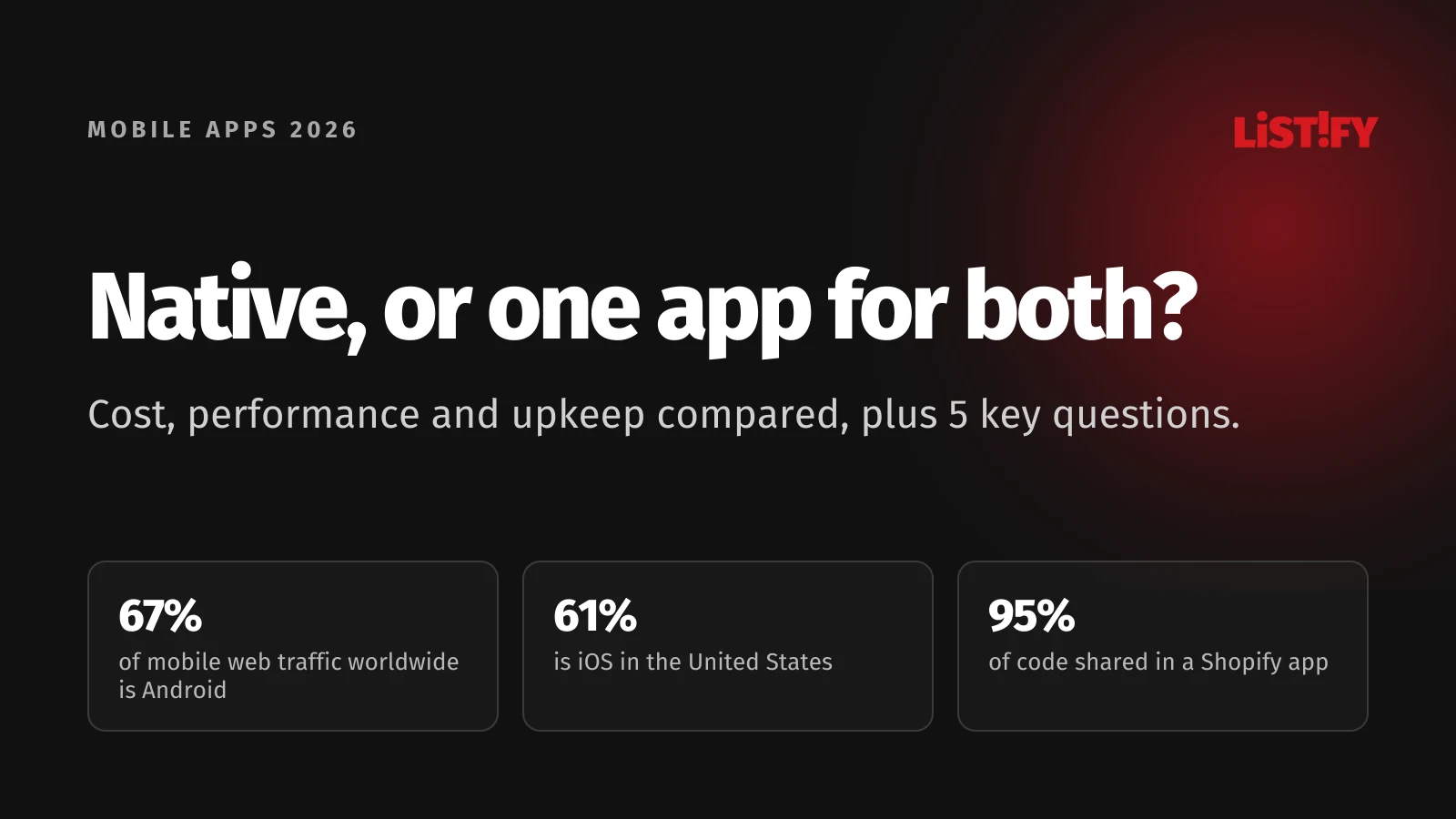
According to StatCounter, which measures website traffic, Android accounted for 67.4% of mobile traffic worldwide in August 2026 and iOS for 32.5%. iOS gained almost seven percentage points in a year, up from 25.7% in August 2025. And in some of the richest markets the picture flips: in the United States, iOS has 60.7%. Wherever your customers are, a large share of them will be on the other platform.
- Android worldwideAugust 2025: 73.9%August 2026: 67.4%
- iOS worldwideAugust 2025: 25.7%August 2026: 32.5%
- iOS in the United StatesAugust 2025: 57.3%August 2026: 60.7%
Source: StatCounter Global Stats, worldwide and United States, monthly data. The headline figure on the StatCounter page itself may differ by a tenth of a percentage point.
The takeaway for your decision is simple. An app for only one platform shuts out a large share of your customers, so most companies need both. And that is exactly where cross-platform development is strongest: the second platform costs a fraction, not double.
04What it costs: one codebase vs. two
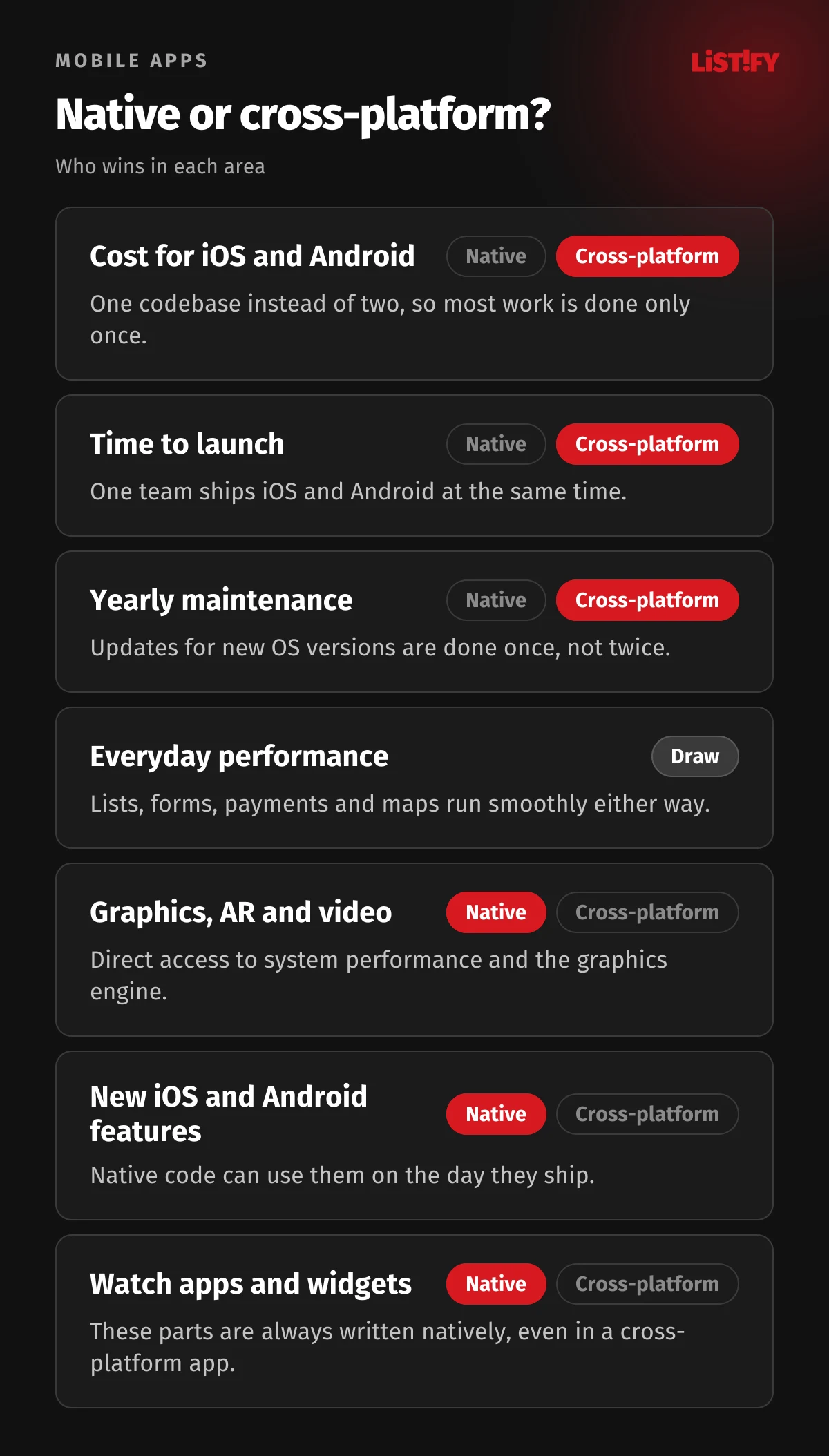
With native development you pay for most of the work twice. Every screen, every server integration and every bug fix is written once in Swift and again in Kotlin. Everything is tested twice, and someone has to keep reconciling the differences, because two apps drift apart over time even when they are meant to do the same thing.
With cross-platform development the vast majority of the code is written once. How much exactly depends on the app. Shopify, which moved all of its mobile apps to React Native, originally expected to share about 80% of the code. In practice two of its apps shared 95% and 99% of their code between iOS and Android (Shopify Engineering).
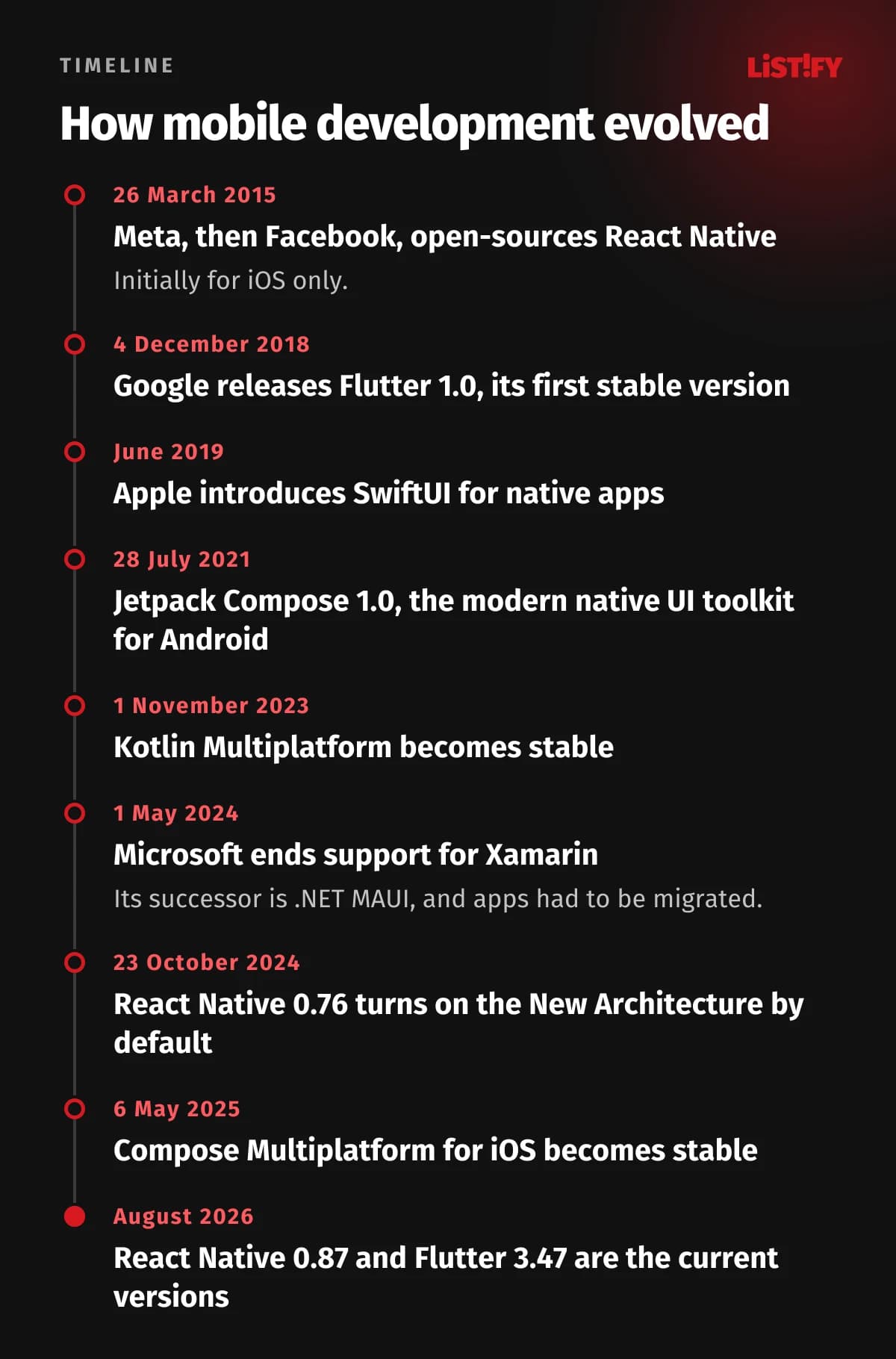
The difference doesn’t end at launch. An app needs care every year: Apple and Google release new OS versions, and the stores require apps to keep up. Since 28 April 2026, the App Store only accepts apps built with Xcode 26 and the iOS 26 SDK, and from April 2027 it will require the iOS 27 SDK (Apple). Since 31 August 2026, Google Play only accepts new apps and updates that target Android 16 (Google). With two native apps, you make these changes twice.
| What you pay for | Native for iOS and Android | Cross-platform |
|---|---|---|
| Screens and logic | Twice, in Swift and in Kotlin | Mostly once |
| Testing | Two apps | One app, checked on both systems |
| Bug fixes | Often in both codebases | Mostly in one place |
| Updates for new OS versions | Twice | Once, native parts separately |
| Widgets, watch apps, native modules | Separately for each system | Also separately for each system |
| Team | iOS and Android specialists | One team, native skills as needed |
| Store fees | The same | The same |
Don’t forget store fees in your budget. An Apple developer account costs USD 99 a year, charged in local currency (Apple). Google Play charges a one-time USD 25 (Google). Both stores take a commission on digital goods sold in the app: developers earning up to USD 1 million a year pay 15% at both Apple and Google; above that, it is usually 30% (Apple, Google). Apple may apply different rates to some apps in the EU. The fees are the same for native and cross-platform apps.
05Performance and experience: will users notice?
For a typical business app, mostly not. Lists, forms, payments, maps and push notifications all run smoothly in React Native and Flutter today. Since version 0.76 in October 2024, React Native ships with its New Architecture enabled by default (React Native). After five years with React Native, Shopify reports that three quarters of screen loads in its app finish within half a second and more than 99.9% of sessions are crash free (Shopify Engineering).
The difference shows up in specific tasks. Native wins when the app:
- processes camera input, video or audio in real time,
- relies on augmented reality or 3D graphics,
- runs in the background for long periods, for example tracking a route or talking to a Bluetooth device,
- includes an Apple Watch app, home screen widgets or Live Activities on the lock screen.
A cross-platform app can still contain native code, though. An iPhone widget is always written in SwiftUI, whatever the rest of the app uses. A good team writes 90% of the app once and adds native code only where it is truly needed.
06React Native, Flutter or Kotlin Multiplatform
Which cross-platform framework leads? The last large survey that asked is the Stack Overflow Developer Survey 2024, as the 2025 edition dropped the question. In it, Flutter and React Native are practically level, while .NET MAUI trails far behind.
- Flutter9.4%
- React Native8.4%
- .NET MAUI3.1%
- Xamarin2.9%
- Ionic2.5%
Source: Stack Overflow Developer Survey 2024, question Other frameworks and libraries, all respondents. Kotlin Multiplatform was not listed separately. The newer edition has no such data.
React Native
Meta’s framework lets you write apps in JavaScript or TypeScript and renders genuine native system components. On an iPhone, the app looks and behaves like an iPhone app. A big plus is that the web uses the same language, so the team can share logic with a web app and hiring is easier. React Native powers all of Shopify’s mobile apps, Discord on mobile and Microsoft apps such as Outlook, Teams and Xbox Game Pass (React Native Showcase).
Flutter
Google’s framework uses the Dart language and draws every component itself. That makes the app look identical on both platforms down to the last pixel, which brands with a strong custom design appreciate. The downsides are a less widespread language and the fact that it imitates the system look instead of using it directly. Google uses Flutter in its own apps, such as Google Pay and NotebookLM, and so do companies like BMW, Toyota, eBay and Nubank (Flutter Showcase).
Kotlin Multiplatform
JetBrains’ technology mainly shares the app’s logic: data handling, calculations and server communication. The UI can stay native or be shared through Compose Multiplatform. It suits companies that already have a native Android app and want to gradually share code with iOS. Netflix, McDonald’s, Cash App and Duolingo use it to share logic (Kotlin case studies).
07What big companies learned
In June 2018, Airbnb announced it was sunsetting React Native and going back to fully native development. Engineer Gabriel Peal described the main reason: the company ended up maintaining code for three platforms instead of two: iOS, Android and React Native. Interestingly, 63% of Airbnb engineers said they would have chosen React Native again (Airbnb Engineering).
Shopify went the other way. In January 2020 it decided to build all new mobile apps in React Native, and over five years it migrated every app to it. Yet Shopify itself warns that 100% React Native should not be the goal: for cutting-edge features that lean on device hardware, native is still the best way to build (Shopify Engineering).
Both stories point to the same lesson: what matters is how well the technology fits your team and your app. Airbnb had strong native teams, and React Native was an add-on they constantly had to work around. Shopify bet on one technology for everyone and built its whole team around it.
08Decide in 5 questions
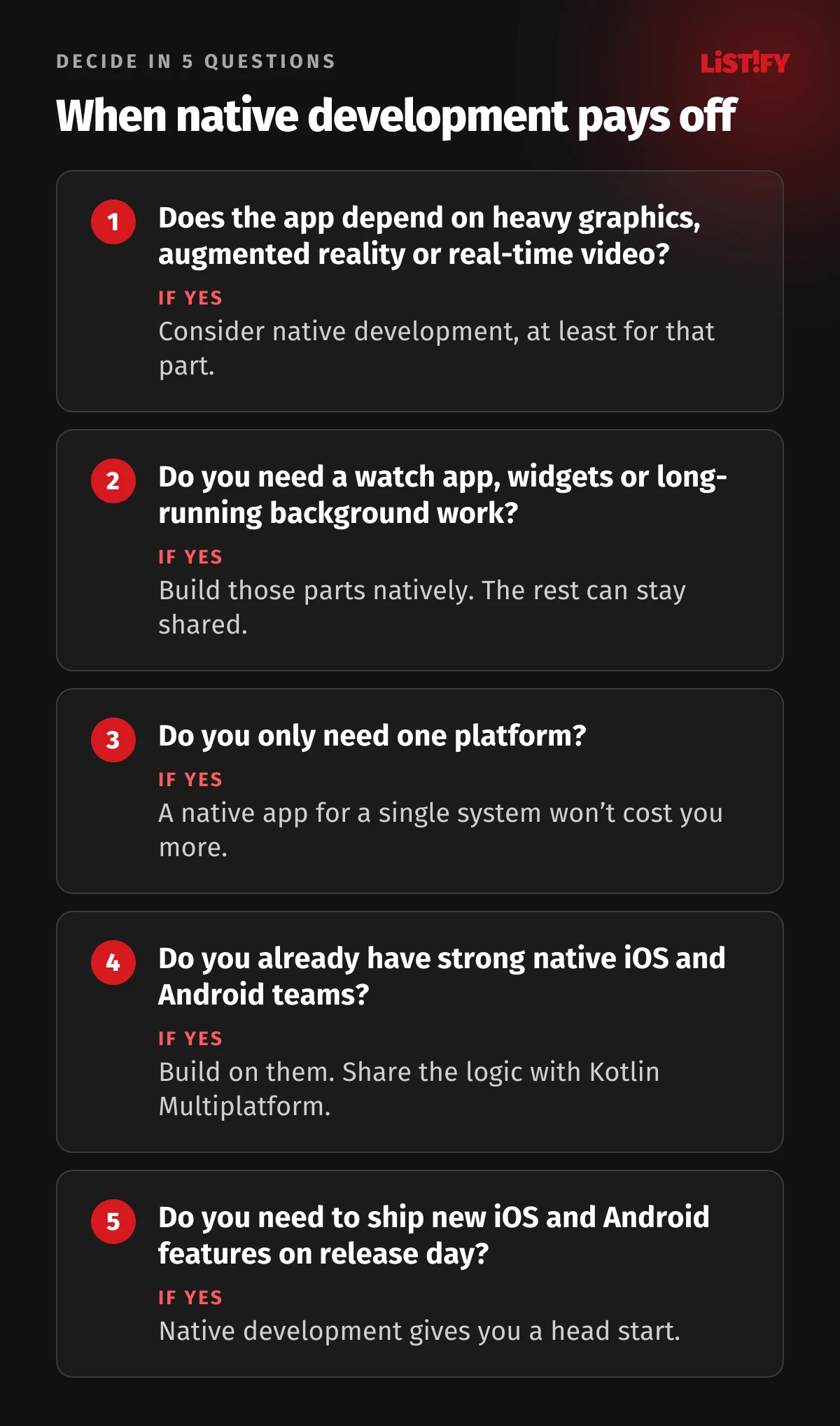
A single yes doesn’t automatically mean going native. Often it is enough to build that one part natively and keep the rest of the app cross-platform.
09The most common mistakes
- Choosing by hype instead of by app. The technology everyone is talking about may not fit your team or your brief.
- Going native “just to be safe”. If the app needs none of the things listed above, you pay double for a difference users won’t notice.
- Forgetting maintenance. Yearly updates for new iOS and Android versions apply to both approaches. With two native apps, you do them twice.
- A website wrapped in an app. A thin shell around a website with no real mobile features is often rejected by Apple and disappoints users.
- A vendor with no native experience. Even a cross-platform app sometimes needs a piece of native code. Ask whether the team can write it.
10How we do it at LISTIFY
We build most mobile apps in React Native with Expo and TypeScript. One codebase for iOS and Android lets us ship the first version in 12 to 14 weeks in most cases. Where the app needs it, we write that specific part natively in Swift or Kotlin. A simpler app for both platforms starts at around CZK 200,000 excl. VAT, and a full product app at CZK 450,000.
If you are not sure yet whether you need an app, a website or both, we are happy to talk it through with you. Sometimes the best app is the one you don’t need to build at all.
11Frequently asked questions
Is a cross-platform app slower than a native one?
For typical apps, users won’t notice a difference. React Native renders native system components, and Flutter has its own fast rendering engine. The gap shows in heavy graphics, video processing or augmented reality.
How much will cross-platform development save me?
It depends on the app. Most screens, logic and tests are written once instead of twice, so the savings grow with every feature and every year of maintenance. Any native parts the app needs are still written separately.
Will Apple and Google approve a cross-platform app?
Yes. It goes through the stores just like a native app and is reviewed under the same rules. The ones that run into trouble are apps that are just a shell around a website with no features of their own.
React Native or Flutter?
Both are mature. React Native fits when you want the UI to follow each system exactly and share the language and logic with your web app. Flutter suits a bold custom design that should look the same everywhere.
Can I start cross-platform and move to native later?
Yes, but it means a new app. It is smarter to plan from day one for the demanding parts to be native and the rest shared.
Is a mobile website enough instead of an app?
For simple things, yes. An app makes sense when you need push notifications, offline mode, the camera, location, one-tap payments or a spot on the customer’s home screen.
12Sources
Data checked on 27 September 2026. Market shares and surveys change, so check current figures before you decide.
- StatCounter: mobile OS market share worldwide
- StatCounter: mobile OS market share in the United States
- Stack Overflow Developer Survey 2024: Other frameworks and libraries
- Apple: Upcoming Requirements
- Apple: Submitting to the App Store
- Google Play: Target API level requirements
- Apple: Program enrollment (fee)
- Google Play: Developer account registration
- Apple: App Store Small Business Program
- Google Play: Service fees
- React Native 0.76: New Architecture by default
- React Native: versions
- Meta: React Native open-sourced (2015)
- Shopify: React Native is the future of mobile at Shopify (2020)
- Shopify: Five years of React Native at Shopify (2025)
- Airbnb: Sunsetting React Native (2018)
- React Native Showcase
- Google: Flutter 1.0 (2018)
- Flutter: release notes
- Flutter Showcase
- JetBrains: Kotlin Multiplatform is Stable (2023)
- JetBrains: Compose Multiplatform 1.8.0 for iOS (2025)
- Kotlin case studies
- Microsoft: Xamarin support policy
- Google: Jetpack Compose 1.0 (2021)
- Apple: WWDC 2019 highlights and SwiftUI