Measure the final outcome: connect marketing campaigns to real business profit
A campaign reports strong revenue, but the business has no more money. It may be discounting heavily, paying too much for delivery or waiting for invoices to be settled. Measurement needs to reach the final commercial outcome: what customers actually bought, what fulfilment cost, what marketing cost and what has been paid.
Measuring the final outcome does not mean waiting until the budget is spent before designing measurement. The links between campaigns, customers, orders and costs must be planned in advance. With those links, you can determine which sales help fund the business, where risk is building and which offers deserve further promotion.
01Agree what earning money actually means
Marketing may count an order, sales may count a signed contract, and management may look for money in the bank. Each view answers a useful but different question. They cannot all sit under a single column labelled “profit”. Start with shared definitions agreed with someone who understands the business’s finances.
| Measure | What it tells you | What it cannot tell you alone |
|---|---|---|
| Revenue-based ROAS | Attributed revenue relative to advertising spend | The cost of goods, work and operations |
| Contribution after marketing | What remains after variable and allocated marketing costs | The company’s final accounting profit |
| Operating result | The result after operating costs under agreed rules | How much cash is in the bank today |
| Cash collected | How much of the receivables has been paid | Whether the delivered work was profitable |
In this article, net revenue excludes VAT and reflects discounts and returns. Costs use the same tax basis and currency. Finance must adapt the definition for non-recoverable tax or a different accounting treatment. Contribution after marketing is a management subtotal, not automatically net profit. Keep the definition visible wherever the figure appears.
02The financial record starts with the order and its items
Use the order system, CRM and accounting records to establish the final count of sales. Advertising platforms offer their own views of attributed outcomes. Adding their reported revenue together does not establish company revenue, because one purchase may appear in several advertising accounts.
For each order, you need items, discounts, fulfilment costs, cancellations and links to payments. A contract may have a deposit and a balance payment; neither should cause the full contract value to be counted again. Our guide to connecting advertising, CRM and paid invoices explains the basic relationships.
Record customer acquisition separately from subsequent purchases. Otherwise every repeat order may be presented as a newly acquired customer. Where the source is unavailable, retain an unknown category. Assigning the campaign that seems most plausible would improve the appearance of the report rather than its reliability.
03Build the calculation from revenue to contribution and profit
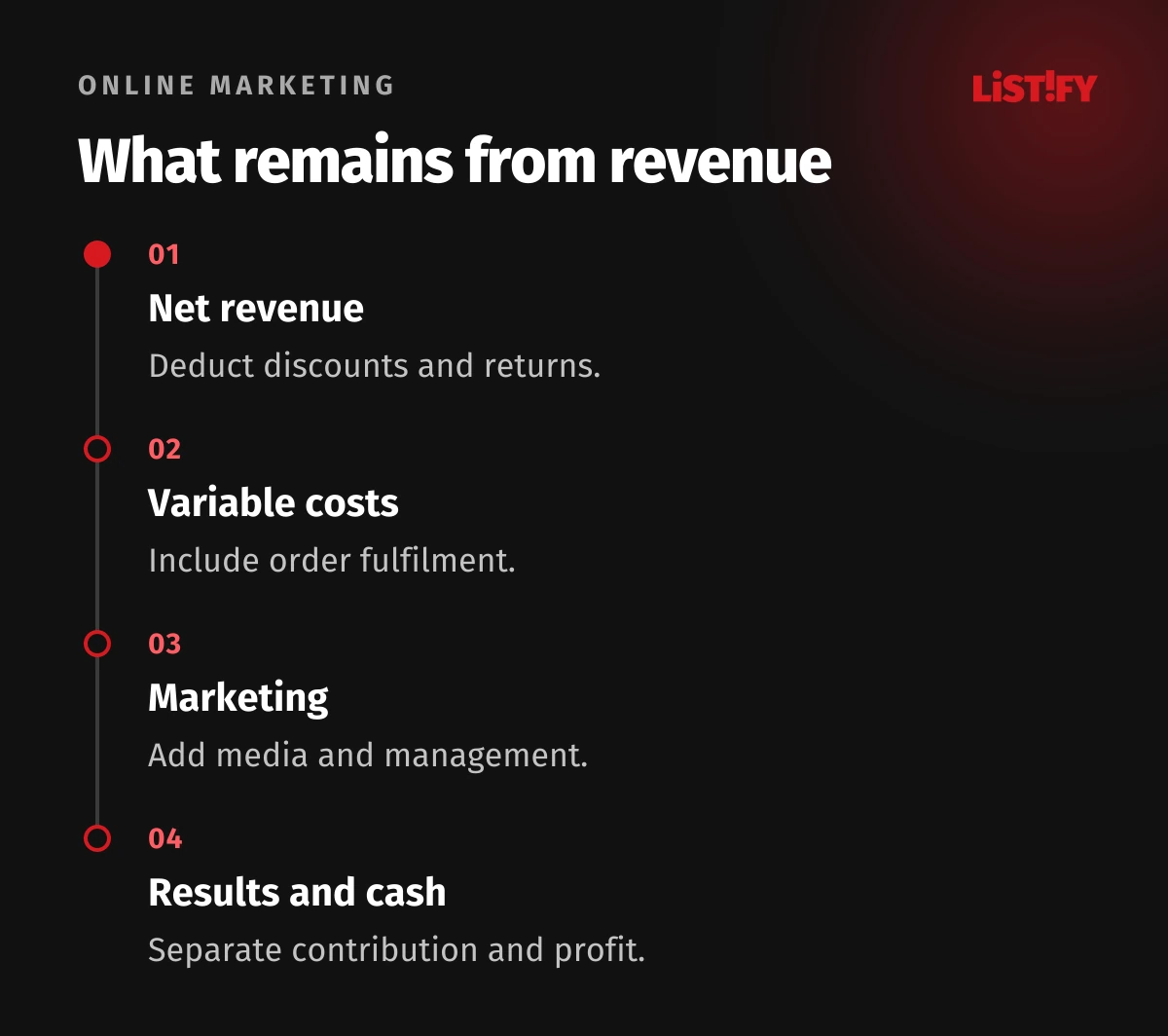
- Net revenue: final value after discounts, cancellations and returns, using the agreed tax basis.
- Variable costs: goods, direct fulfilment, fees, packaging and, where relevant, commissions and return handling.
- Contribution before marketing: net revenue less variable costs.
- Marketing: media buying plus the agreed allocation of management, creative and tool costs.
- Contribution after marketing: the amount remaining for fixed costs and eventual profit.
Avoid deducting the same cost twice. If a salesperson’s work is included in the variable cost of a contract, do not add it again as an acquisition cost. For shared creative work or a management retainer, choose a reasonable allocation rule and describe it. A figure precise to the cent is not especially useful when the allocation itself is a rough estimate.
Fixed overhead matters for total company profit. When deciding whether to take the next order, also identify which costs that order actually adds. A campaign may produce positive incremental contribution even if an administrative allocation of office rent makes it look unprofitable. Preserve both views and state the question each is intended to answer.
04A model: identical ROAS, very different contribution
These two scenarios are illustrative, not client results. Each has €20,000 of net revenue and €4,000 of advertising spend. Revenue already reflects discounts and returns. Revenue and costs exclude recoverable VAT, use the same period and follow the same allocation rule.
| Item | Scenario A | Scenario B |
|---|---|---|
| Net revenue | €20,000 | €20,000 |
| Variable costs | €12,000 | €15,200 |
| Contribution before marketing | €8,000 | €4,800 |
| Advertising spend | €4,000 | €4,000 |
| Campaign management and production | €800 | €800 |
| Contribution after marketing | €3,200 | €0 |
| Revenue-based ROAS | 5 | 5 |
- Net revenueScenario A: 20,000Scenario B: 20,000
- Contribution before marketingScenario A: 8,000Scenario B: 4,800
- Contribution after marketingScenario A: 3,200Scenario B: 0
Illustrative model from the table. All values are in euros; contribution after marketing is not accounting profit. These are not client results.
Under these assumptions, A has a 40% contribution margin before marketing and B has 24%. If additional orders retain that margin and advertising spend stays at €4,000, A needs €12,000 of revenue to cover media and €800 of management, whereas B needs €20,000. This break-even point still does not cover overhead or the profit you require.
The practical conclusion is to inspect the product mix and delivery economics before celebrating the shared ROAS of 5. A campaign can sell more while leaving less money for the business. Whether a different offer, a pricing change or lower delivery cost is the right response requires evidence from the actual orders.
05Separate acquiring a customer from collecting the payment
An online store may receive returns several weeks after the order. A B2B business may receive an enquiry in November, deliver in January and collect payment in February. Comparing the November advertising budget only with November cash receipts therefore answers a different question from assessing November customer acquisition.
For campaign performance, follow cohorts: groups of customers acquired in the same period, observed for the same amount of time. Alongside that, keep a calendar view of receipts, payments and receivables. Show expected pipeline value separately from completed sales and separately from collected cash. These amounts are not interchangeable.
Each figure should have an as-of date, a completeness status and a last update time. New returns should revise the historical result according to a documented method. Our guide to business reporting and dashboards explains how to keep definitions consistent across the organisation.
06Return a selected, reliable signal to advertising platforms
Your financial reporting can contain more detail than the advertising account. For campaign optimisation, choose a milestone that occurs reliably and often enough, such as an accepted opportunity or a completed sale. The later financial outcome also helps check whether that earlier signal predicts useful business.
Google’s enhanced conversions for leads connect later events using permitted customer data and advertising identifiers. Check the current Data Manager workflow and documentation for the import method. Google Ads implementation guidance.
A price change or cancellation in CRM does not automatically update the ad account. Google supports value changes and conversion retractions, subject to the rules of the import method. Conversion adjustment guidance.
Do not send every sales stage as additional revenue. An enquiry, a closed deal and a payment are different events in the same transaction. Before using data for bidding, check duplicates, currencies and delayed records. Our Google Ads measurement checklist provides further controls.
Are the figures split between advertising, CRM and accounting? At Listify, we can design the connections for a specific sales journey alongside your digital marketing. Describe the systems you use and the decision you currently cannot support with evidence.
07Attribution allocates credit; experiments test additional impact
An attribution model allocates credit between recorded contacts before a conversion. Changing it can alter channel results without adding a sale to the business. Google Analytics attribution settings.
To assess the sales advertising actually added, you need a suitable comparison. Google Conversion Lift, for example, compares exposed and control groups; availability depends on the account. How Conversion Lift works.
Business records, attribution models and experiments are therefore not competing versions of the same truth. They answer different questions. Label documented transactions, attributed outcomes and estimates of incremental effect separately. With small volumes, an honest conclusion may include a wide range of uncertainty rather than a precise ranking of channels.
That distinction matters when increasing spend. A campaign that captures people already searching for your brand can look efficient in attributed reporting. Whether more budget creates additional demand is a separate decision. Treat the report as a basis for an explicit hypothesis, rather than proof of causality.
08Check data quality before moving budgets
Select ordinary orders, partial payments, cancellations and returns, then trace them from the source into the final report. “Successfully sent” is not sufficient evidence from an integration. You need to know which records were accepted and whether the resulting relationships and amounts are correct.
| Check | Practical question |
|---|---|
| Completeness | Did orders and costs arrive for the entire period? |
| Uniqueness | Did a repeated transfer create another sale? |
| Amounts and currencies | Do items, discounts, returns and exchange rates reconcile? |
| Freshness | Is the last successful update time visible? |
| Access | Can only the necessary roles see personal and financial data? |
| Traceability | Can you open the underlying record and explain the calculation? |
A missing cost must not silently become a zero cost. Mark the contribution figure incomplete until the missing information is supplied. Treat sharing personal information separately from internal financial reporting, and use only data and purposes for which you have the appropriate permission.
09Start with one decision and a small, verified scope
An initial brief could be: “Compare contribution from new customers acquired by two campaigns after the same observation period.” Choose one offer, available sources and a sample of completed sales. Use them to check definitions and calculations. Automate the recurring transfer and add channels only after that foundation works.
If you are starting acquisition, our guide to generating B2B leads through ads and SEO provides useful context. Design measurement around the actual sales cycle, rather than whichever figures are easiest to export.
The first stage should deliver a metric dictionary, a source inventory, exception rules, a verified sample and a named owner for ongoing operation. Choosing a charting tool comes afterwards. Listify can connect the marketing requirements with the integration design and a view for management.
10Use the meeting to decide what the business will change
Reporting that ROAS increased is not enough. Ask whether new-customer contribution improved, whether collection slowed and whether the team can fulfil more work. For a large movement, check that it was not caused by a new calculation or missing costs before treating it as commercial progress.
The conclusion should lead to an action: change the promoted assortment, restrict a blanket discount, repair lead handover, review payment terms or test additional spend. Assign an owner and a review date. Our article on marketing reporting for executives explains how to communicate that decision clearly.
11Frequently asked questions
Is Google Ads ROAS enough?
It is useful for reviewing advertising performance. If the value represents revenue, it does not automatically include goods, fulfilment, management or overhead. Profit decisions require a connected financial view.
Does a paid invoice mean profit?
No. Payment confirms collection, but the sale also has costs. Profit and cash flow can differ because of delivery dates, deposits and payment terms. Show them separately in reporting.
Do we need a new CRM?
Not necessarily. First check the data and interfaces already available. Adding identifiers, stages and a recurring transfer may be enough. A replacement makes sense when the existing system cannot support the required process.
Can every order be attributed precisely to a campaign?
Complete attribution cannot be promised. Some journey data is missing, customers use multiple devices and platforms apply different rules. Keep an unknown-source category and distinguish transactions from modelled outcomes.
What does Listify need for an initial measurement proposal?
Your advertising channels, CRM or store, invoicing system and a description of the sales journey. Add one question you cannot currently answer. We can then propose an initial scope and a verification approach based on the data available.