Marketing attribution: which channel contributes to sales?
The advertising platform reports a sale, the analytics dashboard credits search and the sales team remembers a referral. These accounts can describe the same customer from different perspectives. Begin with a reliable business outcome, understand how each report assigns credit and use experiments when the decision requires evidence of additional sales.
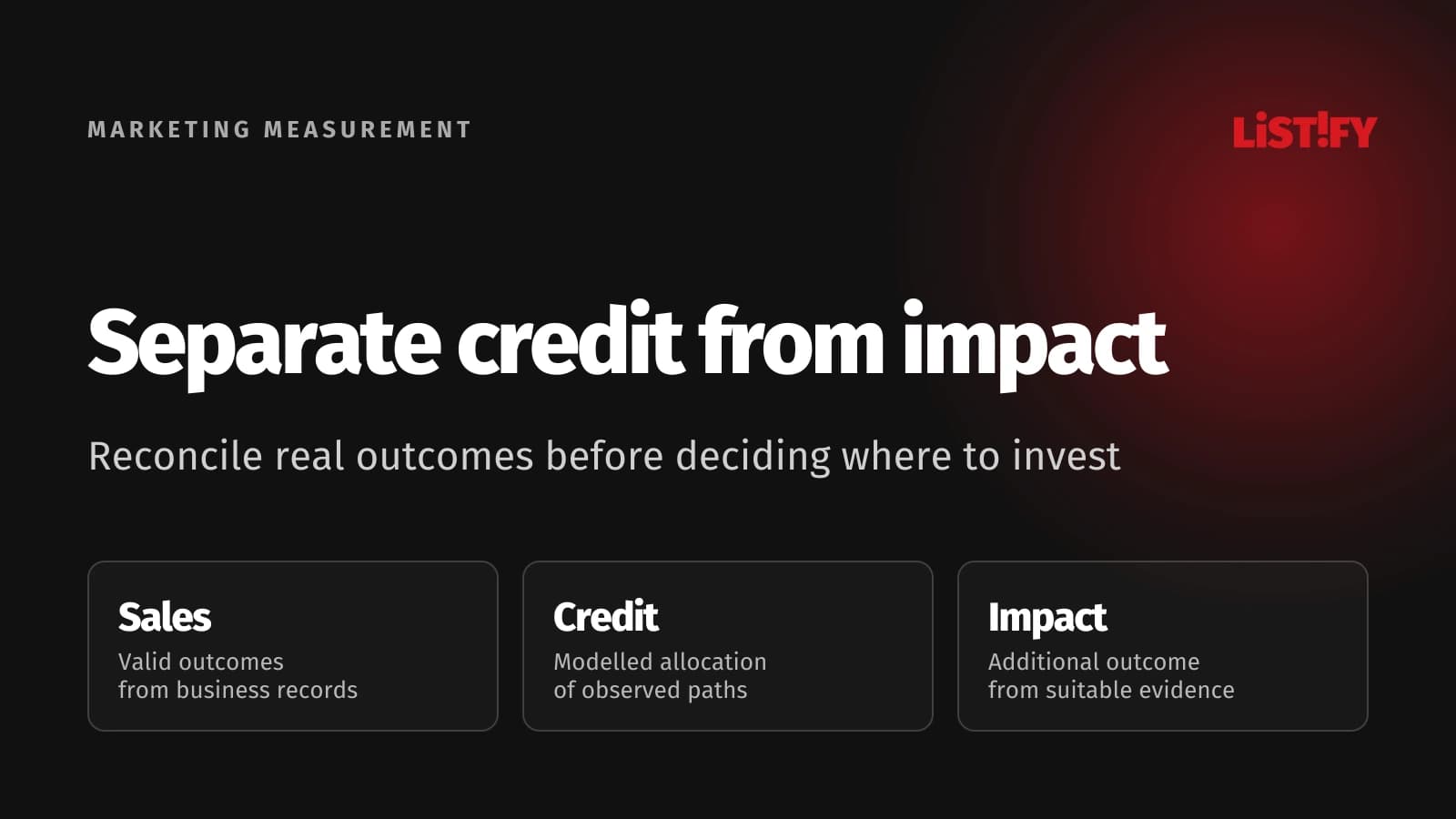
Attribution allocates credit among observed interactions. It is useful for understanding acquisition paths, but it does not automatically show which sales would disappear if a channel stopped. That causal question needs a different kind of evidence.
A practical measurement process keeps three views connected: the business’s actual orders or qualified opportunities, the platforms’ attributed outcomes and the evidence about incremental contribution. Choose the view that fits the decision instead of asking one report to answer every question.
01Define the sale before comparing channels
Agree the outcome and its source of truth. An ecommerce order, a paid subscription and a qualified sales opportunity are different events. Decide whether the report uses placed orders, paid orders or net revenue after returns. Otherwise, channel comparison begins with inconsistent definitions.
For an illustrative equipment supplier, a form submission begins the sales process but does not establish a sale. The team should distinguish valid enquiries, qualified opportunities and closed business. Sending every form submission to ad bidding as equal success can direct spending toward easy but irrelevant leads.
Give outcomes stable identifiers where appropriate and define duplicate handling. A browser event and a server event may represent one order. Refreshing a confirmation page should not create another purchase in the report. Reconcile the measurement against the underlying order system using suitable access and privacy controls.
Record refunds, cancellations and delayed sales. A campaign can appear profitable before returned products or unqualified enquiries are accounted for. State the maturity of the reporting period, especially when recent leads have not had time to reach a sales decision.
Choose the financial measure needed for the budget decision. Revenue, gross margin and contribution after acquisition cost answer different questions. The marketing reporting guide provides context for presenting those distinctions clearly to business leaders.
02Understand the question behind each report
| View | Question it can support | Important limitation |
|---|---|---|
| Business records | How many valid sales or opportunities occurred? | Source information may be incomplete |
| Session acquisition | How did this measured session begin? | Does not represent the whole customer journey |
| Attributed key events | How does the selected model distribute credit? | Credit depends on observed data and model settings |
| Platform conversion report | What outcomes does that platform attribute? | Platforms can credit overlapping outcomes |
| Incrementality experiment | What changed because of the tested exposure? | Design, eligibility and uncertainty affect interpretation |
Google Analytics distinguishes traffic-source scopes, including user, session and event-related reporting. A session acquisition table and an attribution report need not assign the same channel to the same business outcome. Confirm the dimensions and scope before diagnosing a discrepancy.
Write a short definition beside each recurring metric: outcome, denominator, model, window and exclusions. A rate without its denominator can mislead even when every underlying event is recorded correctly. Keep the reporting timezone and currency consistent where comparison requires it.
Treat a platform’s attributed return as a platform-specific signal. A social ad and a search ad may both receive credit for an order under their respective settings. Adding the reported revenue from both can double count the same business sale.
Investigate differences in a fixed sequence: event integrity, reporting scope, timeframe, attribution window, consent and platform settings. Changing the model first can conceal a tracking error. Resolve the basic data questions before arguing about which channel deserves the credit.
03Use attribution models as decision aids
Google’s attribution guide explains available attribution approaches and how credit is allocated. Last-click approaches emphasize a final eligible interaction, while data-driven attribution uses observed data to distribute credit. Neither should be presented as complete knowledge of the customer’s motives.
A last-click view can undervalue earlier discovery interactions, but that does not make every early interaction valuable. A data-driven model can provide a broader view of measured paths, while still being limited by what the system can observe and its supported method.
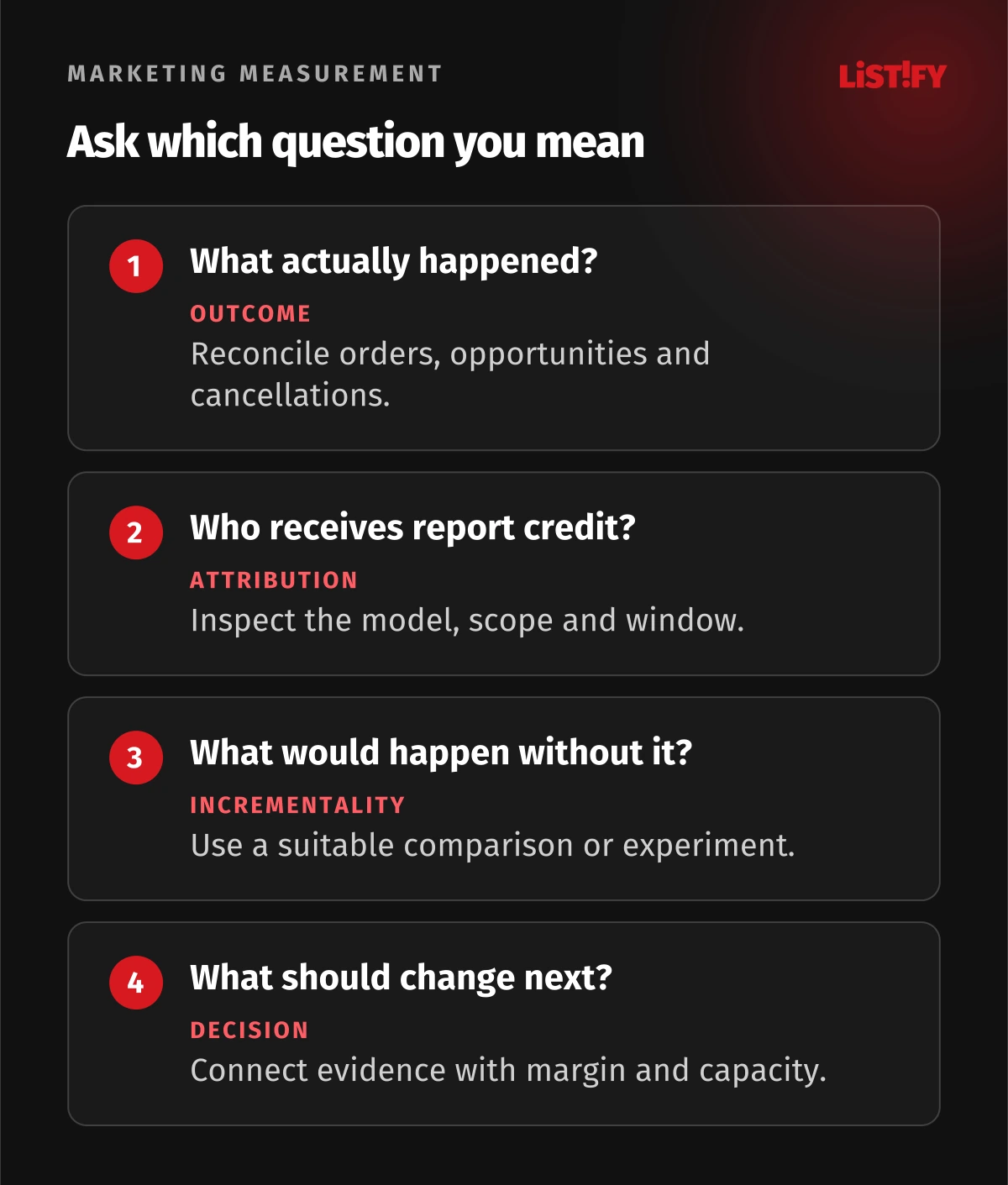
Inspect relevant paths and compare interpretations where tools permit. The aim is to identify a decision-sensitive difference, such as a discovery campaign that looks weak under final-click credit. Avoid switching models simply to produce the most flattering report for a preferred channel.
Match windows to the customer journey and document them. A long purchase cycle can outlast a short measurement window, while a broad window may credit remote interactions. Do not silently change the window between periods and interpret the resulting difference as campaign performance.
Keep the model’s role proportionate. It can inform optimization and generate questions for further investigation. A large budget reallocation should also consider valid sales, margin, capacity and evidence about whether demand would exist without the activity.
04Make missing and ambiguous data visible
Customers can move between devices, use private browsing, reject optional tracking or complete a purchase through another channel. Some interactions will be absent or aggregated. Report the available coverage honestly rather than describing the dashboard as a complete history of every person.
Google’s direct traffic guidance describes traffic without a clear referral source. Direct therefore does not reliably mean that every visitor typed the address or already knew the brand. Missing tags, redirects and other source loss can also affect the category.
Use consistent campaign parameters for links you control and preserve them through legitimate redirects. Establish a naming convention for source, medium and campaign. Avoid using campaign tags on internal navigation, where they can confuse the interpretation of acquisition.
Keep personal information out of campaign names and URLs. A recipient’s email address is not a useful source label. Review consent and processing requirements for the markets you serve, along with the platform’s collection rules. Technical capability to record an event does not establish permission.
Record known changes in measurement coverage. A new consent interface, checkout migration or broken tag can create a trend that resembles a marketing shift. Keep those changes in the reporting log so the business can distinguish behavior from collection conditions.
05Test incremental contribution when it matters
Incrementality asks what additional outcome the activity produced compared with a suitable counterfactual. A well-designed test compares exposed and control conditions while addressing contamination and other changes. It is different from comparing this month with last month after many things changed together.
Google Ads describes Conversion Lift as measuring incremental conversions, including supported user or geography approaches. Availability and suitable volume vary. Check the account’s eligible tools and design requirements before promising that every small campaign can run such a study.
Choose a test around a decision the business can act on. For example, an equipment supplier might investigate whether a particular prospecting activity creates additional qualified demand. Define the primary outcome and guardrails, and account for sales delay before treating recent enquiries as the complete result.
Avoid an uncontrolled channel shutdown being described as a clean experiment. Seasonality, competitor activity, stock changes and other campaigns can affect the same period. If a rigorous design is unavailable, record the limitations of the observational comparison and use it as qualified evidence.
A study with uncertain results does not prove zero effect. Examine the uncertainty, power and operating conditions with an appropriate analyst. The useful decision may be to gather more evidence, revise the tested activity or accept a bounded risk rather than declaring an absolute winner.
06Turn evidence into a budget decision
Reconcile a compact reporting set: actual outcomes, attributed views, channel cost and commercial quality. Include sales capacity and margin where they affect the decision. A campaign producing many enquiries can be expensive if the team cannot qualify or serve them.
Use measured paths to find questions, then choose the evidence needed to resolve them. Attribution can reveal a pattern worth testing. Sales feedback can identify low-quality demand. Neither needs to be discarded because it cannot answer the whole causal question alone.
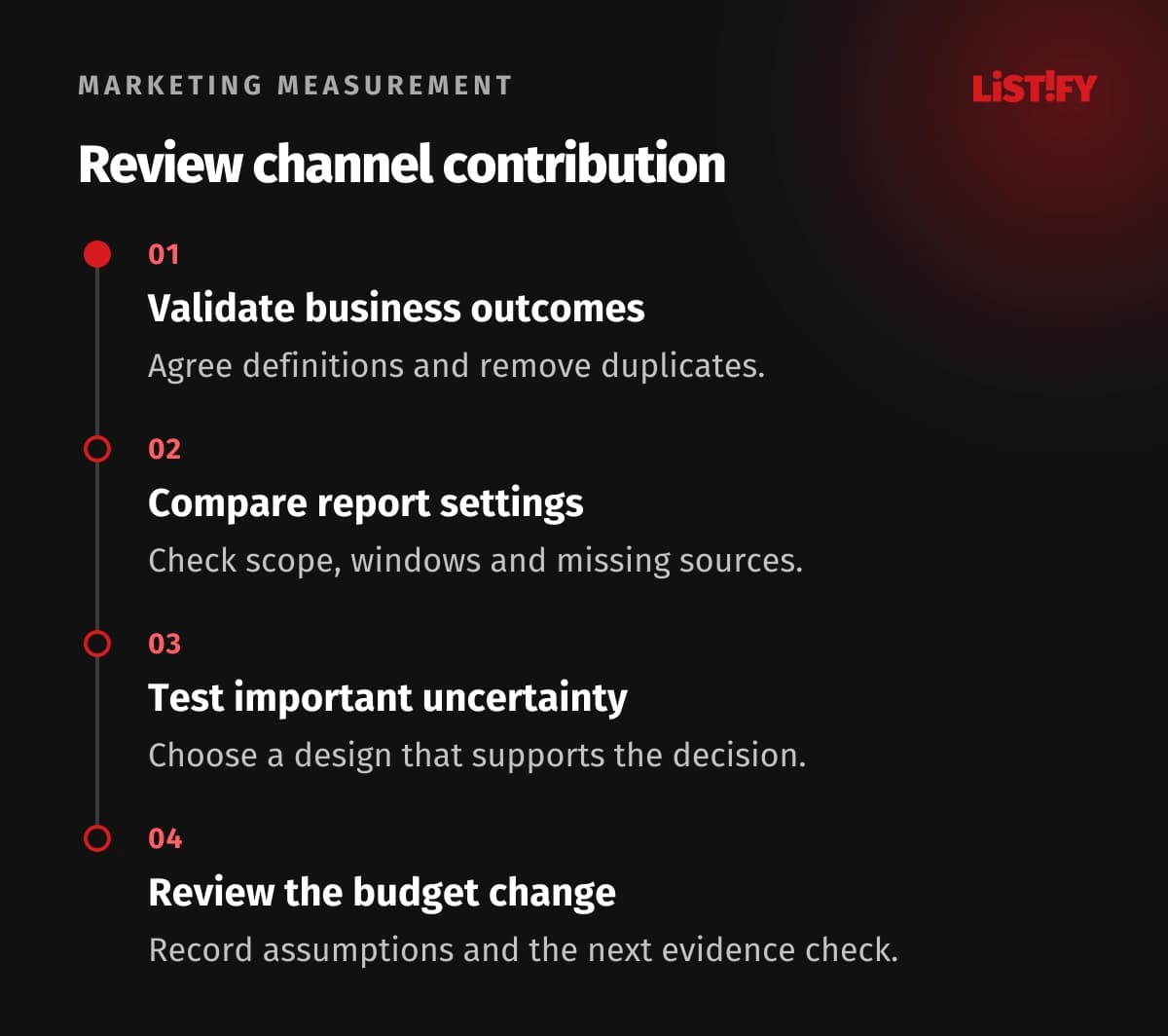
Adjust spending with a stated hypothesis and review date. Explain the expected result, the uncertainty and the indicators that would trigger reconsideration. Avoid a permanent all-or-nothing channel judgment based on one reporting window or an unexplained model score.
Connect immediate demand capture with longer-term brand activity. The brand and performance comparison covers the wider investment tradeoff. A channel serving existing demand and one helping create future demand should not be judged solely by the same final-click total.
Present the conclusion in practical terms: which activity merits more investment, what the evidence supports and what remains unresolved. Keep the business outcome central. A sophisticated attribution setup is valuable when it improves decisions, not merely when it adds another dashboard.
07Questions about marketing attribution
Which attribution model is correct?
No model gives a complete account of every customer decision. Choose a supported model for the reporting question and document its scope, observed data and limitations.
Why do advertising platforms report more sales than the order system?
They may credit overlapping orders or use different windows and definitions. Check event duplication, outcome validity, timeframes and settings before adding platform totals.
Does data-driven attribution prove causation?
It distributes credit using the model and available observations. Causal incremental impact is a separate question that generally requires an appropriate experimental or analytical design.
Is direct traffic always brand awareness?
No. It includes traffic without a clear referral source. Source loss and untagged links can contribute, so the category cannot be treated as a pure measure of brand demand.
Should leads and sales be one conversion metric?
Keep them distinct when they represent different stages and values. Report lead quality and later sales so optimization does not reward volume without business relevance.
Can a small business run a lift study?
It depends on tool eligibility, outcome volume and design. When a rigorous study is impractical, use qualified observational evidence without overstating it as a controlled causal result.
How should uncertainty be reported?
State the collection gaps, model settings and unresolved question. Explain what the evidence supports and what additional check would change the budget decision.