Gamification in everyday apps: reward useful progress
A training app can congratulate someone for completing a useful practice task or award points for repeatedly tapping through screens. Both designs look playful. Only one supports the reason the person opened the app. Good gamification connects a clear goal, an achievable challenge and feedback the user can trust.
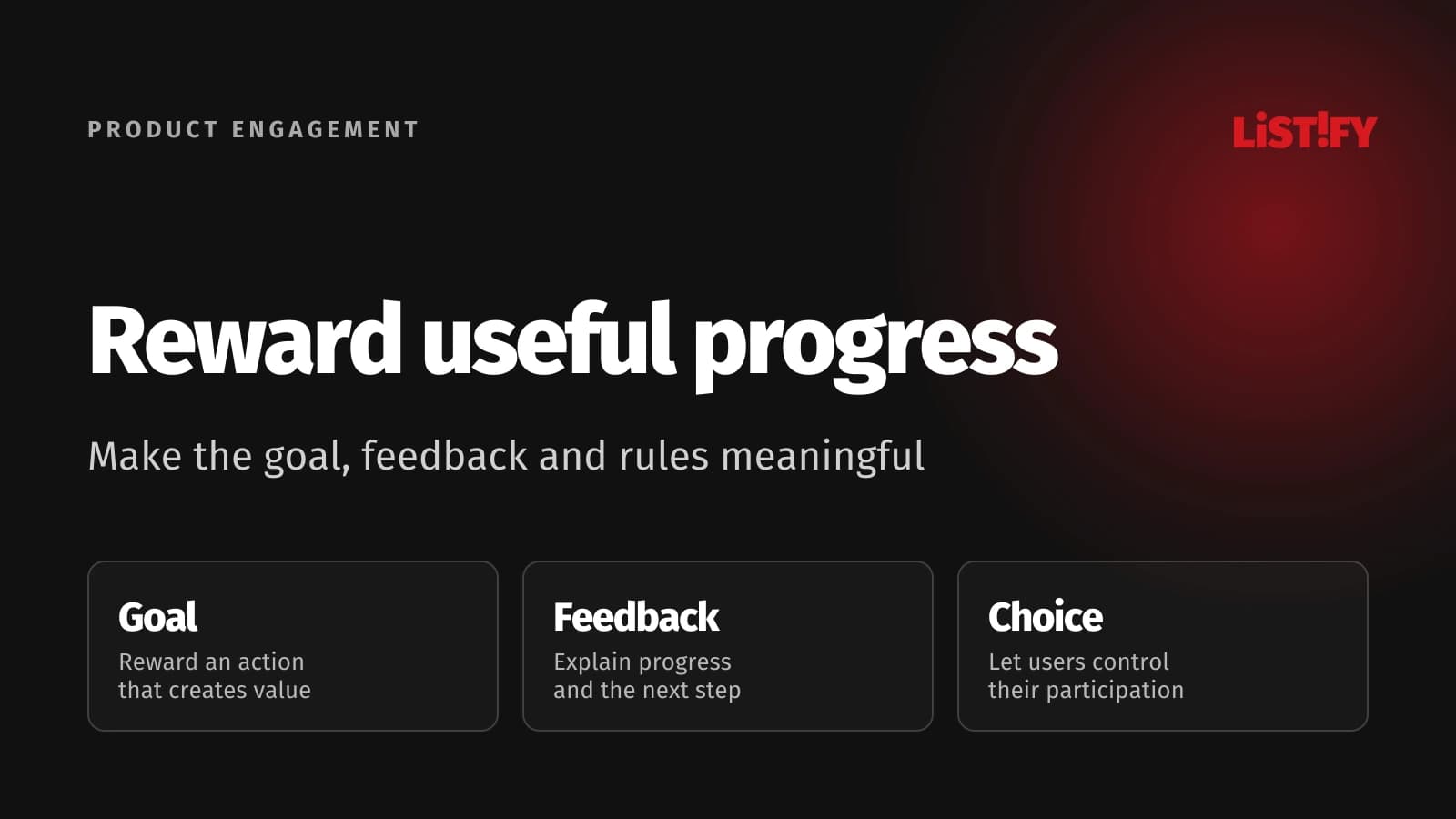
Gamification brings selected game elements into an activity whose main purpose is something else, such as learning a workflow or organizing a project. A full mobile game makes play the product. Borrowing a game’s feedback loop can help an ordinary app without copying its competitive economy or demanding constant attention.
Start with the behavior that creates value for the user, then decide whether a playful mechanism helps it. Treat points, streaks and leaderboards as product decisions to test. Their presence is not evidence of better retention, learning or satisfaction.
01Name the progress the user actually wants
Write the intended outcome in ordinary language. In an equipment-training app, it might be recognizing the correct maintenance sequence and knowing when to ask a supervisor. Completing a screen is an intermediate event. It does not necessarily establish that the person understands the procedure.
Identify the part of the journey where people lose direction. They may not know what to do next, receive little feedback or face a task that is too difficult. A progress marker can address uncertainty, while a points counter cannot fix confusing instructions or a broken exercise.
Define a useful action and the evidence that it occurred. For example, completing a practice scenario with an explanation of the decision may carry more meaning than opening a lesson. Make the event definition visible to the product team before rewards are attached.
Consider the person’s reason for returning. A novice may need a short sequence of manageable exercises, while an experienced user wants quick access to reference material. Requiring both groups to earn access through the same introductory game can obstruct the second group’s task.
The user onboarding guide provides related context. Help people reach the first useful outcome before asking them to care about a badge collection. If the product’s ordinary value is unclear, game elements will be carrying too much of the explanation.
Decide what should happen after the intended outcome is achieved. An app for completing a finite task can celebrate completion and let the person leave. The business should not require endless engagement when the user’s successful result is a finished job.
02Borrow feedback and choice from games
The Center for Self-Determination Theory’s PENS overview describes research on autonomy, competence and relatedness in games. Clear feedback, manageable controls, choices and cooperative interaction are among the relevant factors. This offers a design perspective rather than a guarantee about a particular business app.
Support competence by showing what improved and what to try next. An exercise result can explain why a choice was appropriate and suggest a relevant follow-up. A generic celebration without useful information may reward completion while leaving the user uncertain about the skill.
Support choice by letting people select a suitable goal or practice route. Keep the consequence understandable: a beginner route explains fundamentals, while a refresher route checks existing knowledge. Choice is less meaningful when every option secretly leads to the same compulsory sequence.
Use social features for a purpose the audience values. A small team working toward a shared practice goal can encourage conversation. A public rank of individual performance can create a different experience, especially when participants have unequal time, access or experience.
Choose a challenge that is demanding enough to be interesting and still achievable. Let users recover from mistakes and understand them. An early failure that permanently blocks progress can teach people to avoid the app rather than help them learn the underlying task.
Separate playful learning from consequential decisions. A practice badge should not automatically grant permission to operate equipment or override a formal competency assessment. If the app supports an official qualification, define the relevant assessment and authorization process independently.
03Choose a mechanism with a clear tradeoff
| Mechanism | Useful role | Question before release |
|---|---|---|
| Progress indicator | Show a finite path and remaining work | Does it reflect meaningful completion? |
| Badge | Recognize a specific demonstrated milestone | Can users explain what they earned it for? |
| Streak | Make a chosen routine visible | Can people pause or recover without pressure? |
| Challenge | Provide a manageable next practice goal | Is the difficulty suitable for this user? |
| Leaderboard | Offer an optional comparable competition | Are participants and opportunities comparable? |
| Cooperative goal | Give a group a shared objective | Can each person contribute without exposure? |
Prefer the smallest mechanism that resolves the identified problem. A checklist of completed practice scenarios may be enough to show progress. Building levels, currencies and rewards creates additional rules the team must explain, maintain and support.
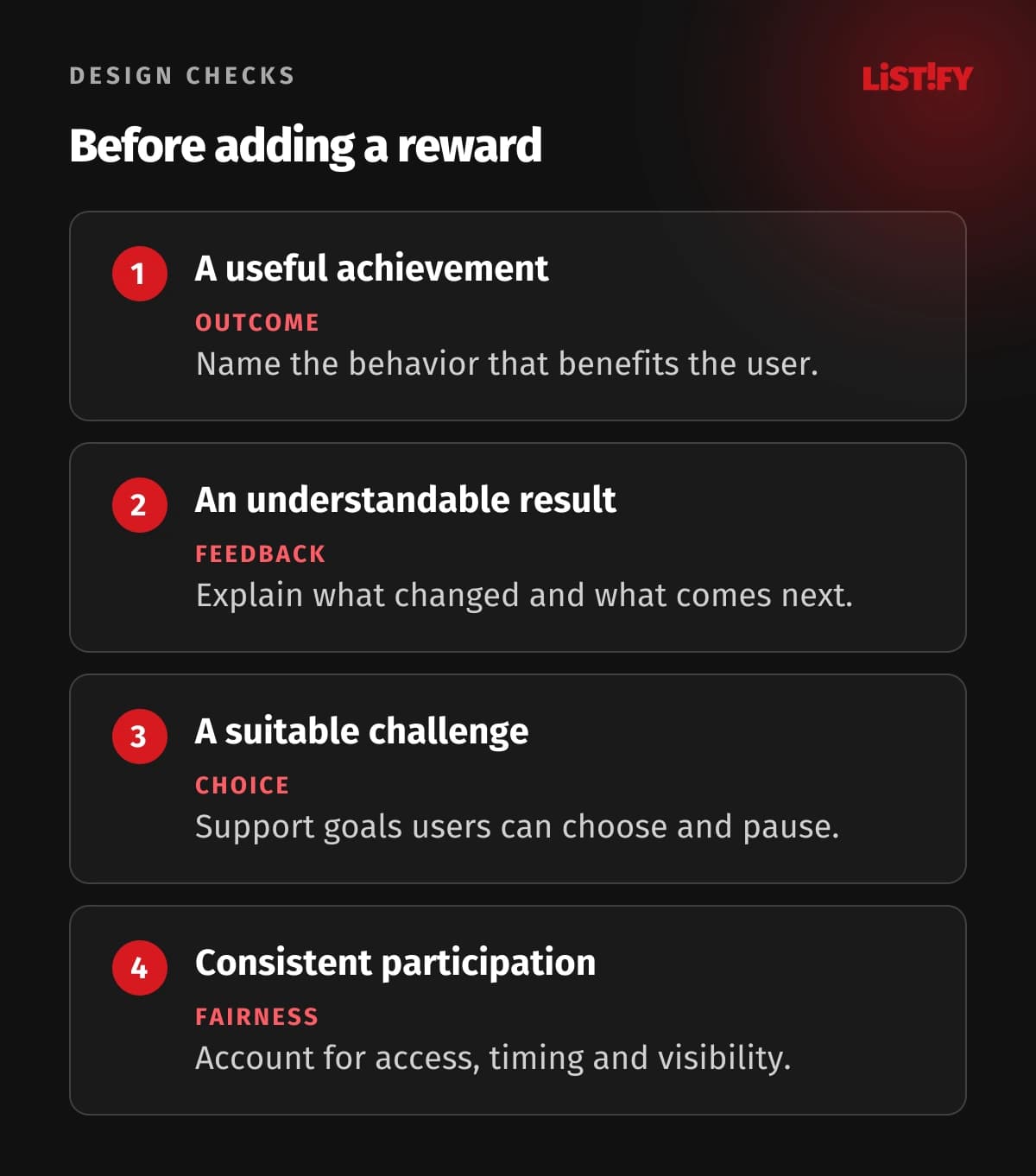
A badge should describe a milestone, such as understanding the inspection sequence, rather than an unexplained point threshold. Keep a record of the underlying evidence so changes to the visual reward do not erase what the user has actually achieved.
Design streaks around the routine’s real cadence. A weekly practice task does not need a daily demand to open the app. Offer understandable breaks and recovery rules, and avoid messages that imply a person has failed because they took time away.
Use leaderboards only when comparison serves the intended experience. Consider optional participation, private groups and comparable starting conditions. Speed rankings in a careful review task can reward the opposite of the behavior the organization needs.
Treat tangible rewards as a separate operating decision. Inventory, eligibility, fulfillment and disputed results require ownership. Do not introduce a reward economy simply because a points counter is easy to build; the obligations continue after the animation ends.
04Protect trust, accessibility and fair participation
Explain the rules before people invest effort. State which actions count, when progress is recorded and how errors are corrected. If the rules change, preserve the meaning of earlier achievements and communicate the change instead of silently removing earned recognition.
Handle time zones, travel, connectivity and delayed synchronization deliberately. A user completing an exercise offline should understand whether it counts toward a chosen routine. Use consistent event identities so a repeated upload does not grant the same reward twice.
W3C’s status-message guidance explains how status changes can be available to assistive technology without moving focus. Progress and reward feedback should be understandable to someone who cannot see a celebration or hear a sound.
Give important achievements a persistent text explanation. Keep optional motion and sound controllable, use readable contrast and make interaction possible through the supported input methods. A decorative effect should not become the only way to understand whether the task succeeded.
W3C’s timing guidance describes control over content-set time limits with specified exceptions. Avoid unnecessary countdowns in ordinary tasks. If a challenge uses timing, assess its purpose and provide an appropriate accessible alternative or adjustment.
Keep social visibility deliberate. Let people know what others can see and give them suitable controls. Do not expose a participant’s absence, mistakes or sensitive personal goals through a ranking merely because the underlying activity happens inside an app.
05Measure outcomes beyond the reward counter
Choose a primary outcome that reflects the app’s purpose. For practice, that could be successful completion of a later relevant task. For project organization, it could be reliably finishing planned work. Measure points and interactions as diagnostic signals rather than treating them as the final result.
Track guardrails such as task errors, abandonment, unwanted notifications, opt-outs and support complaints. A mechanic that increases return visits while making users feel pressured or causing careless completion needs review. Different outcomes can move in opposite directions.
A PLOS One experiment on gamified online surveys found increased drop-out in its specific decision-survey setting. Its results do not describe every app. They are a useful reminder to test the mechanism and audience instead of assuming that playful presentation improves completion.
Compare the proposed design with a clear ordinary version of the task. Keep the underlying content and support quality comparable. Otherwise an experiment may be measuring better instructions or additional reminders rather than the reward mechanism itself.
Inspect effects after the novelty period and across relevant user groups. Someone choosing a challenge may differ from someone who avoids it, so voluntary participation alone is a weak comparison. Use an appropriate experiment design and avoid declaring success from a small early movement.
Combine behavior with conversation. Ask participants what the milestone meant, whether the challenge helped and how they felt when they missed a goal. A person can understand the mechanic and still find it distracting or inappropriate for the task.
06Pilot one feedback loop and operate it carefully
Choose one moment where better feedback could help: completing the first meaningful practice scenario, for example. Define the eligible action, immediate feedback, next suggested task and stopping point. Keep the first pilot small enough that the team can explain every rule.
Make progress updates reliable on the server and visible in the client. An acknowledgment should distinguish recorded achievement from a local pending event. Provide an understandable correction process for missing or disputed progress instead of asking support to edit arbitrary points.
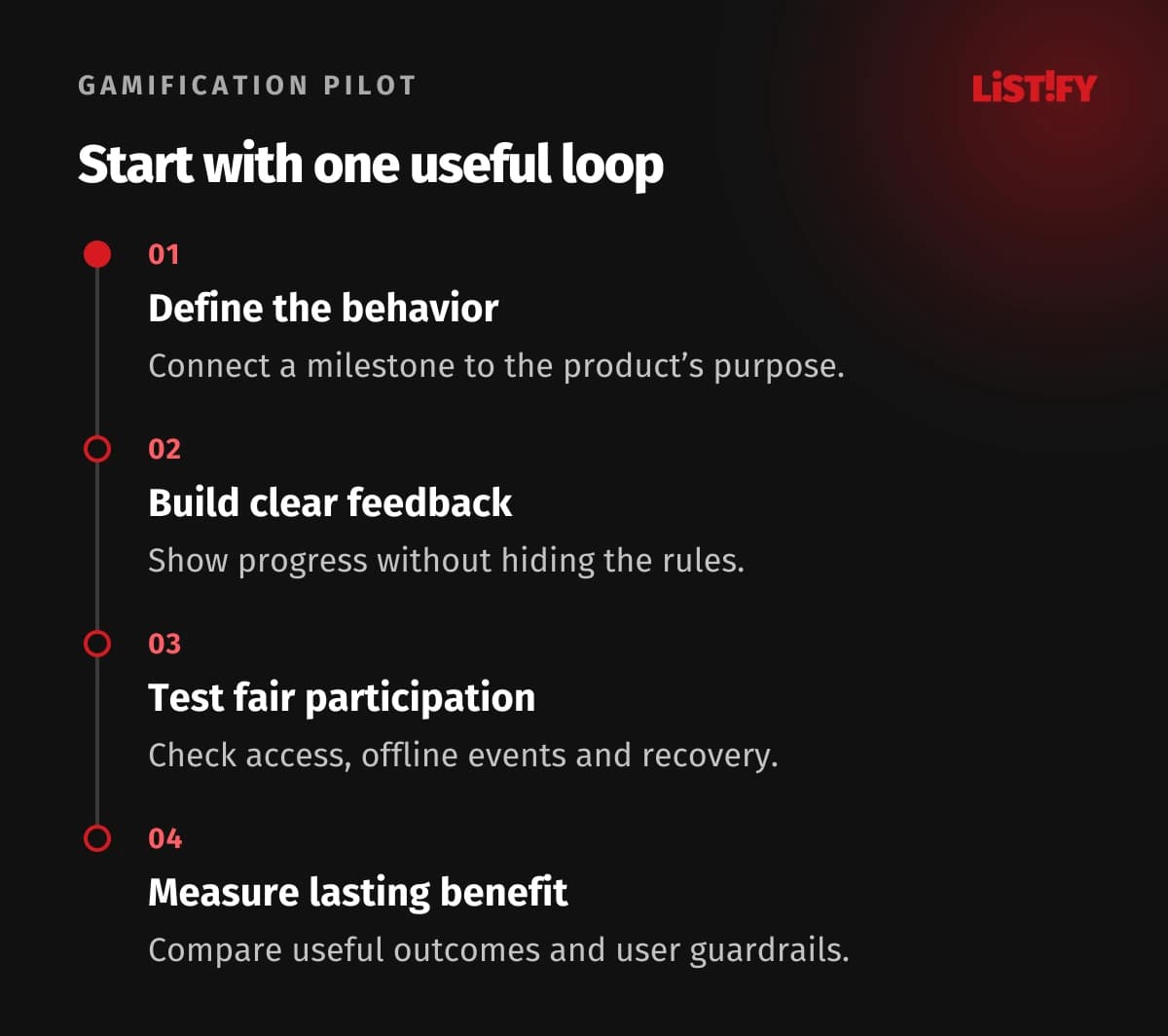
Give content and rules an owner. New lessons, retired tasks and changed milestone criteria can alter the meaning of existing achievements. Version the criteria where necessary and preserve the information needed to explain an earlier result.
Review how the experience works with onboarding, reminders and support. The application UX guide helps connect these decisions to the broader product. Repeated prompts from several features can turn a modest challenge into a demanding routine.
Expand only when the mechanic improves the intended outcome with acceptable guardrails. If a simpler progress explanation works better, use it. The team’s responsibility is to help people do the useful thing, whether the final interface feels playful or straightforward.
07Questions about gamification in everyday applications
Does gamification require a full mobile game?
No. An ordinary app can borrow a clear challenge, useful feedback or a meaningful milestone. A full game makes play central to the product and introduces a different set of design and operating decisions.
Are points enough to improve retention?
Points alone do not establish a benefit. They need to connect to useful behavior and understandable rules. Test whether users achieve the product’s intended outcome and want to return after the initial novelty.
When is a streak a poor fit?
When the task is occasional, people need flexible timing or absence would create unnecessary pressure. Match the routine’s actual cadence and offer clear breaks. A daily app-opening requirement is not automatically useful practice.
Should an internal app have a leaderboard?
Only when comparison serves the task and participation is appropriate. Check comparable opportunities, visibility and incentives. A ranking based on speed can discourage careful work in an activity that requires accuracy.
Can a badge prove professional competence?
A badge can describe a milestone, but its meaning depends on the evidence and assessment behind it. Do not automatically use a practice reward as authorization or formal qualification without the relevant process.
How should offline achievements be handled?
Define when the action counts, show pending progress clearly and process repeated uploads safely. Explain time-zone and timing rules so people are not surprised by a reward disappearing after reconnection.
What makes the pilot successful?
Improvement in the intended user outcome, with acceptable errors, pressure, opt-outs and support burden. Compare against a clear ordinary workflow and examine sustained behavior rather than only points earned or time spent.