Shoptet, Shopify, WooCommerce or custom: which fits your store?
Shoptet, Shopify, WooCommerce, and custom ecommerce can all produce an attractive store. Their differences appear in the orders your team handles, the markets you serve, and the changes you need later. Compare those operations before choosing a theme or a headline subscription fee.
Choosing among Shoptet, Shopify, WooCommerce, and a custom build is partly a purchase and partly an operating decision. Hosted services handle some infrastructure for you; a self-managed store or custom system creates different control and responsibilities. Shoptet also brings a regional ecosystem worth considering for sales in Czechia and Slovakia.
Use actual orders and exceptions to compare the options. The useful question is whether your team can sell, fulfill, support, and change the store reliably within a cost you understand. A feature checklist becomes meaningful only when it connects to these tasks.
01Start with the orders your team must process
Document representative journeys: a straightforward purchase, a customer with negotiated pricing, a mixed-stock basket, a partial refund, and a return. Include the countries, currencies, languages, payment methods, and delivery services you actually need. A platform's international label does not prove that your exact combination works.
Separate essential rules from preferences. A required accounting reference, product configuration, or customer credit limit may determine the architecture. The location of a promotional banner rarely should. Ask operations staff where they currently retype data, repair stock, or use spreadsheets to compensate for missing behavior.
For each requirement, record whether it is native, provided by a supported extension, custom-developed, or manual. Name its cost and owner. A demonstration that works only because someone changed data backstage has not proved the automated workflow.
Include exceptions in the demo script. What happens when payment succeeds but the order event is delayed? Can staff correct an address after fulfillment starts? How does a return affect stock, the refund, and the accounting entry? These are better selection questions than which homepage feels more modern.
02Compare Shoptet, Shopify, WooCommerce, and custom ecommerce
| Decision | Shoptet | Shopify | WooCommerce | Custom ecommerce |
|---|---|---|---|---|
| Regional fit | Evaluate its Czech and Slovak ecosystem for local operations | Check the actual countries, payments, languages, and channels needed | Choose and maintain the regional extensions you require | Build regional rules deliberately and maintain them |
| Infrastructure | Hosted core; configuration and integrations still need owners | Hosted core; your apps and integrations still need owners | Your team or hosting partner maintains the environment | Define who operates every application and service |
| Customization | Check the chosen plan, add-ons, design access, and integration method | Use supported extensions and APIs; important checkout capabilities depend on plan | Change themes, plugins, and code while managing compatibility | Build the required behavior and maintain it over time |
| Integration proof | Demonstrate your accounting, carriers, stock, and data flow | Demonstrate supported endpoints, events, apps, and quotas | Check plugin quality and API behavior with the actual setup | Define interfaces, recovery, and support |
| Operating cost | Include plan, add-ons, payments, support, and changes | Include plan, apps, payment terms, integrations, and changes | Include hosting, extensions, development, and maintenance | Include discovery, build, operation, and future development |
| Exit and change | Test exports and add-on data; document supplier access | Test available exports, app data, and migration constraints | Environment access helps; plugin data and skills still matter | Source, formats, documentation, and handover determine portability |
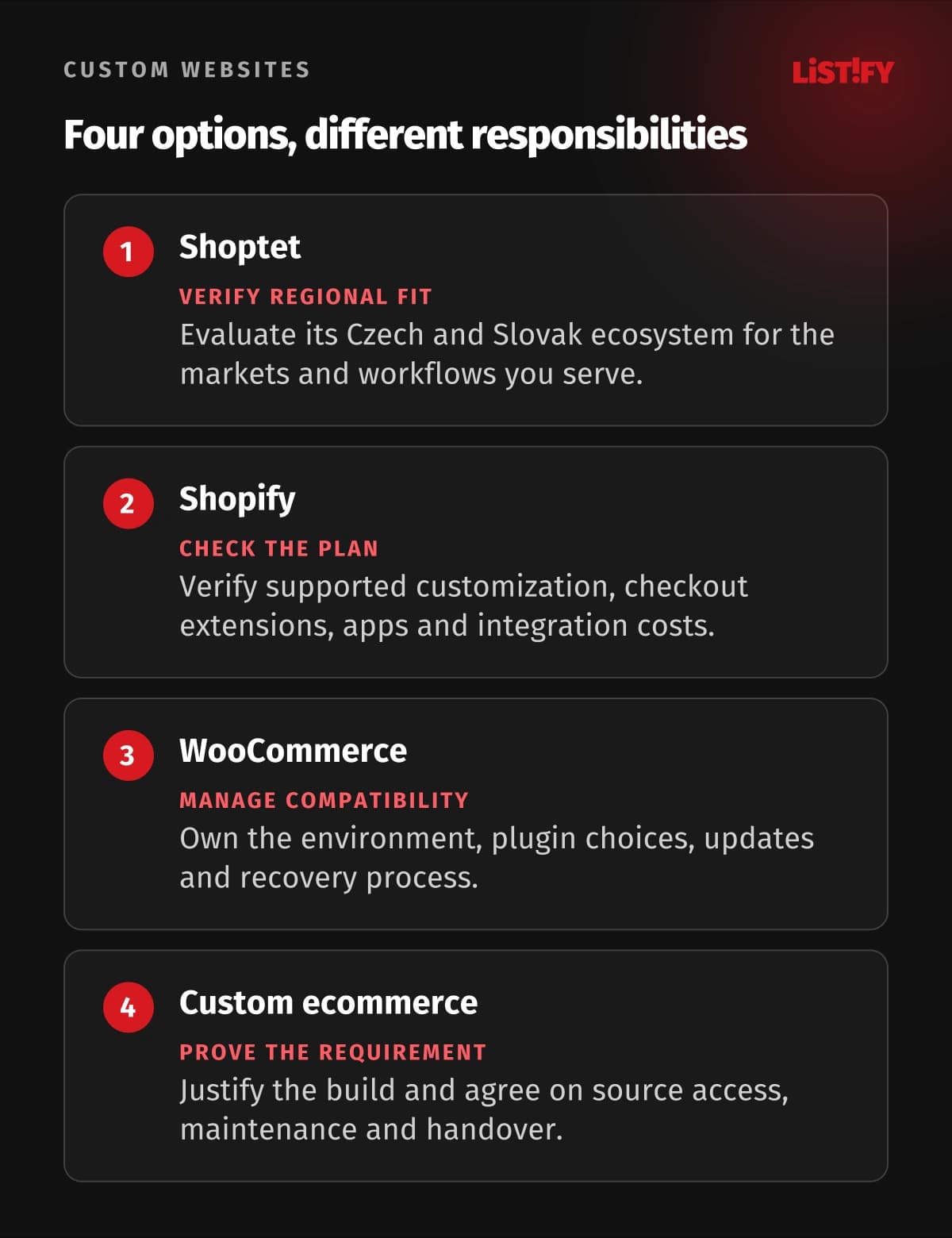
Shoptet and Shopify are hosted options, but their ecosystems and extension paths differ. WooCommerce commonly runs in a WordPress environment managed by the store or its partners. A custom storefront can also use a hosted backend. Identify who operates each part instead of assuming one label describes the whole system.
A headless storefront separates the customer interface from the commerce backend. It may support a particular experience or multiple channels, but it introduces another application to build and operate. Do not choose it solely because it sounds more flexible. Prove the requirement that justifies the extra integration and release work.
03Verify the capability on the plan you will buy
Check the live product documentation, proposed plan, and extension terms for every essential capability. A vendor's enterprise demonstration may show features outside the quoted package. Record the supported method and recurring cost, including the effect of adding more stores, staff, markets, or transaction volume.
For example, Shopify's checkout-extension documentation states that UI extensions for the information, shipping, and payment steps require Shopify Plus. This is a specific limitation to verify if your process depends on changing those steps, not a claim that every checkout change or every useful store requires Plus.
Where Shoptet fits a global company
Shoptet's English site presents operating a Czech store through English administration and identifies stores in Czechia, Slovakia, and Hungary. Its Czech and Slovak ecosystem can be relevant to an overseas brand entering those markets. Evaluate local payment, delivery, accounting, and support workflows rather than treating Shoptet as a universal worldwide platform.
Check storefront language and currency separately from administration language. Shoptet documents foreign-language storefronts and currency settings, but your setup still needs proof for the intended countries, tax handling, carriers, and merchant eligibility. A multilingual site alone does not demonstrate a complete international operating model.
For WooCommerce, server recommendations are a starting point for the environment. They do not prove that your plugin combination, catalog, and checkout can support the expected traffic. Measure a representative configuration and define who investigates slow queries, extension conflicts, and failed jobs.
04Put the store between accounting, stock, and payment carefully
Define a source of truth for products, prices, inventory, customer eligibility, orders, and accounting status. The store should not silently compete with the warehouse system for the same field. Decide which updates are immediate, which can be queued, and what staff should see when synchronization fails.
Use stable identifiers, deduplicate events, and reconcile systems. A repeated payment notification should not create another order or shipment. A webhook outage needs a recovery method. Keep a queue and an operational view that explains what failed, rather than leaving staff to discover discrepancies from customer complaints.
Test currency rounding, discounts, shipping charges, refunds, and the documents your accounting process requires. These details depend on your markets and agreements. Involve the people who will reconcile the records instead of assuming a generic connector handles every local requirement.
Hosted payment processing can reduce what your environment handles, but it does not eliminate all merchant responsibilities. The PCI Security Standards Council explains that outsourced merchants still need to understand shared responsibilities and confirm their validation obligations with the relevant compliance-accepting organization.
Our API integration guide covers this wider integration work. Include its operation and recovery in the platform budget. A cheap connector that needs daily repair can become an expensive part of the store.
05Compare total cost, maintenance, and the ability to change
Build a cost view over a period that matches your planning horizon. Include discovery, implementation, migration, subscription or hosting, extensions, payment terms, support, security maintenance, and expected changes. Separate costs already included in another business system to avoid counting them twice.
Model a normal operating case and a plausible growth case. Use your order volume, catalog, markets, staff, and integration load. Check what creates a plan upgrade or another paid service. These are planning assumptions, not platform price guarantees; verify current quotes and terms before making a commitment.
Assign maintenance responsibility explicitly. WooCommerce's update guidance recommends backups and testing updates in a staging environment. Hosted platforms also require testing of your own apps, themes, and external workflows when something changes. The provider managing its core does not test your complete business process for you.
For a custom build, ask who maintains dependencies, handles incidents, restores data, and documents changes. Confirm access to source, infrastructure, credentials, and deployment instructions. Flexibility is useful only if somebody can safely exercise it after the original developer leaves.
Include internal time spent correcting orders and maintaining workarounds. Sometimes adapting an unusual process to a supported platform is sensible. Sometimes the workaround is the business's essential distinction and needs deliberate development. Make that tradeoff visible rather than assuming customization or standardization is always preferable.
For the broader hosted-versus-build question, our Shopify and custom ecommerce comparison provides context. This decision should now be grounded in the specific operating evidence you have collected.
06Treat migration and exit as selection requirements
Test exports before committing. Products, variants, images, customer records, orders, subscriptions, and extension-specific fields may use different mechanisms. Identify which data can move, which needs transformation, and which account or payment details cannot simply be carried across. A CSV button does not prove a complete migration.
Map old URLs to relevant new destinations and inspect redirects. Shopify's redirect documentation lists constraints, including some paths and locale handling. Use the actual URL inventory rather than sending every old product to the homepage. Our ecommerce SEO guide covers the surrounding search structure.
Rehearse a migration with reconciliation: record counts, prices, variants, images, stock, and sample order totals. Plan the final data transfer, cutover ownership, monitoring, and rollback conditions. Decide how orders placed during the transition will be handled. Keep the old system accessible for the agreed operational needs.
An exit plan also protects everyday operation. Know who owns the domain and vendor accounts, which exports are available, and what a replacement supplier needs. Review it when adding a critical extension. The easier launch path can create a difficult later move if important data lives only inside an undocumented app.
07Run a platform proof before a full build
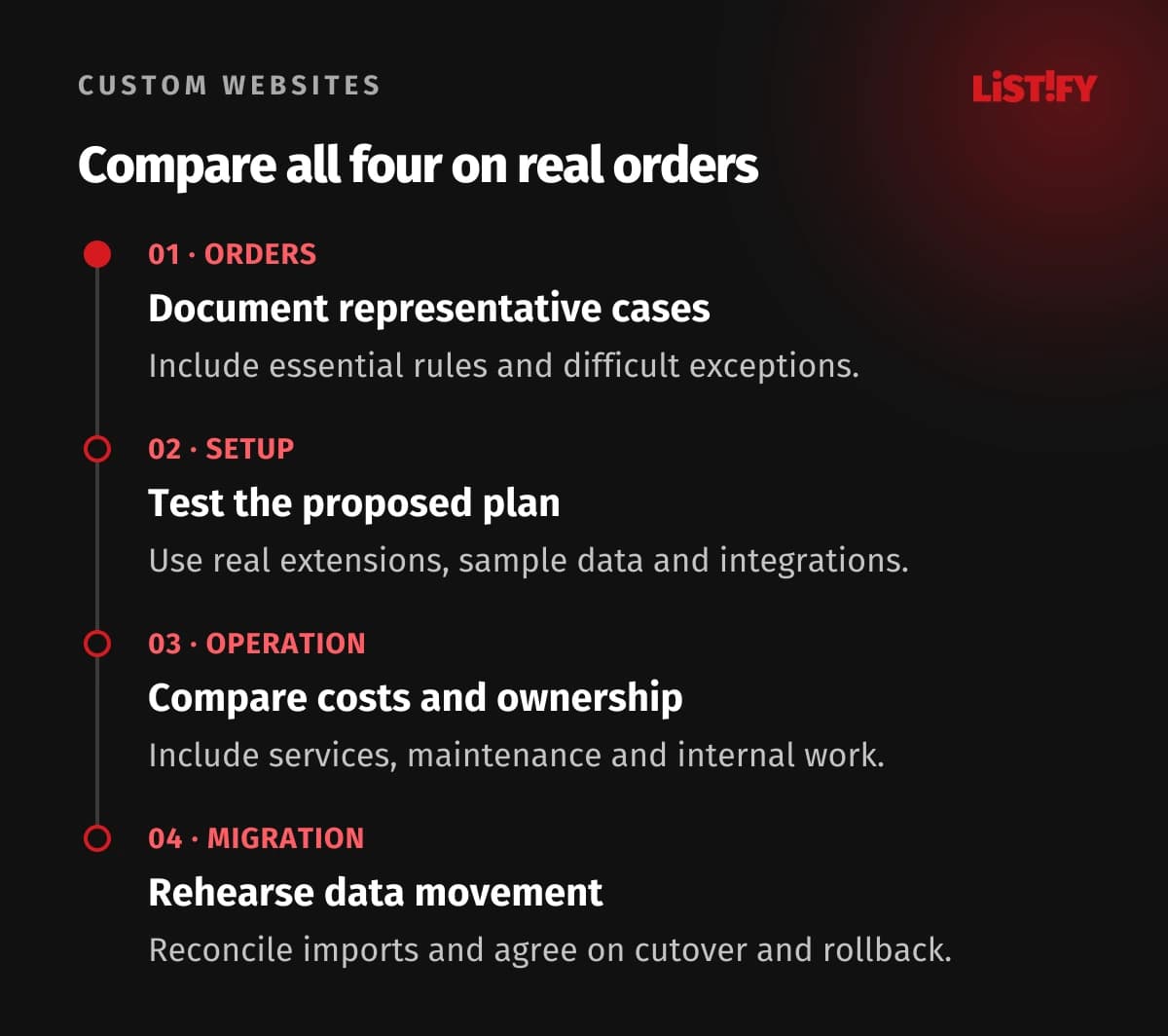
- Choose representative orders. Include the essential business rules, difficult returns, and regional requirements your team actually handles.
- Prove the proposed setup. Use the quoted plan, actual extensions, sample data, and integrations. Record gaps, manual steps, and failure behavior.
- Agree on operation and cost. Name maintenance and incident owners. Include recurring services, expected changes, and internal work.
- Rehearse data movement. Test exports, import reconciliation, URLs, cutover responsibilities, and rollback before scheduling launch.
Compare all four options on the same scenarios and request evidence, not only a score against an open-ended feature list. A global brand focused on Czech or Slovak sales should include Shoptet in that proof. A store needing a different regional ecosystem should verify that fit just as carefully. Choose the option whose limits and responsibilities you can accept.
08Questions before choosing an ecommerce platform
Which platform is cheapest?
Compare the complete operating case rather than the headline fee. Include extensions, hosting, integration, payment terms, maintenance, migration, and internal work. The answer changes with your workflow and expected growth.
Can a global company use Shoptet?
It can be worth evaluating for a Czech or Slovak market operation. Shoptet offers English administration for a Czech store and has a Czechia, Slovakia, and Hungary footprint. Check the exact merchant eligibility, regional services, languages, currencies, and integrations required; do not assume universal worldwide coverage.
Does WooCommerce mean we control everything easily?
You have different access and customization options, but also responsibilities for the environment and compatibility. Plugins, skills, and documentation affect how easily the store can be changed or handed over.
When does a custom store make sense?
When a demonstrated business requirement justifies development and ongoing operation that available configurations cannot reasonably provide. Prove the requirement and compare its lifecycle cost before committing.
Does headless automatically improve performance?
No. It changes the architecture and creates another application to operate. Measure the actual experience and identify the requirement it solves rather than treating the label as a performance guarantee.
Can we move all data later?
Test the exact exports and transformations. Extension records, subscriptions, customer accounts, and payment-related information may have different limits. Include migration and exit evidence in the purchasing decision.
What should a selection demo include?
A real order and its difficult exceptions on the proposed plan, with the actual integration and cost assumptions. Also inspect updates, recovery, exports, refunds, and reconciliation. An attractive homepage is only one part of the proof.