Custom software and CRM for insurance companies: policy journeys, portals and service
A customer has paid online, but internal records still await documents. Custom insurance software must connect the whole journey, including exceptions. Explore 20 features for policy purchase, portals, service and distribution, and how to start with one module.
Custom software and CRM for insurance companies can connect online quote and purchase journeys, customer service, documents, payments and distribution partners. The scope can start with a single product or a customer portal integrated with existing systems. Replacing the core insurance platform is a separate undertaking with substantially broader requirements.
Consider an illustrative scenario. A customer completes an online form and pays. The website shows a completed order, but internal records are waiting for a document check. The customer calls support, the operator sees different information from the sales team, and developers investigate a missing message. A new screen alone will not resolve this. The whole process needs clear states, exception handling and responsibility.
01Where custom development adds value
Custom development is useful when current tools do not adequately support a product or service process: a new distribution channel, a digital purchase journey, a customer portal, a partner workspace or requests moving between departments. CRM connects customer relationships and follow-up work. It does not necessarily replace rating, accounting or other functions of the core platform.
Before making a decision, establish where the authoritative record of a policy, payment or amendment is created. If teams disagree, the new application will inherit the same conflicts. At LISTIFY, we design modules and integrations around those responsibilities. Let us review one product or customer process you want to simplify.
When comparing suppliers, use our questions for choosing a software development company to discuss handover and support as well as the price.
02Quotes and policy purchase: features 1 to 5
1. Forms suited to the product and situation
Customers should answer the questions their product requires, rather than work through a universal list of fields. Validation explains problems beside the relevant input. A case can resume after missing information is supplied where the designed process supports this.
2. Rates with traceable versions
A calculation must be connected to its inputs, rules and validity. A rate change should not silently overwrite an existing proposal. Before implementation, we establish where calculations run and who approves product changes.
3. Clear distinctions between estimates, quotes and policies
An indicative price is not automatically a binding offer or an issued policy. Every stage needs an unambiguous status and understandable customer information. The website, support team and internal records should use the same distinctions.
4. Referral for human review
Not every case should be decided automatically. An application can route an exception to a designated specialist, identify missing evidence and record the decision. The customer sees an appropriate next step rather than internal assessment notes.
5. Documents, verification and signature
Documents must match the product, proposal version and customer. Verification and signature methods depend on the process and requirements reviewed by responsible specialists. Records should show which version was presented and what happened next.
03Payments and policy servicing: features 6 to 10
6. Payments independent of a browser return
A customer may close the window after paying. Confirmation from the payment service therefore needs its own route into the records. Processing a repeated message must not create another payment or issue a second policy.
7. Confirmed policy creation
Sending a request to an internal system is not the same as successfully creating a policy. The application needs confirmation, an identifier and a failure procedure. Customer service must be able to distinguish pending processing from a completed result.
8. A shared view for customer support
An operator can see available information about the quote, documents, payment and customer requests. They can continue an online journey without asking for every detail again. Access is restricted to their role and work purpose.
9. Amendments with a verified outcome
An amendment moves through receipt, review and confirmation in the relevant system. The portal displays its current status. Original details are not replaced merely because the customer submitted a form if further approval is still required.
10. Payments, documents and messages together
A customer account can show scheduled and recorded payments, available documents and request history. Every item needs a clear source and freshness. The scope depends on what connected systems can actually make available.
04Customer service and claims: features 11 to 15
11. Claims notification suited to the event
A guided flow requests descriptions and evidence relevant to the product and incident. Photographs and attachments go to the correct case. The acknowledgement includes a reference and explains the next step without implying that coverage has been confirmed.
12. Additional evidence without lost attachments
A handler requests a particular document, the customer provides it through secure access, and the request changes status. The system preserves the relationship between the request and response. Files no longer need to be repeatedly matched from an inbox.
13. Case status customers can understand
Internal statuses may be detailed, but customers need to know whether anything is missing, who is acting and what follows. A portal can provide that view without exposing internal assessments or information that is not available for disclosure.
14. Requests, complaints and handovers
A service request receives an owner, a target and a history. Transfers between departments record who accepted responsibility. Escalation rules help identify cases that have stalled between teams rather than merely counting open tickets.
15. Notifications based on confirmed events
A customer message should follow a confirmed change, not just a button click. Delivery can reflect language, preferred channel and communication rules. A delivery history helps support establish what the customer was actually sent.
05Distribution and reliable operation: features 16 to 20
16. A distribution partner portal
Partners can prepare proposals, provide evidence and follow their cases within the agreed scope. Organisation and role separation should be tested with practical scenarios. One partner must not gain another's information simply by changing a page address.
17. Reporting on work and outcomes
Management can follow progress through stages, unfinished cases and processing times. Each measure needs a definition. A submitted form, an issued policy and a received payment are different outcomes and should not be treated as interchangeable successes.
18. Permissions and traceable changes
Roles define who may read, edit or approve information. Sensitive operations need appropriate verification and recording. Change history should help explain a problem without copying unnecessary personal information into routine operational logs.
19. Integrations with transfer controls
Every connection needs defined messages, acknowledgements and recovery behaviour. A view of outstanding transfers enables timely intervention. Technical access and contractual availability of third-party services are checked before an integration enters the agreed project scope.
20. Support, backups and recovery
The operating plan assigns responsibility for monitoring, updates, backups and recovery checks. Releases need outcome checks and an agreed rollback procedure. A support response and service restoration are different commitments and should be described separately.
Explore our custom software development services. We can work with you on a standalone portal, a digital insurance journey or connections between existing services.
When planning data transfers, use our practical guide to connecting systems through APIs, which covers data ownership, checks and recovery when a connection fails.
06An illustrative journey for one product
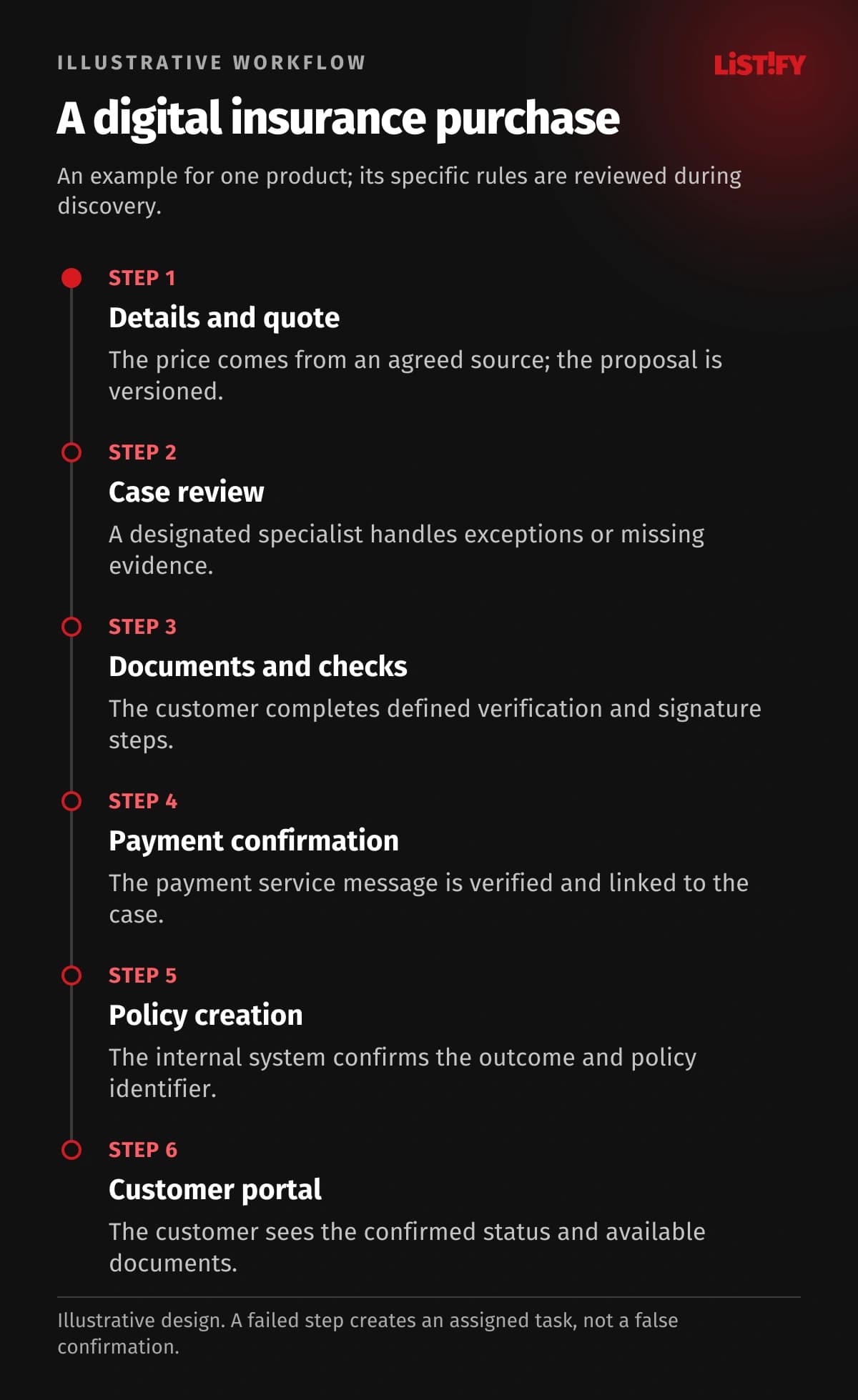
Imagine a digital purchase journey for a simple product. The customer supplies the required details, the system obtains a price from the designated source and stores the proposal version. A case outside the rules is referred for review. Once the specified steps are complete, payment and policy creation take place. Only a confirmed outcome appears in the customer portal. If payment succeeds but policy creation fails, a specific task is assigned to an owner instead of sending the customer a misleading completion message.
- Service addressModel: before integration: 2Model: proposed design: 1
- Payment referenceModel: before integration: 2Model: proposed design: 1
- Specialist decisionModel: before integration: 1Model: proposed design: 1
Illustrative workflow, not a measurement. The address is in CRM and a service sheet (2); the payment reference in an exception list and a CRM note (2). The proposed design shares one record. A specialist still records their decision once (1). Only these service records are counted, not the whole core platform. No saving is guaranteed; partner APIs must be verified.
07Budget and a phased launch
We first map the existing process, data sources and decision points. An interactive prototype tests the customer journey, while a technical check examines the most uncertain integration. A pilot can then begin with one product, a group of partners or selected service requests.
Cost depends on products, decision rules, roles, integrations and availability requirements. It also includes migration, testing, specialist review, external service access and ongoing maintenance. A portal estimate cannot be used as the price for replacing the entire core insurance platform.
You do not need to assemble an internal development team for every new module. You do need an accountable process owner, cooperation from the teams responsible for connected systems and specialists who understand applicable requirements. LISTIFY can provide design, development, integration, handover and agreed maintenance.
For the transfer itself, see our guide to migration from spreadsheets and legacy systems, including relationship checks, duplicate handling and trial imports.
08Frequently asked questions
Is CRM the same as an insurer's core platform?
No. CRM handles relationships, communication and related activities. Policy administration, rating, payments or claims may belong to other systems. Their responsibilities are established during design.
Can we keep our existing insurance platform?
Yes, where it exposes the required functions and information. A new module can work alongside it. Integration limitations must be checked before committing to a specific journey.
Can we begin with a customer portal alone?
Yes. We first choose which information and requests customers should access. A read-only policy overview has a different scope from policy amendments or payments.
Will an application meet every compliance obligation by itself?
No. Responsible specialists assess the requirements. Development translates them into controls, permissions, documents and records whose operation can then be verified.
What happens if a connected service goes down?
Each important step needs agreed behaviour: wait, retry, refer to a person or stop the process. Users must be able to distinguish the real status from a successful completion.
What should we prepare for an initial consultation?
Describe one product or process, the systems involved, responsible teams and the main obstacle. Real customers' personal information is not needed for the first discussion.
09Choose the first process for your new system
Do you need a custom insurance application, CRM or customer portal? Tell us how your customer journey works and where it gets stuck. LISTIFY will help define a first release, necessary integrations and how to assess the outcome before a wider rollout.