Custom CRM and software for consulting firms: projects, capacity and profitability
Connect consulting sales, projects, timesheets, retainers and billing. Listify designs custom CRM, client portals and software around your firm.
Illustrative situation: a consultancy sells a fixed-fee project. During a workshop the client asks for an additional analysis, and a consultant agrees. The hours appear in a timesheet, the scope change never reaches the proposal, and the project manager learns about it during billing. The missing step was a decision about the work.
01A consultancy CRM should continue beyond the signed contract
Custom CRM and software for consulting firms connects sales, delivery, staffing, recorded work and billing. This article concerns management, operations, HR and strategy consultancies delivering professional work and defined outputs. Financial product advice requires a different operating model.
Owners need more than a sales pipeline total. They need to understand promised work, remaining effort and the people required to finish it. Invoiced amounts, revenue and profit are different measures. Useful reporting explains the calculation and the records behind it.
Walk us through your last project from proposal to final invoice. Listify can design a connection that reflects how you sell and deliver consulting services.
02Six modules for sales and project initiation
1. Clients and decision-makers. Separate the day-to-day contact, project sponsor, deliverable approver and billing contact. The team knows who can authorise a change and who simply needs progress updates.
2. Opportunity qualification. Capture the client’s problem, expected outcome, budget and assumptions. Sales can hand over the engagement without making consultants repeat the entire discovery conversation.
3. Proposal costing. Build the estimate from roles, effort and external costs. Preserve the approved version so managers can see the assumptions behind the commercial decision.
4. Agreed scope. Keep deliverables, included activities, exclusions and acceptance criteria together. A manager can distinguish a contractual commitment from an idea raised in a later workshop.
5. Staffing. Match consultants to expertise, availability and delivery dates. Separate confirmed assignments from tentative opportunities so two proposals do not silently consume the same capacity.
6. Sales handoff. Transfer objectives, approved budgets, contacts and risks through a structured initiation step. A project inherits the actual agreement, not just the client name.
03An illustrative project with an extra workshop
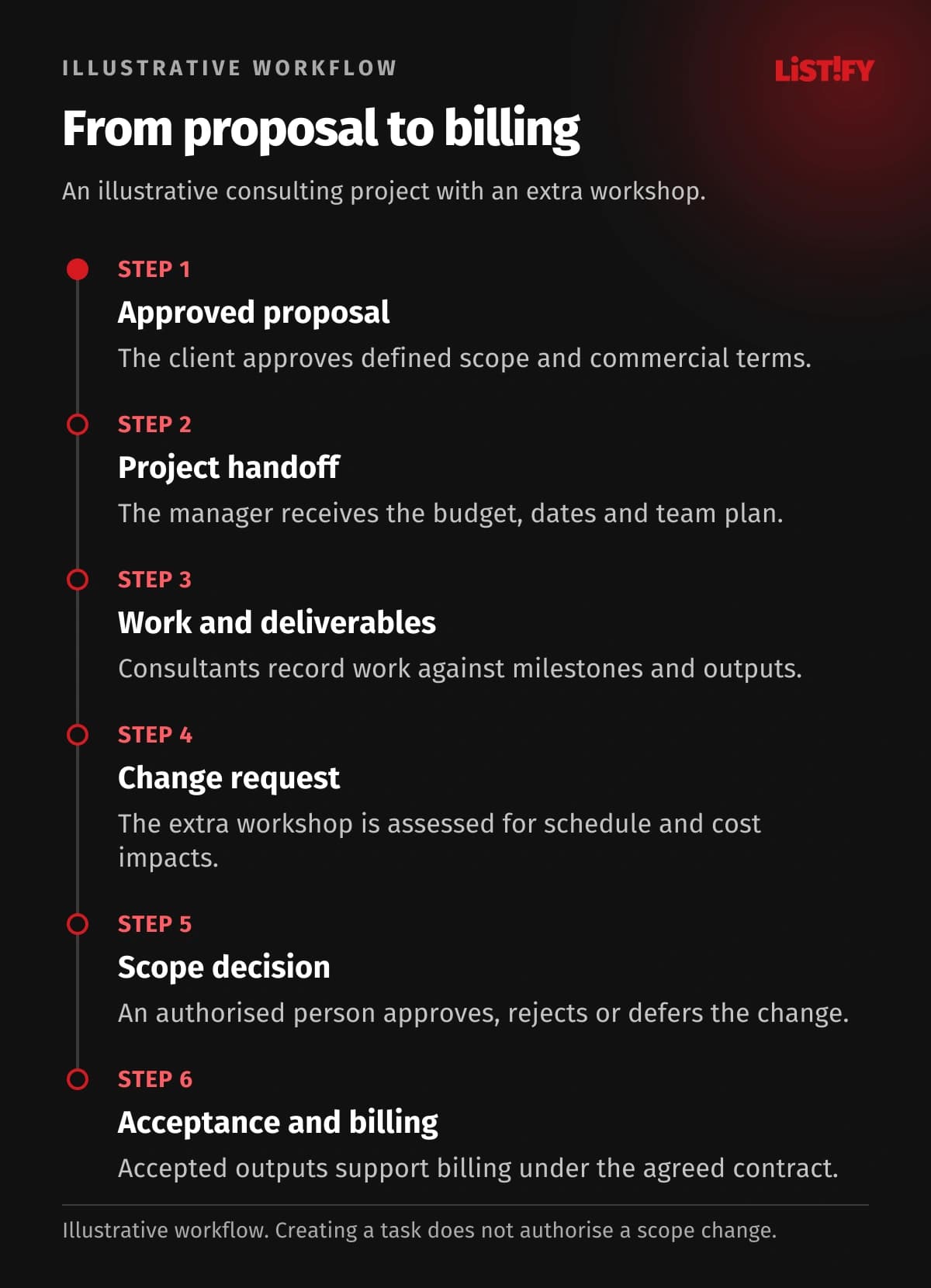
- Sales prepares a proposal with defined outputs and obtains client approval.
- The project manager accepts the scope, budget and proposed staffing.
- Consultants record work against milestones and attach developing deliverables.
- The client requests another workshop. A change request records its effect on price, timing and capacity.
- An authorised person decides on the request. Only the approved change updates the delivery baseline.
- Accepted deliverables and approved records support the agreed billing process and project review.
A new request is not automatically chargeable additional work. The manager first compares it with the existing agreement. APM’s change-control guidance separates recording a proposed change, evaluating its impact and deciding on it. Software should make those transitions visible.
04Six modules for day-to-day delivery
7. Milestones and deliverables. Link tasks to actual outputs. A completed analysis, unresolved client comments and an accepted deliverable should remain different states rather than a single completion tick.
8. Timesheets. Consultants record time against projects and activities for approval. Billable work, internal effort and rework follow agreed definitions instead of being guessed during invoicing.
9. Capacity forecasts. Compare remaining delivery effort with team availability. Leave, training and tentative opportunities need different treatment; utilisation is not simply the sum of every recorded hour.
10. Scope changes. Capture the reason, impact, decision and authorised approver. An unapproved request must not appear as committed revenue merely because somebody created a task.
11. Deliverable review. Authors submit a version to a practice lead. Internal review and client comments have distinct states so working material is not accidentally released into the client portal.
12. Knowledge library. Store reusable methods, templates and lessons separately from confidential client evidence. New consultants can find approved resources without receiving access to every historical engagement.
- Approved hoursBefore integration: 3Proposed design: 1
- Change priceBefore integration: 2Proposed design: 1
- Professional recommendationBefore integration: 1Proposed design: 1
Illustrative model, not a measurement. Hours appear in timesheets, a project sheet and billing records (3); a change price in the proposal and budget (2). The design shares an approved record. The consultant still records advice once (1). No measured saving or guaranteed profit is implied.
05Six modules for commercial control and client service
13. Project economics. Compare the approved budget with recorded costs and forecast remaining work. Show cost assumptions so a dashboard estimate is not mistaken for fully accounted profit.
14. Billing rules. Distinguish fixed fees, time-based charges and milestones. Accounting handoffs follow the individual contract, and their acceptance or failure remains visible to the responsible person.
15. Retainers. Track the agreed scope or capacity for each period. Treatment of unused allowances and out-of-scope work follows the contract, not a universal application default.
16. External specialists. Connect purchase commitments, accepted work and partner costs to the engagement. Contractors see their assigned portion; their invoice can wait for confirmation of delivery.
17. Client portal. Share agreed outputs, dates and approval requests. Internal cost rates and personnel information remain in restricted areas rather than being exposed through a general project view.
18. Website intake. Route visitors to the appropriate service enquiry or consultation. Carry that context into CRM, and verify calendar, accounting or document integrations against the available interfaces.
06Choose the first phase around your billing model
| Commercial model | What needs control |
|---|---|
| Fixed fee | Scope, changes and cost to complete |
| Time and materials | Approved time and applicable rates |
| Retainer | Period, included services and additional work |
| Milestone billing | Acceptance and invoice conditions |
If your projects are standard and an existing product fits, a custom build may not be justified. The first module might simply connect proposals, approved scope and timesheets. Our comparison of existing CRM and custom development provides a broader decision framework.
07Migration, cost and operations without internal IT
Migration must retain clients, contracts, projects, budgets and historical rates. Recalculating an old timesheet with today’s rate would rewrite its meaning. Validate completed and open engagements and distinguish original plans from approved changes. Our migration guide explains the preparation.
Development cost depends on commercial models, approvals, integrations and reporting requirements. Listify starts with discovery and a prototype, then defines a first phase that sales, managers, consultants and finance can validate. Each role needs appropriate permissions, including limits on exports and contractor access.
The selected provider supplies hosting. Agree support, backup, recovery, administration and code and data handover before launch. An internal IT department is optional; a process owner who understands engagement economics is essential. Use our supplier selection questions. Let us define the first phase around your billing arrangements.
08Frequently asked questions
Is this intended for financial advisers?
This design concerns firms delivering consulting projects and professional services. Financial product records, adviser commission networks and insurance policies belong to a different type of system.
Do we need CRM or project management?
If sales and delivery diverge, you need them connected. That can mean one platform or integrations between existing tools, depending on the workflow and available interfaces.
How are scope changes handled?
Compare the request with the agreement, record its impact and obtain a decision from the authorised person. An approved change updates the plan; creating a task does not constitute approval.
Can retainers and hourly work coexist?
Yes. Define rules for each contract and period: what is included, what is charged separately and how unused allowances are treated. There is no universal retainer formula.
Will the system show actual profitability?
It can calculate a defined measure from complete cost and revenue inputs. Agree rates, external costs and the calculation method. A chart alone cannot repair incomplete records.
How does the pilot work?
Choose a representative engagement and test proposal, delivery, change and accounting handoff. Include a rejected timesheet and returned deliverable, not only the ideal path.
09Connect the commercial promise to the work delivered
Show Listify an anonymised proposal, timesheet and project overview. We can design a CRM, delivery module, client portal or website around your consultancy. Begin where scope, responsibility or completed work loses its connection to the rest of the business.