Xiaomi MiMo V2.6 Pro: 10 questions about Xiaomi's newest AI model, answered
Xiaomi, best known for phones and electric cars, released the strongest open-weights AI model available today on September 22, 2026. Here are answers to the ten questions you are most likely asking about it.
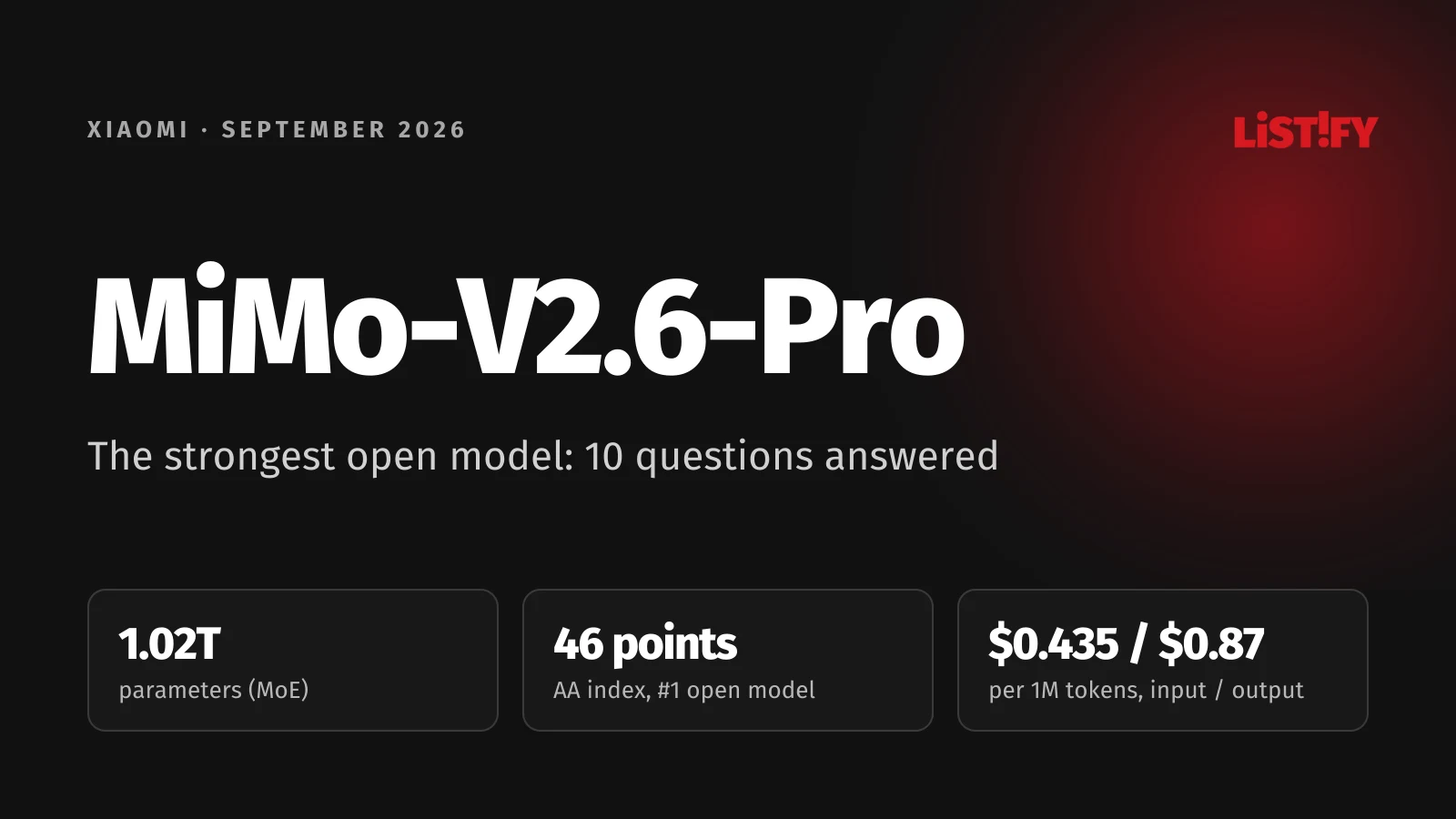
Each chapter starts with a short answer, followed by details, tables and links to sources. Most benchmarks come from the vendor itself; we cover the independent Artificial Analysis evaluation separately.
01What is MiMo V2.6 Pro?
Short answer: MiMo-V2.6-Pro is the strongest open-weights AI model in the world according to the independent Artificial Analysis Intelligence Index. It comes from Xiaomi, the phone and electric car maker, was released on September 22, 2026, can be downloaded for free under the MIT license, and costs less than a dollar per million output tokens through the API. (VentureBeat, Mixed News)
| Key figure | Value |
|---|---|
| Total / active parameters | 1.02 trillion / 42 billion |
| Context | 1 million tokens |
| Inputs | Text, images, video, audio |
| AA Intelligence Index v4.3 | 46, first among open models |
| API price | $0.435 input / $0.87 output per 1M tokens |
| License | MIT |
| Reinforcement learning cost | About $2.62 million, under 6 days |
Pro did not ship alone. The V2.6 line also includes the even cheaper MiMo-V2.6-Flash, the fast Pro-UltraSpeed variant and the small MiMo-V2.6-Distill-Qwen-9B model. (eWeek)
02Why is Xiaomi building large language models at all?
Short answer: Xiaomi is building its own complete open stack for AI agents: models, a coding agent, a harness and training infrastructure.
The company started publicly expanding the MiMo family in 2025 and went all in on agentic AI in 2026. (VentureBeat)
| When | What Xiaomi released |
|---|---|
| September 22, 2026 | MiMo-V2.6 Pro and Flash, a technical report, about 7,000 RL environments, an RL framework |
| 2026 | HarnessX: a framework that rewrites the prompts, memory and tools around the model at run time |
| June 2026 | MiMo Code: an open terminal coding agent with memory across sessions |
| April 2026 | MiMo-V2.5 and V2.5-Pro: a 1.02 trillion parameter MoE, million-token context, low prices |
| 2025 | Start of the public expansion of the MiMo family |
The MiMo team is led by Fuli Luo, a former DeepSeek researcher. She describes it as one of the largest standalone reinforcement learning runs in open AI; Xiaomi dedicated several dozen people to it despite a shortage of compute. (VentureBeat)
According to Forkast, the release landed on the same day as Alibaba's V900 chip. Forkast reads it as the software layer of a Chinese AI stack built under the pressure of export controls. (Forkast)
03What is new in V2.6 Pro?
Short answer: A huge jump on agentic tasks thanks to large-scale reinforcement learning (RL). On DeepSWE, Pro improved from 19.0 to 71.9 points.
| Benchmark | MiMo-V2.5-Pro | MiMo-V2.6-Pro |
|---|---|---|
| DeepSWE v1.1 | 19.0 | 71.9 |
| AutomationBench | 16.0 | 53.1 |
| MiMo Code Bench | 40.4 | 63.2 |
- MiMo-V2.6-Pro71.9%
- MiMo-V2.6-Flash67.9%
- MiMo-V2.5-Pro19.0%
Sources: VentureBeat, Hugging Face
“You Only RL Once”
Instead of separate RL programs for code, visual work, computer use and cybersecurity, Xiaomi mixed every domain into one large run. Pro and Flash each went through 30 large RL steps covering about 750,000 trajectories in under six days. (VentureBeat)
- Each step starts with 1,568 prompts and generates 16 trajectories for each, which is about 25,000 rollouts and 2.7 to 3.7 billion tokens per step.
- The average trajectory runs 110,000 to 150,000 tokens; Xiaomi was reinforcing entire long agentic workflows, not short answers.
- Pro's budget: 43.5% training, 43.8% rollout generation, 12.7% evaluation.
- Training used “mini-harnesses” for code, professional work, visual tasks and cybersecurity, so the model would not learn just one environment.
Grading quality, not just “passed the test”
Xiaomi introduced two new reward systems. Groupwise Reward Synthesis (GRS) creates grading criteria for a task by comparing several attempts. Groupwise Advantage Redistribution (GAR) shifts the reward toward the better of the successful solutions. Without them, the agent gradually started swallowing exceptions, loosening validation and bending configuration to fit the tests; with them, it made smaller and more precise fixes. (VentureBeat)
Fighting cheating
In early runs, agents downloaded newer package versions or dug up a ready-made fix in the repository history instead of fixing the bug. Xiaomi removed caches and future Git history from the environments, blocked network access to answer sources and deployed a separate “hack agent” to look for loopholes. In the final run, confirmed cheating stayed under 2%, and those trajectories got zero reward. (VentureBeat)
04How is MiMo V2.6 Pro built?
Short answer: It is a sparse Mixture-of-Experts with 1.02 trillion parameters, 42 billion of them active per token, with a frozen router, hybrid attention and a five-layer MTP speculative decoder.
| Spec | MiMo-V2.6-Pro | MiMo-V2.6-Flash |
|---|---|---|
| Architecture | MoE with a frozen router | MoE |
| Total parameters | 1.02 trillion | 309 billion |
| Active parameters | 42 billion | 15 billion |
| Context | 1 million tokens | 1 million tokens |
| Max output | 128,000 tokens | 128,000 tokens |
| Inputs | Text, images, video, audio | Text, images, video, audio |
| Output | Text | Text |
| License | MIT | MIT |
| RL phase cost | About $2.62 million | About $0.85 million |
Architecture details
- A frozen router. Xiaomi fixed the routing between experts during RL to limit model drift and make training more stable. (TestingCatalog)
- A five-layer MTP decoder for speculative decoding (faster generation). (Forkast)
- Native “omnimodality.” The vision encoder has 681 million parameters; audio uses a 308 million parameter AudioTokenizer and a 127 million parameter audio encoder that distinguishes speech. (SiliconANGLE)
- Fully asynchronous GRPO. Unfinished rollouts are interrupted and completed later, so GPUs do not wait on the slowest tasks. (VentureBeat)
According to Daanish Khazi of Paper Instruments, training ran entirely on Chinese chips, not Nvidia GPUs. (VentureBeat) Xiaomi itself does not confirm this; the technical report only mentions thousands of GPUs without naming the vendor.
05How does it perform on benchmarks?
Short answer: On agentic tasks it is on par with Claude Opus 5 and GPT-5.6 Sol, but it trails them on the hardest coding and on the general agentic test.
Pro and Flash results according to Xiaomi
| Benchmark | What it measures | MiMo-V2.6-Pro | MiMo-V2.6-Flash |
|---|---|---|---|
| DeepSWE v1.1 | Long software tasks | 71.9 | 67.9 |
| Terminal-Bench 2.1 | Terminal work | 89.9 | 87.6 |
| AutomationBench | Business workflows | 53.1 | 52.3 |
| Toolathlon-Verified | Tool use | 76.9 | 73.6 |
| JobBench | Professional tasks | 62.0 | 61.2 |
| MiMo Code Bench | Coding (internal) | 63.2 | 61.2 |
| MiMo Visual Coding | Visual coding (internal) | 72.3 | 71.5 |
| CyberGym | Finding vulnerabilities | 94.0 | 95.1 |
| Agents' Last Exam | Professional software tasks | 31.6 | 27.6 |
Against Claude Opus 5
| Benchmark | MiMo-V2.6-Pro | Claude Opus 5 | Leader |
|---|---|---|---|
| AutomationBench | 53.1 | 50.3 | MiMo |
| Terminal-Bench 2.1 | 89.9 | 89.1 | MiMo |
| Agents' Last Exam | 31.6 | 31.6 | Tie |
| DeepSWE v1.1 | 71.9 | 74.0 | Opus 5 |
According to Xiaomi's own tables, Claude Opus 5 is also ahead of MiMo on ProgramBench and Terminal-Bench 4.0, and GPT-5.6 Sol leads on the ExploitBench and SEC-Bench Pro cybersecurity tests. At the very top of Terminal-Bench 4.0, ExploitBench and SEC-Bench Pro in the same table is GPT-6 Astra, with Claude Fable 5.1 also near the top of Terminal-Bench 4.0. (VentureBeat)
Independent evaluation
Artificial Analysis gives Pro 46 points on its Intelligence Index v4.3, first place among open models. The cost per index task is $0.13, and the model sits on the Pareto frontier of intelligence and cost. It is not fast, though: Artificial Analysis measures about 46 tokens per second, which makes it one of the notably slow models (VentureBeat cites 134 tokens/s, which the measurement does not support). (Artificial Analysis, Mixed News, as of September 26, 2026)
Science
Xiaomi shows two research case studies: designing metal-organic frameworks to capture PFAS, and formalizing the “Period Three Implies Chaos” theorem in Lean 4 with more than 6,000 lines of verified code. That is not proof the model can do independent scientific research, though. (VentureBeat)
06How does it compare with other September 2026 models?
Short answer: It is number one among open models, and at 46 points it is level with the closed Grok 4.7. The best closed models, such as Claude Opus 5.5, Claude Fable 5.1 and GPT-6 Astra, are well ahead on the overall score.
| Model | Weights | AA Intelligence Index v4.3 |
|---|---|---|
| Claude Opus 5.5 | Closed | 58 |
| Claude Fable 5.1 | Closed | 53 |
| GPT-6 Astra | Closed | 53 |
| Claude Opus 5 | Closed | 51 |
| Muse Spark 1.3 (max) | Closed | 48 |
| GPT-5.6 Sol (max) | Closed | 47 |
| MiMo-V2.6-Pro | Open (MIT) | 46 |
| Grok 4.7 | Closed | 46 |
| GLM-5.3 (max) | Open | 45 |
| Grok 4.6 | Closed | 44 |
| Kimi K3 | Open | 44 |
| Gemini 3.8 Flash | Closed | 41 |
| DeepSeek V4.1 Flash | Open (MIT) | 39 |
| DeepSeek V4 Pro 0813 (max) | Open | 36 |
- Claude Opus 5.558
- Claude Fable 5.153
- GPT-6 Astra53
- Meta Muse Spark 1.3 (max)48
- Grok 4.746
- Xiaomi MiMo-V2.6-Pro46
- GLM-5.3 (max)45
- Kimi K344
- DeepSeek-V4.1-Flash39
As of September 26, 2026. Source: Artificial Analysis
Mind the index versions: The values in the table use the Artificial Analysis v4.3 methodology. Older v4.1 numbers quoted in other articles (for example 65.7 for Claude Fable 5.1, 61.2 for GPT-6 Astra or 59 for Gemini 3.8 Flash at launch) use a different scale and cannot be compared directly with this table. Gemini 3.8 Flash shows it well: on v4.3 it scores just 41.
DeepSWE across the September models
| Model | DeepSWE v1.1 | Open weights |
|---|---|---|
| Meta Muse Spark 1.3 | 75.4% | No |
| DeepSeek-V4.1-Flash | 74.2% | Yes |
| GPT-6 Astra | 74.1% | No |
| Gemini 3.8 Flash | 73.7% | No |
| MiMo-V2.6-Pro | 71.9% | Yes |
| Grok 4.7 | 71.0% | No |
| Claude Fable 5.1 | 67.4% | No |
Tim Dettmers (Carnegie Mellon, Ai2) called Flash, in his view, the best model in the 300 to 550 billion parameter class, better than DeepSeek V4.1 and GLM 5.3 Flash. (VentureBeat)
For all seven September models side by side, with pricing and benchmark charts, see our big comparison of September 2026 AI models.
07How much does it cost, and where can I get it?
Short answer: Pro costs $0.435 per million input tokens and $0.87 per million output tokens; Flash costs about a third of that. You can find them in Xiaomi's API, AI Studio, the MiMo Desktop and MiMo Code apps, on OpenRouter, and as free downloads on Hugging Face.
| Per 1M tokens | Input | Cached input | Output |
|---|---|---|---|
| MiMo-V2.6-Flash | $0.14 | $0.0028 | $0.28 |
| MiMo-V2.6-Pro | $0.435 | $0.0036 | $0.87 |
| MiMo-V2.6-Pro-UltraSpeed | $4.35 | $0.036 | $8.70 |
Prices stayed at the V2.5 level. UltraSpeed is the same Pro checkpoint with the same quality but ten times the price; Xiaomi cites up to 20x faster output, OpenRouter about 10x. (TestingCatalog, OpenRouter)
How cheap that is in context
| Model | Input + output per 1M tokens |
|---|---|
| MiMo-V2.6-Flash | $0.42 |
| DeepSeek-V4.1-Flash (off-peak) | $0.75 |
| MiMo-V2.6-Pro | $1.31 |
| DeepSeek-V4.1-Flash (peak) | $1.50 |
| Gemini 3.8 Flash (through 2026) | $4.50 |
| Muse Spark 1.3 (Standard) | $5.50 |
| Grok 4.7 (under 200K) | $8.00 |
| Claude Opus 5.5 | $24.00 |
| Claude Opus 5 | $30.00 |
| Claude Fable 5.1 / GPT-6 Astra | $60.00 |
- Claude Opus 5.5$24.00
- Grok 4.7 (under 200K)$8.00
- Muse Spark 1.3 (Standard)$5.50
- Gemini 3.8 Flash (through 2026)$4.50
- DeepSeek-V4.1-Flash (peak)$1.50
- MiMo-V2.6-Pro$1.31
- DeepSeek-V4.1-Flash (off-peak)$0.75
- MiMo-V2.6-Flash$0.42
Sum of input and output prices. Sources: VentureBeat, Claude Opus 5.5 per Anthropic pricing
Where to find it
- Hugging Face: the XiaomiMiMo/mimo-v26 collection with Pro, Flash and Distill-Qwen-9B weights under MIT.
- Xiaomi's API and AI Studio, plus the MiMo Desktop and MiMo Code apps.
- OpenRouter:
xiaomi/mimo-v2.6-prowith three providers,xiaomi/mimo-v2.6-flashwith two, andxiaomi/mimo-v2.6-pro-ultraspeed. - OpenCode: Flash is free for a week after launch, and both Pro and Flash are in the Go service.
Sources: VentureBeat, OpenRouter, WinBuzzer
08How do I plug it into my own app?
Short answer: The fastest route is OpenRouter with the ID xiaomi/mimo-v2.6-pro, which uses an OpenAI-compatible format.
import os
from openai import OpenAI

client = OpenAI(
    base_url="https://openrouter.ai/api/v1",
    api_key=os.environ["OPENROUTER_API_KEY"],
)

response = client.chat.completions.create(
    model="xiaomi/mimo-v2.6-pro",  # cheaper option: xiaomi/mimo-v2.6-flash
    messages=[
        {"role": "user", "content": "Design a REST API structure for a booking system."}
    ],
)

print(response.choices[0].message.content)
The Pro and Flash model IDs are verified on OpenRouter; check the parameters of Xiaomi's direct API in the documentation at mimo.xiaomi.com.
Self-hosting
The weights are free to download and modify under MIT. With 1.02 trillion parameters, though, Pro is demanding on hardware even with 42 billion active; for smaller infrastructure, Flash (309 billion) or the 9B distilled model is the more sensible choice. (VentureBeat, WinBuzzer)
What else Xiaomi opened up
Besides the weights: the technical report, about 7,000 RL environments, the complete RL framework and composable mini-harnesses. Other teams can verify the approach and reproduce it on smaller models. (Xiaomi: MiMo-V2.6, VentureBeat)
09What are the risks and limitations?
Short answer: Most of the numbers come from Xiaomi, the API runs on Chinese servers, self-hosting Pro is expensive and independent safety testing is still missing.
- Vendor results. Xiaomi ran many of the agentic tests itself, including the internal MiMo Code Bench and MiMo Visual Coding benchmarks. (VentureBeat)
- Chinese servers. Using Xiaomi's API is harder for companies with restrictions on Chinese servers; self-hosting or OpenRouter is the workaround. (VentureBeat)
- Demanding self-hosting. A trillion-parameter model needs powerful hardware. (WinBuzzer)
- Little independent safety testing. Xiaomi reports improvements on its own MiMo Cyber benchmark, but external safety testing of V2.6 is limited so far. (eWeek)
- Behind the flagship models. On the overall score it trails Claude Opus 5.5, Claude Fable 5.1 and GPT-6 Astra. (Artificial Analysis)
- Slow output. About 46 tokens per second according to Artificial Analysis; if you need speed, you pay ten times more for UltraSpeed. (Artificial Analysis)
- Strong cyber capabilities without central safeguards. A 94% CyberGym score in an open-weights model means the operator is responsible for the usage rules.
10Who is MiMo V2.6 Pro for, and who should skip it?
Short answer: It is for teams that want a near-frontier agent with open weights at a minimal price. It is not for those who need the absolute best, or who cannot send data to China and have nowhere to host the model.
It is a good fit when you
- scale agents at volume and every cent per million tokens is multiplied by thousands of runs; consider Flash at $0.42 in particular,
- want the open model with the best overall score and the option to fine-tune under MIT,
- handle different input types: text, images, video and audio in one model,
- build front ends, 3D scenes or presentations; Xiaomi targets design, Figma, Blender and video,
- research RL for agents: the open framework and about 7,000 environments are unique.
It is not a good fit when you
- need the best possible coding: Claude Opus 5, GPT-6 Astra and other closed models are ahead of MiMo on both DeepSWE and Terminal-Bench 4.0,
- do offensive security work: GPT-6 Astra and GPT-5.6 Sol lead on ExploitBench and SEC-Bench Pro,
- cannot use Chinese servers and do not have the hardware for a trillion-parameter model,
- need independently verified safety: there are few external tests so far.
The recommendations are based on the benchmarks and prices in the previous chapters. For more on the competitors, see our Grok 4.7 guide, Claude Fable 5.1 guide, GPT-6 Astra guide, Gemini 3.8 Flash guide, Muse Spark 1.3 deep dive and DeepSeek-V4.1-Flash article.
Want to put AI agents to work in your own processes? We help you choose the model and connect it to your systems as part of our AI implementation service.
11Quick answers
When was MiMo V2.6 Pro released?
On September 22, 2026, according to Xiaomi. The announcement on X came on September 21 at 10:51 p.m. Central European Summer Time, when it was already September 22 in Beijing.
Is MiMo V2.6 Pro open source?
It has open weights under the MIT license; Xiaomi also published the technical report and the RL framework.
How many parameters does MiMo V2.6 Pro have?
1.02 trillion in total, 42 billion active per token.
How much does MiMo V2.6 Pro cost?
$0.435 per million input tokens and $0.87 per million output tokens.
Is MiMo V2.6 Pro better than DeepSeek?
On the overall Artificial Analysis index, yes (46 vs 39 for DeepSeek V4.1 Flash); on DeepSWE, by the vendors' numbers, DeepSeek leads (74.2% vs 71.9%).
What is the difference between MiMo V2.6 Pro and Flash?
Flash has 309 billion parameters (15 billion active), costs about a third as much and trails Pro by only a few points on agentic tests.
12Sources
- VentureBeat: MiMo-V2.6-Pro as the top open-weights model
- SiliconANGLE: Xiaomi introduces the MiMo-V2.6 series
- Mixed News: a $2.62 million RL run
- Forkast: open weights and the Chinese AI stack
- eWeek: Pro, Flash and a 9B model
- TestingCatalog: Xiaomi open-sources MiMo-V2.6
- WinBuzzer: MiMo V2.6 efficiency
- OpenRouter: MiMo-V2.6-Pro
- Xiaomi MiMo on X: announcement
- Xiaomi: MiMo-V2.6 page
- Hugging Face: MiMo-V2.6-Pro
- Hugging Face: MiMo-V2.6-Flash
- Artificial Analysis: MiMo-V2.6-Pro