Gemini 3.8 Flash: the technical guide to benchmarks, API, pricing and how it compares
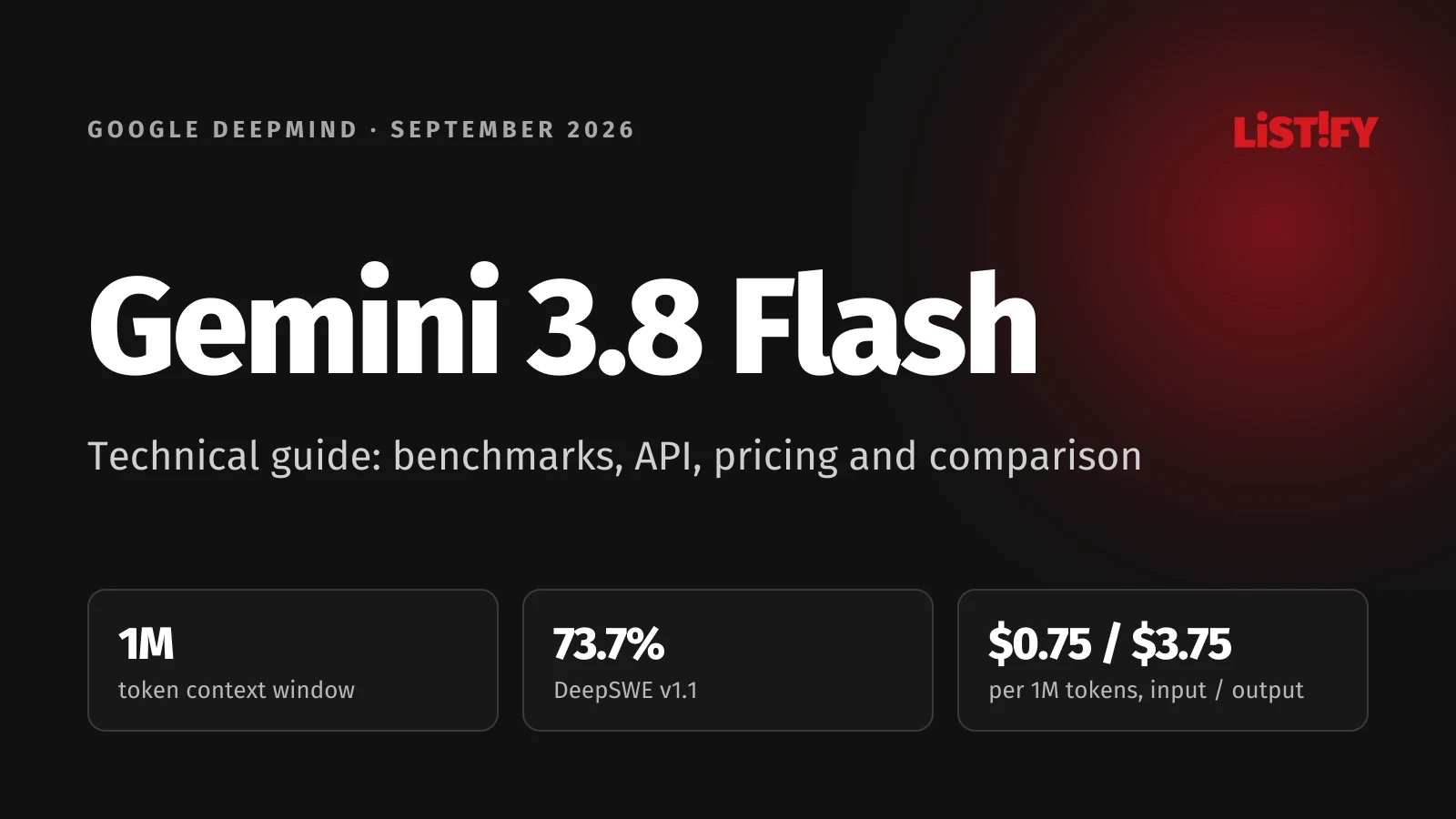
Gemini 3.8 Flash is Google's newest model, and on coding and agentic tasks it reaches the level of large models at a fraction of their price. It launched on September 2, 2026 as the third Flash model in six weeks. It scores 73.7% on DeepSWE, practically the same as Claude Opus 5, while an input token costs about a seventh as much.
The newest Pro model, meanwhile, is still Gemini 3.1 Pro from February 19, 2026. This guide covers the specs, benchmarks, pricing including the January 2027 increase, the Cyber variant and how it compares with the competition.
01What is Gemini 3.8 Flash
Gemini 3.8 Flash is a fast, low-cost model from Google DeepMind, which Google calls its smartest Flash model yet. It is built for scaling AI agents: coding, agentic tasks and multi-step reasoning. It shipped alongside Gemini 3.8 Flash Cyber, a variant for cyber defense. (Google AI for Developers)
“Gemini 3.8” is just the generation label. The generally available model is gemini-3.8-flash; there is no separate Gemini 3.8 Pro model yet. (Agentpedia)
Google is shipping Flash models in quick succession: 3.6 Flash, 3.7 Flash and 3.8 Flash within six weeks. Each version builds on the agentic capabilities of the previous one. (Agentpedia)
Independent evaluation
On the current Intelligence Index v4.3, Gemini 3.8 Flash scores 41 at high reasoning, 2 points more than 3.7 Flash (39); GPT-5.6 Sol at xhigh scores 44. The model outputs roughly 330 tokens per second. (Artificial Analysis, as of September 26, 2026) According to Artificial Analysis' launch article, it sits on the Pareto frontier of intelligence and cost per task. (Artificial Analysis)
02The Gemini model family in September 2026
Gemini 3.8 Flash is the newest model, but the strongest Pro version is the older Gemini 3.1 Pro, which is still only a preview in the API (gemini-3.1-pro-preview). Current models:
| Model | Released | Focus |
|---|---|---|
| Gemini 3.8 Flash | September 2, 2026 | Fast agentic model, coding, documents, video |
| Gemini 3.8 Flash Cyber | September 2, 2026 | Finding and fixing vulnerabilities, only through the Fairwind program |
| Gemini 3.5 Flash-Lite | July 21, 2026 | Cheapest high-volume tasks |
| Gemini 3.1 Pro | February 19, 2026 | Strongest Pro version, a preview in the API |
| Gemini 3 Deep Think | February 12, 2026 | Deep reasoning for hard problems |
In September, Google also released the Gemini app for Windows and introduced agentic video understanding. (The Soo Group)
03Gemini 3.8 Flash technical specifications
Gemini 3.8 Flash has a 1 million token context window, up to 65,536 output tokens and an explicit reasoning mode.
| Spec | Value |
|---|---|
| Developer | Google DeepMind |
| API model ID | gemini-3.8-flash |
| Release | September 2, 2026 (stable, generally available) |
| Predecessor | Gemini 3.7 Flash |
| Context window | 1M tokens |
| Max output | 65,536 tokens |
| Reasoning | Explicit mode; adjustable level and thinking budget |
| Multimodality | Text, images, audio, video and documents (including agentic processing of long video) |
| Output speed | About 300 tokens/s (high reasoning, measured at launch) |
| Average time per task | About 2.5 min (high reasoning) |
| Price (introductory, through December 31, 2026) | $0.75 input / $3.75 output per 1M tokens |
| Price (from January 1, 2027) | $1.50 input / $7.50 output per 1M tokens |
| Availability | Gemini API, Google AI Studio, Gemini app (Pro and Ultra subscriptions) |
Reasoning levels
On index v4.3, the model scores 41 at high reasoning, 40 at medium and 33 at low. An index task costs about $1.24 at high and about $0.93 at medium. (Artificial Analysis)
Agentic video understanding
Instead of fixed sampling at 1 frame per second, the model decides which parts of a video to look at. On the LVBench long-video benchmark, that yields 87.8% versus 87.1% without agentic mode. (Agentpedia)
04How to use Gemini 3.8 Flash
You can run Gemini 3.8 Flash in the Gemini app, in Google AI Studio or through the Gemini API.
In Google AI Studio
- Open Google AI Studio and sign in with your Google account.
- Select Gemini 3.8 Flash in the model settings.
- Set the reasoning level and tools (search, code execution) to fit the task.
- You can export a finished prompt as API code.
Through the Gemini API
An illustrative call in Python with the google-genai SDK:
from google import genai

client = genai.Client()  # reads GEMINI_API_KEY from the environment

response = client.models.generate_content(
    model="gemini-3.8-flash",
    contents="Find and fix the failing test in this repository.",
)

print(response.text)
Example source: Agentpedia. Reasoning level, thinking budget and tools are set the same way as for 3.7 Flash; check the exact parameter names in the Gemini API documentation.
Migrating from 3.7 Flash: just change the model name. Agentic video settings stay the same. (Agentpedia)
05Gemini 3.8 Flash benchmarks
Gemini 3.8 Flash wins agentic and domain tests (code, terminal, finance, law, biology), but trails the large models on computer use and general knowledge work. Numbers from Google's official card:
| Benchmark | What it measures | Gemini 3.8 Flash | Gemini 3.7 Flash | Claude Opus 5 | GPT-5.6 Sol |
|---|---|---|---|---|---|
| DeepSWE v1.1 | Long software tasks | 73.7% | 65.3% | 74.0% | 72.7% |
| Terminal-Bench 2.1 | Terminal work | 89.4% | 85.8% | 89.1% | 88.8% |
| Terminal-Bench 4.0 | General agent | 19.1% | 11.2% | 51.8% | 37.3% |
| Vals Finance Agent v2 | Finance agent | 61.4% | 59.0% | 58.6% | 53.8% |
| Harvey Legal Agent | Legal agent | 10.0% | 8.8% | 6.7% | 2.5% |
| GDPval-AA v2 (Elo) | Knowledge work | 1545 | 1482 | 1824 | 1710 |
| HLE-Verified | Expert reasoning | 54.9% | 53.6% | 54.4% | 54.5% |
| CharXiv Reasoning | Reading charts | 86.2% | 84.5% | 83.7% | 85.8% |
| LVBench | Long video | 87.8% | 85.4% | 75.4% | 82.1% |
| OSWorld 2.0 | Computer use | 59.0% | 50.6% | 75.4% | 62.6% |
| GDP.PDF | Document understanding | 35.0% | 34.0% | 37.0% | 40.0% |
| LABBench2 | Biology research | 86.2% | 82.1% | 84.2% | 82.1% |
- Claude Opus 574.0%
- Gemini 3.8 Flash73.7%
- GPT-5.6 Sol72.7%
- Gemini 3.7 Flash65.3%
Google's official card; Google chose the competitors' configurations. Source: Agentpedia
The strongest argument is efficiency: on DeepSWE, Gemini 3.8 Flash matches Opus 5's accuracy at a fraction of the cost per task. Glean reports that in long document workflows it completed more than three times as many tasks as 3.7 Flash. (Google DeepMind)
- Claude Opus 575.4%
- GPT-5.6 Sol62.6%
- Gemini 3.8 Flash59.0%
- Gemini 3.7 Flash50.6%
A weaker spot for 3.8 Flash. Source: Google's official card via Agentpedia
How it compares with the September 2026 flagships
Against GPT-6 Astra and Claude Fable 5.1, Gemini 3.8 Flash is a class below on general intelligence and agentic tasks, but it keeps pace on long software tasks and costs far less.
| Benchmark | Gemini 3.8 Flash | GPT-6 Astra | Claude Fable 5.1 |
|---|---|---|---|
| AA Intelligence Index v4.3 | 41 | 53 | 53 |
| DeepSWE v1.1 | 73.7% | 74.1% | 67.4% |
| Terminal-Bench 4.0 | 19.1% | 57.9% | 55.8% |
| API price input / output (per 1M tokens) | $0.75 / $3.75 | $10 / $50 | $10 / $50 |
On the independent BenchLM leaderboard, 3.8 Flash scores 69.2% on CursorBench 3.2 (Fable 5.1: 73.4%) and 59% on OSWorld 2.0 (GPT-6 Astra: 72.6%). (BenchLM) For more on the competitors, see our GPT-6 Astra guide, Claude Fable 5.1 guide, Grok 4.7 guide and Muse Spark 1.3 deep dive.
For all seven September models side by side, with pricing and benchmark charts, see our big comparison of September 2026 AI models.
06Gemini 3.8 Flash Cyber and the Fairwind program
Gemini 3.8 Flash Cyber is a specialized variant for finding and automatically fixing vulnerabilities. It is not in the public API; only trusted defenders get it through the new Fairwind program. Governments and national cyber agencies, critical infrastructure operators and key technology platforms with a proven ethical track record can apply through a form. Google has not published pricing. (Google DeepMind: Fairwind)
| Benchmark / deployment | Gemini 3.8 Flash Cyber result | Comparison |
|---|---|---|
| CyberGym Pass@1 (finding vulnerabilities in C/C++) | 86.2% | GPT-5.5-Cyber 85.6%, Mythos 5 83.8%, 3.5 Flash Cyber 77.5% |
| CWE-Bench (fixes, pass@1) | 47.2% | A leading frontier model 47.8%, at a much higher price |
| Chrome Security team | 2.6x more correct fixes | Than the best larger commercial models |
| Wiz (internal penetration test) | 7.5% to 9.7% higher detection | At 2.3x to 5.2x lower cost |
By available reports, the Cyber variant found a bug in Chrome that engineers had missed for 13 years. (Miraflow)
Google did not test the standard Gemini 3.8 Flash on CyberGym or CWE-Bench, so do not use it as a replacement for a specialized security model. (Miraflow)
07Gemini 3.8 Flash pricing and availability
Through the end of the year, Gemini 3.8 Flash costs $0.75 per million input tokens and $3.75 per million output tokens. From January 1, 2027, the price doubles.
| Model | Input (per 1M tokens) | Output (per 1M tokens) |
|---|---|---|
| Gemini 3.8 Flash, introductory price (through December 31, 2026) | $0.75 | $3.75 |
| Gemini 3.8 Flash from January 1, 2027 | $1.50 | $7.50 |
| Claude Sonnet 5 | $2.00 | $10.00 |
| GPT-5.6 Sol | $4.00 | $20.00 |
| Claude Opus 5.5 | $4.00 | $20.00 |
| Claude Opus 5 (previous generation) | $5.00 | $25.00 |
| GPT-6 Astra / Claude Fable 5.1 | $10.00 | $50.00 |
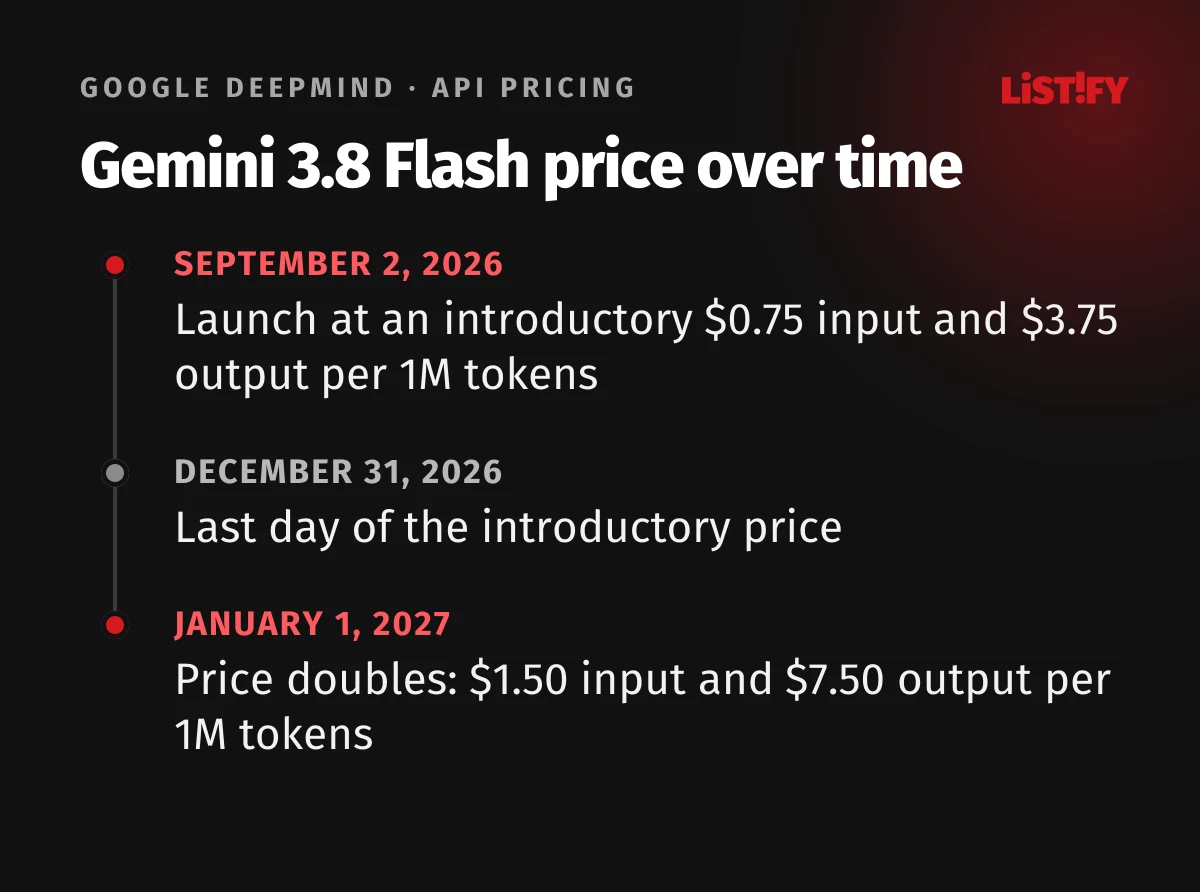
Plan budgets around the price from January 2027, not the introductory one. Even after the increase, 3.8 Flash is 1.3x to 6.7x cheaper on input than the competitors in the table. The same price schedule also applies to Gemini 3.7 Flash. (Agentpedia)
- GPT-6 Astra$10.00
- GPT-5.6 Sol$4.00
- Claude Opus 5.5$4.00
- Claude Sonnet 5$2.00
- Gemini 3.8 Flash from January 1, 2027$1.50
- Gemini 3.8 Flash through 2026$0.75
Sources: Agentpedia, OpenAI, Claude: API pricing
The model is available in the Gemini API and Google AI Studio. In the Gemini app, now also on Windows, Pro and Ultra subscribers get it. (BenchLM, The Soo Group)
08Who should use Gemini 3.8 Flash
Gemini 3.8 Flash pays off wherever you run a lot of agentic tasks and cost per task matters. For the hardest general tasks, reach for a larger model.
| Situation | Recommendation | Why |
|---|---|---|
| Coding agents, test fixes, CI | Gemini 3.8 Flash | DeepSWE on par with Opus 5 at a fraction of the price |
| Finance, law, biology | Gemini 3.8 Flash | Leads Vals Finance, Harvey Legal and LABBench2 |
| Long documents and videos | Gemini 3.8 Flash | 1M tokens, agentic video processing |
| High volumes of simple queries | Gemini 3.5 Flash-Lite | The cheapest option |
| Computer use, general agent | GPT-6 Astra or Claude Opus 5.5 | 3.8 Flash scores only 59% on OSWorld and 19% on Terminal-Bench 4.0 |
| Hardest code and research | Claude Fable 5.1 or GPT-6 Astra | Higher general intelligence |
| Deep reasoning in the Google ecosystem | Gemini 3.1 Pro or 3 Deep Think | Google's strongest models |
| Cyber defense | Gemini 3.8 Flash Cyber (Fairwind) | Specialized model |
The recommendations are based on the benchmarks above (Agentpedia). Always test the model on your own tasks before migrating production.
09How to prompt Gemini 3.8 Flash
Gemini 3.8 Flash is built for agentic loops, so give it the goal and a way to verify the result, not individual steps.
- Start at medium reasoning. On index v4.3, medium scores 40 instead of 41, but a task costs about a quarter less ($0.93 vs $1.24); switch to high only where the result falls short. Leave low (33 points) for simple tasks. (Artificial Analysis)
- Define what done looks like. For example: “all tests pass, no new dependencies.” The model then iterates until it meets the condition.
- Use the long context. Load the whole document, contract or video instead of excerpts; with 1M tokens the model can handle all of it.
- Turn on agentic processing for video. The model picks the important segments itself instead of sampling at a fixed rate.
- Watch the output length. The limit is 65,536 tokens, so split long generation (whole modules, reports) into several steps.
- Measure cost per task, not per token. A higher reasoning level makes tasks longer; the average at high is about 2.5 minutes.
10Gemini 3.8 Flash FAQ
What is Gemini 3.8 Flash?
A fast, low-cost model from Google DeepMind released on September 2, 2026, focused on coding, agentic tasks and multi-step reasoning. Google calls it its smartest Flash model yet.
How much does Gemini 3.8 Flash cost?
Through December 31, 2026, the introductory price is $0.75 per million input tokens and $3.75 per million output tokens. From January 1, 2027, it will be $1.50 and $7.50.
How big is the Gemini 3.8 Flash context window?
1 million input tokens and up to 65,536 output tokens.
Is there a Gemini 3.8 Pro?
Not yet. The newest Pro version is Gemini 3.1 Pro from February 19, 2026, still a preview in the API.
Is Gemini 3.8 Flash better than Claude or GPT?
On long software tasks (DeepSWE) it reaches the level of Claude Opus 5 and GPT-6 Astra at a fraction of the price. On computer use and general intelligence it trails them.
What is Gemini 3.8 Flash Cyber?
A variant for finding and fixing vulnerabilities, available only to trusted defenders through the Fairwind program. It scores 86.2% on CyberGym.
11Verdict: is Gemini 3.8 Flash worth it?
In September 2026, Gemini 3.8 Flash offers the best price to performance for agentic coding and work with long documents. On code it reaches the large models at a fraction of their price.
It is not a universal winner, though. GPT-6 Astra and the Claude models have the edge on computer use and general agentic tasks, and the introductory price ends in January 2027. If you are scaling agents and watching costs, start with 3.8 Flash; keep a larger model in reserve for the hardest tasks.
Want to put AI agents to work in your own processes? We help you choose the model and connect it to your systems as part of our AI implementation service.
12Sources
- Google DeepMind: Gemini 3.8 Flash
- Google DeepMind: Gemini 3.8 Flash model card
- Google DeepMind: Fairwind program
- Google AI for Developers: Gemini API models
- Agentpedia: the complete Gemini 3.8 Flash guide
- Artificial Analysis: Gemini 3.8 Flash
- BenchLM: Gemini 3.8 Flash
- Emergent: Gemini 3.8 Flash benchmarks
- Miraflow: Gemini 3.8 Flash Cyber
- Wikipedia: Google Gemini
- Capital and Compute: September 2026 models
- The Soo Group: September 2026
- OpenAI: GPT-6 Astra
- Claude: API pricing
- Anthropic: Claude Fable 5.1