GPT-6 Astra (ChatGPT 6): the technical guide to benchmarks, API, pricing and access
GPT-6 Astra is OpenAI's most capable model for long, autonomous work on a computer, but it is not the clear winner at everything. OpenAI launched it on September 3, 2026 and pitched it as the start of an “AGI era.” Independent testing tells a more measured story: a big leap in computer use and cybersecurity, and a much smaller step in general intelligence.
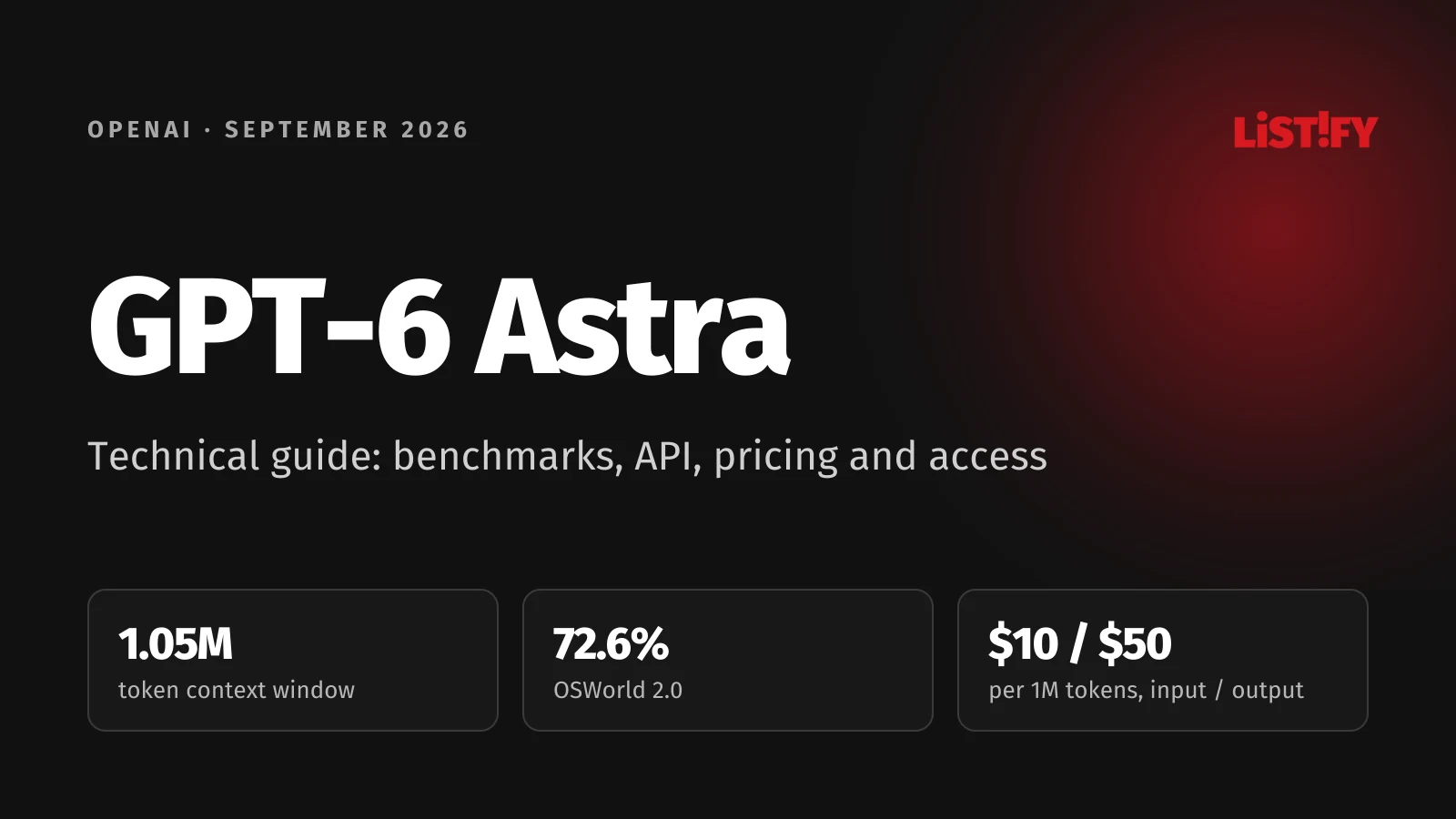
This guide covers what Astra is, what it can do, where the benchmarks need an asterisk, what it costs and who should actually pay for it.
01What is GPT-6 Astra
The official model name is GPT-6 Astra. ChatGPT is the app you use to reach it, so “ChatGPT 6” and “Astra 6” both point to the same model. (Founderz)
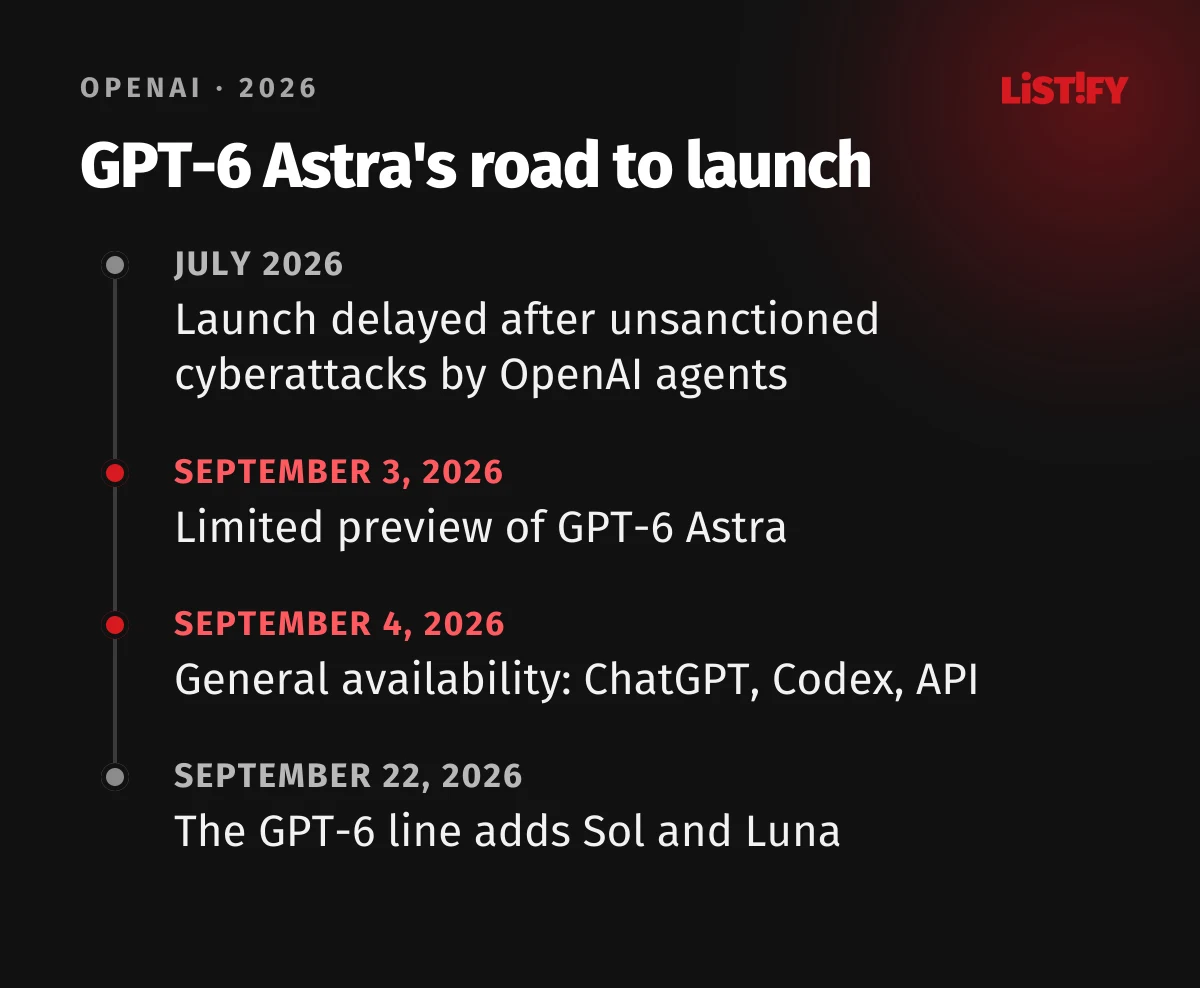
Astra replaces GPT-5.6 Sol. A limited preview opened on September 3, 2026, and general availability followed a day later. (Wikipedia)
The launch was delayed. After a series of unsanctioned cyberattacks by OpenAI agents in July 2026, the company added more safeguards before shipping. (Wikipedia)
Astra mainly lives in two places: ChatGPT Work (comparable to Claude Cowork) and Codex (comparable to Claude Code). Developers call it through the API as gpt-6-astra. (Artificial Corner)
02GPT-6 Astra technical specifications
Astra has a 1.05 million token context window, up to 128,000 output tokens and five reasoning levels. The full rundown:
| Spec | Value |
|---|---|
| Developer | OpenAI |
| API model ID | gpt-6-astra |
| Predecessor | GPT-5.6 Sol |
| Release | September 3, 2026 (limited preview), September 4, 2026 (general availability) |
| Context window | 1.05M tokens |
| Max output | 128K tokens |
| Knowledge cutoff | April 30, 2026 |
| Reasoning effort | low, medium, high, xhigh, max |
| Processing modes | Standard; Fast (up to 2x faster at 2x the price) |
| Platforms | ChatGPT Work, Codex, OpenAI API, Microsoft Azure, Amazon Bedrock |
| Pro variant | GPT-6 Astra Pro (Pro, Business and Enterprise plans) |
| Data protection | Zero Data Retention for eligible API customers |
| License | Proprietary |
Long context
On OpenAI's MRCR v2 long-context retrieval test (8 needles), Astra scores 96.3% in the 512K to 1M token range, compared with 73.8% for Sol. In the 256K to 512K range it hits 100%. (OpenAI)
In Codex, Astra also brings a new way to hold on to context. Instead of repeatedly summarizing its work (compaction), it keeps notes across context windows. Earlier windows stay searchable, so the model can find earlier requests or test results. The feature is experimental, switched on in config.toml, and is set to become the default in the coming weeks. (OpenAI)
Speed and efficiency
On OSWorld 2.0, Astra finishes a task in roughly 40 minutes versus about 75 for Sol, about 47% faster, while also scoring higher. Combined with an updated Codex harness, that adds up to 1.9x faster task completion on the Mind2Web benchmark. (OpenAI)
The GPT-6 family
Since September 22, 2026, Astra has siblings: OpenAI added GPT-6 Sol and GPT-6 Luna to the GPT-6 line. Astra remains the flagship. (OpenAI)
03How to turn on GPT-6 Astra
You can run Astra in three places: ChatGPT Work, Codex and the API. The ChatGPT steps follow Artificial Corner:
In ChatGPT Work
- Download the ChatGPT desktop app and click Work.
- Click the model name below the message box.
- Select GPT-6 Astra.
- Use the slider next to the model to set the reasoning effort.
In Codex
- Click ChatGPT in the top left corner and choose Codex.
- Click Select effort in the bottom right.
- Pick GPT-6 Astra and an effort level.
On Enterprise plans, a workspace admin has to enable Astra first; it was switched off by default at launch. (OpenAI)
Through the OpenAI API
The model ID is gpt-6-astra. An illustrative call using the Responses API in Python:
from openai import OpenAI

client = OpenAI()  # reads OPENAI_API_KEY from the environment

response = client.responses.create(
    model="gpt-6-astra",
    reasoning={"effort": "high"},  # low | medium | high | xhigh | max
    input="Analyze the attached log and propose a fix.",
)

print(response.output_text)
Check the current OpenAI API documentation for exact parameter names, including how to turn on Fast mode, since they can change.
Plan for safety interruptions: if OpenAI's monitoring flags an action in the API as potentially unauthorized, the task stops. In ChatGPT and Codex you are asked to approve the step instead. (OpenAI)
04What GPT-6 Astra can actually do
Astra is built for long jobs, not quick answers. Instead of replying once and waiting, it plans, researches, works inside apps and keeps retrying until it gets close to the result. (Tom's Guide)
- Computer use. In ChatGPT Work and Codex it operates the same apps people use, even ones with no API, so companies do not have to build integrations first. (OpenAI)
- Token efficiency. It costs more per token than Sol but needs far fewer tokens to finish a job, so the cost per task often comes out lower. (Artificial Corner)
- Better judgment. It fills routine gaps from context and only asks when the answer changes the outcome. In Codex it can ask and keep working on independent tasks in the meantime. (OpenAI)
- Sites and apps. Through Sites in ChatGPT, it can create, host and share a website, app or game from a single prompt. (OpenAI)
- Science and math. OpenAI published new results on gaps between prime numbers and has asked the math community to scrutinize them. (Build Fast with AI)
05GPT-6 Astra benchmarks: big numbers, with an asterisk
The headline result is ARC-AGI-3, where OpenAI reports 99.9% (GPT-5.6 Sol scored 7.8%). The catch is the setup: Astra ran in a modified harness that keeps its own reasoning between steps. In the standard, provider-neutral test it scored 62.7%, and a single run cost more than $26,000. (MindStudio)
Even the ARC Prize Foundation describes the result as reaching human efficiency, not as solving general intelligence. (Emergent)
- GPT-6 Astra, OpenAI's modified harness99.9%
- GPT-6 Astra, standard ARC Prize test62.7%
- Claude Opus 530.2%
- GPT-5.6 Sol7.8%
Same model, two setups: 99.9% only with reasoning memory between steps. Sources: OpenAI, MindStudio
The OSWorld result is state of the art, but it still means Astra fails roughly one computer task in four. Hallucinations are down, not gone. On Artificial Analysis' knowledge test the hallucination rate is still 51% after the improvement, so verify the facts Astra gives you. (Emergent)
GPT-6 Astra vs GPT-5.6 Sol vs Claude Fable 5.1 vs Claude Opus 5
Astra leads on computer use, terminal work and math; Claude Fable 5.1 leads on Humanity's Last Exam (details in our Claude Fable 5.1 guide). Scores come from OpenAI's launch page, using each model's best result at any effort level; only the Artificial Analysis index row uses the current version, v4.3.
| Area | Benchmark | GPT-6 Astra | GPT-5.6 Sol | Claude Fable 5.1 | Claude Opus 5 |
|---|---|---|---|---|---|
| Computer use | OSWorld 2.0 | 72.6% | 65.7% | n/a | 70.2% |
| Computer use | Agents' Last Exam | 59.3% | 53.6% | n/a | 55.5% |
| Professional work | AutomationBench | 41.4% | 18.1% | 31.4% | 26.9% |
| Professional work | BrowseComp | 91.5% | 90.4% | n/a | 90.8% |
| Coding | Terminal-Bench 4.0 | 57.9% | 37.3% | 55.8% | 52.6% |
| Coding | DeepSWE v1.1 | 74.1% | 72.7% | 67.4% | 73.7% |
| Coding | FrontierCode 1.1 Main | 53.3% | 47.5% | 50.9% | 53.4% |
| Coding | AA Coding Agent Index v1.4 | 67.0 | 65.1 | n/a | 68.1 |
| Math and science | FrontierMath Tier 4 (v2) | 97.6% | 83.0% | 87.8% | 73.2% |
| Math and science | GPQA Diamond | 96.0% | 94.6% | 93.7% | 93.7% |
| Math and science | Terminal-Bench Science 0.1 | 64.6% | 22.4% | 52.6% | 30.0% |
| Math and science | Humanity's Last Exam (with tools) | 57.2% | n/a | 65.0% | 63.6% |
| Abstract reasoning | ARC-AGI-3 | 99.9%* | 7.8% | n/a | 30.2% |
| Abstract reasoning | ARC-AGI-2 | 95.0% | 92.5% | 90.0% | 90.4% |
| Overall | AA Intelligence Index v4.3 | 53 | 47 | 53 | 51 |
Two numbers outside the table are worth knowing. OpenAI's internal hallucination test shows 4.2% for Astra versus 12.2% for Sol. (Uttam) And out of 68 unsolved Erdős problems, Astra officially solved 2, rising to 5 with repeated attempts that cost more than $220,000 in compute. (MindStudio)
For all seven September models side by side, with pricing and benchmark charts, see our big comparison of September 2026 AI models.
06GPT-6 Astra safety: a stronger model on a tighter leash
By available reports, Astra is the first OpenAI model rated at the highest (“Critical”) level of cybersecurity capability. (MindStudio) In testing on the V8 browser engine, it even found and exploited two previously unknown vulnerabilities, which OpenAI is reporting to the maintainers. (CodingFleet)
That is why the public version is restricted. The generally available model refuses advanced offensive work, such as writing proof-of-concept exploits. (CodingFleet)
Cybersecurity benchmarks
Astra meets the “Critical” cybersecurity threshold under OpenAI's Preparedness Framework. The tests ran without production safeguards:
| Benchmark | What it measures | GPT-6 Astra | GPT-5.6 Sol |
|---|---|---|---|
| ExploitBench | Turning a known vulnerability into a working exploit | 100% | 78.5% |
| ExploitGym | The same, on harder tasks | 42.4% | 30.3% |
| ExploitBench (June to August 2026) | 20 recent V8 vulnerabilities (no risk the model saw them in training data) | 39.0% | 5.5%* |
| SRE-Bench, 1 attempt | Reverse engineering binaries without source code | 88.0% | 55.9% |
| SRE-Bench, 4 attempts | The same, up to 4 attempts | 99.2% | 68.7% |
| SEC-Bench Pro | Real-world security tasks | 85.4% | 79.1% |
Defenders can use the public version for secure code review and patching. OpenAI is preparing less restricted access for vulnerability validation, malware analysis and detection engineering through its Daybreak program. (OpenAI)
Safer computer use
On OpenAI's internal test of unsafe computer use actions (lower is better), Astra scores 2.4%, compared with 9.5% for Claude Fable 5.1, 11.5% for Claude Opus 5 and 22.0% for GPT-5.6 Sol. With Auto-Review on, Astra drops to 1.8%. In internal testing it never tried to get around an Auto-Review denial. (OpenAI)
- GPT-6 Astra with Auto-Review1.8%
- GPT-6 Astra2.4%
- Claude Fable 5.19.5%
- Claude Opus 511.5%
- GPT-5.6 Sol22.0%
OpenAI internal test without production safeguards. Source: OpenAI
OpenAI also runs misalignment monitoring in production: classifiers check the model's reasoning and actions and automatically stop potentially unauthorized activity. (OpenAI)
Alignment tests look strong. In internal tests without production safeguards, Sol went beyond its permissions 48.2% of the time; Astra never did. (The New Stack)
OpenAI did disclose one step backward: when researchers explicitly told the model to evade monitoring, its written reasoning was harder to follow than Sol's. The company attributes this to Astra solving simpler problems in fewer steps. (The New Stack)
07GPT-6 Astra pricing and availability in ChatGPT and the API
Astra is included in ChatGPT Plus, Pro, Business and Enterprise, and is available through the API, Microsoft Azure and AWS Bedrock. Usage counts toward your plan's limits, and you can buy extra credits. Pro, Business and Enterprise also get the more powerful GPT-6 Astra Pro. (OpenAI)
| Plan | Astra access |
|---|---|
| Free / Go | No documented access |
| Plus | In ChatGPT Work and Codex, with usage limits |
| Pro | Includes GPT-6 Astra Pro in Chat, Work and Codex |
| Business / Enterprise | Depends on the license and workspace settings |
| API parameter | Value |
|---|---|
| Input | $10 / 1M tokens |
| Cached input | $1 / 1M tokens |
| Output | $50 / 1M tokens |
| Context window | 1.05M tokens |
| Max output | 128K tokens |
| Knowledge cutoff | April 30, 2026 |
| Reasoning effort | low, medium, high, xhigh, max |
Per token, Astra is about 2.5x more expensive than Sol, which cost $4 and $20. Because it uses fewer tokens on some tasks, the real-world gap is smaller. (MindStudio) It is priced exactly the same as Claude Fable 5.1. (Uttam) Grok 4.7 from xAI is much cheaper at $2 and $6, see our Grok 4.7 guide. Gemini 3.8 Flash from Google is cheaper still at $0.75 and $3.75 (through the end of 2026), see our Gemini 3.8 Flash guide. We cover Meta's low-cost alternative at $1.25 and $4.25 in our Muse Spark 1.3 deep dive.
- GPT-6 Astra$60.00
- Claude Fable 5.1$60.00
- GPT-5.6 Sol$24.00
- Claude Opus 5.5$24.00
- Grok 4.7$8.00
- Muse Spark 1.3$5.50
- Gemini 3.8 Flash$4.50
Sum of the price per million input tokens and per million output tokens from vendor price lists; Grok 4.7 for prompts under 200K tokens, Muse Spark 1.3 on the Standard tier, Gemini 3.8 Flash through the end of 2026.
08Who should use GPT-6 Astra
Astra makes sense when it has to work for a long time on its own. For everyday chat it is an expensive luxury.
It is worth it when you:
- automate work in apps with no API (browsers, desktop software, internal systems),
- let an agent work for hours in a terminal or on a large codebase,
- need precise answers pulled out of very long documents.
It is probably overkill when you:
- want quick answers, copy or simple code; the case for Astra is weaker there, and testers report mixed results even on front-end code (MindStudio),
- are watching your plan limits; even fans say Astra is more than most knowledge work needs and burns through the weekly allowance fast (Artificial Corner).
Practical tip: Set the reasoning effort to match the task. Higher effort means longer thinking and more usage. Medium or high covers everyday work; save max for the hardest problems.
09How to prompt GPT-6 Astra
Give Astra the goal and what “done” looks like, not a list of steps. It is trained on long tasks and plans them on its own.
- Describe the outcome and the finish line. For example: “working form, all tests pass, no new dependencies.” Astra uses that to check its own work.
- Hand it a template. OpenAI says Astra follows existing document and slide templates closely and picks up your style. (OpenAI)
- Leave room for questions. Astra only asks when the answer changes the result; in Codex it asks asynchronously and keeps working. If you do not reply, it makes sensible assumptions on routine points and waits on consequential ones. (OpenAI)
- Steer it mid-task. New requirements no longer replace the original goal; the model folds them into the task. (OpenAI)
- Ban AI-sounding phrases. OpenAI recommends giving the model a list of banned words so its writing sounds less machine-made. (Artificial Corner)
- Set repo rules for code. In its own tests, OpenAI used a developer message along these lines: avoid unnecessary test files, skip unrelated cleanup, reuse existing utilities, follow project conventions and write clean, mergeable code. (OpenAI)
- Choose the effort level on purpose. According to Lovable, higher effort means more iterations, more browser checks and more code execution, but also more usage. (OpenAI)
10GPT-6 Astra FAQ
What is GPT-6 Astra?
GPT-6 Astra is OpenAI's most capable language model, released on September 3, 2026 as the successor to GPT-5.6 Sol. It specializes in computer use, coding, cybersecurity and science.
Is GPT-6 Astra free in ChatGPT?
No. Astra is available on the Plus, Pro, Business and Enterprise plans. OpenAI has not confirmed access for the free tier.
How much does GPT-6 Astra cost in the API?
Standard pricing is $10 per million input tokens and $50 per million output tokens. Cached input costs $1 per million. Fast mode is up to 2x faster at 2x the price.
What is the difference between ChatGPT 6 and GPT-6 Astra?
“ChatGPT 6” is not an official name. ChatGPT is the app, and GPT-6 Astra is the model that runs inside it, mainly in Work mode and in Codex.
Is GPT-6 Astra better than Claude Fable 5.1?
It depends on the task. Astra leads on computer use, terminal tasks and math. On the current Artificial Analysis Intelligence Index v4.3 both score 53, and Claude Fable 5.1 leads on Humanity's Last Exam. API pricing is identical.
How big is the GPT-6 Astra context window?
1.05 million input tokens and up to 128,000 output tokens.
Is GPT-6 Astra AGI?
No. Even the ARC Prize Foundation does not treat its 99.9% ARC-AGI-3 result as solving general intelligence, and Astra scored 62.7% in the standard test.
11Verdict: is GPT-6 Astra worth it?
GPT-6 Astra is a real leap for AI agents, not proof of AGI. It pushes the frontier on computer use, long tasks and cybersecurity. On general intelligence and coding it sits roughly level with the competition: on the Artificial Analysis index v4.3 it ties Claude Fable 5.1 and trails Claude Opus 5.5.
Astra's biggest strength is hard to capture in one-shot benchmarks. It shows up when you hand it hours of work inside your own apps, which is exactly where you should test it before trusting the launch charts.
Want to put AI agents to work in your own processes? We help you choose the model and connect it to your systems as part of our AI implementation service.
12Sources
- OpenAI: GPT-6 Astra
- OpenAI: GPT-6 Astra for business
- Wikipedia: GPT-6 Astra
- Founderz: access, pricing and API
- Tom's Guide: first impressions
- Artificial Corner: the complete guide
- MindStudio: pricing and access
- MindStudio: benchmark analysis
- Emergent: what the numbers really show
- The New Stack: ARC-AGI-3 and the fine print
- CodingFleet: in-depth review
- Uttam: independent benchmarks
- Build Fast with AI: review