Build a social media strategy from zero: a usable operating plan
A new social media account needs more than a calendar full of posts. Decide who you want to help, what action or understanding should follow and who can produce and manage the work. Start with a manageable operating plan, then expand when the team has evidence that the channel deserves more investment.
A useful strategy is a set of choices: audience, objective, channel, message, production capacity and review process. It explains why a post exists and what the team will learn from it. A visual calendar records those choices but cannot make them on its own.
This plan focuses on getting the operation started. It complements the community strategy guide, which develops the relationship side. The immediate task is to establish a sustainable process with clear responsibility, rather than opening every network at once.
01Define the audience and the business role
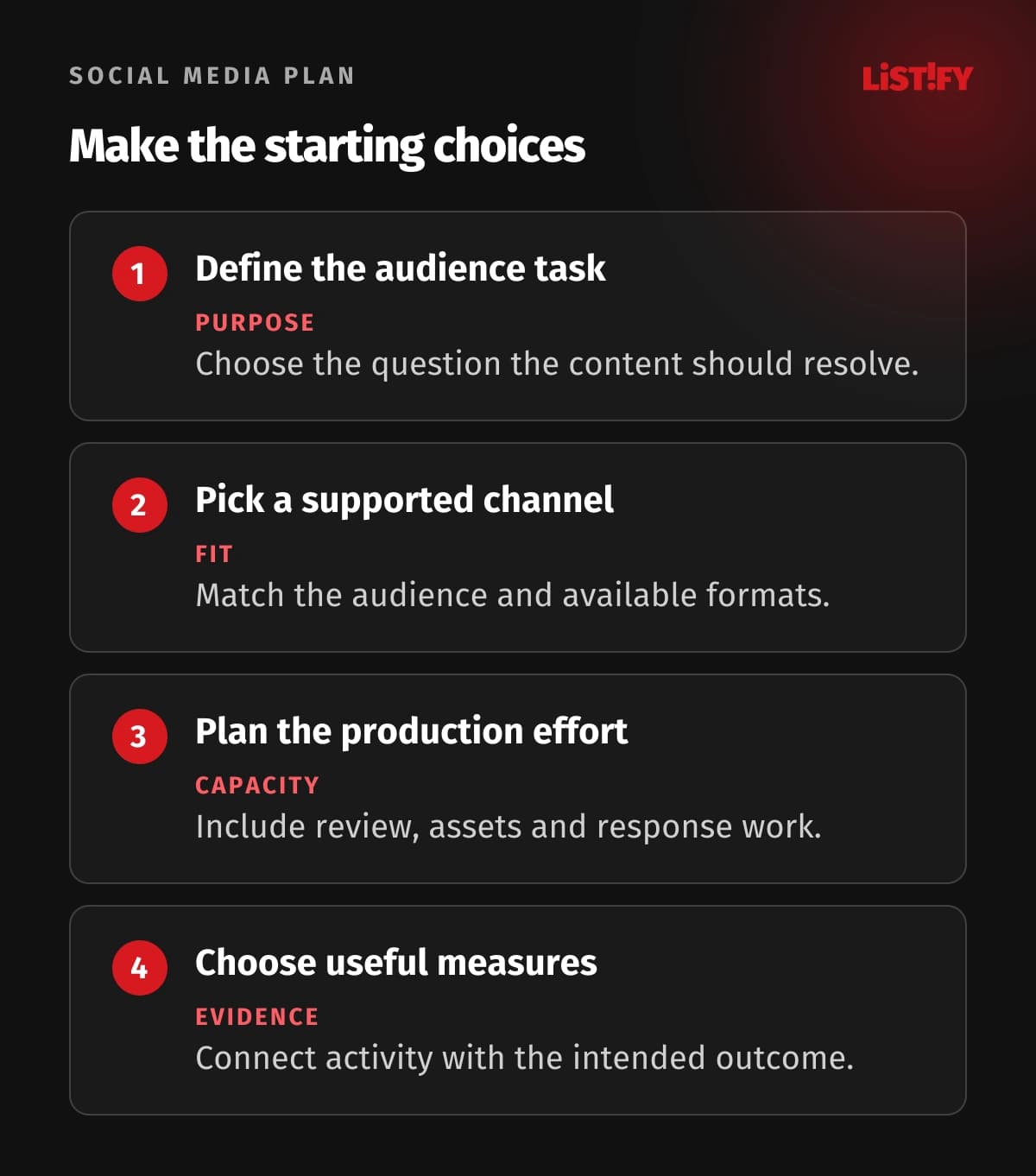
Choose a specific audience you can serve. An industrial service company may address operations managers who need to evaluate maintenance options. A consumer product brand faces a different decision context. Describe the people, their task and the question your content can answer before choosing a format.
Identify the channel’s intended role: create familiarity, explain a complex decision, generate suitable enquiries or support existing customers. You can pursue more than one role over time, but an initial plan becomes clearer when there is a primary objective and a supporting measure.
For an illustrative maintenance supplier, the objective might be helping facilities managers recognize the conditions that merit an inspection. Useful content would explain visible symptoms, the inspection process and reasonable next steps. An unrelated entertaining post can attract attention without supporting that objective.
Collect real questions from sales, support and technical staff. Separate frequent uncertainty from a single loud request. Keep sensitive customer information out of planning documents and anonymize examples appropriately. The questions give the team a practical content backlog grounded in the work it understands.
Write a short positioning statement: we help this audience understand this problem through this kind of useful evidence. If the statement is vague enough to fit any business, refine it. The aim is a decision rule for what deserves production time, not a slogan for the profile banner.
02Choose a channel the team can support
| Operating situation | Useful starting question | Capacity to budget |
|---|---|---|
| Professional buyers comparing expertise | Where do they discuss the relevant work? | Expert input, clear writing and enquiry follow-up |
| Product use needs a demonstration | Which format makes the task understandable? | Filming, editing, captions and visual proof |
| Customers ask recurring practical questions | Where can answers reach them reliably? | Response ownership and maintained guidance |
| A brand has a strong visual product | Which audience and buying context fit it? | Original assets, permission and customer service |
Assess audience fit, useful formats and operating effort together. Being able to create a profile does not mean the team can publish, respond and evaluate it. Choose a primary channel with a clear reason, and define the purpose of any secondary presence.
LinkedIn’s tactical planning resource connects content types with different objectives. Use platform guidance as input, then judge whether the audience and business case fit your situation. A platform’s promotional advice is not a guarantee of commercial results.
Review available evidence from existing enquiries, customer interviews and any previous account activity. Competitor presence can suggest where to investigate, but it does not show whether their work is profitable. Avoid treating a large follower count as proof that the same approach will work for your business.
Keep the decision reversible. Start with a defined learning period and record what would justify expanding, changing or stopping the activity. This is easier to manage than announcing a permanent daily schedule across several networks before production has been tested.
03Build content themes around customer decisions
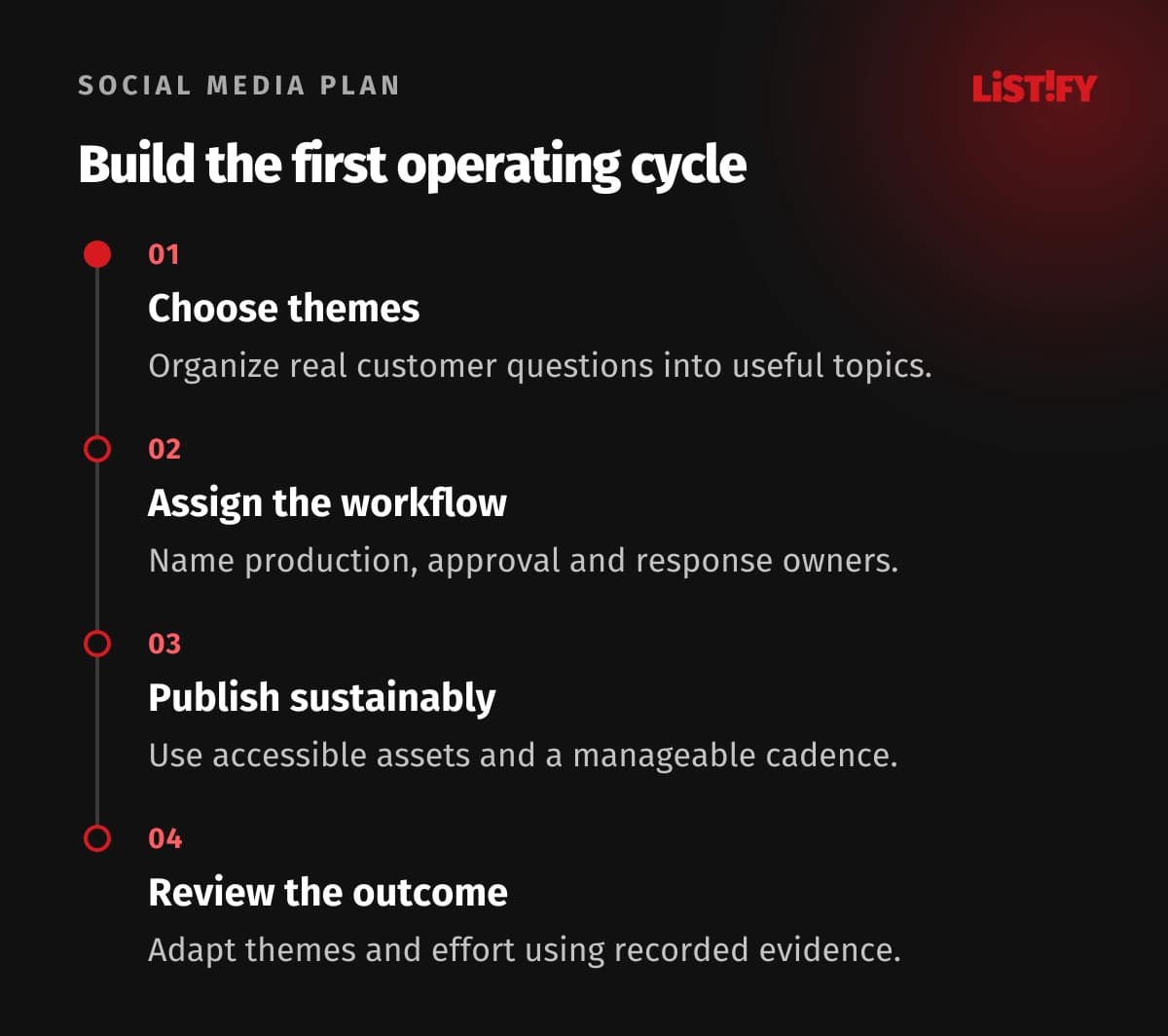
Choose a small set of themes that serve different questions. The maintenance supplier might explain warning signs, show how an inspection proceeds and clarify how to evaluate a proposal. Each theme should have a role in the audience’s decision, not merely fill a weekday slot.
Create a content brief for each proposed item: audience question, useful answer, supporting evidence, format and next step. Keep one main point. A post that tries to introduce the company, teach a technical topic and sell several services is difficult to evaluate or improve.
Distinguish explanation from proof. An expert’s recommendation can be useful, while a customer result needs permission and evidence. Do not invent case studies or convert an illustrative calculation into a reported outcome. Label demonstration examples so viewers understand what they represent.
Adapt the presentation to the medium while preserving the message. A technical conversation can become a short explanation, a diagram and a longer website reference, but each needs enough context to make sense alone. Reusing the same oversized graphic everywhere can make the work unreadable.
Choose a relevant next action. Some posts should direct people to a service explanation, while others simply resolve a common question or invite an appropriate response. Repeating a sales demand in every item can obscure the useful content the audience came to see.
04Set a production workflow with real ownership
Name the editor, subject expert, designer and final approver, even if one person fills several roles. Define who can resolve factual uncertainty and who handles customer-specific claims. A post should not wait indefinitely because every colleague is informally expected to review it.
- Collect and select a customer question.
- Prepare a brief and identify the evidence needed.
- Draft and review the answer for accuracy and audience fit.
- Prepare the native format, accessibility and permissions.
- Approve, schedule and assign response responsibility.
Budget the full production effort, including review, captions and response work. YouTube’s scheduling guidance emphasizes a sustainable schedule and evaluating production time. Apply that principle to your operating plan without assuming every channel requires the same frequency.
Keep a small reserve of approved material for predictable absences, while reviewing scheduled content when circumstances change. Automation saves publishing effort, but it does not decide whether a post remains appropriate during a service incident or an outdated product announcement.
Make accessibility part of preparation. W3C’s media guidance explains captions and alternatives for audio and video. Review automatic captions for errors, describe important visual information and keep graphic text readable. Accessibility supports understanding beyond any immediate reach metric.
05Prepare moderation, access and escalation
Determine who monitors comments and messages, when they do so and what response expectations the business can meet. Publishing creates an incoming channel. A useful enquiry left unanswered can undermine the purpose of the original content, even if the post performs well in a reach report.
Agree which questions can be answered publicly and which need a private support process. Do not ask customers to share order, account or sensitive personal information in comments. Provide an appropriate next step and keep case details out of public replies.
Create an escalation path for complaints, factual errors, safety concerns and account compromise. Name the responsible contacts and the person allowed to pause scheduled publication. The plan should let the team act quickly without improvising a company position under pressure.
Control account access through named roles where supported, with recovery ownership held by the business. Review third-party scheduling tools and remove access after staff or agency changes. A content strategy is difficult to sustain if the account depends on one former employee’s device.
Maintain a simple corrections process. If a post contains a material mistake, assess the appropriate edit, clarification or removal and record why. Treat correction as part of publishing responsibility, rather than leaving inaccurate guidance online because it generated engagement.
06Review useful outcomes and refine the plan
Set measures according to the objective. Reach indicates exposure, while relevant website actions, enquiries or product use indicate different stages. Do not use a single combined score to conceal that distinction. The social measurement guide provides further context for choosing business-relevant evidence.
Use platform metrics with their definitions and limitations. YouTube’s retention guidance helps inspect where viewers remain or leave within a video. A drop can generate a useful question about clarity, but does not itself establish why every viewer stopped watching.
Review content patterns alongside production effort and incoming questions. A format that performs well but consumes all expert availability may need a different process. A low-reach explanation that resolves recurring sales confusion may still have a useful role. Make that judgment visible.
Separate paid distribution from organic activity in the report. A boosted post can reach more people because of spending, while creative quality and audience fit remain separate questions. Record the support given to each item before comparing totals across a publishing cycle.
Finish each review with a small set of changes: improve one theme, adjust the format, revise the enquiry path or reduce an unsustainable commitment. Keep the reasons and the next check. A working strategy develops through evidence, while preserving enough consistency for the audience and team to understand it.
07Questions about starting a social strategy
Should a new business open every social channel?
Start where audience fit and production capacity support a clear objective. Additional accounts create response and maintenance obligations even if publication is automated.
How many posts should the plan require?
Choose a sustainable cadence based on the full production and response effort. Review quality and outcomes rather than applying a universal daily quota.
Can one piece of content be reused?
Yes, when adapted to the audience and native format. Preserve the useful point and supply enough context for each version to stand alone.
Are follower counts a sufficient objective?
They show one aspect of audience size, but do not establish relevant demand or sales. Link the measures to the channel’s intended business role.
Who should approve technical claims?
Name a subject expert and a final publishing owner. The approval should establish accuracy and permissions without requiring an indefinite informal review by everyone.
Can automatic captions be published without review?
Review them for terminology and meaning, especially in technical or sensitive material. Captions should help people understand the actual content.
When should the strategy change?
When evidence, capacity or the business objective materially changes. Record the reason and choose specific adjustments rather than replacing the entire plan after one weak post.