From Idea to MVP: How to Validate Demand for Your Web App Before You Build It
The most expensive mistake in app development isn’t bad code. It’s building an app nobody wants. Here’s how to test demand in six weeks for a few hundred dollars, before you sign a development contract.
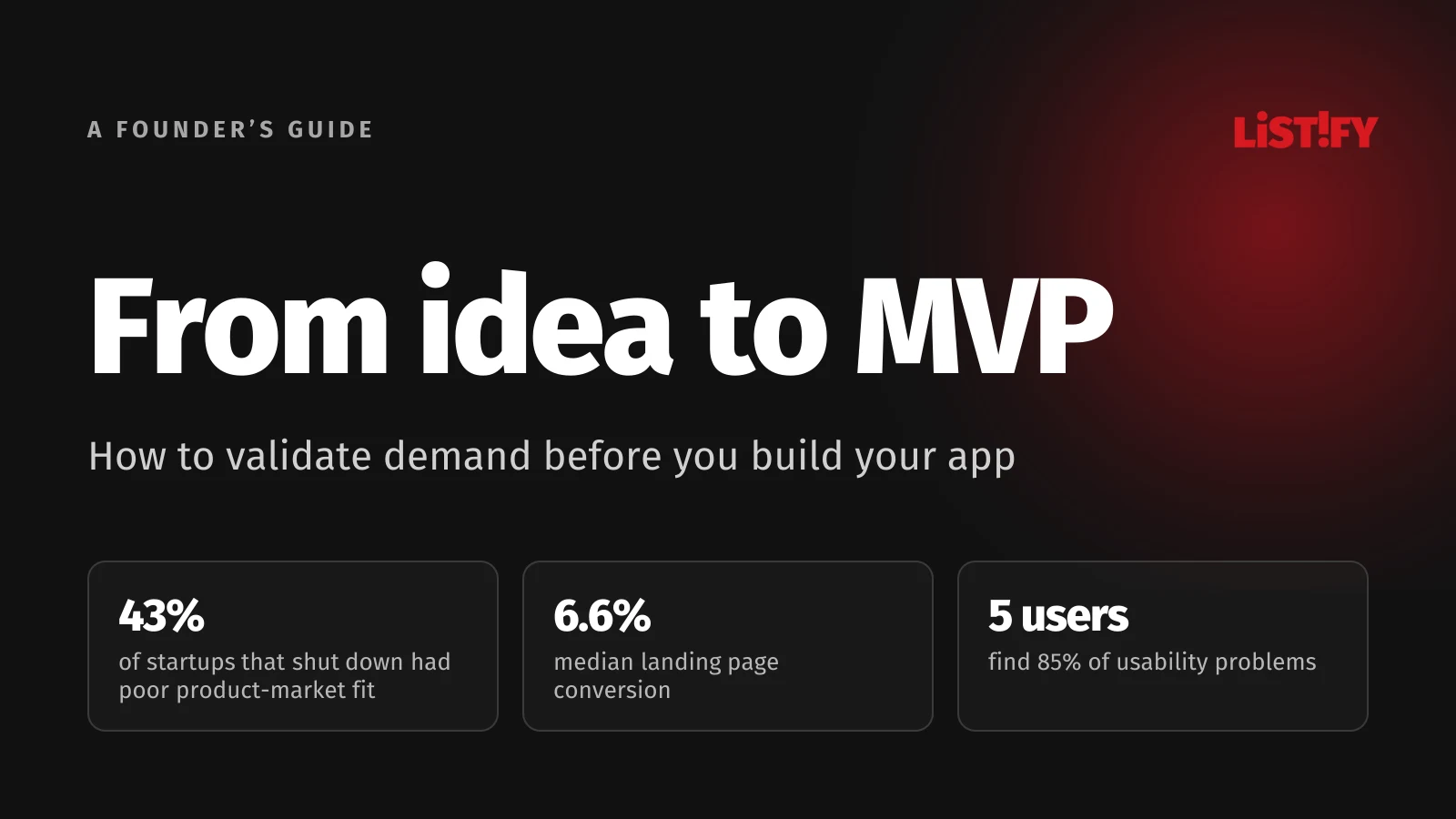
The short answer: an MVP (minimum viable product) is the simplest version of your product that tells you whether people really have the problem and will pay to solve it. But the cheapest validation often happens before the MVP: customer interviews, a simple landing page and an attempt to pre-sell. Start coding only once the data says yes.
Y Combinator puts it in four words on its homepage: “Make something people want.” This guide is for founders, companies and solo builders with an idea for a web app, SaaS product or online platform. Figures and tool prices are current as of September 2026, and every source is linked where it’s used, with the key ones listed at the end.
01What is an MVP, and how is it different from a prototype?
The term was popularized by Eric Ries, author of The Lean Startup. In his 2009 definition, the MVP is the version of a new product that lets a team collect the maximum amount of validated learning about customers with the least effort. He stresses right away that the point is learning fast, not shipping the smallest possible product.
So an MVP doesn’t have to be an app. It can be a video, a pricing page, a form or a service you run by hand for now. Three terms get mixed up constantly in software, and they mean different things:
| Aspect | Proof of concept | Prototype | MVP |
|---|---|---|---|
| Question it answers | Can it be built? | Do people understand how to use it? | Do people want it and will they pay? |
| Who sees it | Mostly developers | A handful of test users | Real customers |
| What it looks like | A piece of code or a technical experiment | A clickable mockup with no real data | A working product with one core flow |
| What you get | Confidence the technology holds up | A better interface before any code | Usage data and first revenue |
In software, then, an MVP is the first version that real customers actually use, built to measure whether they care. You show people a prototype. People use an MVP.
02Why validate before you write a line of code
In March 2026, CB Insights analyzed venture-backed startups that had shut down since 2023. Out of 431 companies, it found the reason for 385. The most common was running out of capital (70%), followed by poor product-market fit (43%). A company could have more than one reason.
- Ran out of capital70%
- Poor product-market fit43%
- Bad timing29%
- Unsustainable unit economics19%
Source: CB Insights, The top 9 reasons startups fail, March 5, 2026. Sample of 385 startups that have shut down since 2023; companies could cite multiple reasons, so the total exceeds 100%.
The authors point out that running out of money is almost always the final cause of death, not the root problem. Money runs out because the product isn’t growing. And the product isn’t growing because not enough people want it. The 2021 edition of the same analysis said it more bluntly: 35% of failed startups had no market need.
The second trap is premature scaling: hiring, marketing and new features before you know the product works. The Startup Genome report (2011, more than 3,200 startups) found that 74% of high-growth internet startups failed because of it. The data is old, but the point still stands: the longer you build without validation, the more you stand to lose.
03Step 1: write down hypotheses, not a feature list
Most ideas start as a list of features. What you actually need to test are the assumptions the idea rests on. Write them as statements that can be proven wrong.
- Customer: who exactly has the problem? Not “small businesses” but, say, “accounting firms with 3 to 10 people who retype invoices by hand.”
- Problem: what they do today, how often, and what it costs them in time or money.
- Current solution: what they use now. Spreadsheets, email, a competitor, an intern. If they use nothing at all, the problem often isn’t painful enough.
- Willingness to pay: how much they’d pay and who signs off on the purchase.
- Channel: where you’ll find them and what one customer will cost you to acquire.
For each hypothesis, decide in advance what result confirms it and what kills it. For example: “If fewer than 6 out of 10 interviewees describe the problem without prompting, the hypothesis fails.” Set the bar after the test and you’ll read the results in your own favor without noticing.
04Step 2: talk to people, but don’t pitch your idea
Interviews are the cheapest test there is, and the one most often done wrong. People are polite. Ask whether they like your idea and they’ll say yes. Rob Fitzpatrick wrote a whole book about it, The Mom Test (2013). The idea: ask questions so well that even your mom, who wants to make you happy, can’t lie to you. He boils it down to three rules:
- Talk about their life instead of your idea.
- Ask about specifics in the past instead of opinions about the future.
- Talk less and listen more.
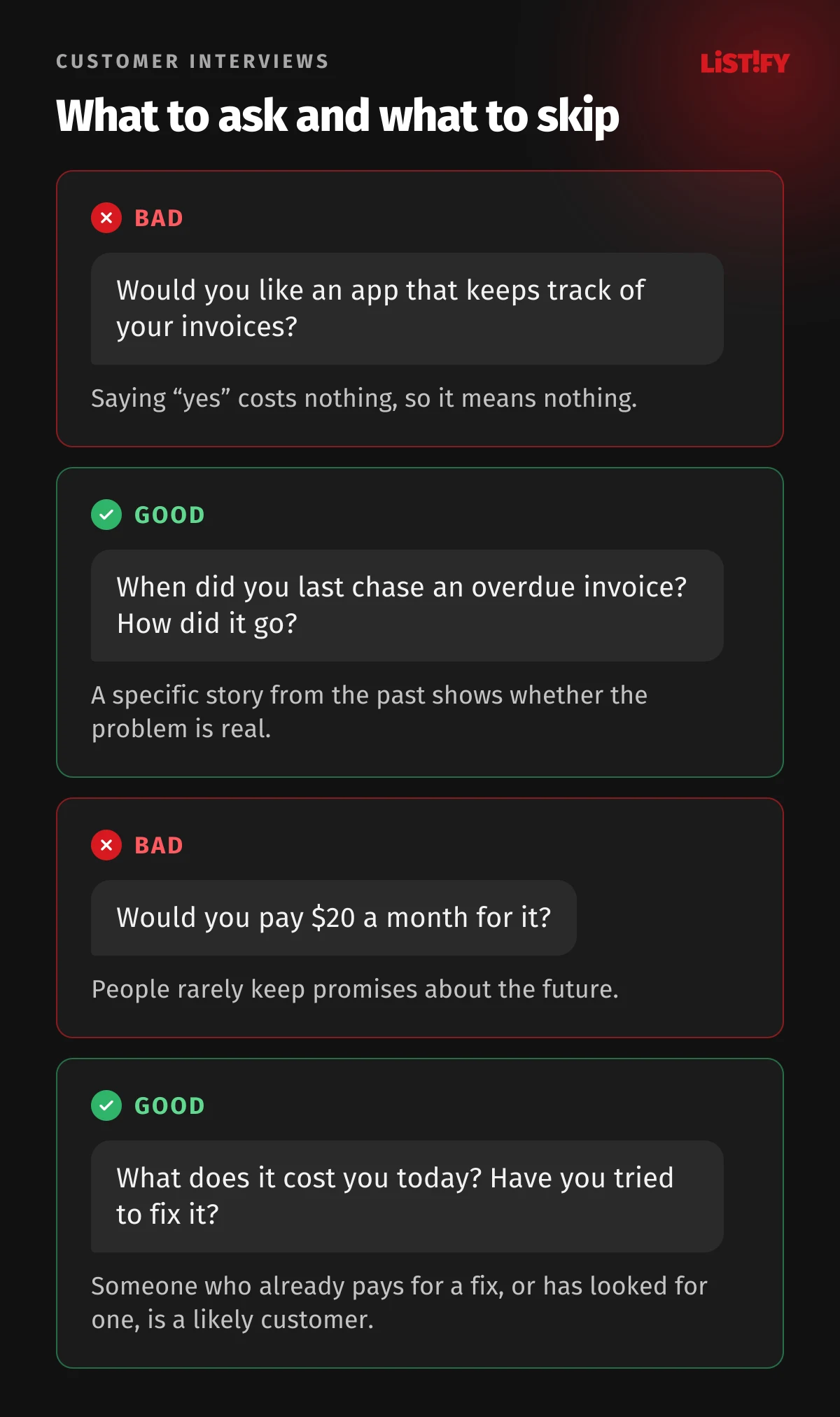
How many interviews are enough? There’s no fixed number. A good rule is to keep going until the answers start repeating, which with a narrow customer segment often happens after 10 to 20 conversations. The strongest signals are the ones that cost people something: an intro to a colleague, a copy of their spreadsheet, a follow-up meeting, or the question “when will it be ready?”
Where do you find them? LinkedIn, industry Facebook groups, Reddit and niche forums, your own network and your network’s network. Don’t sell anything. Ask for 20 minutes on a topic they know better than you.
05Step 3: measure demand in search and among competitors
When people really have a problem, they search for a fix. Google Keyword Planner, free inside Google Ads, shows how often people search for specific terms in any country. Google Trends shows how interest changes over time.
Zero search volume doesn’t mean zero demand. With new product categories, people often don’t know what to type. Search for the problem (“how to track invoice due dates”), not the name of the solution.
Competition is usually good news: it proves people pay for a solution. Read the one- to three-star reviews of competing products. They tell you what customers are missing, often in the exact words they use to describe the problem. Use those words on your own page. If a ready-made tool exists, work out what it costs over several years, as we did in our breakdown of what a CRM really costs over 5 years.
Buying online is routine: in the EU alone, according to Eurostat, 78% of internet users aged 16 to 74 bought something online in 2025. What you need to find out is whether they’ll pay you.
06Step 4: run a landing page and fake door test
A landing page is a single page that describes the problem, promises a solution and asks for an action: leave an email, pick a plan, book a demo. Send people to it from ads or communities and measure how many take that action.
A fake door test goes one step further. The page has a “Buy” or “Start free trial” button for a product that doesn’t exist yet. Whoever clicks sees an honest message that the product is on its way, with an option to leave an email. The Real Startup Book also calls it a painted door or coming soon test. Clicks on a specific pricing plan are a far stronger signal than newsletter sign-ups.
You can build all of this in a weekend for next to nothing. Prices as of September 2026:
| Tool | What for | Price |
|---|---|---|
| Carrd | A simple one-page site | Pro Standard $19 a year, including a custom domain and forms |
| Framer | A more polished site with animations | Free plan; Basic $10 a month billed yearly |
| Tally | Forms and surveys | Free, unlimited forms and submissions within fair use |
| Stripe Payment Links | Pre-sales and card payments with no code | No monthly fee; 2.9% + 30¢ per US card transaction |
What’s a good conversion rate? According to the Unbounce benchmark (41,000 landing pages, 2024 data), the median across industries is 6.6%. For SaaS it’s only 3.8%.
- SaaS3.8%
- All industries6.6%
- Events and entertainment (highest)12.3%
Source: Unbounce Conversion Benchmark Report, 41,000 landing pages, 464 million visitors, 2024 data.
Treat these as rough guides. They come from Unbounce customers’ pages, mostly campaigns for established products rather than tests of brand-new ideas. Before the test, set an ad budget, say $300 to $500, and the threshold you’ll count as success. Show the page to people who have the problem, not to your friends.
07Step 5: ask for money or a real commitment
An email address is a weak signal. A payment, deposit or signature is a strong one. In 2011, Buffer founder Joel Gascoigne described how he put a pricing page between his landing page and the email form. That one extra click showed him whether people expected to pay and which plan they wanted. He then built the first version over seven weeks of evenings and weekends and got his first paying customer within four days of launch.
Options by product type:
- Discounted pre-sale: “Founding members pay for a year upfront at half price.” Stripe Payment Links let you set this up without code. If the product never ships, you refund everyone.
- Paid pilot for businesses: a reduced fee for the first few months, with the option to walk away.
- Letter of intent (LOI): a company’s written intent to buy at a given price. Not a contract, but a lot more than “yeah, I’d totally use that.”
- A demo booked with the decision-maker: for B2B products, this is the first real commitment.
With any pre-sale, state clearly when you’ll deliver and that you’ll refund the money if you don’t.
08Step 6: do by hand what the app will do later
In his 2013 essay Do Things That Don’t Scale, Y Combinator co-founder Paul Graham calls this one of the most common pieces of advice YC gives founders: recruit and serve your first customers manually, even though it can’t work at scale.
Two kinds of MVP are built on that idea:
- Concierge MVP: you deliver the service personally and the customer knows it. Instead of a meal planning app, for example, you email meal plans and watch what people actually use.
- Wizard of Oz MVP: the customer sees what looks like a finished product, but you do the work behind the curtain. That’s how Nick Swinmurn started Zappos. He photographed shoes in local stores, posted the photos online, and when someone ordered, he bought the pair at full price and shipped it. Eric Ries tells the story in The Lean Startup (2011).
Running things by hand teaches you more than any analytics dashboard. You see where people hesitate, what extras they ask for and what they never touch. And when you can no longer keep up by hand, you know exactly what to automate first.
09Step 7: build a lean first version and measure it
When interviews, the landing page and pre-sales all point the same way, it’s time to build. Keep the first version to one core user flow: sign up, take the main action, get the result. Everything else waits for data.
Dropbox showed how far an MVP can go without a finished product. Before launch, Drew Houston posted a demo video aimed at the Digg community. According to Houston, quoted by Eric Ries in TechCrunch, the beta waiting list jumped from 5,000 to 75,000 people literally overnight.
- Before the video5,000
- The day after75,000
Source: Drew Houston, quoted by Eric Ries in TechCrunch, October 19, 2011.
Test the interface before you build
Show a clickable prototype to five people from your target group. Jakob Nielsen of Nielsen Norman Group calculated that a single tester uncovers 31% of usability problems on average, and five testers about 85%. He recommends three rounds of five people rather than one big study. A fix in the design costs a fraction of a fix in finished code.
What to measure after launch
- Activation: how many sign-ups complete the main action, like sending their first invoice or first request.
- Retention: how many come back after a week and after a month. This is the number that tells you whether you’re solving a real problem.
- Payments: how many move from trial to paid.
- The Sean Ellis test: ask active users how they’d feel if they could no longer use the product. After comparing nearly 100 startups, Sean Ellis wrote that product-market fit usually means at least 40% answer “very disappointed.” He admits the threshold is a bit arbitrary, but it works as a benchmark.
AI prototypes: a faster start, the same questions
In 2026 you can build a clickable prototype in a day or two. Lovable says more than 60 million projects have been created on its platform since November 2024. And according to TechCrunch, a quarter of Y Combinator’s Winter 2025 batch had codebases that were 95% AI-generated.
That has made steps 4 and 7 much cheaper. What AI can’t tell you is whether anyone wants the product. And an AI prototype is not a production-ready app: authentication, permissions, payments and personal data all need a careful review. Our web app security checklist covers what to check before launch.
10How to validate your idea in six weeks: a plan
You can run the whole validation in six weeks, even part-time. Here’s what it can look like:
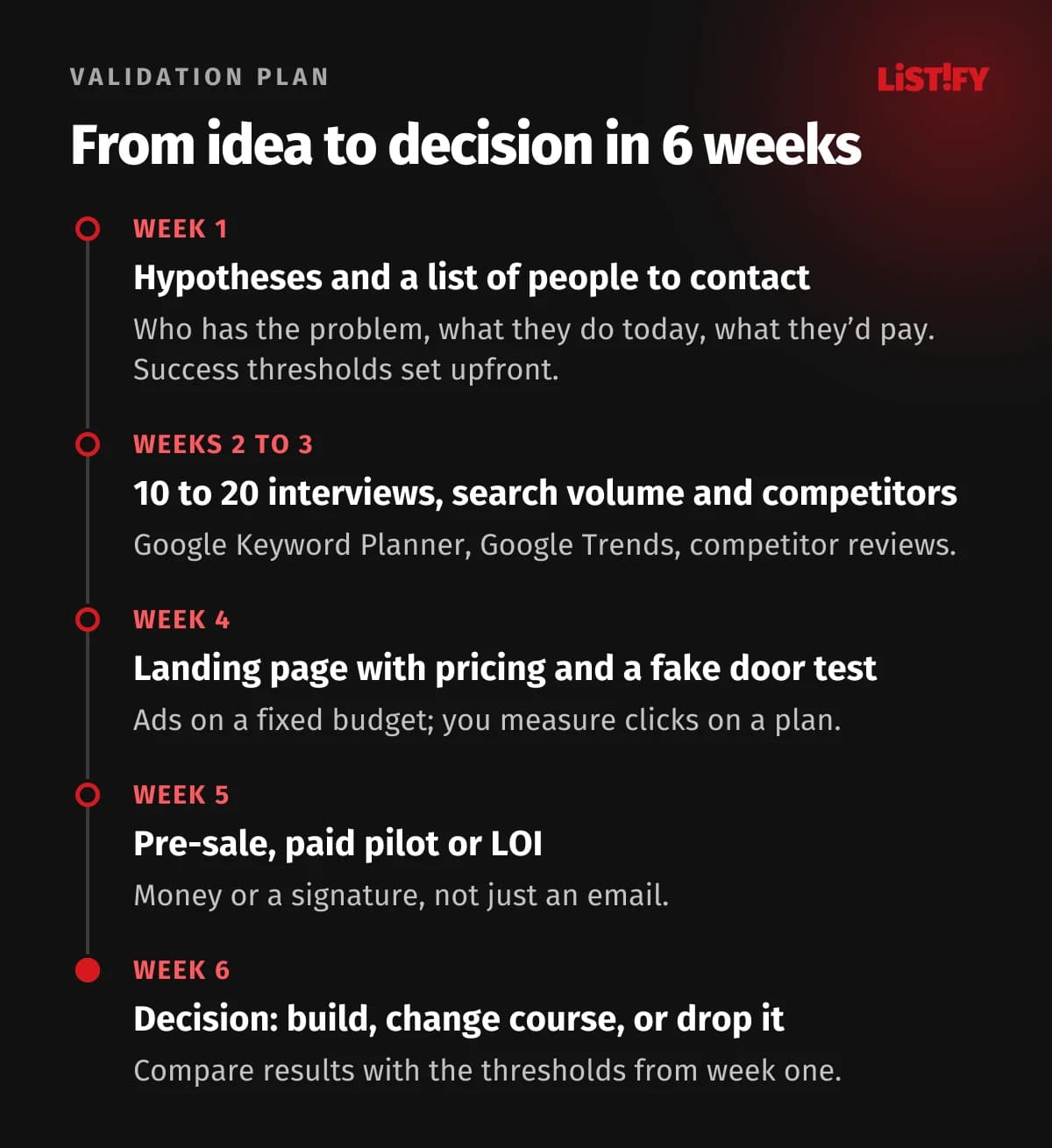
Direct costs usually come to tens of dollars for a domain and tools, plus an ad budget you set yourself. The main cost is your time. Compared with building a web app, which typically runs into five or six figures, that’s a rounding error.
11When to build and when to walk away
| Signal | Keep going | Stop or pivot |
|---|---|---|
| Interviews | People describe the problem unprompted and already try to solve it | You have to explain the problem; people “manage somehow” |
| Search and competitors | Competitors exist and their reviews show what’s missing | Nobody searches for or sells anything and you don’t know why |
| Landing page | Visitors click on a specific pricing plan | They read but don’t click, even with well-targeted ads |
| Money | At least a few people pay upfront or sign a pilot | Everyone says it’s great, nobody pays |
| Manual service | Customers come back and ask for more | They drop off after the first try |
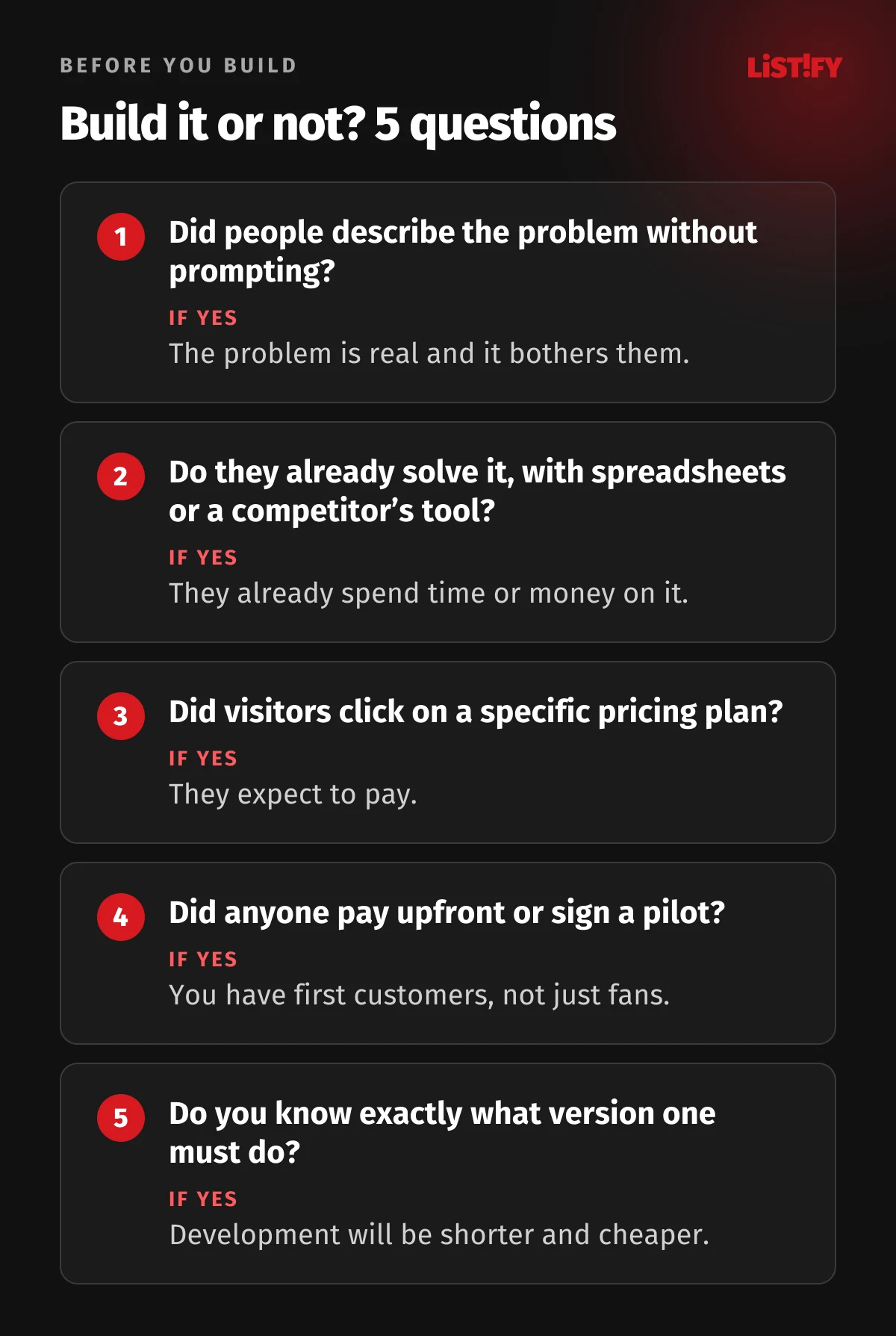
Dropping an idea after six weeks and a few hundred dollars beats a year of development and a six-figure bill. Often you only need to change the target customer or the problem you focus on (a pivot) and test again.
12FAQ
What is an MVP in software development?
An MVP (minimum viable product) is the first version of a product that real customers use, built to measure whether they want it. It usually focuses on one core user flow; everything else is added based on usage data.
What is the difference between an MVP, a prototype and a proof of concept?
A proof of concept tests whether something can be built. A prototype tests whether people understand how to use it and uses no real data. An MVP tests whether people want the product and will pay for it, and real customers use it.
How much does it cost to validate a startup idea?
Interviews are free. A landing page costs tens of dollars a year, Tally forms are free and Stripe only charges per transaction. Ads are usually the biggest expense, with a budget you set yourself, typically a few hundred dollars.
How long does it take to build an MVP?
Validating demand takes about six weeks. Building a web app MVP with one core user flow then typically takes two to three months. AI tools let you show a prototype within a day or two, but a version with payments, accounts and proper security takes longer.
How many customer interviews do I need?
Keep going until answers start repeating, often after 10 to 20 conversations with a narrow segment. For usability testing, five people per round is enough; according to Jakob Nielsen they find about 85% of problems.
Is a fake door test misleading to customers?
Not if you’re honest. Right after the click, say the product is in development and offer to let them know when it’s ready. Never take payment for something that may not exist without a clear refund promise.
How do I know I have product-market fit?
Users come back on their own, recommend you, and in the Sean Ellis test at least 40% of active users say they’d be very disappointed without your product.
13Sources
- CB Insights: The top 9 reasons startups fail (March 5, 2026)
- Eric Ries: Minimum Viable Product, a guide (2009)
- Startup Genome Report: Premature Scaling (2011)
- Rob Fitzpatrick: The Mom Test (2013)
- Unbounce: Conversion Benchmark Report (2024 data)
- Jakob Nielsen: Why You Only Need to Test with 5 Users (2000)
- Joel Gascoigne: Idea to Paying Customers in 7 Weeks (2011)
- Paul Graham: Do Things That Don’t Scale (2013)
- Sean Ellis: The Startup Pyramid (archived)
- Eurostat: E-commerce statistics for individuals (2025)