Personal Branding for CEOs and Founders: Why People Want to Know Who Runs the Company, and How to Build Yours Without Cringe Posts
Job candidates check who runs a company before they apply, and B2B buyers increasingly want to hear from a named person rather than a logo. In a 2022 Brunswick survey of employees at large companies in five markets, 82% said they would research a CEO’s online presence when considering a new job. Done well, a founder’s personal brand has nothing to do with vanity or influencer culture. Below: the data, the real time cost, what to post and the rules that apply.
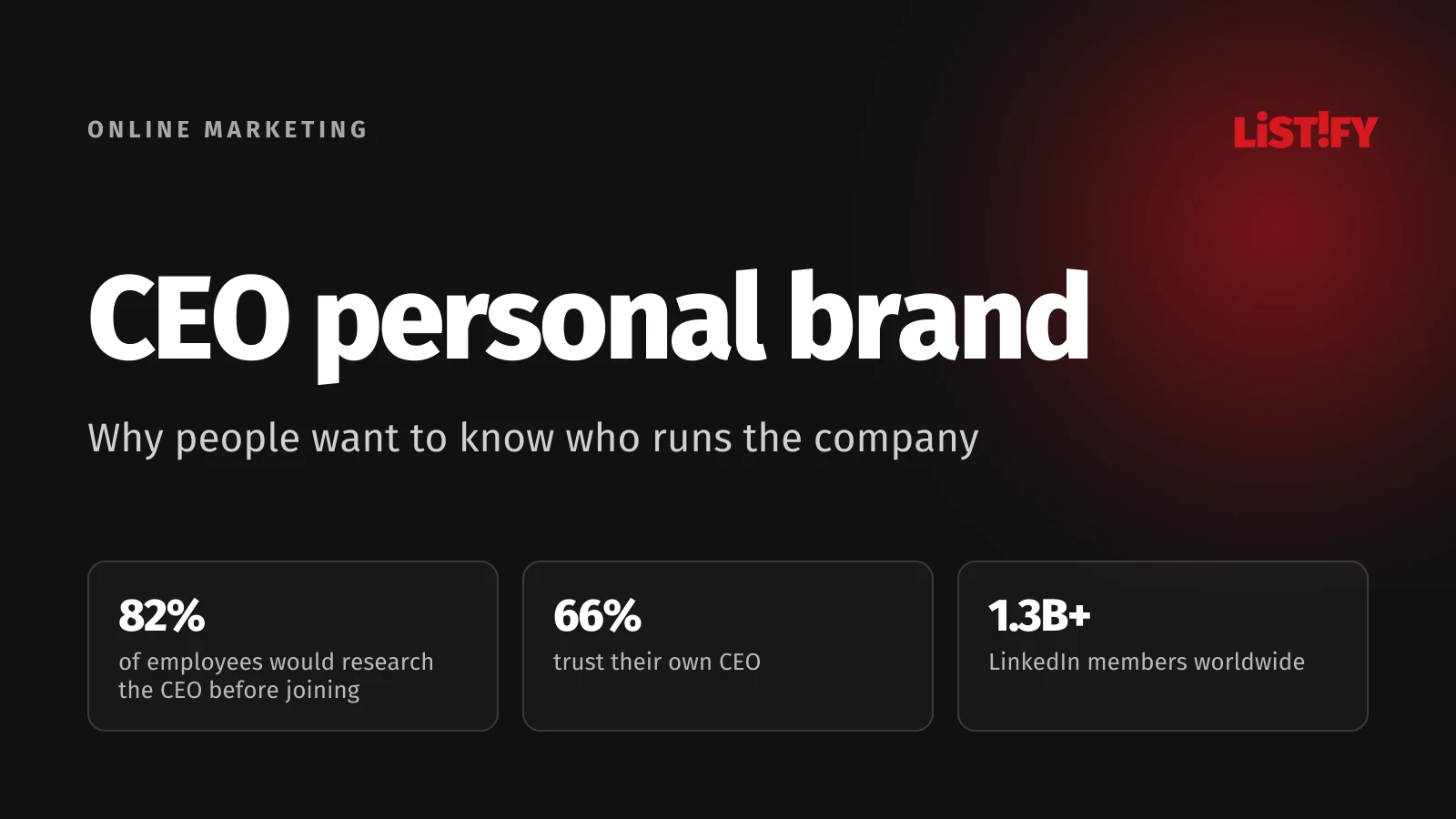
Companies spend heavily on logos, websites and ads. According to the 2026 Edelman Trust Barometer, 78% of employees trust their own employer, while only 64% of the general public trust business and 53% trust government. Two in three people trust their own CEO, and that trust has grown over the past five years.
That’s good news if you run a small or mid-sized business. You don’t need a global brand budget, just a clear and steady way of showing how you think and what your company is good at.
01Why a CEO’s personal brand matters
The Edelman Trust Barometer is now in its 26th year. The 2026 edition covered nearly 34,000 people in 28 countries. People trust the institution they know best: 78% of employees trust their employer and 66% trust their own CEO. By comparison, 64% of the general public trust business and 53% trust government (Edelman, 2026 press release).
- My employer78%
- My CEO66%
- Business in general64%
- Government53%
Source: 2026 Edelman Trust Barometer, online survey in 28 countries, October and November 2025. Trust in employer is measured among employees; business and government among the general population.
Executives see it the same way. In 2014, Weber Shandwick asked more than 1,700 executives at large companies in 19 countries how much of their company’s standing comes from the CEO. Their answer: 45% of reputation and 44% of market value (Weber Shandwick). That’s the executives’ own estimate, not a measurement, and it covers companies with revenue of $500 million or more. Even so, it shows how closely executives at large companies tie a company’s value to the person running it.
Sales and marketing leaders see it the same way. In a 2021 study by LinkedIn and Edelman among about 3,600 managers in sales and marketing, 67% said they want content that features the view of a clearly identifiable author, not just material published under a brand name. 64% said thought leadership is a more trustworthy basis for judging a vendor than marketing materials and product sheets (LinkedIn).
02What job candidates look up about the CEO
Some of the most detailed data on how employees view CEOs on social media comes from Brunswick’s Connected Leadership survey. In 2022 it polled 3,600 employees of companies with more than 1,000 staff and 2,800 regular readers of financial media. 82% of employees said they would research a CEO’s online presence when considering joining a company. After the company website, the CEO’s LinkedIn profile is the most common place they would look (Brunswick, Connected Leadership 2022).
- Company website62%
- The CEO’s LinkedIn profile34%
- First Google result for the CEO31%
- The CEO’s Facebook23%
- The CEO’s Twitter (now X)20%
- CEO reviews on Glassdoor19%
- Wikipedia18%
- The CEO’s blog18%
Source: Brunswick, Connected Leadership 2022, p. 10. Employees of companies with 1,000+ staff in the US, UK, Germany, Singapore and Hong Kong; multiple answers allowed.
In the same survey, employees said by a ratio of 4 to 1 that they would rather work for a CEO who uses social media than for one who doesn’t. Expectations vary a lot by market, and financial readers care even more than employees. Among employees, Germany is the most reserved, Hong Kong and Singapore the most demanding.
- All marketsFinancial readers: 86%Employees: 73%
- Hong KongFinancial readers: 90%Employees: 89%
- SingaporeFinancial readers: 90%Employees: 85%
- United KingdomFinancial readers: 75%Employees: 71%
- United StatesFinancial readers: 87%Employees: 70%
- GermanyFinancial readers: 71%Employees: 59%
Source: Brunswick, Connected Leadership 2022, p. 5. Financial readers were also surveyed in Saudi Arabia (96%) and the UAE (93%), employees were not.
Set realistic expectations. A personal brand won’t send a flood of applicants your way overnight. But when a candidate is weighing two similar offers, a company whose CEO they can actually learn about often feels like a safer bet than one with an empty profile.
03In a crisis, people expect to hear from the CEO
The expectation gets stronger when something goes wrong. In the Brunswick survey, 78% of employees and 91% of financial readers said it’s important for a CEO to communicate on social media during a crisis. A CEO who already has an audience and a track record of plain speaking can explain what happened within hours. One who shows up for the first time in the middle of a crisis sounds defensive.
- All marketsFinancial readers: 91%Employees: 78%
- SingaporeFinancial readers: 94%Employees: 89%
- Hong KongFinancial readers: 93%Employees: 94%
- United StatesFinancial readers: 88%Employees: 72%
- GermanyFinancial readers: 83%Employees: 66%
- United KingdomFinancial readers: 82%Employees: 77%
Source: Brunswick, Connected Leadership 2022, p. 18.
Where to post? For most B2B companies, LinkedIn. The network reports more than 1.3 billion members worldwide (LinkedIn). That figure counts members, not active users, but your buyers, candidates and partners are very likely on it.
04Is a personal brand right for you?
Not every founder needs thousands of followers. Before you start, answer five questions honestly.
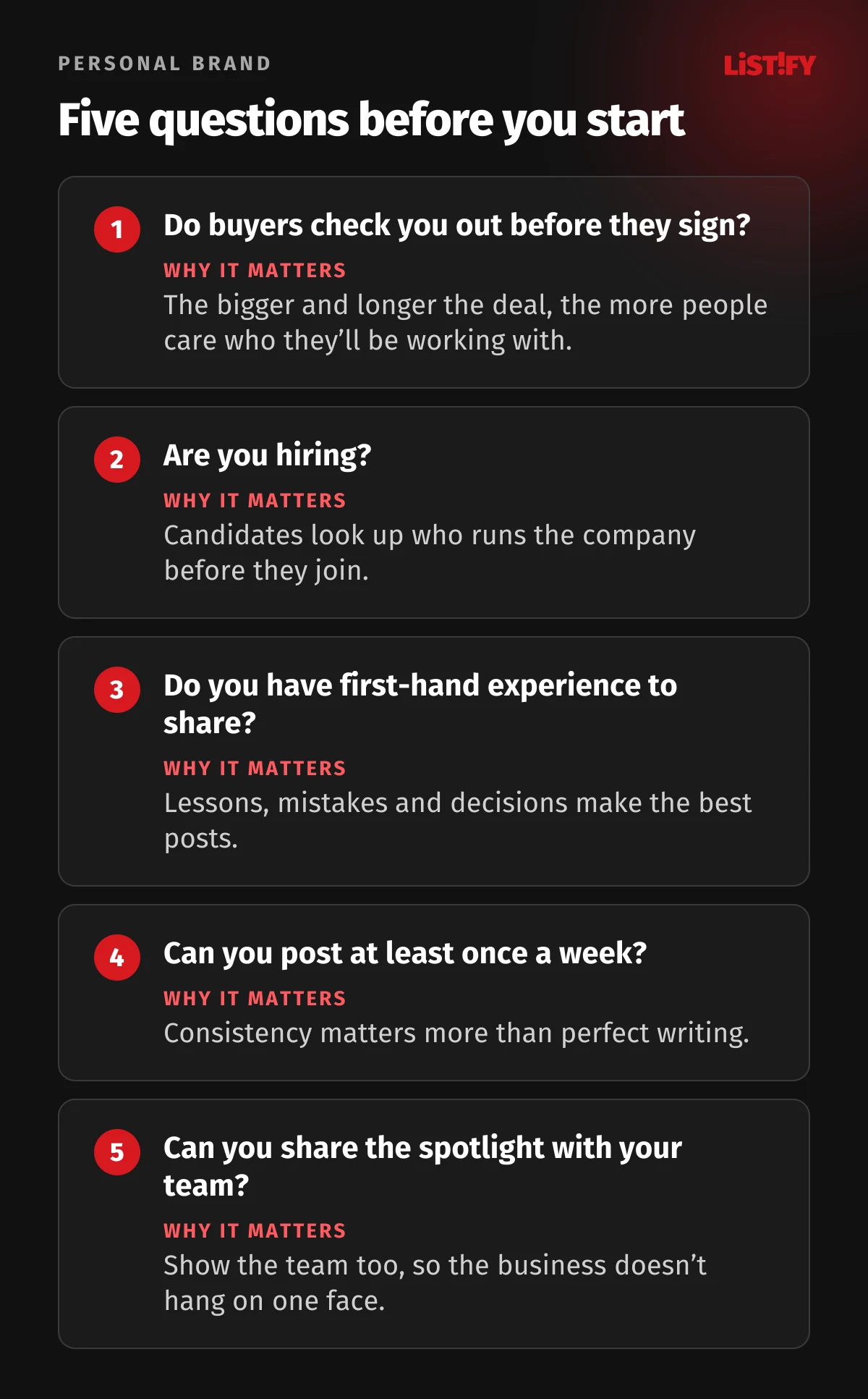
There are times to hold back. If you plan to sell the company soon and the new owner won’t want it tied to your name, a big personal brand can work against you. The same goes for the middle of a dispute or crisis you can’t talk about openly. Starting to post while under pressure looks like damage control.
There is also key-person risk. A study of Danish companies published in the Journal of Finance found that when a CEO is hospitalized, profitability and investment fall, and the effect is stronger in family-controlled and growing firms. The authors conclude that CEO contingency plans are valuable (Bennedsen et al., 2020). If your brand is only your face, it shares that risk. Bring colleagues into your posts and let customers get to know the team too.
05The foundation: topics, tone and boundaries
A strong personal brand is, above all, easy to read. After a few posts people should be able to say what you know about and how you think. Decide three things up front.
- Two or three topics. Your industry, running a company, and one personal theme connected to work. For a manufacturer, say: quality and standards, hiring skilled trades, running a family business.
- Tone. Write the way you talk to customers. If you’re matter-of-fact in meetings, don’t turn into a motivational speaker online.
- Boundaries. Decide what you won’t post about: numbers you don’t want public, clients without their consent, family, politics. Written boundaries make decisions easier in a heated moment.
Your profile and your company page do different jobs. Don’t turn your profile into a second corporate channel.
| Content | Company page | Your personal profile |
|---|---|---|
| Offers and pricing | Yes: services, promotions, contact details | Rarely, and with the story of why you do it |
| Experience and opinions | In general terms, for the whole company | Yes, in the first person, with specific examples |
| Hiring | Job ads and benefits | Why people work for you, who leads them, what day one looks like |
| Mistakes and lessons | Rarely | Yes, these often get the most attention |
| Wins | Case studies and testimonials | Thanking the team and the client, and what you learned |
06Your LinkedIn profile: what to fix first
Your profile is the first place people go after they come across one of your posts. Give it an hour before you start writing.
- Photo. Recent, face clearly visible, no sunglasses, not cropped from a wedding photo. It doesn’t need a studio, but it should be sharp.
- Headline. Instead of just “CEO”, say who you help and with what. For example: “Founder of a design-build firm. We build custom family homes in the Denver area.”
- Banner image. Your work, your team or your premises, not a generic stock photo.
- About section. A few paragraphs in the first person: what the company does, for whom, what makes you different and how to reach you.
- Experience. Under your current role, briefly describe what you’re responsible for and link it to the company page.
- Links. Company website and contact details. If people don’t know where to go next from your profile, you lose leads.
Your company website should have a page about you or the leadership team, with a photo and a short story. We cover how to build a site that fits your personal brand in Custom website development: benefits, costs and a 9-step guide.
07What to post so people actually read it
The most common mistake is writing about the company instead of what you experienced. A few colleagues will read an announcement that you earned a certification. A customer will read the story of why you needed it in the first place and what it cost you to get there.
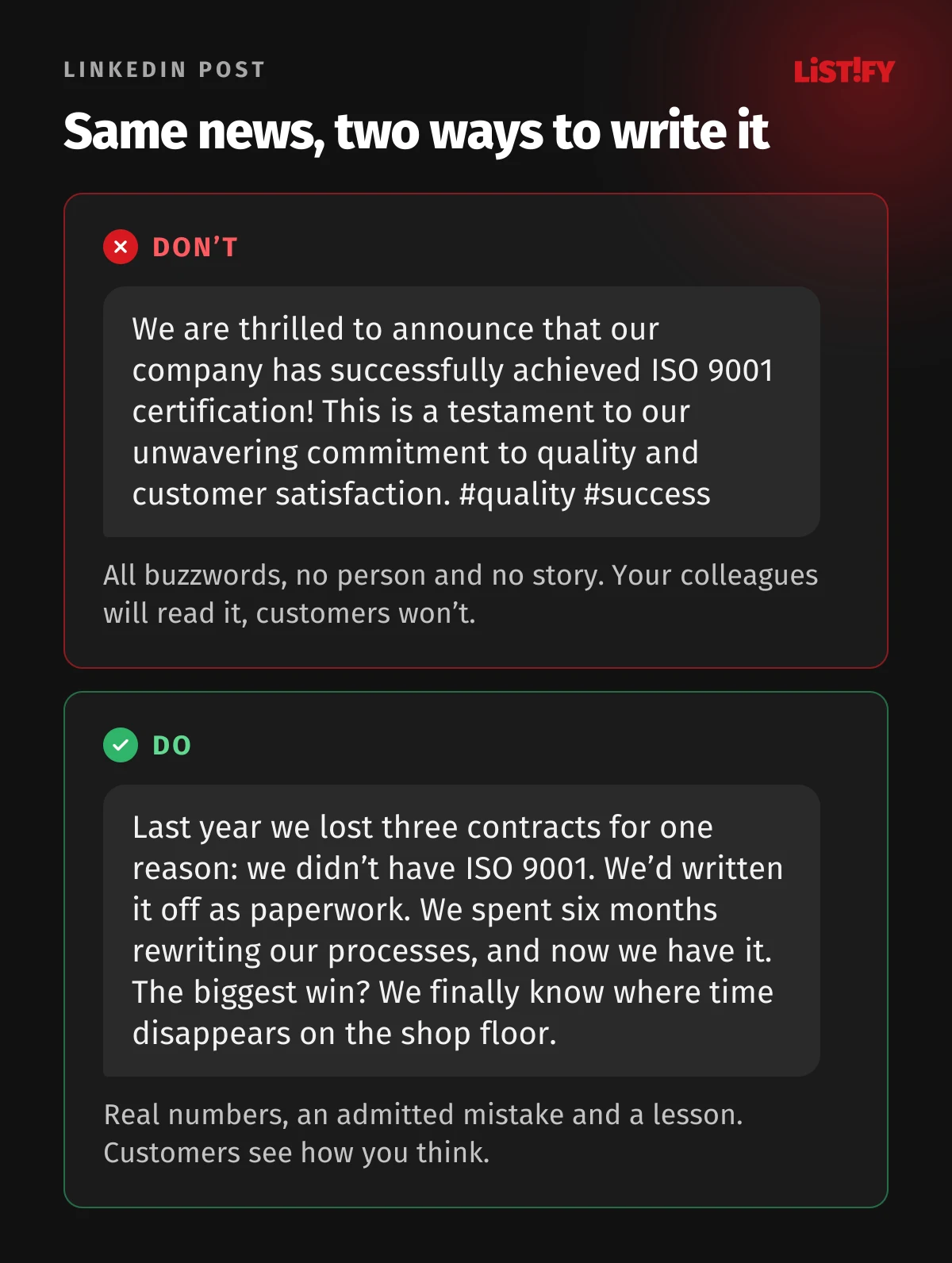
Topics that tend to work well for founders and CEOs:
- Decisions and the reasons behind them. Why you raised prices, turned down a contract or switched suppliers.
- Mistakes. What went wrong and what you changed. You don’t need sensitive details, the lesson is enough.
- Customer questions. What people ask most often and how you answer. Every question is a post.
- Your people. Who does what and why they’re good at it. It builds trust and attracts candidates.
- Real numbers. How long a project takes, what a typical job costs, how many leads turn into contracts. A number says more than an adjective.
- Comments on other people’s posts. A thoughtful comment under a client’s or expert’s post can reach more of the right people than a post of your own.
Break longer posts into short paragraphs and say what the post is about in the first two lines. Take your own photos, even on your phone, because stock images feel impersonal. For how your profile fits into your company’s wider social plan, see A social media strategy that builds a real community.
08How much time it takes: a 90-day plan
A personal brand doesn’t take hours a day. Brunswick interviewed 16 executives at large companies with standout social media programs. They personally spend 30 to 60 minutes a week on average, but each has help: between half a person and four full-time staff drafting and running their content (Brunswick, p. 21). If you write your own posts, set aside at least an hour or two a week for one solid post and a few comments. Consistency is what counts. One good post a week for six months beats ten posts in one month followed by silence.
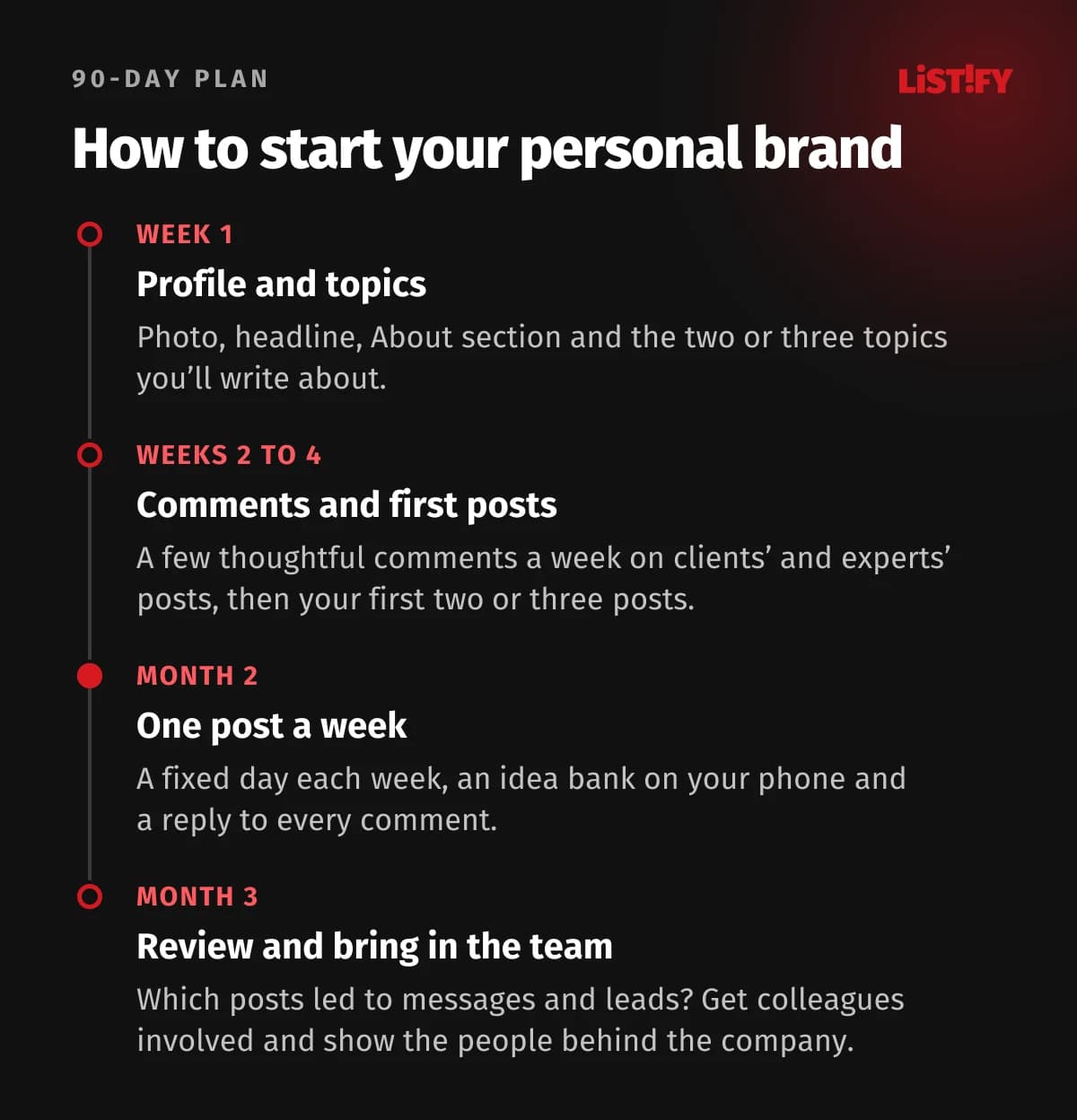
Keep an idea bank. Every customer question, interesting meeting or mistake goes straight into a note on your phone. After a month you’ll have topics for the whole quarter.
09Ghostwriters, agencies and AI: who can write for you
Most founders don’t have time to write every post themselves, and that’s fine. Help with wording is common. What matters is that the ideas, experience and opinions are yours, and that you read and approve every post before it goes out.
One thing to avoid: handing over your login. LinkedIn’s User Agreement says “You will not share your account with anyone else” and also that “as between you and others (including your employer), your account belongs to you” (LinkedIn User Agreement). An assistant or agency can draft the post, and you publish it.
That cuts both ways. When a CEO leaves, their followers leave with them. Keep client contacts, testimonials and content on the company page and website too, not only on a personal profile.
AI works much like a ghostwriter. It helps with outlines, trimming and proofreading, but readers quickly notice when a post has no real experience behind it. Generic advice like “communication is the key to success” has been posted thousands of times. The story from your meeting yesterday hasn’t.
10The rules: endorsements, paid partnerships and fake engagement
Advertising rules apply to executives as well. The main rules by region and platform:
| Where | What applies | What to do |
|---|---|---|
| United States | The FTC Endorsement Guides require clear disclosure of a material connection to the seller. Under the 2024 rule on reviews, owners and executives may not write reviews or testimonials of their own business without clearly disclosing their relationship | Make it clear you own or run the company, for example “our new product”, never a neutral-sounding review |
| European Union | Commercial content must be recognizable as such, including posts promoting your own company. Influencers who regularly promote products count as traders under EU consumer law and must disclose ads | Label paid or gifted posts using the platform’s paid partnership feature or a clear ad label |
| Community Policies require a clear notice of any personal benefit for an endorsement and ban artificially inflating engagement, including agreeing in advance to like each other’s posts | No engagement pods, no bought followers, disclose paid partnerships |
Regulators are checking. In 2024, the European Commission and consumer authorities in 22 member states plus Norway and Iceland reviewed posts by 576 influencers. 97% posted commercial content, but only about 20% consistently disclosed it as advertising (European Parliament briefing, 2025). The US rule on reviews also bans buying fake followers, likes or views that misrepresent your influence for commercial purposes.
Photos of employees are another thing to get right. Privacy and image rights vary by country, so the simplest safe habit is to ask the people in the picture before you post.
11How to tell it’s working
Likes are the weakest signal. A post with fifty reactions from industry friends won’t win you a contract. A useful post read by ten buyers might. Track these instead:
- Leads and calls that start with “I saw your post”. Log them; one source field in your CRM is enough.
- Candidates who know you from LinkedIn. Ask in interviews how they heard about the company.
- Invitations to speak, join podcasts or comment in the press.
- Profile views and new followers from the industry you sell to. Who they are matters more than how many.
- Comments from people you don’t know. They show your post traveled beyond your own network.
A personal brand works alongside other channels. For turning LinkedIn, ads and search into B2B leads, read How to Generate B2B Leads with Paid Ads and SEO. To size the paid side, use our guide How Much Should a Small Business Spend on Marketing?.
12Common mistakes
- Going all in, then stopping after a month. A profile last active a year ago looks worse than no profile.
- Only posting wins. People trust someone who admits mistakes.
- Resharing company posts with no comment. Nobody reads a bare reshare. Add a line on why it matters.
- Buying followers or joining engagement pods. It distorts your data and breaks LinkedIn’s rules.
- Having an opinion on everything. If you comment on every topic, your brand stops being clear.
- Replying in anger. Answer criticism the next day, calmly. You can delete a post, not a screenshot.
13FAQ
What is a CEO personal brand?
It’s what people think of when they hear your name: what you know, how you behave and why they should trust you. For a founder or CEO it carries over to the company, because candidates look up who runs a business before they apply and buyers prefer to hear from a named person.
Which platform should a CEO start on?
For B2B companies, LinkedIn, which reports more than 1.3 billion members. If you sell to consumers, consider Instagram or Facebook as well. Either way, one platform used consistently beats three used now and then.
How much time does it take?
Executives with strong programs spend 30 to 60 minutes a week themselves, but they have a team doing the drafting. On your own, set aside at least an hour or two a week, plus a few extra hours at the start for your profile and topics.
Can someone else write my posts?
Someone can draft them, but the ideas should be yours and you should publish them yourself. LinkedIn’s terms forbid sharing your account with anyone else, so don’t hand over your password.
Who owns the profile when a CEO leaves?
The CEO, not the company. Under LinkedIn’s User Agreement, the account belongs to the individual, even as between them and their employer. The company controls only paid services it bought for them, such as a Recruiter seat. It should keep contacts, testimonials and content on its own page and website as well.
When will a personal brand bring in business?
Usually over a period of months. Comments and messages from people in your industry come first, inbound leads later. Give it at least six months before you judge the results.
14Bottom line: start with one post a week
You don’t have to become an influencer. The goal is simpler: when people are deciding whether to work with you, they should find someone they can trust. The data shows candidates are looking at your website, your LinkedIn and the first Google result for your name, and buyers do much the same.
A founder’s profile doesn’t replace the company brand, though. For how to split your budget between brand building and performance ads, see our guide to brand vs. performance marketing.
Fix your profile, pick two or three topics and post once a week about things you’ve actually experienced. After three months you’ll know what resonates. If you’d like help with strategy or your company’s social channels, see how we handle social media management, check our pricing and read how we work.
15Sources
- 2026 Edelman Trust Barometer, press release
- Brunswick, Connected Leadership 2022 (PDF)
- Weber Shandwick, The CEO Reputation Premium
- LinkedIn, what decision makers want to see in thought leadership
- LinkedIn, About us
- Bennedsen, Pérez-González and Wolfenzon: Do CEOs Matter?, Journal of Finance 2020
- LinkedIn User Agreement and Professional Community Policies
- FTC Endorsement Guides, 16 CFR 255 and rule on consumer reviews, 16 CFR 465
- European Commission, Influencer Legal Hub
- European Parliament, Regulating influencer marketing in the EU (PDF)