Product feeds: get Heureka, Zboží.cz and Google Merchant working reliably
A shopper sees a product in stock at one price, clicks through, and discovers a different variant with a higher price. The campaign may be configured correctly, but the product data have failed. A reliable feed connects your catalogue, actual offer, destination page, and each channel's requirements.
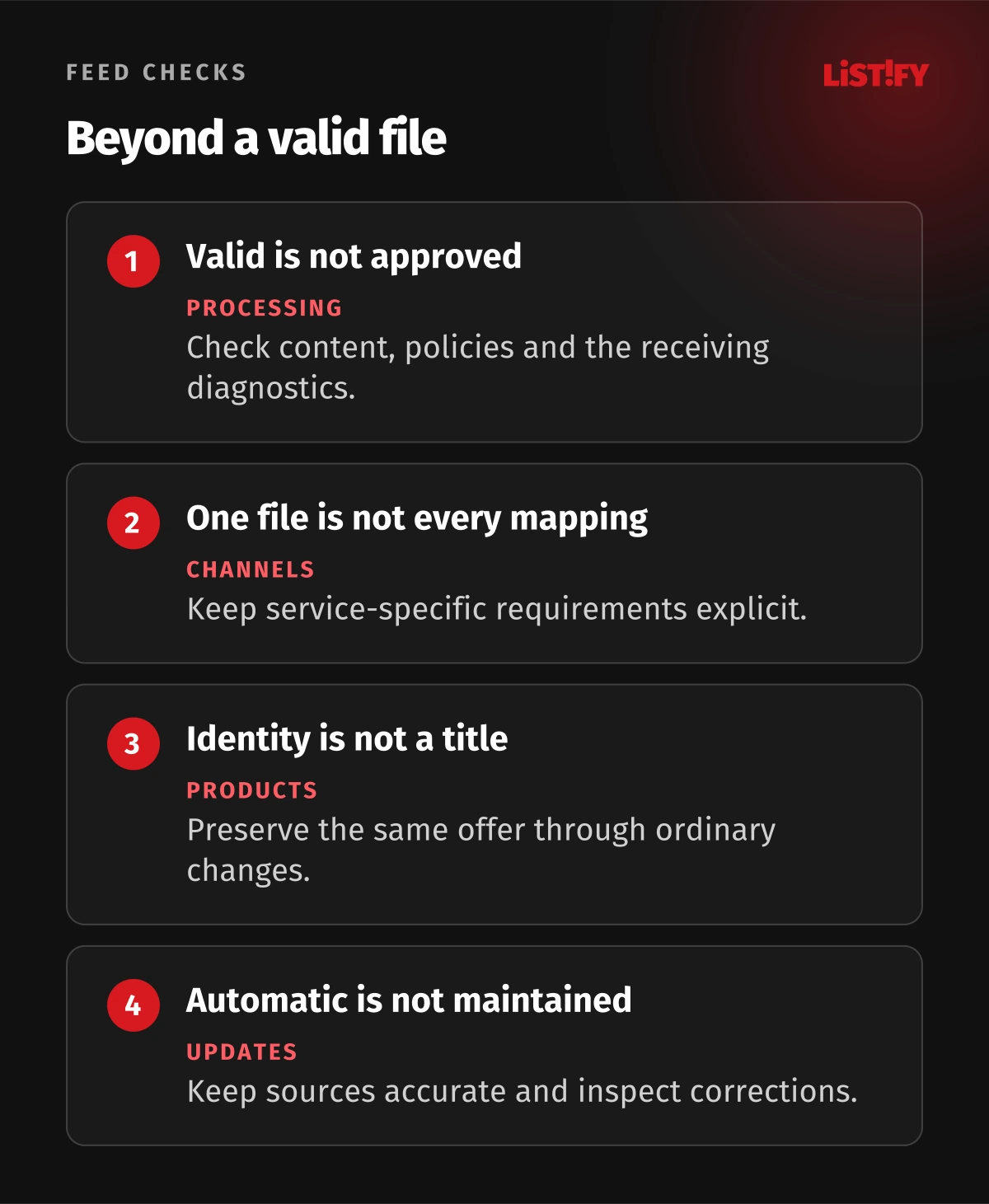
A product feed is a structured way to supply product information to another service. It can support matching, discovery, listings, or advertising depending on the platform and account. Sending a valid file is only the first step: the receiving service also evaluates the data, offer, and relevant policies.
Heureka and Zboží.cz deserve particular attention for businesses selling into their regional markets. Google Merchant Center serves supported markets with its own specifications and program requirements. A common catalogue can supply all three, but it needs explicit mappings rather than one unchanged export assumed to work everywhere.
01Choose channels from the markets you actually serve
For a global company entering Czech or Slovak retail, local product comparison services can be relevant alongside broader shopping channels. Confirm your store's eligibility, delivery market, currency, language, customer support, and the service you intend to use. A feed integration alone does not make the offer suitable for that market.
Heureka provides separate Czech feed documentation and Slovak specifications. Zboží.cz serves Czech shoppers within Seznam's shopping environment. Current English documentation calls the campaign Shopping Ads, previously the Zboží.cz campaign. Feed and shop administration uses Seznam's Merchant Center, called Centrum prodejce, while campaign bidding can use Sklik. This Merchant Center is separate from Google's product.
For a foreign store, Seznam's registration requirements include a Czech website, prices in CZK and shipping information for the Czech Republic. Review the current commercial arrangement and account setup. Treating Czech and Slovak markets as interchangeable can produce the wrong offer, even when the XML file is technically valid.
| Channel | Where to consider it | Implementation focus |
|---|---|---|
| Heureka | Relevant Czech and Slovak stores and market-specific services | Local specification, product identity, matching, price and availability |
| Zboží.cz | A suitable offer for Czech shoppers | Current Seznam shopping feed specification and accurate regional offer |
| Google Merchant Center | Supported markets, languages and programs | Google product specification, destination consistency, account and program policies |
For Google, the supported language and currency guidance helps frame international targeting. Review the destination pages and checkout as well as the feed. A translated product title cannot compensate for shipping or support that the business does not provide.
02Use one maintained catalogue with channel-specific mappings
Decide which system owns each field. The product information system may own descriptions and attributes, while the warehouse or commerce platform owns stock and the pricing system owns the current selling price. Record precedence so an integration does not accidentally replace fresh data with an older export.
Create a mapping for each channel: internal field, destination attribute, transformation, validation, and owner. Preserve required distinctions such as product condition, variant, currency, tax treatment, availability, and shipping. Do not force different concepts into one generic field because their labels look similar.
Keep track of content created with generative AI. Google requires AI-generated titles in structured_title and descriptions in structured_description, with digital_source_type set to trained_algorithmic_media and the text in the content sub-attribute. Sending the ordinary title or description as well causes Google to use that ordinary field, so check the actual export rather than assuming a tag in your content system reaches Merchant Center.
For AI-generated images, Google's AI content policy requires IPTC DigitalSourceType metadata identifying the generated content, including the TrainedAlgorithmicMedia tag for generative AI images. Preserve it through image resizing, optimisation and delivery. An image that looks accurate can still be submitted without the required metadata if your processing pipeline removes it.
A feed-management tool can transform and distribute data, but it still needs correct source information and operating rules. Agree whether it can override the commerce platform and how those changes reach the actual offer. Otherwise the channel and website can drift apart while both teams believe their own values are authoritative.
Keep the mapping under change control. A new product type, category tree, pricing rule, or storefront migration can affect many records. Test the affected subset and preserve a way to return to the last known good configuration if the change produces an unexpected result.
03Keep product identity and variants consistent
Use stable identifiers for the same sellable offer. Changing an identifier because a title was edited can break continuity. Reusing an old identifier for a different product can create a different problem. Define the lifecycle before catalogue cleanup or migration.
Heureka's basic specification describes permanent item identity. The current Seznam shopping feed specification explains offer identifiers and distinguishes changes to the same offer from changes to a different product or variant. Check the exact channel rules instead of assuming one identity scheme has identical meaning everywhere.
Describe variants precisely. A shirt's color and size, a pack quantity, or a device's capacity can change what the customer buys. Map each variant to the correct offer, image, price, stock, and destination state. A generic parent product page that defaults to the wrong variant can undermine otherwise correct feed data.
Use genuine product identifiers where applicable and available. Do not invent a GTIN or substitute an internal stock code simply to fill a required-looking field. Google's product data specification explains identifier and grouping attributes together with their conditions.
04Make the visible offer agree with the feed
Check the price, currency, availability, condition, and variant on the landing page. Review the checkout where relevant, including shipping and other information required by the channel. The customer should not need to discover that the advertised offer depends on a different product or an unexplained condition.
Time matters. A file generated overnight may be unsuitable for stock that changes rapidly during the day. Decide the update process from your sales pattern and channel capabilities. Define what happens when the source is unavailable or an export contains an implausible number of products.
Heureka has a separate availability-feed specification with its own conditions and item identity linkage. Do not treat it as an unrestricted second copy of the main catalogue. Confirm the eligible items and applicable mode before implementing it.
Google's automatic item update documentation explains how eligible website information can help correct certain mismatches. This is a supporting mechanism, not a replacement for maintaining the product source and submitting accurate data. Check its scope and diagnostics in the actual account.
Test representative offers manually as well as automatically. Include an unavailable variant, a recent price change, a discounted item, a product with special shipping, and a destination reached from the feed URL. Testing only the most popular product misses many operational errors.
05Validate structure, content and processing results separately
Structural validation checks whether the file or supplied data can be read and whether expected fields are present. Content checks inspect whether values make sense. Channel diagnostics show what the receiving service accepted, warned about, or rejected. All three matter.
Build checks for duplicate identifiers, missing destinations, invalid currency, empty required fields, implausible prices, unreachable images, and inconsistent variant information. Use the current channel requirements, including conditions for particular categories or destinations, rather than treating every possible attribute as universally mandatory.
Review the generated output itself. An integration can report success while exporting yesterday's data or omitting a category because of a filter. Record generation time, record count, changes, and the status of delivery or retrieval. Protect the feed endpoint appropriately while allowing the channel's intended access.
Assign someone to review diagnostics and resolve the underlying cause. Separate a data error from a policy or account issue. Repeatedly resubmitting the same unchanged offer is unlikely to fix a wrong price, inaccessible destination, or prohibited representation.
After a correction, confirm that the receiving service processed it and check the customer-facing result where possible. The moment you save a source field is not necessarily the moment the displayed offer changes. Communicate that distinction to sales and support teams.
06Measure useful sales while preserving operational quality
Feed quality can improve eligibility and reduce misleading offers, but it does not guarantee profitable acquisition. Product demand, competitors, margins, delivery, the website, and campaign settings all affect commercial results. Keep data reliability and advertising performance as related but distinct questions.
Review qualified visits, actual orders, cancellations, returns, and contribution after relevant costs. A low acquisition cost can be misleading if the advertised variant is routinely unavailable or if shipping makes the purchase unattractive. Include the effort spent fixing errors and handling disappointed customers.
Use channel-specific segmentation where supported, with documented meaning. You may want to distinguish seasonal products, margin groups, or operational priorities. Do not let a label automatically justify advertising an inaccurate offer, and avoid changing categories merely to seek a favorable match.
Keep measurement and privacy requirements appropriate to the actual integration and markets. Connecting order data, advertising accounts, and customer information deserves separate review. A feed of product attributes is not the same as permission to transfer a customer database.
If the store itself needs structural improvement, our ecommerce SEO guide covers related issues in categories and product discovery. A feed cannot repair every problem on the destination website.
07Roll out a small, representative catalogue first
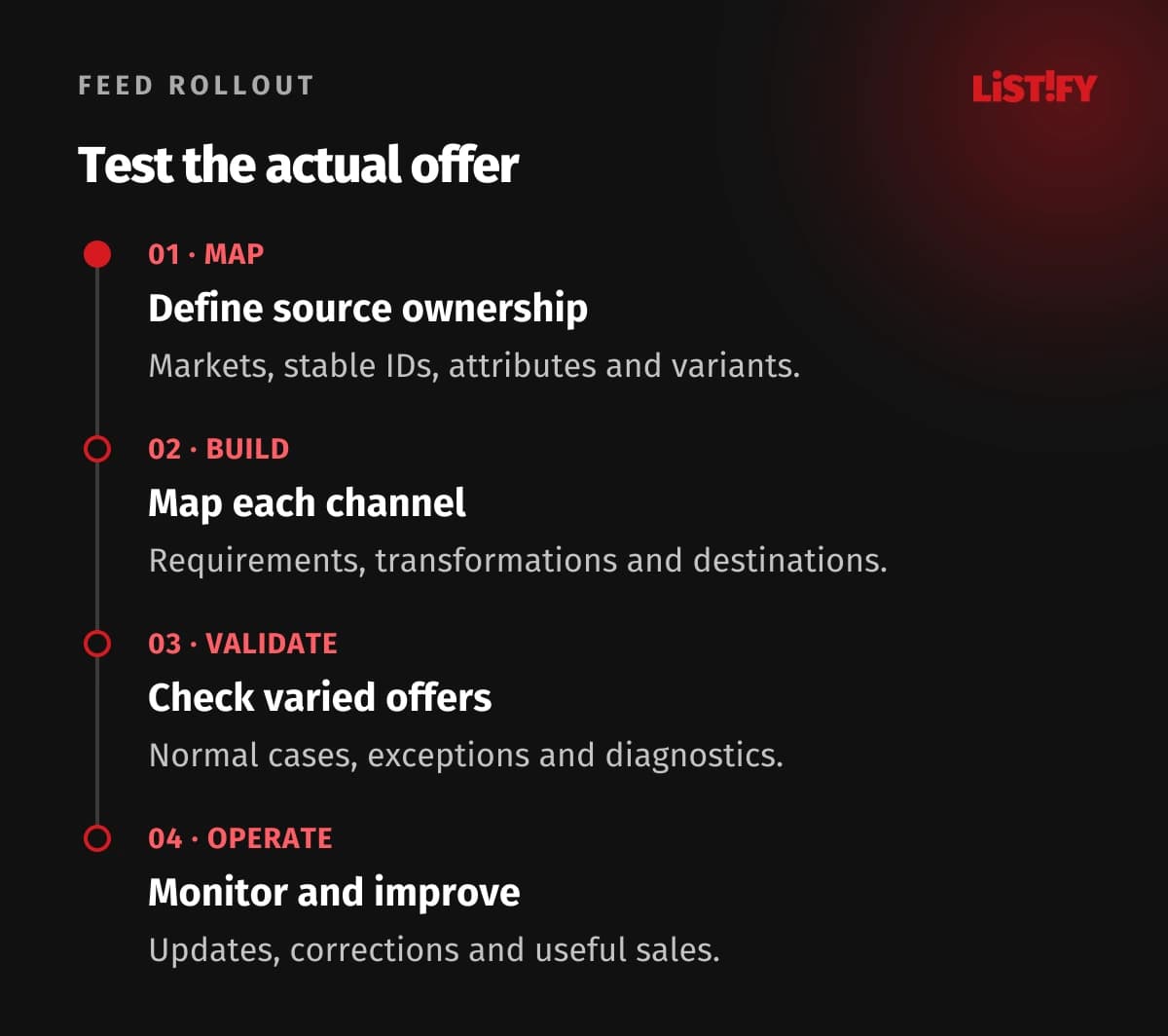
- Map the source. Define ownership, stable identity, variants and target markets.
- Build channel mappings. Review requirements, transformations and destination consistency.
- Validate a representative sample. Check normal offers, exceptions and receiving diagnostics.
- Operate and improve. Monitor updates, correct errors and assess useful sales before expansion.
Choose a pilot that includes the awkward cases, not only the simplest category. Include different variants, availability states, shipping conditions, and price changes. This makes the test more informative without sending the entire catalogue through an unproven mapping.
Define the response to failed exports and suspicious changes. Someone should know when to stop a rollout, restore a mapping, correct the source, or contact the platform. A maintained operating procedure makes the feed dependable when the person who originally built it is unavailable.
08Questions about product feeds and comparison channels
Can one unchanged feed serve all three channels?
A common catalogue can supply them, but each channel needs its own current mapping and requirements. Field names, conditions, markets and processing behavior differ.
Are Heureka and Zboží.cz useful for a global company?
They can be relevant when the company serves their regional shoppers with an eligible local offer. Review Czech or Slovak market conditions, delivery, currency and support rather than assuming worldwide coverage.
Why must product identifiers remain stable?
The receiving service needs to recognize the same offer through ordinary changes. Use a new identity when the relevant rules require it for a different product or variant, and do not recycle identifiers casually.
Does a valid XML file prove the feed is correct?
No. Syntax, sensible content, channel acceptance and the visible customer offer need separate checks. A readable file can still contain wrong prices, variants or destinations.
Can automatic Google updates replace our feed maintenance?
No. They support certain eligible corrections from website information. Maintain accurate source data, review the feature's scope, and check account diagnostics.
How often should we update the feed?
Choose the process from stock and price changes, channel capabilities and the business risk of stale information. Check each relevant specification rather than applying one universal schedule.
What should we measure after launch?
Review update reliability, accepted and rejected offers, accurate destinations, useful orders and their economics. Include cancellations, returns and the effort spent fixing data problems.