AI in marketing: what to delegate and what to keep under review
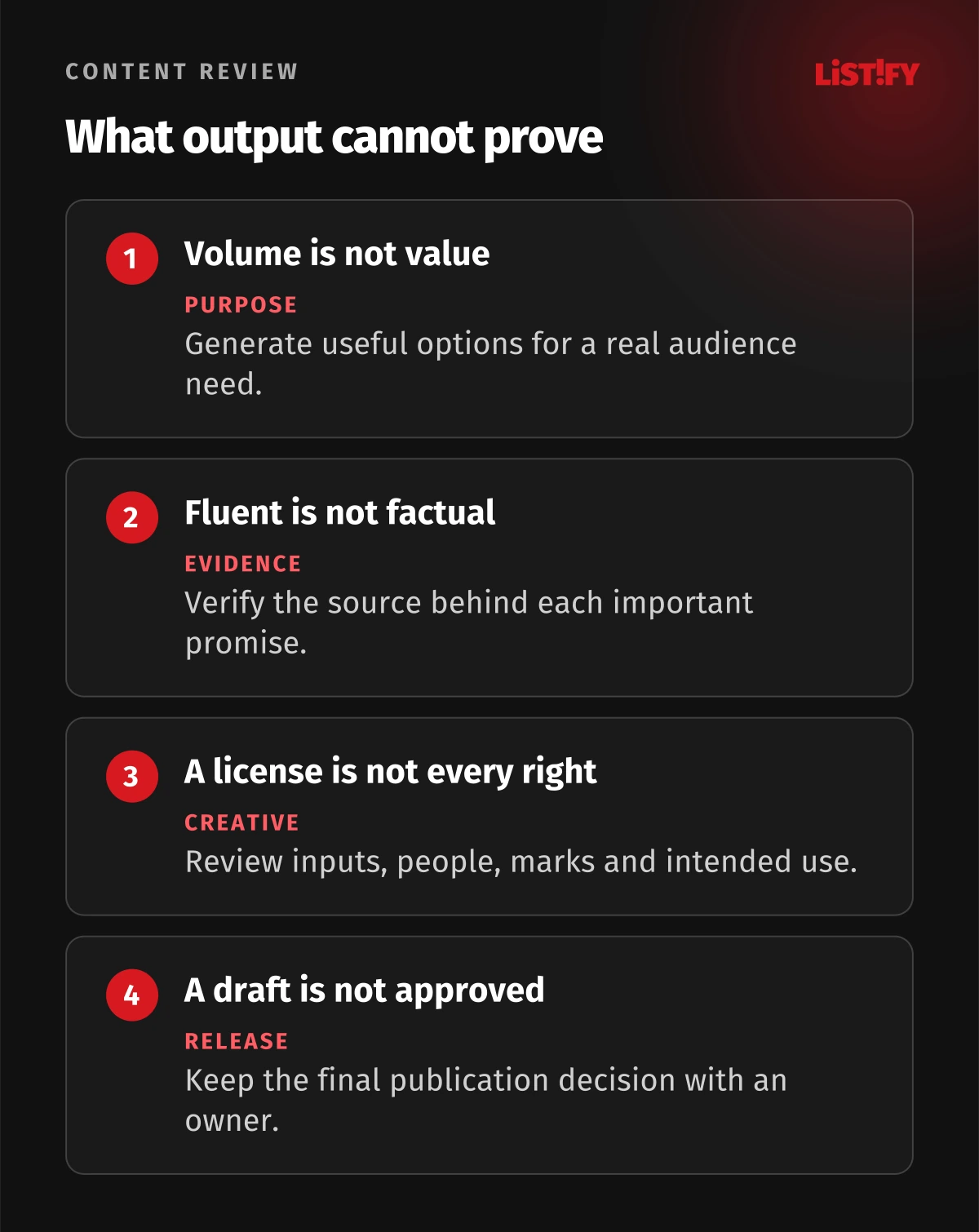
The team can produce twenty headlines before lunch, but someone still has to decide what the campaign promises. AI changes the cost of generating options. It does not supply the evidence behind an offer, the permission to use a customer's story, or the judgment needed to publish something under your brand.
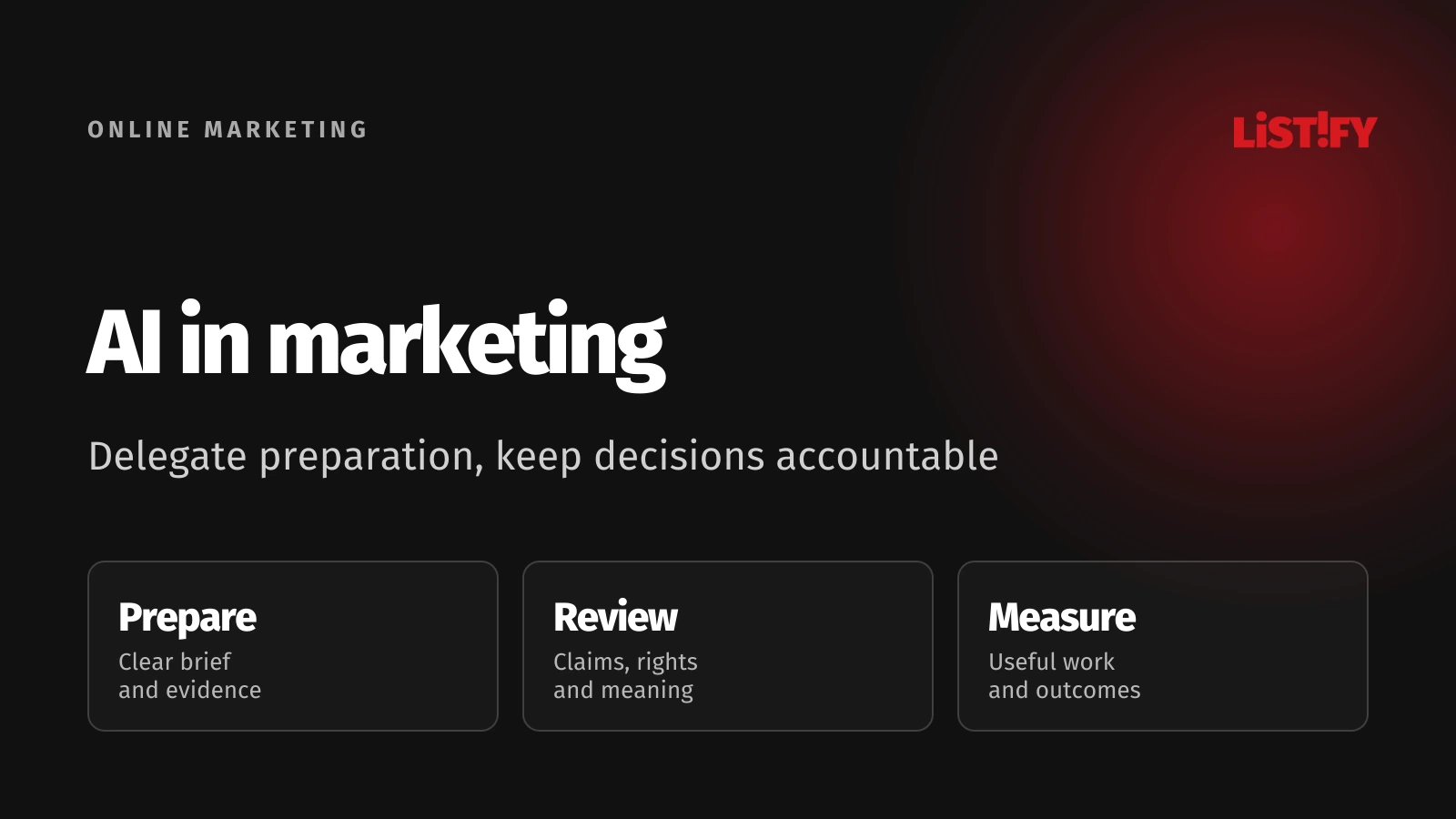
A useful division of work starts with the decision, rather than the content format. Let tools help prepare material that a person can evaluate. Keep ownership of strategy, factual claims, customer understanding, rights, and the final release with named people.
This applies to a small B2B services team as much as an online store. Both can benefit from faster preparation, and both can waste time reviewing large volumes of weak output. The aim is a better working process with a defensible result, rather than a larger publishing calendar.
01Delegate preparation with a defined standard of quality
Start with work that has clear inputs and a reviewer who understands the result. Examples include outlining a page from approved product information, turning an interview transcript into a first draft, proposing headline alternatives, or adapting a verified message to a shorter format. The tool should know what evidence it may use and what remains uncertain.
Keep campaign strategy connected to the business. Decide who the audience is, what action matters, why the offer is relevant, and what you can truthfully promise. A model can suggest options, but it cannot know whether your operations team can deliver a proposed service level or whether a new audience is commercially useful.
| Marketing task | Useful AI contribution | Human responsibility |
|---|---|---|
| Research preparation | Suggest questions, topic structure and sources to inspect | Check original sources, dates and relevance |
| Copy drafting | Produce a draft from approved facts and an explicit brief | Verify claims, offer, tone and reader understanding |
| Creative variants | Explore different messages or visual directions | Check rights, accuracy, brand and production suitability |
| Localization | Prepare an initial adaptation for another audience | Native review of meaning, culture, claims and local requirements |
| Publication and testing | Prepare metadata, variants and test hypotheses | Approve release, measurement and interpretation |
If the reviewer spends longer correcting drafts than writing them, change the task or the brief. A useful workflow may involve fewer outputs with stronger source material. Record why drafts fail so the next iteration addresses the actual problem instead of merely changing the prompt's tone.
02Give the tool evidence instead of asking it to invent authority
For a product page, prepare a source pack containing specifications, current availability, supported features, permitted claims, and the relevant audience. For a services page, include what the team actually delivers and where scope needs discussion. Identify the owner and date of each document.
Ask the tool to distinguish supported statements from questions that need an answer. If the brief lacks a delivery time, it should flag the gap rather than choose a plausible number. The same principle applies to prices, compatibility, certifications, customer outcomes, and comparisons with competitors.
Verify research against the original publication. A generated citation can look convincing while linking to the wrong document or a page that does not support the claim. Look at the source, its date, its context, and the limits of the evidence. Do not turn a small study or a supplier's example into a general promise.
Google's current guidance on generative AI content recommends checking accuracy, quality, relevance, and associated metadata before publication. This also makes practical sense outside search: a false statement in a headline or image caption can survive even when the body text has been carefully edited.
03Keep claims, customer stories and brand decisions accountable
Someone should own every important promise in the campaign. They need to confirm the supporting evidence and whether the wording goes further than it. A draft that changes a cautious statement into a confident benefit can create a material problem, even when the grammar improves.
In the United States, the FTC's advertising guidance states that advertising claims must be truthful, nondeceptive, and supported. Other markets have their own requirements. AI assistance does not remove the need to review the markets where the campaign will run or the rules relevant to the product.
Do not generate invented testimonials, reviews, expert endorsements, or customer results and present them as real. Use authorized source material and preserve its meaning. If an example is illustrative, label it clearly. Changing the identity or adding a favorable quotation can turn a useful story into a false representation.
Brand review needs more than a style list. Check whether the message answers a real concern, sounds natural for the audience, and gives an understandable next step. Our guide to landing page copy can help define the message before generating variants.
04Review creative rights and relevant disclosure duties
Check the inputs as well as the outputs. Source images, music, customer recordings, recognizable people, logos, and confidential briefs can bring different rights and restrictions. A tool's commercial-use terms do not automatically grant every permission connected with the material you upload or publish.
Copyright questions also depend on jurisdiction and the human contribution. The US Copyright Office's AI resources include its copyrightability report and registration guidance. Do not assume a generated asset has exclusive protection worldwide, or that a tool's license resolves resemblance to another person's work, trademarks, or personality rights.
Where the EU AI Act applies, Article 50 distinguishes provider duties from specified deployer disclosure duties. Its provisions address matters including machine-readable marking, deepfakes, and certain text informing the public on matters of public interest, with relevant conditions and exceptions. It does not require the same visible label on every assisted marketing sentence.
As of 3 October 2026, the enacted 2026 amendment provides a narrow transition until 2 December 2026 for Article 50(2) providers of generating systems placed on the market before 2 August 2026. That is not a blanket grace period for marketing teams or all disclosure duties.
Review platform rules as well as law. Keep relevant provenance and marking metadata, and document required approvals and permissions. For a realistic synthetic person or altered product demonstration, consider whether the audience could misunderstand what happened, independently of a minimum labeling requirement.
05Keep customer and business data within the approved workflow
A marketing brief rarely needs a full CRM export. Use aggregate insight or anonymized material where suitable, and remove unnecessary personal or confidential information. A customer support conversation can contain account details, health information, or third-party data that have no place in a generic copy task.
Approve the tools and integrations used by the team. Review what happens to uploaded files, prompts, outputs, and logs, including retention and use for other purposes. Confirm access, vendor terms, and relevant privacy requirements for the actual configuration. Do not infer the full arrangement from one interface setting.
Connected agents need additional boundaries. A tool that can read a content library is different from one that can edit a live website, spend an advertising budget, or send a newsletter. Limit permissions, require appropriate release approval, and define what happens when a source or integration fails.
Keep a usable audit trail: the brief, source pack, selected draft, edits, approvals, and released version. Collect enough evidence to understand a problem without retaining unnecessary sensitive content. This also helps the next editor see why a claim was included or removed.
06Publish original value and test a meaningful hypothesis
For search content, decide what the page contributes. Original explanation, practical experience, useful comparison criteria, clear examples, or verified product detail can help a reader. Rephrasing existing pages at scale without added value is a weak editorial strategy regardless of the tool used.
Google's spam policies address scaled content abuse based on the purpose and resulting low-value content. They do not establish a blanket ban on AI-assisted pages. Avoid framing automation as either a guaranteed ranking shortcut or an automatic search penalty.
Review translations with someone who understands the market. A sentence can be grammatically correct yet use the wrong buying vocabulary, imply an unavailable offer, or sound unnatural. Adjust examples, units, contact expectations, and legal references without quietly changing the underlying promise.
When testing variants, state the hypothesis first. Perhaps clearer compatibility information reduces unsuitable enquiries, or a more specific headline improves qualified responses. Keep audience, timing, offer, and measurement in view. A higher click rate can coexist with lower-quality leads, so evaluate the commercial action that matters.
Use a manageable number of variants. A small campaign may not produce enough evidence to support a confident winner across many options. Review results with that limitation and avoid presenting illustrative projections or incomplete attribution as proof of AI-generated growth.
07Build one repeatable workflow before expanding
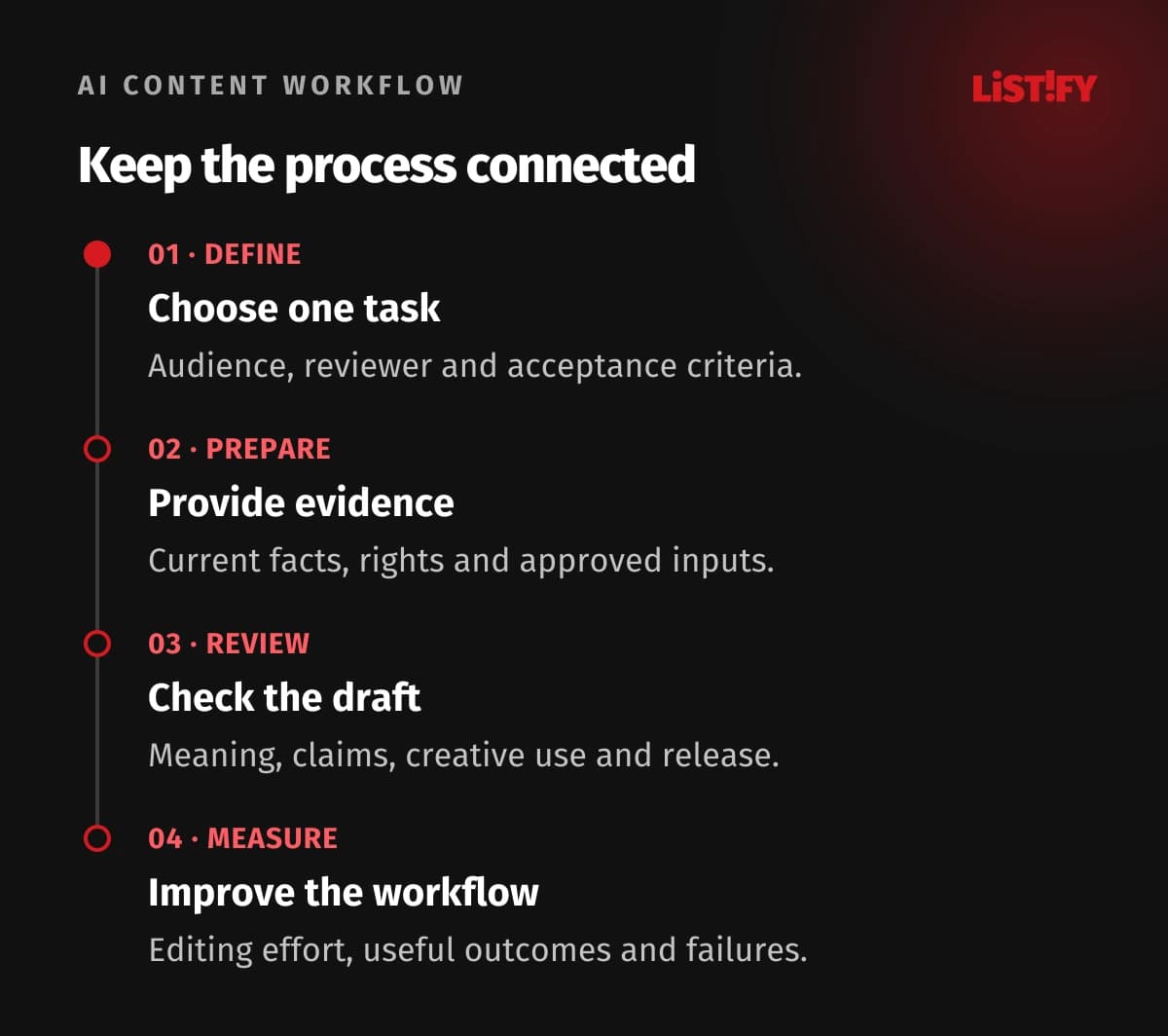
- Define the task. Choose a recurring output, audience, reviewer and acceptance criteria.
- Prepare evidence. Supply current facts, permitted material, rights and data boundaries.
- Draft and review. Check meaning, claims, sources, creative use and release approval.
- Measure and improve. Review editing effort, useful outcomes and failures before expanding.
For a monthly B2B newsletter, start with approved product updates and one useful customer question. Generate an outline and a draft, let the owner check facts and offer details, and let an editor improve the language. Keep sending permissions and suppression within the normal email process. Draft approval does not authorize a new use of the subscriber database.
After a few runs, compare preparation time, editing time, corrections, and the quality of the final work. Include tool costs and ongoing maintenance. The team should be able to explain which parts improved and which still need direct human work, without relying on an impressive count of generated words.
08Questions about AI in marketing and content
Which marketing tasks are a sensible starting point?
Try a recurring task with approved inputs and a clear reviewer: an outline, first draft, headline variants, or format adaptation. Keep strategy, factual promises, rights and final publication accountable to named people.
Can we publish a draft that reads well without further checks?
Fluent language does not establish accuracy, relevance, rights, or a truthful offer. Check the sources and important claims, then review the final page, metadata and creative material before release.
Will Google penalize every AI-written page?
Google's guidance does not impose a blanket AI-content ban. Focus on original value, accuracy and relevant policies. Generating many low-value pages to manipulate rankings can fall under scaled content abuse.
Does a commercial AI subscription give us every image right?
No. Review the tool's terms, source material, recognizable people, trademarks and other relevant rights. Copyrightability and protection can also depend on jurisdiction and human contribution.
Must every AI-assisted marketing sentence have a visible label?
Requirements depend on applicable law, the output and platform rules. The EU AI Act separates specified duties and exceptions. Do not assume one label or one transition date resolves every situation.
Can we upload customer interviews to a tool?
Review permission, personal information, confidentiality, vendor arrangements and relevant privacy requirements first. Use only what the task needs, and keep sensitive material inside the approved process.
What shows that the workflow is useful?
Review preparation and editing effort, error rates, approved output quality and relevant commercial outcomes. Define the test before generating variants and acknowledge limited samples or incomplete attribution.