Email remarketing: when a useful follow-up becomes too much
A customer buys the product, then receives three reminders to finish the same order. Someone unsubscribes, but the next campaign includes them again after a CRM import. These problems rarely start with the wording of the email. They start with uncertain permissions, delayed events, and automations that never check whether the message is still useful.
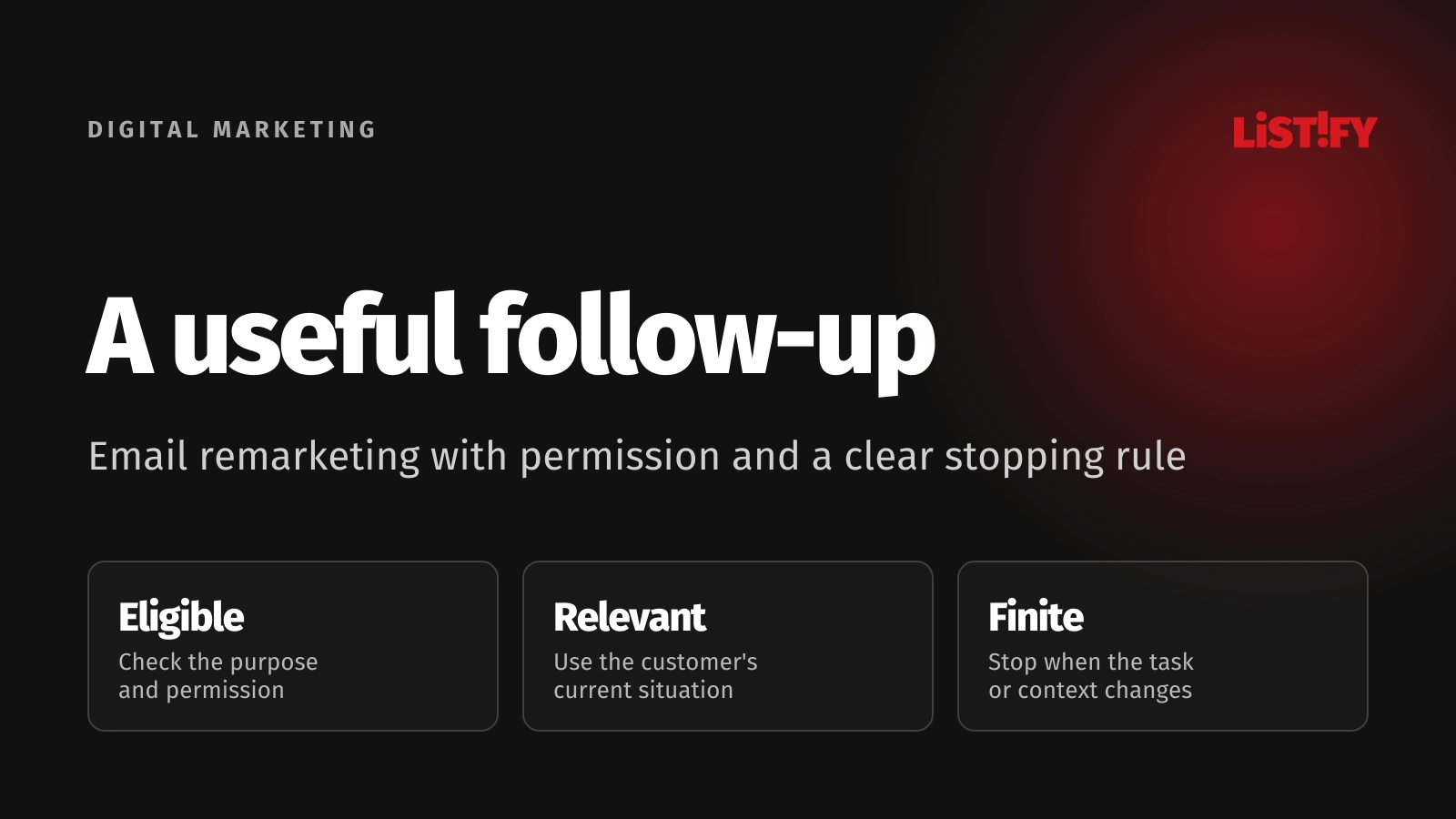
Email remarketing uses a previous interaction to decide whether a later message could be relevant. That might be a saved basket, a product purchase, a requested quote, or a period of inactivity. The interaction gives you context. It does not automatically give you permission for every channel or purpose.
Build the program around three questions: may we send this message, does the customer still need it, and what evidence will show that it helped? You can answer those before designing an elaborate sequence. A small, reliable workflow is easier to evaluate than ten overlapping campaigns.
01Distinguish service messages from marketing
An order receipt and an invitation to buy again serve different purposes. So do a response to a requested quote and a promotional sequence added afterward. Classify the actual message, including its subject and prominent content. Calling an email transactional in the sending platform does not settle its legal status.
Rules differ by jurisdiction. In the UK, ICO guidance on electronic mail marketing explains consent requirements for unsolicited marketing to individual subscribers and the limited products-and-services soft opt-in. That exception requires direct collection during a sale or negotiations, your own similar offers, and opt-out opportunities at collection and in subsequent messages. An existing email address alone is insufficient.
For US commercial email, the FTC's CAN-SPAM guide covers truthful information, identification, an address, and opt-out obligations. It distinguishes commercial from narrowly defined transactional content and examines mixed messages by their primary purpose. This is a US example, not permission to export the same approach to every market.
Where GDPR applies, separately assess the basis, transparency, recipients, and data handling for the processing involved. EU electronic-marketing requirements also depend on national implementation. Business addresses, purchased lists, and a customer's previous order are not universal exemptions. Define an eligibility rule for each workflow with the appropriate regional review.
Keep essential service communications available when someone rejects optional marketing. Conversely, do not use the service channel to disguise a promotional sequence. This separation should appear in the templates, preference center, sending rules, and support team's explanation.
02Choose a trigger that reflects a real need
Begin with a customer problem you can name. A replacement reminder may help when a consumable is likely to run out. A blanket discount after every visit might merely teach regular buyers to wait. Avoid inventing urgency or a personal explanation you cannot support from the interaction.
| Workflow | Eligibility and useful content | Stop or exception rule |
|---|---|---|
| Saved basket | Eligible marketing recipient; available items and a route back to the basket | Stop after purchase, withdrawal, expiry, or unavailable items |
| Post-purchase guidance | Useful setup or care information; classify any added promotion separately | Avoid messages for cancelled orders or incorrect product variants |
| Replenishment reminder | Relevant purchase history and a realistic replacement interval | Stop after another purchase; allow timing or product correction |
| Quote follow-up | Requested context and a clear next step; review promotional extensions | Stop when answered, declined, expired, or assigned to a salesperson |
| Re-engagement | Eligible recipient with a useful reason to return | Set a finite sequence; suppress continuing inactivity and opt-outs |
Decide how long the trigger remains meaningful. A basket with discontinued stock should not keep generating messages. A quote already being discussed with a salesperson should not trigger a generic automated chase. Use a current state check immediately before sending, not only when the person first enters the sequence.
If you need the broader foundation, our guide to ecommerce email marketing and automation covers the surrounding program. The narrower job here is to make behavioral follow-ups relevant and safe to operate.
03Make suppression stronger than your campaign imports
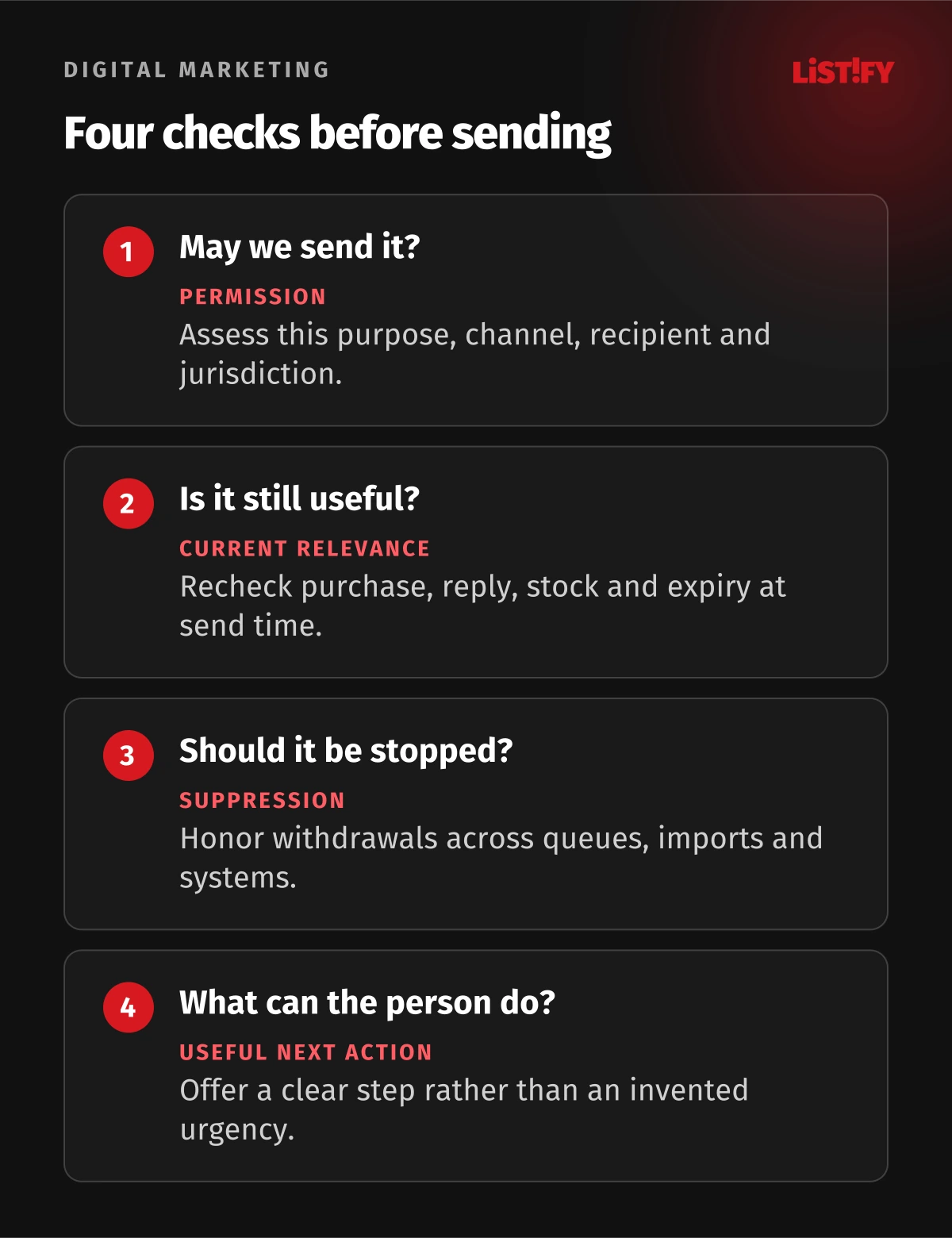
Maintain a clear source of truth for channel permissions and suppression. Record the scope of the choice, its source, the time, and the wording or version that matters. Keep this separate from a salesperson's note saying interested. A CRM contact field and a newsletter subscription are different records.
A suppression decision should survive a new audience upload, a synchronization retry, and an older export being reimported. Define precedence explicitly: a stale affirmative value should not overwrite a newer withdrawal. Apply suppression to queued sends as well as future enrollments. Check the behavior across the CRM, store, and email provider.
Deduplicate trigger events so that a webhook retry cannot enroll the same order repeatedly. Recheck purchase status and eligibility before dispatch. If the current state cannot be confirmed, choose a conservative pause and send the issue to an owner. A failed integration is not a reason to assume the recipient is still eligible.
Give support staff a way to stop a sequence and explain why a person received it. Keep the diagnostic record useful without copying sensitive browsing details into every ticket. For these connections, our API integration guide explains event handling and recovery considerations.
04An email subscriber is not automatically an ad audience
Email remarketing and uploading an email list to an advertising platform are separate uses. Before an audience sync, assess the sharing, disclosure, applicable permissions, vendor terms, and exclusions. A checkbox promising a newsletter should not silently become authorization for every matching service.
Google's Customer Match policy requires first-party collection, appropriate disclosures, consent where required, and compliance with its policies and applicable law. It also restricts sensitive categories and some audience uses. Check the current policy for the actual campaign rather than assuming every CRM contact can be uploaded.
Hashing an email address supports matching without sending the plain address in that format. It does not automatically make the use anonymous or remove the need to assess sharing. The point of the audience is still to match people. Map the data flow, limit access to exports, and remove recipients from relevant destinations when the applicable choice changes.
Define exclusions around the intended outcome. Someone who just purchased may need to leave an acquisition audience while remaining eligible for an appropriately permitted care sequence. Avoid inferring health, financial difficulty, or other sensitive circumstances merely to make the targeting more specific.
05Deliverability starts before the subject line
Verify the sending domain and its authentication with the provider. Gmail's sender guidelines distinguish general and bulk-sender requirements, including SPF, DKIM, and DMARC, and require appropriate one-click unsubscribe for bulk marketing and subscribed messages. A visible footer link and the technical one-click mechanism are separate checks.
Use a recognizable sender and a monitored reply address. Test real message headers, unsubscribe behavior, and links on representative inboxes. An email platform showing verified does not prove that every sending domain and message stream has the correct setup. Review changes when moving providers or adding another product.
Control frequency across campaigns, not just inside each workflow. A person can receive a welcome message, a basket reminder, and a weekly offer on the same day if every automation looks only at itself. Set a shared prioritization rule and pause marketing during an unresolved complaint or support issue where appropriate.
Monitor bounces, complaints, provider rejection, and the consequences of list imports. Stop and investigate unusual changes. Do not keep emailing an invalid address or move rejected contacts to another domain to evade the problem. Maintain a list because its recipients are eligible and the messages are useful, not because the raw count looks impressive.
06Measure behavior you can interpret honestly
Open rate is an uncertain proxy for attention. Apple's Mail Privacy Protection can prevent senders from learning whether an email was opened. Therefore a sequence that assumes not opened means not interested can make decisions on incomplete evidence.
Track relevant next actions: a completed purchase, an answered quote, an activated feature, or a support task resolved. Interpret clicks cautiously too, and reconcile conversions with actual outcomes and refunds. Attribution tells you which rules assigned credit; it does not by itself prove that the email caused a purchase.
Tracking needs its own review. France's CNIL recommendation on email tracking pixels distinguishes permission for sending an email from the tracking-pixel regime and discusses purpose-specific consent. This is jurisdiction-specific guidance. Do not assume permission to send covers all observation of what happens afterward.
Where volumes permit, compare an eligible group receiving the workflow with a comparable randomized holdout. Define the outcome and evaluation period beforehand. Include unsubscribe and complaint outcomes alongside revenue. Small samples and other simultaneous campaigns can limit the conclusion; avoid turning an uncertain difference into a guaranteed uplift.
Evaluate contribution after discounts, refunds, fulfillment costs, and sending costs. A campaign can attribute more sales while reducing margin or reaching people who would have bought anyway. Use the result to decide whether to improve, expand, or stop the sequence.
07Launch one workflow with an explicit stopping rule
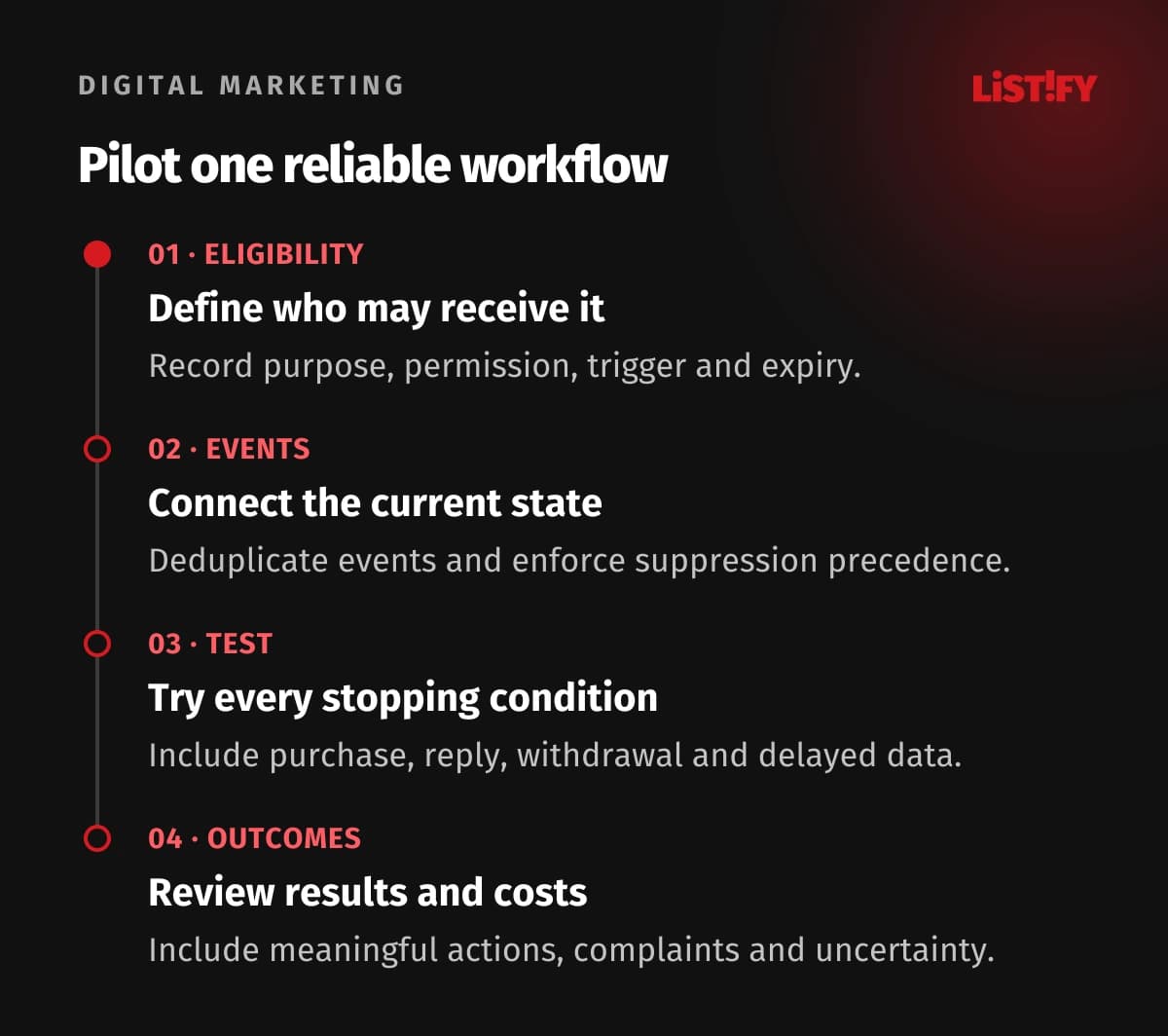
- Define the eligible recipient. Specify jurisdictional requirements, purpose, channel, trigger, expiry, and the information promised at collection.
- Connect the current state. Implement event deduplication, send-time eligibility checks, suppression precedence, and ownership of failures.
- Test the whole sequence. Include purchase, withdrawal, duplicate events, delayed updates, unavailable stock, provider rejection, and replies.
- Evaluate and decide. Review meaningful outcomes, costs, complaints, and limitations. Expand only after the workflow behaves as intended.
Keep a short specification with the message examples and the stop conditions beside them. Name who approves a copy change, who owns the integration, and who can pause the campaign. When a new offer changes the purpose or audience, review eligibility again instead of assuming the previous approval carries over.
08Questions about email remarketing
Can we email everyone who entered a basket?
Not automatically. Assess whether you have the necessary eligibility for that marketing message under the applicable rules. Then recheck purchase status, stock, expiry, and opt-outs before sending.
Is a previous customer always eligible for marketing?
No. Customer exceptions, where available, have conditions and limits. The UK's products-and-services soft opt-in is one specific example. Do not treat purchase history as worldwide permission.
Can a subscriber list be uploaded to an ad platform?
Assess that sharing separately from email sending. Check disclosures, permissions, the platform's rules, sensitive-category restrictions, and removal behavior. Hashing the list does not by itself make the use anonymous.
How many reminders should we send?
Set a finite sequence around a real need and review the outcome. Coordinate frequency across all campaigns. Stop when the trigger expires, the task is completed, or eligibility changes; do not use a universal sequence length.
Can we segment people by whether they opened an email?
You can configure that rule, but the evidence is incomplete because privacy protections affect open reporting. Prefer meaningful actions where possible and avoid treating a missing open signal as a reliable statement of interest.
What prevents unsubscribed contacts from returning?
A suppression source of truth with clear precedence, timestamps, synchronization checks, and enforcement at send time. Test older imports and queued messages. A footer link alone cannot guarantee this behavior.
What should our first pilot prove?
That eligible people receive a useful message, ineligible or completed cases stop, retries do not duplicate sends, and results can be reconciled with actual outcomes. Check costs and complaints as well as attributed sales.